Today world is focused on the topic due to the changing nature of energy geopolitics with respect to reserves in 2026, the investment opportunities, and the environmental issues surrounding the topic as states seek to balance their reliance on fossil fuels with the development of renewable fuel sources, seeking a hegemonic position in the world energy markets.There are 1.77 trillion barrels of proven oil reserves in the world as of 2025. The world has proven reserves equivalent to 47.2 times its annual consumption.
|
Key highlights
- Top 10 Countries Highest Oil Reserves
- Most Oil Reserves
- Globe Oil Landscape
- Concentration of Oil reserves
- List of Top 10 Countries
- OPEC and OPEC+ Countries
- Comparative Analysis
|
Global proven oil reserves are estimated around 1.7 trillion barrels, with Venezuela holding the largest share, followed by Saudi Arabia, Canada, and Iran, though figures vary slightly by source and year. Although countries are driving toward renewable sources of energy, oil reserves still remain a basic component of energy security and stability on the international stage. These proven reserves determine international relations, trade, and policy making. The ranking of the top oil reserves in nations has received fresh academic interest in 2026, with ever-changing geopolitical powers, technological brand development in the extracting sector, and the discussion of sustainable energy shifts. A closer look at the top 10 reserve holders gives the picture of both the overdependence on fossil fuels and a struggle on how to balance resource richness and accountability to the environment this article discusses the reserves of these countries and their role in the world.
Current Oil Landscape in the World
A continuation and a change is witnessed in the world oil market in 2026, where the traditional reserve countries are still in the dominant position, but the energy geopolitics is changing with renewable transitions taking center stage. Proven reserves continue to be the focus of economic and strategic strength.
Distribution of Oil Reserves across Globe
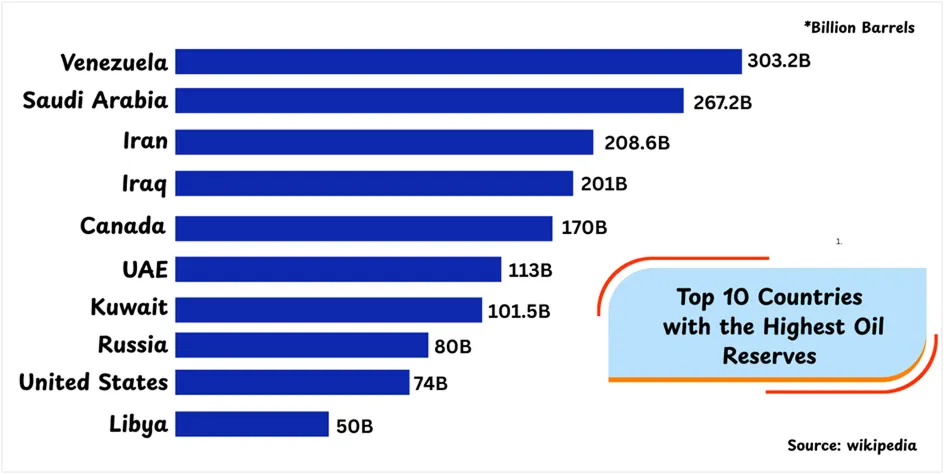
The concentration of oil reserves is tremendous in that a few countries can predominantly control the supply in the world market. Venezuela takes the first place, with 303.2 billion barrels (19.4 percent), then Saudi Arabia with 267.2 billion barrels (17.69 percent). Together, the members of OPEC make up almost three-quarters of the world's reserves, which highlight the lasting impact on the energy markets.
Geopolitical Significance of Oil Reserves
Unevenness of reserves supports geopolitical power. Iran and Russia, or other states, use their reserves to influence politics regionally and globally, whereas Canada and the United States are balancing the resource enrichment and environmental talks. This monopoly of energy resources still determines the direction of trade and international orientation.
Transition Challenges of Oil Reserves
Oil cannot be done away with despite the push to renewables being practiced throughout the world. This is the difficulty that carbon reliance must be reconciled with climate commitments, and the world oil arena becomes an important platform for both prospects and contention.
Top 10 Countries with the Highest Oil Reserves
The oil reserves in the world continue to be highly concentrated in a few countries, a factor that dictates energy and trade and various underlying geopolitics in the world. The top 10 countries with the Highest Oil Reserves, their reserve levels, their roles in the economy, and their world influence have been listed below.
1. Venezuela Oil Reserves
Venezuela has the largest Oil reserves in the world with 303.2107 billion barrels (19.4107 percent). Its Orinoco Belt is a strategic energy resource despite the political instability and sanctions. The economy is oil-based and thus is the dominant source of national revenue, but inefficient usage prevents growth. The reserves of Venezuela all over the world represent the untapped potential and impact on the OPEC plans and American foreign policy.
2. Saudi Arabia- Oil Reserves
Saudi Arabia has a reserve of 267.2 billion (17.1 0 -1) barrels. Its economy thrives on oil that operates the Vision 2030 diversification. Being the representative voice of OPEC, it plays the role of stabilizing the markets of the world by adjusting production. Its deposits give it a geopolitical advantage, which would guarantee a say in Middle Eastern politics, as well as in world energy politics.
3. Iran - Oil Reserves
The breakdown of the PSLV-C62 mission has caused numerous implications on the Indian space mission, including the technological user confidence, capital investments, and partnerships. These results provide an understanding of the general consequences of the repetitive failures in the ISRO launch systems.
4. Iraq - Oil Reserves
The proven reserves in Iraq are 201 billion barrels, equivalent to 9.3 percent of the entire global reserves. The Iraqi economy is mainly based on oil-derived revenues that act as the fiscal support to the reconstruction and provision of services to the population. Under the umbrella of OPEC, the OPEC deposits in Iraq are critical to supply stability. But continued political unrest and structural hiccups limit its exploitation, but it continues to be a major frontrunner in global energy markets.
5. Canada - Oil Reserves
The proven reserves of Canada are 170 billion barrels, about 10.4 percent of the world's reserves, which are concentrated especially in the oil sands. The resources are instrumental in the growth of the economy of Alberta and the exports of the country. Canada presents itself internationally as a balanced country, withoil resources and completely committed to being an environmental steward, which makes it a reliable source of resumption in the United States of America and Europe, but also engages in global climate negotiations.
6. United Arab Emirates (UAE) - Oil Reserves
In the United Arab Emirates, 113.09 billion barrels of proven reserves of petroleum are reported, which constitute 7.2 percent of the worldwide reserves. The revenues of such reserves underlie the diversification policy of the country, which involves a great share of investments in tourism and financial services. The reserves are globally a boost to the recognition of the UAE as an energy hub in the region and as a stable member of OPEC. At the same time, the UAE government is working on renewable energy projects, thus assuming a dual approach that looks at the combination of protecting the existing use of fossil fuel with the gradual shift to sustainability.
7. Kuwait - Oil Reserves
The established hydrocarbon reserves in Kuwait amount to 102 billion barrels, which is 6.5 % of the global value. The Kuwaiti economy depends on oil-generated income, which is used to finance welfare programs and infrastructural development. At the global level, Kuwait has enough reserves, which guarantee its adequate inputs into the production proportions of OPEC. The relatively low population in the country, coupled with a large reserve base, creates an extreme level of wealth per-capita that strengthens the geopolitical stability of the country in the Gulf.
8. Russia- Oil Reserves
Russia has 80.0 billion barrels of proven reserves, which is equal to 5.1% of the global resource base. The exports of oil revenue, along with natural gas, are some of the fundamental elements in the Russian economy. These assets are strategic to the country, especially when compared to the European and Asian markets. Constant sanctions and political reasons complicate the accessibility of the market; however, Russia is also an influential supplier that significantly drives the dynamics in the world market.
9. United States - Oil Reserves
America has 74 billion barrels of proven reserves, which is about 4.8 percent of the entire world’s reserves. The shale resources have become an independent source of domestic energy. Petroleum helps a country in the economy through employment and export, but renewable sources of energy are getting a greater portion of the energy mix. U.S. reserves on the international market strengthen its leadership in energy domination, and give it a chance to balance between production and climate commitments, which in turn determines the outcomes of energy security on the international level.
10. Libya - Oil Reserves
Libya also has proven reserves that were estimated to be 50 billion barrels, which constituted 3.1 percent of the world's reserves. In Libya, oil is the breadwinner of the economy, but it is unable to cope with the political vagaries that cripple the production capacity. The untapped potential in Libya globally is indicated by the Mediterranean location the country has because of supply routes. This would perhaps open its potential in the global energy market through successful political reconciliation.
Comparative Analysis of top 10 Oil Reserve Countries
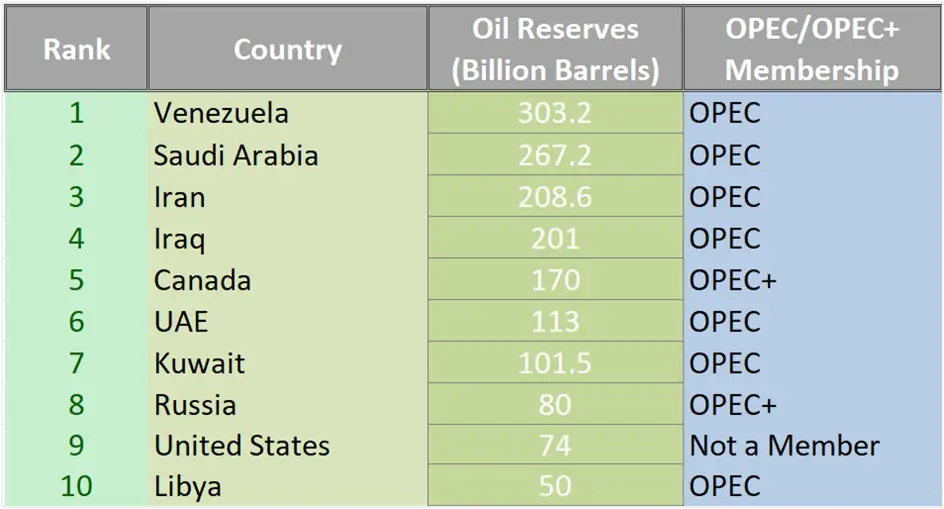
The comparative study of oil reserves in the world as of 2026 indicates the presence of an asymmetric nature of resources, the production potential, and the geopolitical bargaining power. Reserves, though pooled together, differ in usage in different countries.
Concentration of Oil reserves
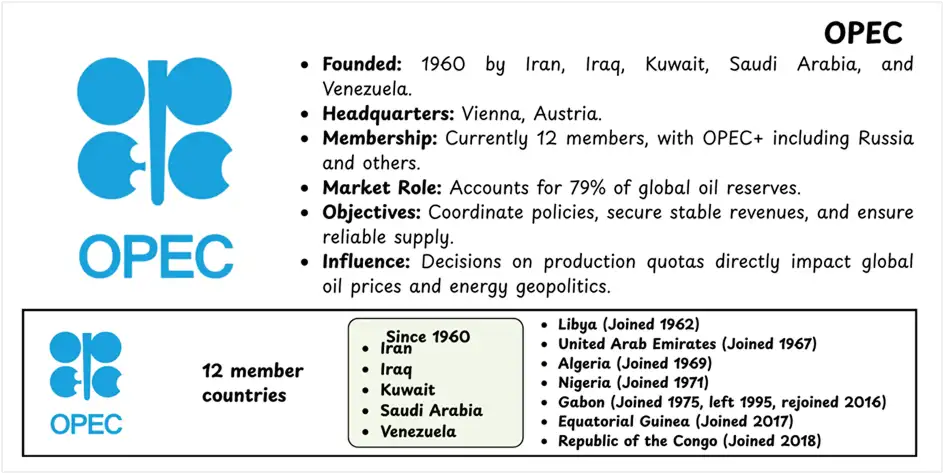
The members of OPEC are dominant in oil reserves, as they have almost 79% of the world's oil reserves. In the lead are Venezuela with 303.2 billion barrels (19.4 percent) and Saudi Arabia with 267.2 billion barrels (17.1 percent). This concentration highlights the strategic significance of countries in crafting the global energy markets.
Oil Production vs. Reserves present
The problem with countries with huge reserves like Venezuela and Iran is that despite their potential, they have difficulties in turning it into production because of sanctions and political instability. In contrast, the United States, with 80 billion barrels (2.9 percent), uses the best of the best technology in shale production because these producers are interested in producing more, and that is the key point that shows that efficiency in production is usually more important than the mere size of the reserve.
Impact of These Oil Reserves on world order
The mismatch between the production capacity and reserves also affects energy security, the balance of trade, and climate discussions. Countries that have durable governance and infrastructure, such as Saudi Arabia and Canada, have more effects on the stability of the prices and supply of oil in the world.
Conclusion
To sum it up, the oil reserves highlight the long-term relevance of fossil fuels in the development of economic and geopolitical relations in the world. Whereas some countries like Venezuela and Saudi Arabia dominates the reserve capacity, others like the United States portray the significance of technological innovation and efficiency in production. The comparative study shows that reserves are not sufficient factors to exert influence; the role in this case continues to be played by governance, infrastructure, and market access. Ultimately, the world energy environment reflects both continuity and the urgent need for transition on a sustainable basis.
Frequently asked questionsFrequently asked questions
Current Oil Landscape in the World?
A continuation and a change is witnessed in the world oil market in 2026, where the traditional reserve countries are still in the dominant position, but the energy geopolitics is changing with renewable transitions taking center stage. Proven reserves continue to be the focus of economic and strategic strength.
Transition Challenges of Oil Reserves?
Oil cannot be done away with despite the push to renewables being practiced throughout the world. This is the difficulty that carbon reliance must be reconciled with climate commitments, and the world oil arena becomes an important platform for both prospects and contention.
Top 10 Countries with the Highest Oil Reserves?
The oil reserves in the world continue to be highly concentrated in a few countries, a factor that dictates energy and trade and various underlying geopolitics in the world. The top 10 countries with the Highest Oil Reserves, their reserve levels, their roles in the economy, and their world influence have been listed below.
Comparative Analysis of top 10 Oil Reserve Countries?
The comparative study of oil reserves in the world as of 2026 indicates the presence of an asymmetric nature of resources, the production potential, and the geopolitical bargaining power. Reserves, though pooled together, differ in usage in different countries.