|
Key highlights
- India-New Zealand FTA
- India received zero-duty on 100% exports
- USD 20 billion FDI by New Zealand
- India also opened tariffs on 95 percent exports
- Domestic criticism faced by New Zealand
- Strategic win for India
- Strengthening Viksit Bharat 2047
|
The article “From Tariffs to Trade: Decoding the India–New Zealand Free Trade Agreement” explains the India-New Zealand Free Trade Agreement (FTA) and India's achievement of accessing zero tariffs in its labour-intensive sectors, including textiles, leather, gems, and processed food. It analyses future foreign direct investment obligations of the New Zealand government by the year 2030, criticisms being put forward by industries such as dairy, and contextualises such changes in view of India's strategy of speeding up the free-trade bloc. The article assesses the supposed economic gains and employment opportunities, and the positioning of the global trade that the agreement is supposed to bring.
|
Tips for Aspirants
The article has a special importance to examinations like the UPSC Civil Services Examination and State Public Service Commissions because it is a summary of trade policy, foreign direct investment, sector-specific implications, and diplomatic factors, which are the main subjects of economics, international relations, and governance.
|
|
Relevant Suggestions for UPSC and State PCS Exam
- The India-New Zealand Free Trade Agreement (FTA) became formal in December 2025 after nine months of negotiation and highlighted India's faster trade diplomacy.
- India received zero-duty on 100% of its exports, especially those that are labour-intensive, including textiles, leather, gemstones, and processed foods.
- New Zealand is also committed to investing USD 20 billion in foreign direct investment by the year 2030, which shall be invested in infrastructure, renewable energy, and agri-technology.
- India also opened tariffs on 95 percent of the exports of New Zealand, although there are segments that are very sensitive to India, such as dairy, which are still in tariff protection.
- In New Zealand, the dairy and manufacturing sectors are the primary concerns of the critics, with competitiveness and the possibility of disruption domestically.
- The broad approach of India to broaden its portfolio and FTA is to diversify markets, strengthen supply chains, and improve export performance.
|
A Fresh Directive in the Architecture of World Trade and the New Zealand-India Free Trade Agreement embodies an opportune issue as it pertains to the emergence of the new framework of world trade and India's participation in global trade relations. The accord was made under a wider policy to diversify trade relationships and gain privileged market exposure. The accord aims at abrogating or removing hindrances to trade by way of tariff, thus leading to the efficient process of exchange of goods and services between the two states. At the center of the deal is the fact that India will have gained zero-tariff access in labour-intensive industries, such as textiles, leather, gems, and processed food, the industries that are key in creating jobs as well as competing in exports. At the same time, New Zealand has made major commitments regarding foreign direct investment by the year 2030, especially in the areas of infrastructure, renewable energy, and agri-technology, hence highlighting the mutual responsibility of the partnership. However, the agreement has aroused controversy; some sectors of New Zealand, especially the dairy and the local manufacturing industry, have developed fears about the increased competition as well as future market disruptions. It is against this backdrop that India is hastening its FTAs with a heterogeneous set of business associates, as this is an indication to build stronger global supply-chain integration, improve the strengths of exporting, and strengthen local job opportunities. This article will examine the provisions, criticisms, and strategic implications of the India-New Zealand FTA and place them in the context of the overall direction of the Indian trade policy and its possible social-economic consequences.
Key Objectives of the India–New Zealand Free Trade Agreement (FTA)
The India-New Zealand Free Trade Agreement (FTA) stands as a watershed in the history of India's trade diplomacy because it reflects both the economic expediency and strategy when it comes to the globalisation efforts of integrating the supply chain. India will receive zero-duty market access for all its exports to New Zealand. In return, India will relax tariffs on 95% of imports from New Zealand, with 57% of these products becoming duty-free from day one.
Background and Context
The India-New Zealand FTA was concluded in December 2025 after nine months of negotiations, making it the fastest finalised trade agreement by India. It is the political goodwill of both governments that the agreement shows the need to strengthen the economic interrelations and diversify trading alliances. The growing international presence of India and the need for New Zealand to expand its market base beyond the conventional channels gave the point of departure to this bilateral agreement.
Market Access and Tariff Liberalisation
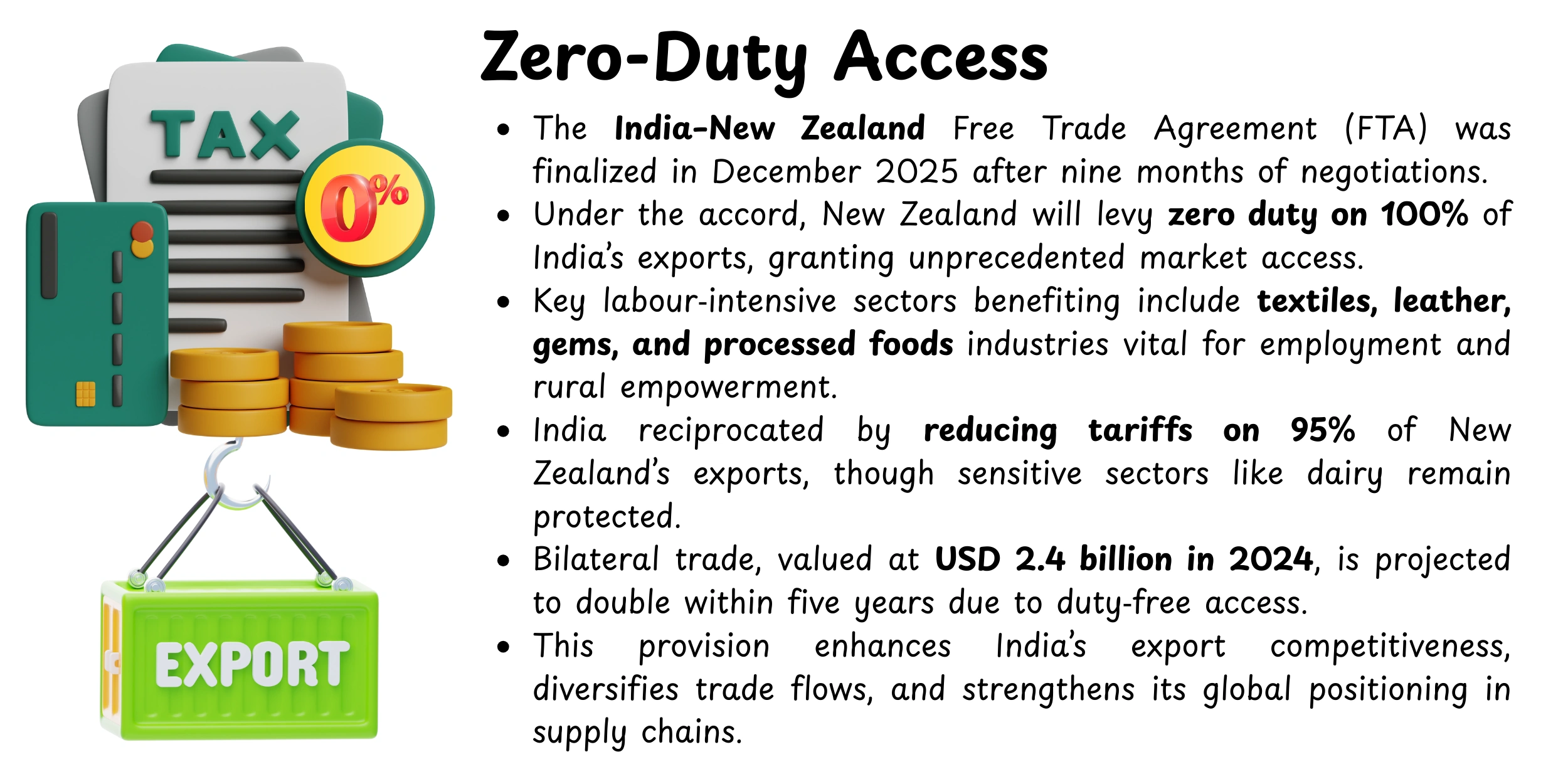
Based on the accord, New Zealand will put an end to customs duty on 100 percent of the exports of India, which will therefore provide the Indian manufacturers with unprecedented access to the market. In reciprocity, India has already agreed to make 95 percent of the imports that are imported by New Zealand free, with 57 percent of imports and goods being duty-free. This two-way agreement is meant to balance the stream of trade at the expense of protecting the sensitive industries in India, such as dairy and agriculture.
Investment Engagements and Economic Co-operation
One of the main elements of the FTA is the commitment of New Zealand to make an investment of USD 20 billion in India by 2030. The areas in which such investment will concentrate are infrastructure, renewable energy, agri-technology, and skill mobility. The agreement is also accompanied by student mobility and a post-study work visa for STEM graduates, which strengthens the ways of human capital exchange. Bilateral trade, which was USD 2.4 billion in 2024, is expected to reach 4 times in five years.
The Implications on Strategic and Sectoral Levels
The FTA has significantly benefited the labour-intensive industries of India, like textiles, leather, gems, and processed foods, which now have access to the New Zealand market without paying any duty. These sectors are critical in the generation of employment and rural empowerment. However, the dairy and domestic manufacturing industries in New Zealand have been vocal over increased competition and the threat of disruption in the market. Regardless of these criticisms, these agreements are seen as a strategic victory for India in its bigger plan of hastening FTAs with various other partners, so as to boost its resiliency in exports and its standing relative to the world.
Important Provisions
The India-New Zealand Free Trade Agreement (FTA) is a detailed agreement about tariff liberalisation and the movements of investments, aimed at providing power to the bilateral economic relations and the location of India in the sphere of global trade.
Zero-Duty on Indian Exports
One of the most important was the fact that New Zealand agreed to impose no duty on 100 percent of the goods exported by India. This openness is available to labour-intensive industries such as textiles, leather, gems, and processed food that will play a critical role in job creation and empowerment of the rural population. According to the official statistics, India had a surplus in trade in 2024 with New Zealand by exporting goods of USD 2.4 billion. The opening up of tariff barriers will see the bilateral trade doubling in five years, thus providing an advantage to Indian exporters in the high-value market.
Indian Reciprocal Tariff Reduction
India, in its turn, has liberalized its tariffs on 95% of imports made by New Zealand, with 57% of the goods being made duty-free at once. To save local producers, sensitive industries like dairy and agriculture were excluded. This is an act of caution in the liberalisation process by India that has allowed the influx of Indians to New Zealand without compromising the industries that are vulnerable.
FDI Commitments
What is also important is the commitment of New Zealand in terms of investing USD 20 billion in India by 2030. The investment will focus on infrastructure, renewable energy, agri-technology, and skill mobility. To make sure that it is being adhered to, India has put in place an oversight committee responsible for the mandate of suspending FTA benefits in case investment targets are not achieved. The agreement between New Zealand and India does not introduce any grace period, as compared to the agreement with the European Union, which has a grace period of three years, making accountability much stronger.
Provisions on the Strategic Level
The two-pole system of zero-duty access and the binding FDI commitments make the FTA a trade and investment partnership. In the case of India, it is not just limited to growing exports, capital, and technology, but also New Zealand is likely to invest in modernising India, leading to the creation of jobs and skill development. In the case of New Zealand, the contract gives entry to the huge Indian consumer base, service, educational and renewable energy prospects. These provisions combine to highlight how deep strategic the accord is, which makes it a template for the future FTAs of India.
Criticism and Sectoral Concerns in New Zealand
India-New Zealand Free Trade Agreement (FTA), even though being regarded as a ground-breaking deal, has caused much controversy in New Zealand, with various sectors expressing concerns regarding its impact on the economy in the long term.
Political Criticism
Foreign Minister Winston Peters, of New Zealand, characterized the FTA as a low-quality agreement and claimed it gives too much on immigration and investment without getting anything of substance in return for the fundamental export economic areas in New Zealand. He flouted the government by criticising the government on speed over content, as the agreement was reached in only nine months, yet more time should have provided stronger safeguards against the industries within the country.
Dairy Sector Concerns
Of special concern is the dairy industry, which, being one of the pillars of the New Zealand economy, has been extremely vocal in its resistance. The stakeholders believe that the non-opening of the dairy market by India can jeopardise the potential success of the deal. As dairy is already almost 30% of all exports made by New Zealand, the farmers are worried that the FTA would give undue preference to the labour-intensive industries of India without considering the most competitive industry in New Zealand.
Manufacturing and Labour Mobility
Domestic local manufacturing associations have also been apprehensive over the possibility of an increase in competition because of the tariff cut on Indian exports, which may wipe out the market shares. Moreover, the labour mobility articles, together with immigration, have faced objections. The opponents are concerned that the increased visa routes will overload the labour market in New Zealand and draw attention away from local industries.
Incongruent Perspectives in New Zealand
Prime Minister Christopher defended the FTA; however, pointed out that it would add jobs, increase incomes, and increase exports to the huge market in India. According to its proponents, the deal will diversify the trade base of New Zealand, which is commonly linked to China and Australia, and has long-term key strategic advantages. Nevertheless, the contrast between political leaders and industry stakeholders is sharp, and it shows how controversial the deal may have been.
Strategic FTAs and Sectoral Benefits in India
The recent Free Trade Agreement (FTA) acceleration initiative that has been undertaken by India is an intentional course of action that has been taken in the bid to strengthen economic resiliency, diverse reliance on markets, and ensure macro-economically sustainable advantages in an environment of global trade volatility.
Strategic Imperatives
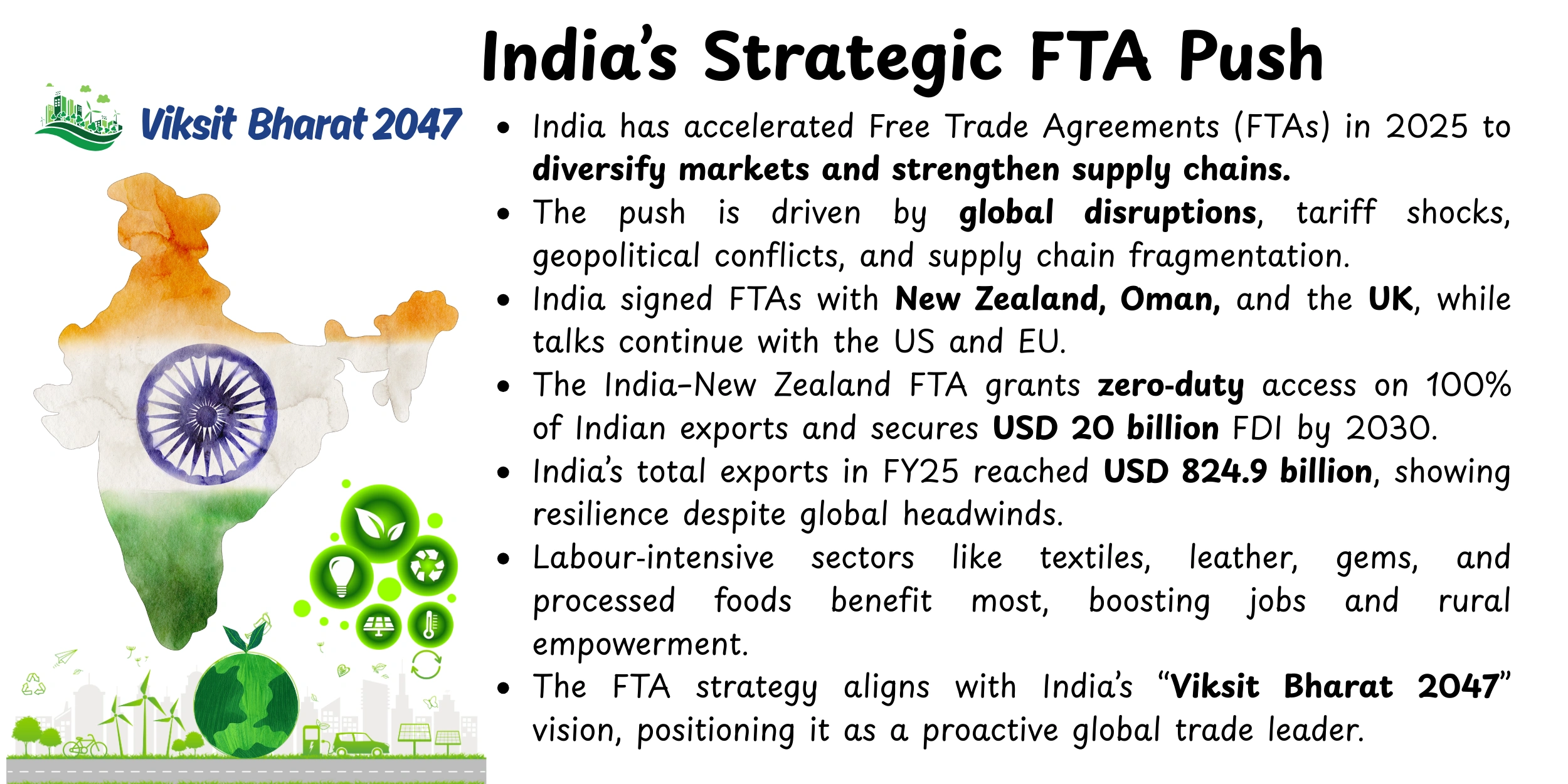
The current upsurge in India to focus on FTAs in 2025 is highly explained by widespread destabilisation around the world, such as tariff hikes, supply-chain fragmentation, and sluggish growth of key economies. India is looking to reduce its dependency on a few markets to sell its products and increase its bargaining power in the international business community through the increase of its portfolio of trade partners. According to the Times of India, in FY 2024-25, the total exports of India recorded USD 824.9 billion with a yearly increase of 6 percent, even with the dampened global demand. The continuity of this shows just how instrumental FTAs can be as a tool of strategic diversification.
The extension of Bilateral and Multilateral Engagement
India has made several FTAs within a short period, with agreements being made with Oman, New Zealand, and the United Kingdom. Not only is each accord aimed at stimulating the volume of trade, but also at the further integration of cooperation in the framework of investment, education, and technology. India NEW Zealand FTA allows 100 percent of Indian exports zero-duty entry, with New Zealand committing USD 20 billion of foreign direct investment by the year 2030. Similarly, the India-UK FTA includes the elements of a tariff cut and increased educational partnership, reflecting the vision of India in the framework of Viksit Bharat 2047.
Industrial & Sectoral Benefits
Certain industries that are labour-intensive, like textiles, leather, gems and processed foods, are the beneficiaries of the FTA strategy in India. Free entry into new markets only makes them more competitive, boosts demand and helps in employment creation. The example is the India- New Zealand FTA that is expected to increase bilateral trade by two times during the next five years, thus providing meaningful opportunities to small and medium enterprises (SME) and rural producers. These areas are fundamental in inclusive development, since they are able to receive a substantial number of workers in India as well as add variety to its exports.
Benefits in the Long Term
The FTA drive in India strengthens its position in the world, as opposed to the benefits of trade in the short term. India guarantees that the accords could be used in the technology transfer, infrastructural growth, and human-capital improvements by entrenching the commitments of investments and skill-mobility provisions in the agreements. This strategy conforms to the desire of India to become a meeting point of global supply chains and a sustainable growth leader. FTAs have a strategic placement, therefore represent not only economic pragmatism but diplomatically forward-looking as well, portraying India as one that does not sit back and wait as international trade takes its direction.
Conclusion
The example of the India-New Zealand Free Trade Agreement is an opportune example of liberalising trade with binding promises to invest, as India has made forward-looking moves to ensure long-term economic gains. Although the issue regarding the competitiveness and market interference remains present in the dairy and manufacturing industries of New Zealand, the accord still bestows many benefits to India, such as zero duty access to labour-intensive facilities and commitment to inflow of foreign direct investment. In essence, the agreement is an extension of India generally through alternative strategies to diversify, resist, and improve its global standing through the rapid process of the free-trade agreements. The FTA is an effective example of how India has created a clear balance between domestic sensitivities and international economic opportunities by creating employment, amplifying exports, and institutionalising investment oversight.