|
Key highlights
- Polygamy in India
- Statutory Frameworks
- Criminalisation
- Exceptions in Law
- State-Level Bans
- Constitutional Debate
- Uniform Civil Code
|
In India, polygamy is controlled by a complex integrated combination of personal laws and criminal laws. Protestant, Christian and Parsi give equal decrees to polygamous marriage, whilst Islamic personal law allows a male to marry up to four wives under strict conditions. The association Bharatiya Nyaya Sanhita, by declaring bigamy a criminal offence, nationwide, gives rise to a statutory prohibition; however, the application of the prohibition has shown a wide range across the whole nation. Lately, the efforts of states like Assam and Uttarakhand, which have come up with prohibitively enforced measures against polygamy, have become a source of scholarly controversy over gender justice and a controversial application of a Uniform Civil Code.
Polygamy in India lies at the meeting point of personal laws, criminal law and new state-level reforms. Personal laws like the Hindu Marriage Act, Parsi Marriage and Divorce Act, and the Indian Christian Marriage Act prohibit bigamy for the majority of the population, with the exception of Muslims.
|
Tips for Aspirants
The article is of interest to candidates taking the UPSC CSE and State PSC examinations since it will be dealing with key themes that are related to governance, constitutional law, gender justice, and issues that surround the Uniform Civil Code, some of the fundamental topics in modern-day polity and contemporary affairs.
|
|
Relevant Suggestions for UPSC and State PCS Exam
- History: Polygamy was commonly practised among the elite in ancient India, and then the colonial government codified various laws on individuals.
- Legal System: Hindu, Buddhist, Sikh, and Jain marriage laws forbid engagement in polygamy through the Hindu Marriage Act of 1955; Christian and Parsi laws also forbid polygamy.
- Muslim Personal Law: According to this body of law, an individual male may get married to up to four wives, depending on conditions that induce equity; it is a major exemption of the law.
- Criminalisation: The Indian Penal Code criminalises bigamy, and today it is reinforced by the Bharatiya Nyaya Sanhita, but this implementation suffers inconsistencies because there are personal law exemptions to bigamy.
- State Bans: State laws have been instructed by the state of Uttarakhand (2024) and Assam (2025) to prohibit polygamy on the basis that it is within their competence under the Concurrent List of the Constitution.
- Constitutional Debate: The dilemma between the freedom of religion (Article 25) and the equality and dignity (Articles 14 and 21) highlights the constitutional argument as far as polygamy is concerned.
- Uniform Civil Code (UCC): The UCC has been at the forefront of the debate about harmonisation of laws, gender equality and disparity between constitutional demands and diversity.
|
The movement of polygamy in India is a good example of a complex nexus of personal law systems, legislative acts and state-level interventions. The arrangements of marriage in the subcontinent have traditionally been governed by a multi-religious pointillism: the laws of Hindu, Christian, and Parsi religions categorically denounce polygamy, but Muslim personal law permits up to four wives simultaneously on certain conditions. Such a pluralistic legal structure is a kind of manifestation of the Constitution through which very little concern would be advocated on gender justice and substantive equality. Criminalisation of bigamy, which historically was included in the Indian Penal Code, and more recently, incorporated within the Bharatiya Nyaya Sanhita, is a codified national taboo, but whose implementation is still uneven, to a significant degree due to historic exemptions in personal law. The modern trends in legislation, the most important being the passage of Assam of a ban on polygamy, and then the law-making steps by Uttarakhand, demonstrate the process of harmonisation of the law and can denote the growing body of state control over the areas previously controlled by personal law. These steps have prompted a new analytical examination of the Uniform Civil Code, feminist legal studies and the fragile balance between cultural heterogeneity and general constitutional principles. In this regard, the detailed analysis of polygamy control in the territory of India is bound to imply a subtle analysis of the old and current legal codices, contemporary state campaigns and the socio-legal analysis of equality and reform.
History and Legal Foundations
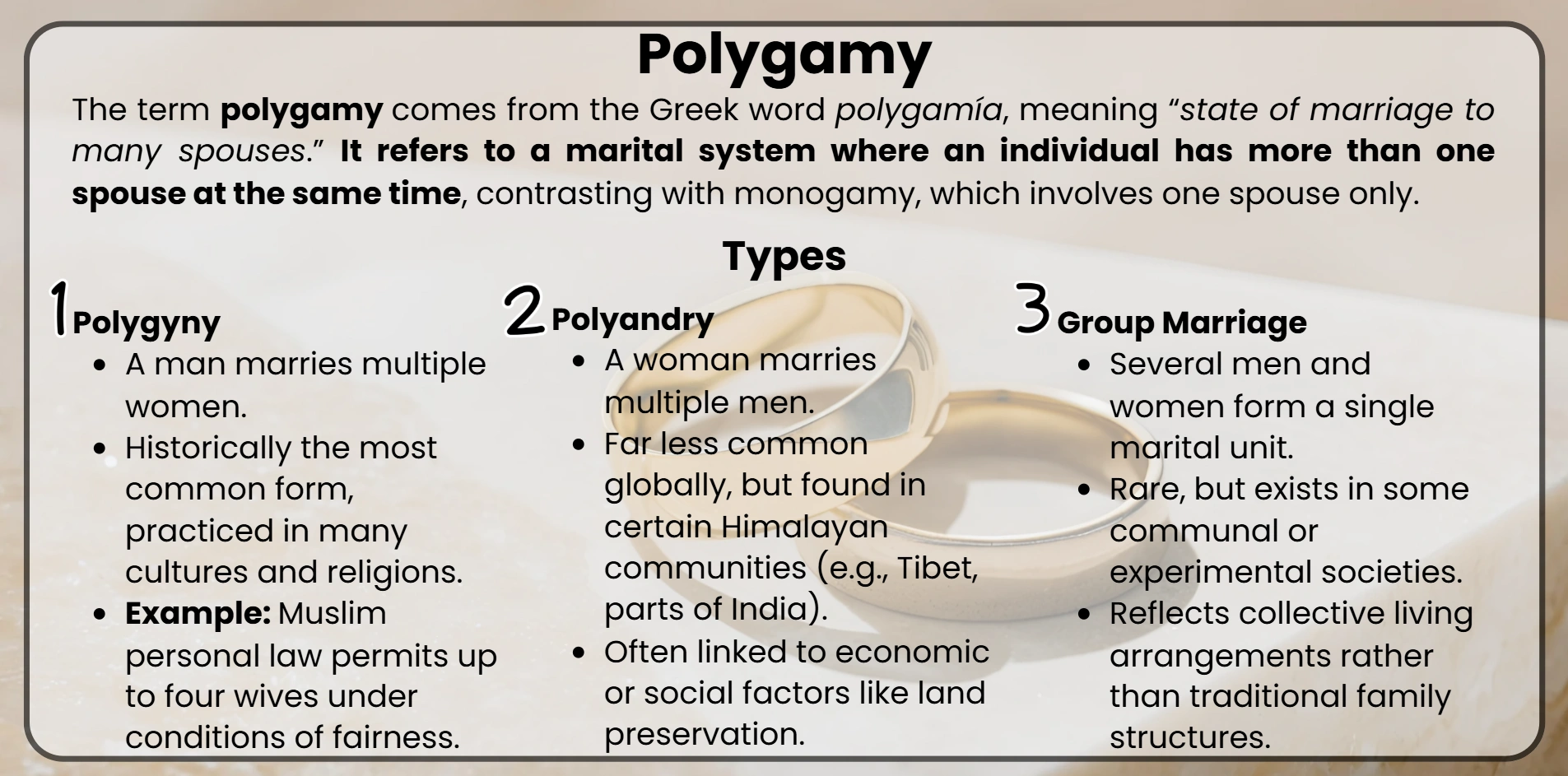
In India, polygamy has a long history but is now largely outlawed, with the key exception of Muslim men, who are permitted to have up to four wives under their personal law. The Indian polygamy regulation is one example of a complex history of development, which is enlightened by religions, colonial policies, and post-independent laws. Its development reveals contradictions between the freedom of different cultures and legal uniformity.
Practices in the ancient and the pre-colonial times
During the ancient reign, it was not something extraordinary to see rulers, aristocrats, and wealthy elites keeping as many as three wives as a strategy of making dynastic alliances and increasing their social status. However, monogamy was the leading method amongst the common people, and polygamy was not very common. The religious texts in the Hindu religion, Buddhism, and even the Jainism religion were inclined to give a neutral approach to polygamy without consenting to it explicitly or even banning it.
Colonial Legal Framework
There were a variety of marriage practices in different communities that the British administrators experienced during the colonial period. They also codified individual personal laws of Hindus, Muslims, Christians, and Parsis as an alternative to imposing a single standard of law. Polygamy was not forbidden according to Muslim legislation, where up to four wives were allowed, when compared with Hindu and Christian customs, which tended to lean towards monogamy. The colonial state did not universally outlaw polygamy (universally), but incorporated religious pluralism into the law. This strategy formalised the co-existence of different marriage regimes and provided the basis of the post-independence discourses.
Statutory Reforms after Independence
Since gaining independence, India has strived to modernise family law without interfering with religious autonomy. In 1955, the Hindu Marriage Act, which banned polygamy among Hindus, Buddhists, Sikhs, and Jains, was created, and bigamy was criminalized by the Indian Penal Code. The Christian laws and the Parsi laws were similar, having monogamy. But Muslim personal law led to the right to polygamy, provided that there is fairness and equality between the wives. This was a clarification of the lack of a Uniform Civil Code (UCC) and the constitutional complexity of finding a compromise between the right to practice religious freedom and the right to gender justice.
Modern jurisprudence Law
Currently, criminalizing bigamy throughout the country, the Bharatiya Nyaya Sanhita (BNS), which has replaced the IPC, criminalizes bigamy. However, enforcement is still subject to personal-law exceptions, such that communities apply these in disparate ways. More recent state interest interventions, like the Assam Prohibition of Polygamy Bill (2025) and previous bills in Uttarakhand, relate to a shift towards harmonisation. Those actions indicate the increased interest in the rights of women and social justice at the same time, rejuvenating the debates related to the UCC and the constitutional promise of equality.
Personal Laws and Religious Exemption
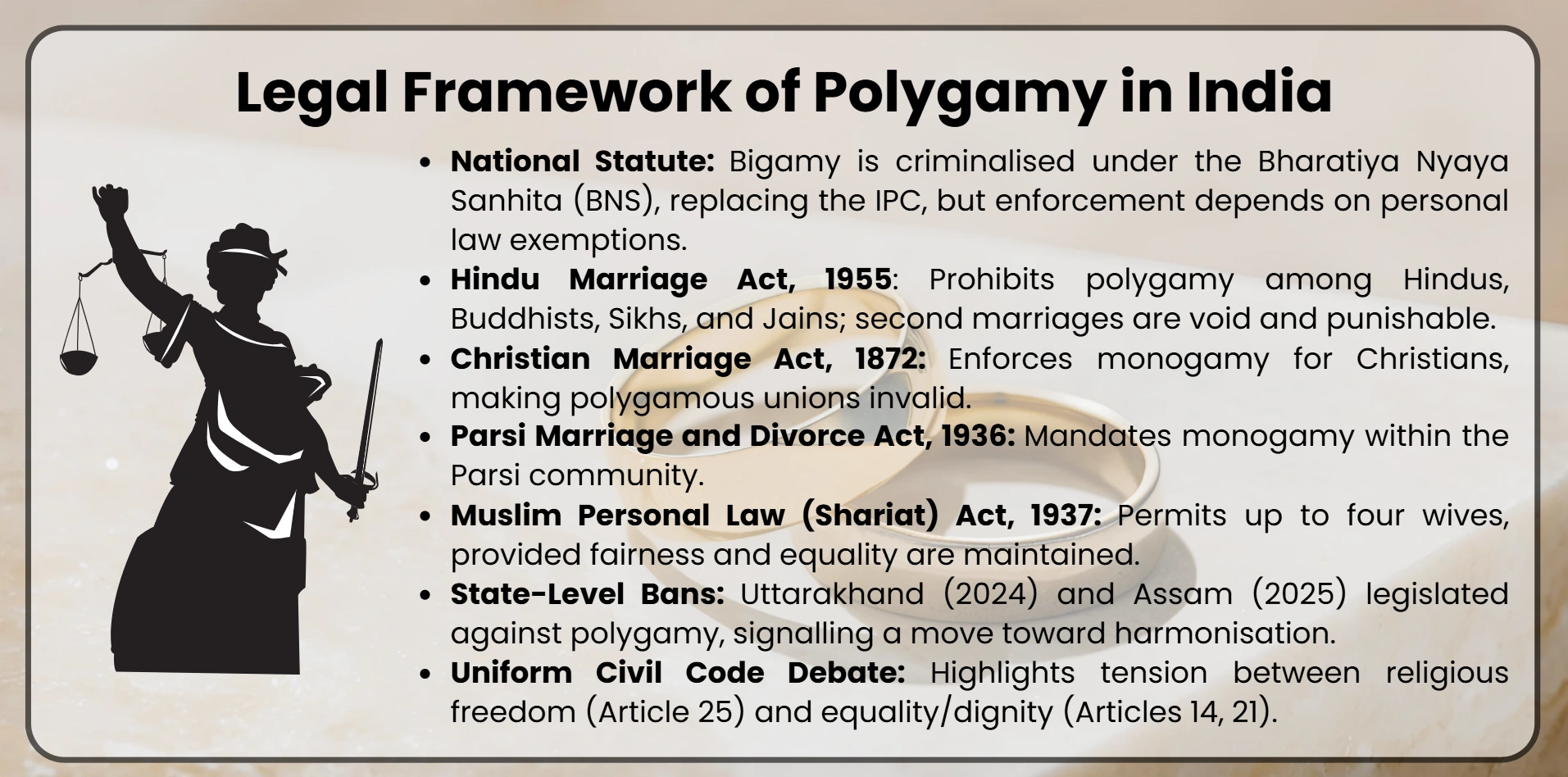
Polygamy in India is legal for Muslim men under personal law, but it is prohibited and legally void for Hindus, Buddhists, Jains, and Sikhs under the Hindu Marriage Act, 1955. Other communities like Christians are also governed by laws that prohibit bigamy. Not only are the statutory laws in place that regulate polygamy in India, but also an array of personal laws. With such laws, which are rooted in the religious tradition, exemptions emerge, which make it difficult to enforce nationwide bans.
The Hindu, Sikh, Buddhist, and Jain Laws
In the Hindu Marriage Act of 1955, polygamy is expressly precluded among the Hindus, Sikhs, Buddhists, as well as Jains. The later marriage contracted with the one that is still in existence is declared void, and whoever flouts it will be prosecuted under the Bharatiya Nyaya Sanhita (which was previously IPC). This reform was an expression of post-independent efforts to modernise the family law and ensure gender equality, and made a sharp break with the historical traditions where polygamy was deemed acceptable by elites.
Christian and Parsi Laws
The Christian marriage in India is regulated by the Indian Christian Marriage Act, 1872, which is monogamous. Similarly, the Parsi Marriage and Divorce Act, 1936, prohibits polygamy and is therefore in line with other reforms aimed at protecting the rights of women. Such communities therefore operate in hard statutory provisions which criminalise bigamy and hence offer limited exemptions.
Muslim Personal Law
The Muslim Personal Law, which is a part of the Muslim Personal Law (Shariat) Application Act, 1937, empowers a man to have women as wives, provided that he treats them fairly and equally. This is the only exception that exists in the Indian legal context, allowing polygamy in defiance of the countrywide bans in the Bharatiya Nyaya Sanhita. According to critics, the practice often undermines the rights of women, and according to its advocates, it is based on constitutionally protected religious liberty. The tension produced between gender justice and religious autonomy is still the determinant of the discussion of reforms.
Tribal and Customary Practices
As a part of customary law, certain groups of people in the tribes continue to engage in polygamy. These are often referred to in an informal manner, but they happen within the confines of the most common statutes. State interventions with the Assam Prohibition of Polygamy Bill (2025), being one such example, have already begun to challenge these exemptions and so represent a shift towards legal uniformity.
State-Level Interventions
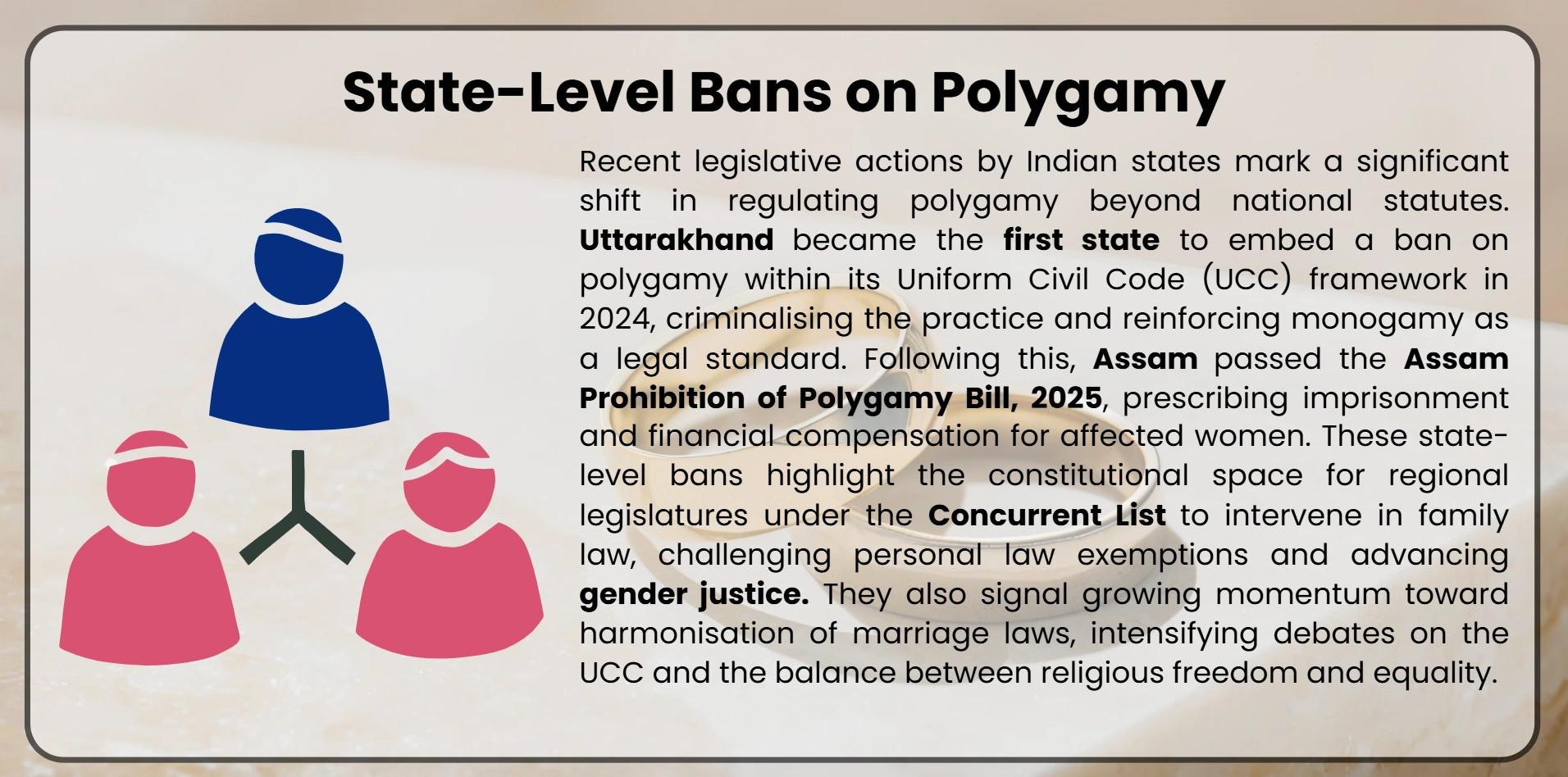
Several Indian states have initiated significant legislative interventions against polygamy, moving towards a Uniform Civil Code (UCC) framework within their borders. These efforts aim to override personal laws that permit polygamy and mandate monogamy for all citizens in the state, with certain exceptions for tribal communities. Though the national law, like the Bharatiya Nyaya Sanhita, criminalises bigamy, the state governments have increasingly taken legislative autonomy through the addition of a prohibition on polygamy, thus reflecting the regional interests and constitutional debates on uniformity.
The Legislative Initiative of Uttarakhand
Uttarakhand became the first Indian state to pass a specific law against polygamy that legitimized the concept in the wider context of a Uniform Civil Code (UCC), which was adopted in 2024. The legislation criminalizes polygamous marriages and also provides a punitive action, which creates a precedent for other states. This intervention has been put forth as a move towards gender equality and uniformity of the law, which should embody a move out of relying strictly on national law.
Prohibition of Polygamy Bill of Assam
The state of Assam then enacted the Assam Prohibition of Polygamy Bill, 2025, therefore becoming the second state to pass such a law. The Bill dictates that women will be compensated in money as a result of being subjected to polygamy, hence combining punitive and restorative justice. The Chief Minister, Himanta Biswa Sarma, emphasised that the act does not target any religion but is aimed at protecting the right of women and has set the stage for a future UCC in the state.
Federalism and Autonomy over Personal Law
These actions at the state level highlight the conflict between federalism and the autonomy of the law. Marriage and family law is still under the Concurrent List, in which both the Union and state legislatures are permitted to pass legislation. In states where bigamy is a criminal offence recognised by the national law, the personal law of Muslims, and the tribal practice allows exceptions to the law, and enforcement is difficult, it is the implementation of the state prohibition that states its legislative authority, the heterogeneity of the personal law, and a trend towards harmonisation.
Gender Justice and Reform Implications
The laws that have been passed in Uttarakhand and Assam have more far-reaching concerns on gender justice and the UCC debate. Criminalising polygamy on a state level, the acts are meant to protect women against exploitation, as well as ensuring equality in the relationship between marriage unions. At the same time, they also pose constitutional issues related to the reconciliation of the freedom of religion with the delivery of equal rights. The trend of these reforms is that more states can follow suit, thus slowly transforming the family law situation in India.
Modern Problems and Debate
Polygamy in India presents a complex intersection of personal laws, gender equality debates, and recent state-level legislative action. While monogamy is the norm for most citizens, the practice is legally permitted for Muslim men under personal law and persists in some tribal communities under customary law, leading to ongoing social and legal challenges. Management of polygamy in the modern Indian society is characterized by a meeting point of various issues. They are the scores of enforcement loopholes, constitutional anxieties, gender justice anxieties, and the general narrative of the Uniform Civil Code (UCC).
Execution and Legal Grey Areas
Although the Bharatiya Nyaya Sanhita (BNS) criminalizes bigamy, there is still an incongruity in the enactment due to exceptions offered by the personal laws. This creates a distinct difference between Islamic personal law, which allows polygamy, and Hindu, Christian, and Parsi laws that do not; the difference creates uncertainty in the courts. The courts are often faced with struggles between the prohibitions made in legislation and the constitutional protections of the freedom of religion. These loopholes in the application of the law erode the uniformity and hindrance of women to justice.
Gender Justice and Women's Rights
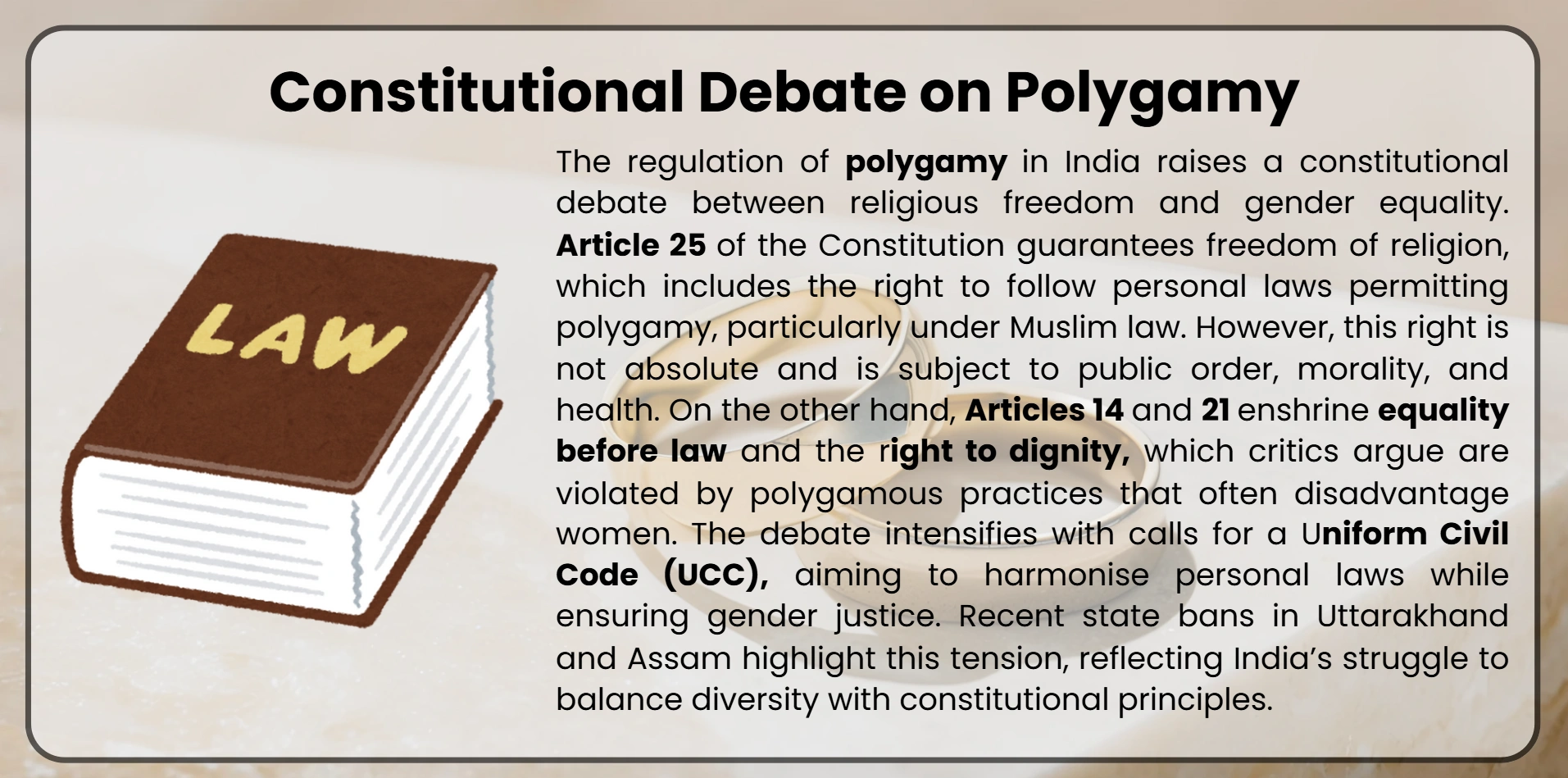
Gender equality is a dominant issue of polygamy. Females in polygamous families tend to experience financial insecurity, emotional and psychological pain, as well as unfair treatment. Opponents argue that the exemption can be used to further the patriarchal system by personal law, thus contravening the constitutional provisions of protection of equality in Article 14 and dignity in Article 21. Advocates of change claim that it is necessary to end polygamy to protect the rights of women and provide them with even-handed marital relationships.
Uniform Civil Code
The UCC discussion dominates the centre of the modern discussion. The supporters argue that a uniform system would put an end to the discriminatory practices, harmonize the differences in legislative systems, and advance the agenda of gender justice. Critics warn such a move could result in the destruction of cultural differences and religious independence on religion. The recent circumambulation of state-level prohibitions in Assam (2025) and Uttarakhand (2024) has put the national debate front and center once again, although adhering to the gradualism of harmonisation and reflecting on federal complications.
Social Acceptance and Customary Practices
More than the law, even in some of the tribal and rural societies, polygamy exists and is socially tolerated according to the customary norms. These customs make it hard to enforce since the law tends to conflict with the established customs. To deal with such issues, legislative reform is not enough, but also campaigns related to social consciousness and interaction with the community to change the mindset towards monogamy and gender equality.
Conclusion
The polygamy in India is an illustration of how there is always conflict between individual law and the constitutional obligation to equality. Though equal treatment before the law is granted to marriages in national laws, particularly The Bharatiya Nyaya Sanhita, the exemptions granted by the Muslim and customary laws for bigamy have remained a source of pluralistic legal order. The recent state prohibitions, Uttarakhand (2024) and Assam (2025), are pointers to a new movement toward harmonisation, which anticipates the enactment of gender justice and the defence of the rights of women. Nevertheless, the situation about a Uniform Civil Code is not resolved yet, thus indicating the ongoing problem of India facing how to balance the cultural diversity with its constitution. Conclusively the direction of change points to the necessity of subtle, accommodative policies of family law in a pluralistic society.