The proposal of the United States to purchase Greenland in 2019 has prompted recent analytic scrutiny that has renewed debate over the large amount of minerals the Island has to offer. The rare earth elements, which are vital to both clean energy systems and geopolitical stability, have now been in the limelight of the discussion, which is why extraction has been a slumbering industry despite the overwhelming interest in the matter and the importance of the strategic rivalry among countries.
|
Key highlights
- Mineral Wealth of Greenland
- United States Interest
- Historical Consciousness of Greenland Resources
- Reasons why these Minerals remained underground?
- Why is Ownership No Longer the Same as Access?
|
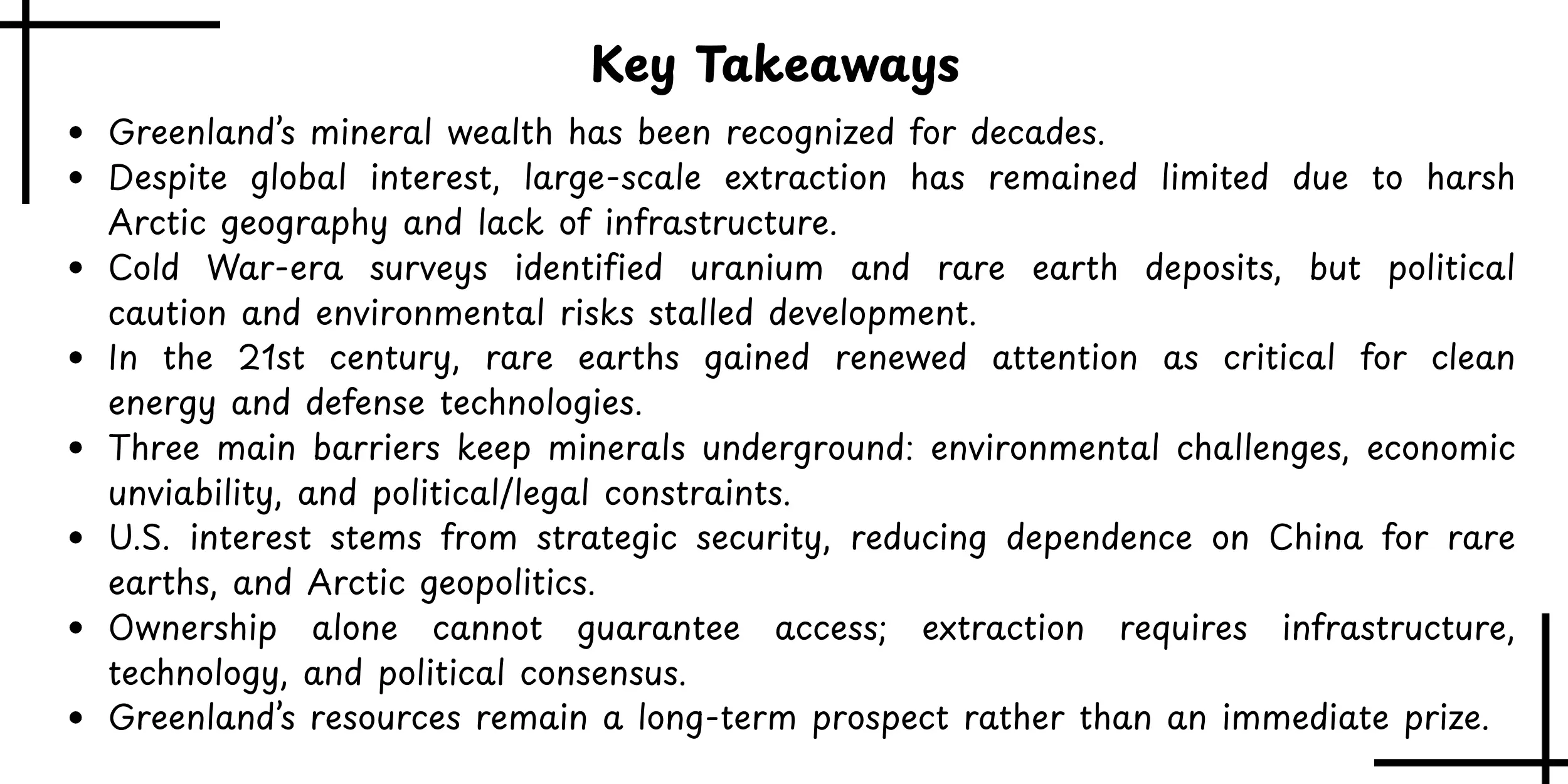
Greenland ranks eighth in the world for rare earth reserves, with 1.5 million tons, and is home to two rare earth deposits that are among the largest in the world: Kvanefjeld and Tanbreez. Still, no rare earth mining has taken place on the island to date The strategic significance of the untapped resources of Greenland is enhanced by the international attention given to the mineral endowment of the island, especially following the 2019 offer of the island as an acquisition by U.S. President Donald Trump. Researchers believe that Greenland contains rare Earth and uranium, among other important minerals essential in modern technologies, making the shift towards clean energy. Nevertheless, the large-scale exploitation has not yet been witnessed, despite the decades-long sustained interest by Denmark, the European Union, China, and multinational corporations. This article examines the continuity of the resources of Greenland, examining environmental, economic, and political barriers, and argues that only possessing the resources is not sufficient to remove the structural issues of extracting them.
Historical Consciousness of Greenland Resources
The mineral potential of Greenland is not a new phenomenon, its existence has been in the limelight of the world since time immemorial; however, in historical literature, history has shown a recurrence of being discussed, but not something that has been exploited on a grand scale.
Early Geological Recognition
The Geological diversity of Greenland,shaped over the four billion years, has been known since the beginning of the twentieth century. Danish and foreignGeologistshad found iron and cryolite deposits, as well as the rare elements. The cryolite at Vitus was mined over long periods in large amounts until 1987, and was an essential raw material in smelting aluminium. This premature extraction proved both the material potential of the island while highlighting the difficulties of the long-term activity of operations in the Arctic conditions.
Strategic Interest duringthe Cold War
The resources of Greenland acquired a new strategic importance in the course of the middle half of the twentieth century. The United States and Denmark realised the Uranium and rare earth reserves on the island, as important to defence and nuclear power schemes. However, organised exploitation was hampered by logistical setbacks such as a lack of infrastructure and harsh climatic conditions. The Cold War context amplified awareness, but it did not lead to long-term mining projects, as most deposits remained unexploited.
Global Attention in the 21st Century
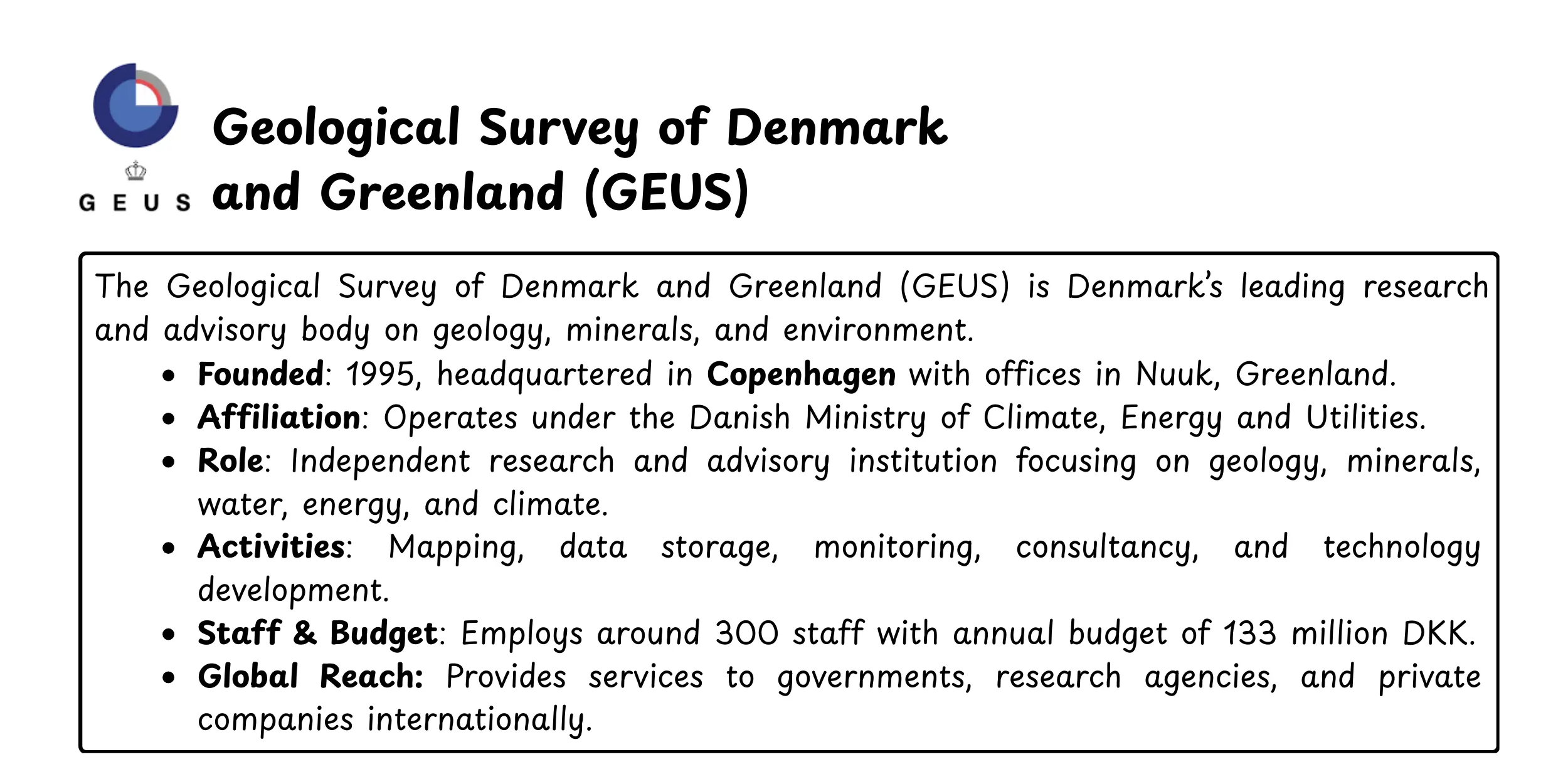
During recent decades, the issue of Greenland has revisited in the spotlight as the area where resources can be explored. According to research by the Geological Survey of Denmark and Greenland (GEUS), three of the rare earth element-bearing deposits located under the ice of Greenland could take up to 3rdof the world in volume. These reserves are quite important due to the increasing need for clean energy technologies, batteries, and electronics. Nevertheless, business enterprises have found it difficult to overcome the high costs of extraction and environmental issues, which come with the development of the arctic.
Statistical Points and Study Findings
According to geo-scientific research, Greenland contains lithium, uranium, zinc and hydrocarbons along with rare earths. Indicatively, a study by Jonathan Paul of the University of London proposes that green land has the potential to have its rare earth deposits compete with China, the present leader of the world supply. Nevertheless, the lack of transport infrastructure and the increased sensitivity of the Arctic ecosystems have always been a barrier to development.
Why is the United States so much interested?
The strategic, economic, and geopolitical factors combine to prompt the interest of the United States in Greenland. The uncommon resources of rare-earth in the island, a central location in the Arctic security, and the larger competition with other countries, such as China and Russia, are the main forces behind this agenda.
Strategic Security Concerns
The geographic location of Greenland is a part of U.S. defense and surveillance interests because of its location in the Arctic region. The Thule Air Base is an example of the importance of the island in terms of the alert concerning missiles and the northern sea. Researchers at CSIS have observed that Washington views Greenland as a key to reversing Russian and Chinese military presence in the Arctic.
Economic Interests and the Critical Minerals
Greenland has large deposits of rare-earth elements, uranium, and zinc, which are invaluable to clean-energy technologies, electronics, and the defense sector. According to CNBC, the U.S. government has also conducted research on investment options in the Greenland mining industry as one of the various measures to reduce reliance on China, which currently possesses more than 80 percent of the rare-earth processing power in the world.
Geopolitical Competition
The U.S. involvement can be seen as a part of an overall geopolitical struggle in addition to the exploitation of resources. The takeover of mineral resources and strategic infrastructure of Greenland is consistent with the attempts to limit the Chinese influence on the supply chains in the Arctic, as well as to improve the strategic position of NATO.
Reasons why these Minerals remained underground?
The mineral wealth of Greenland has long been the subject of interest of both scholars and policymakers, but the transfer of this asset into massive industrial exploitation has been unattainable. The combination of factors, namely environmental, economic, and political, is in a way an exhaustive explanation of the inert nature that prevails in these underground resources.
Harsh Climate
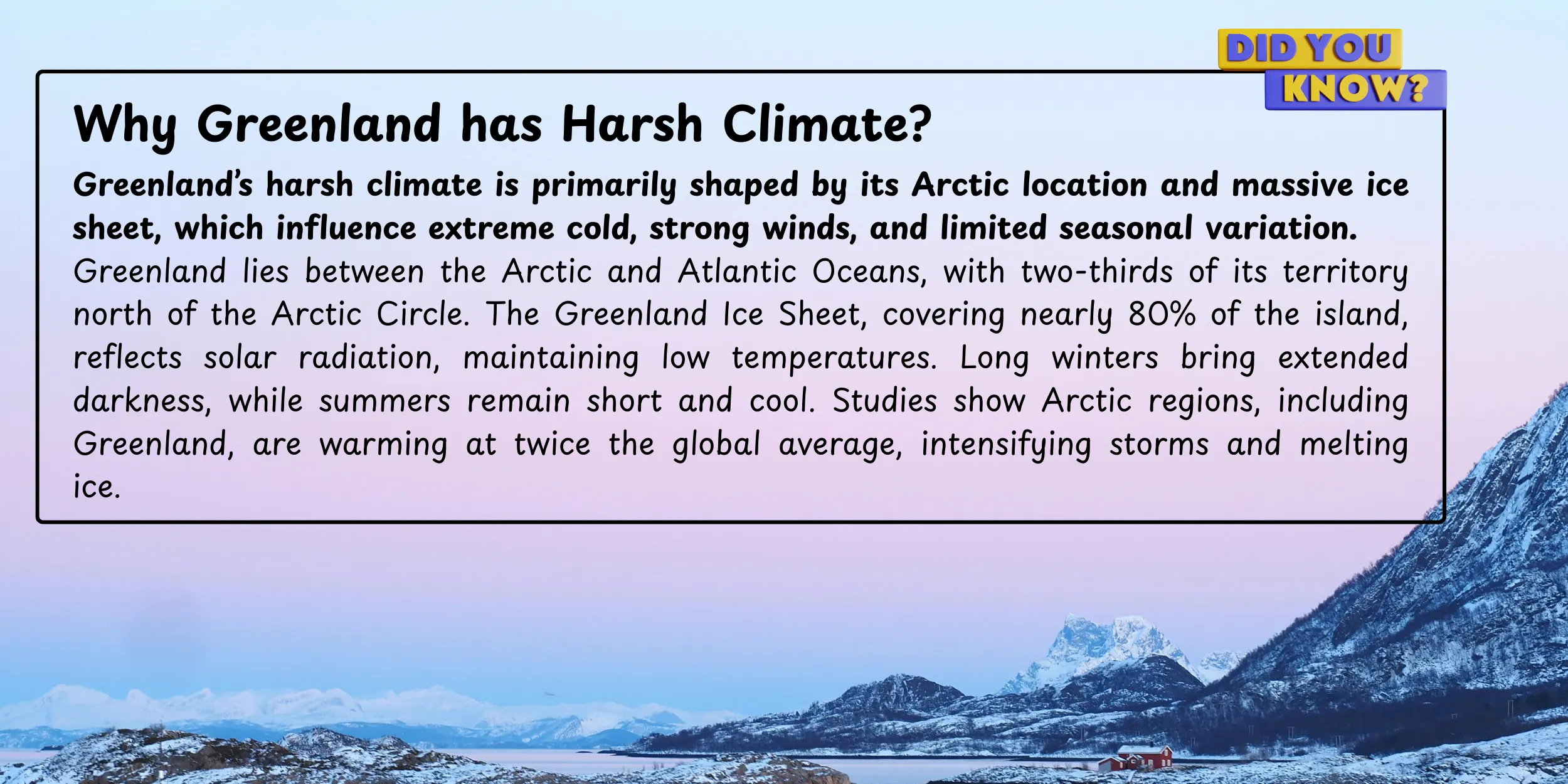
The Arctic terrain of Greenland poses huge logistical challenges to mining projects. The ice sheet covering the island is very thick to the extent that it occupies nearly eighty percent of the total land mass, making direct accessibility of mineral-enriched areas extremely tedious. Due to extreme weather, shortened length of photoperiod in winter, and instability of native ecosystems, there are operational challenges.
Infrastructure Shortfall
There is a significant lack in the infrastructure network: Greenland does not have a developed arterial road network, deep-water ports, or a reliable energy supply that will allow mining on an industrial scale. According to the Indian Express, this has historically been a barrier to sustained investment since the cost required to construct the requisite infrastructure in such conditions is expensive.
Economic Viability
The economic feasibility of extraction seems to be negative even when economically viable reserves are discovered. The mining projects in Greenland require huge capital investment, and prospects of profits are undermined by the instability of the world market of commodities. Despite its availability of such important elements as rare-earth ones, uranium, and zinc, the competitive strengths of Greenland are undermined by long-established manufacturers in China and Australia.
Uncertainty of the Market
The reserves in Greenland are of strategic significance, and extraction and transportation costs often exceed returns. Moreover, the demand for rare-earth minerals worldwide is characterized by intensive volatility, as it is directly associated with the changes in the technological season and the process of the development of the political relationship, which makes long-term planning inherently dangerous.
Political and Social Limitations
Local government models focus on environmental protection and upholding the rights of the natives, and are in constant opposition to the large-scale mining projects.
- Indicatively, uranium mining proposals have faced strong opposition from the population due to environmental and health factors.
- As noted by Down to Earth, the Greenlandic leaders have made numerous efforts to raise the sustainable development agendas above the high rate of resource exploitation.
- The existence of foreign interest; foreign proposals that include the one forwarded by the United States and China have further politicized the discourse, further creating concerns about external control and possible resource dependency.
Why Ownership is No Longer the Same as Access
The fact that the territorial boundaries of Greenland belong to it does not, in and of itself, provide the ability to obtain unilateral access to its mineral endowments. Any solo exploitation under the umbrella of structural, environmental and geopolitical difficulties will limit the exploitation regardless of the territorial claim.
Geographic and Environmental Conditions
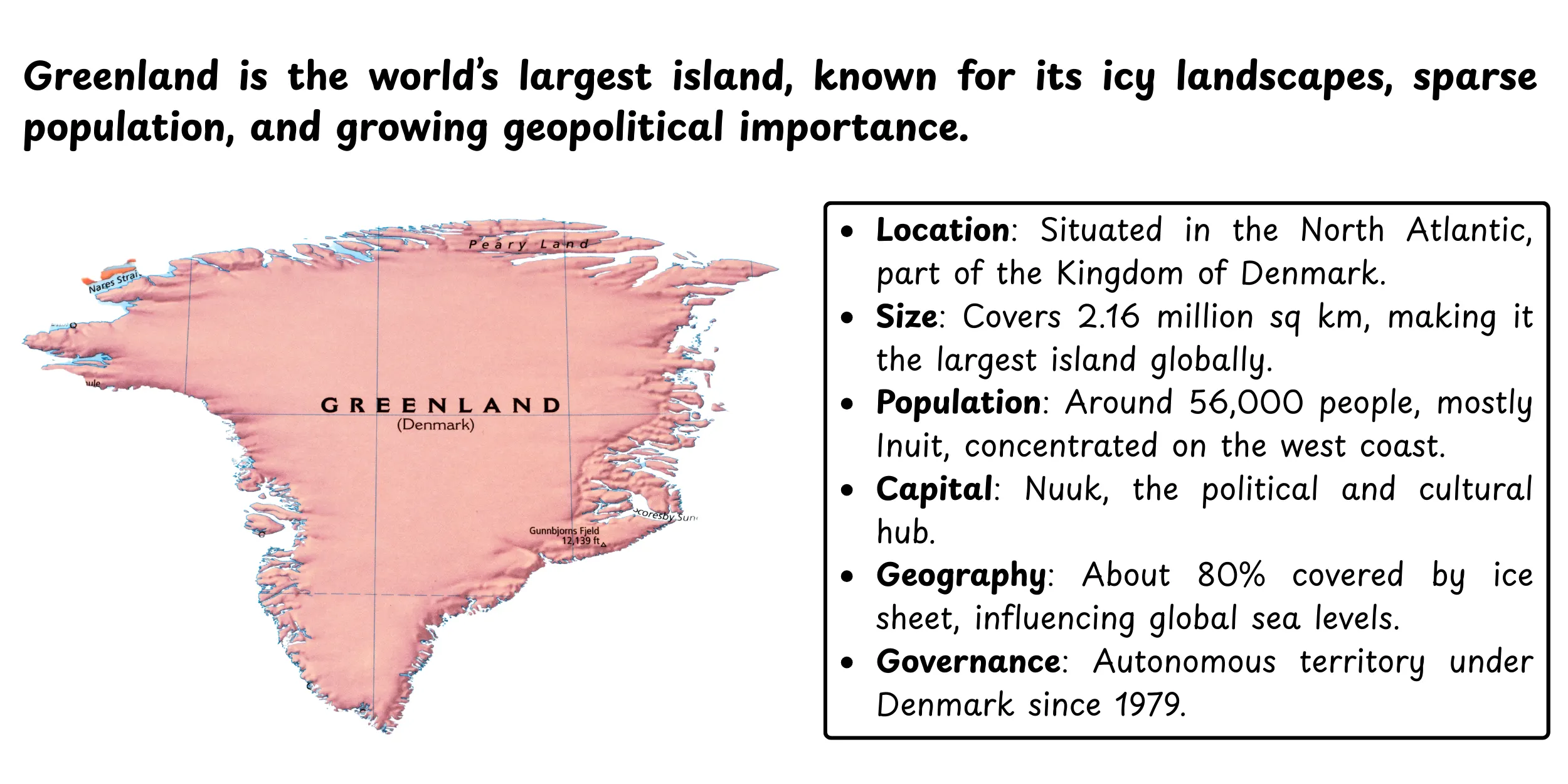
The landmass of Greenland, covering 2.16million square kilometres, is majorly covered by ice, with only 19 percent of the land being ice-free. In this remnant terrain, less than 10 percent of the total has been surveyed forminerals, as per the Geological Survey of Denmark and Greenland (GEUS). The island, as a result, never becomes accessible a priori on the basis of ownership, and the possibilities of exploration and mining practices are always limited by geographic isolation, weather extremes, and the frailty of regional ecosystems.
Economic Limitations
do-Pacific and maintaining the ability to make independent policy decisions will be a challenge to the diplomatic nimbleness of India. Strategic independence during alliances is vital to maritime stability in the long run.
Equipment Limitations
Empirical research shows that, despite the deposits of rare earth elements, uranium and zinc in Greenlanddevelopment of profitable exploitation implies the presence of primary mining equipment as well as midstream processing and downstream manufacturing plants, which do not exist currently. Therefore, without investment in industrial systems, mere possession of those resources will render them out of reach.
Geopolitical limitations
The semi-autonomous government of Greenland under Denmark focuses on environmental management, including indigenous rights, which are often antagonistic to large-scale mining projects. Political aspects that bring the dimensions of resource development have also been added by international stakeholders, especially the United States and China, despite the concern of export-dependency and sovereignty. This would remain inaccessible even in the event that an ownership change takes place due to local resistance and strict regulation policies.
Conclusion
To conclude, Greenland's mineral endowment is a paradox of a huge potential that is inhibited by environmental, economic, and political constraints. The strategic significance of the archipelago has continuously been recognised in the historical analysis, but the process of acquiring these sources remains unreachable. Geographical Isolation, limited logistics and governance interests all makeownership not a guarantee that one can have access to resources. Instead of an easily reachable bounty, resources in Greenland form the long-term problem, which requires innovation in technologies and development of the infrastructure on a sustainable basis and political agreement. The interest that has been articulated by Trump is therefore indicative of timeless predicaments and not necessarily a clear-cut procedure to open up the mineral treasure on the island.
Frequently asked questionsFrequently asked questions
Historical Consciousness of Greenland Resources?
The mineral potential of Greenland is not a new phenomenon, its existence has been in the limelight of the world since time immemorial; however, in historical literature, history has shown a recurrence of being discussed, but not something that has been exploited on a grand scale.
Why is the United States so much interested?
The strategic, economic, and geopolitical factors combine to prompt the interest of the United States in Greenland. The uncommon resources of rare-earth in the island, a central location in the Arctic security, and the larger competition with other countries, such as China and Russia, are the main forces behind this agenda.
Reasons why these Minerals remained underground?
The mineral wealth of Greenland has long been the subject of interest of both scholars and policymakers, but the transfer of this asset into massive industrial exploitation has been unattainable. The combination of factors, namely environmental, economic, and political, is in a way an exhaustive explanation of the inert nature that prevails in these underground resources.
Why Ownership is No Longer the Same as Access?
The fact that the territorial boundaries of Greenland belong to it does not, in and of itself, provide the ability to obtain unilateral access to its mineral endowments. Any solo exploitation under the umbrella of structural, environmental and geopolitical difficulties will limit the exploitation regardless of the territorial claim.
Equipment Limitations?
Empirical research shows that, despite the deposits of rare earth elements, uranium and zinc in Greenlanddevelopment of profitable exploitation implies the presence of primary mining equipment as well as midstream processing and downstream manufacturing plants, which do not exist currently. Therefore, without investment in industrial systems, mere possession of those resources will render them out of reach.