Congress opposition formally submitted a no-confidence motion notice against Lok Sabha Speaker Om Birla on February 10, 2026 to the Secretary General of the House. The Congress party, supported by over one hundred members of parliament, tabled a motion of no confidence against Lok Sabha Speaker Om Birla in the Budget Session, accusing him of favouritism and refusing to give an opportunity to opposing voices.
|
Key highlights
- What has happened in the Parliament?
- What is a No-Confidence Motion (NCM)?
- Procedural Requirements for Removal
- Past Incidents in Lok Sabha
- Potential Results and Prospective Dynamics of this Motion
- Implications on Parliamentary Democracy in India
|
The recent issue of a motion of no confidence by members of the Congress Party against the Speaker of the Lok Sabha, Om Birla, has gained much attention in the Indian parliamentary landscape. The notice was formally handed over to the Secretary-General by Chief Whip K. Suresh, with Whip Jawed Ahmed, and thus, the presiding officer of the House could be formally challenged by an institution on a rare basis. This process is not only consequential in that it is rare in terms of procedure, but also in its symbolic significance, in that it highlights concerns about the opposition's fear of impartiality and non-democratic responsibility as well as the changing balance of power in the Lok Sabha. What is important about this act is that it is very rare that such an act is challenged as a direct interference with the impartiality on the part of the presiding officer; it is a form of cohesion and provokes a re-examination of the democratic procedures in the constitution of the parliament.
No-Confidence Motion in Lok Sabha- What has happened in the Parliament?
The Congress party has presented the no-confidence motion against Om Birla, Speaker of the Lower House, that is Lok Sabha of the Indian Parliament, and it has become the subject of focus in the Indian parliamentary debate, both of a symbolic nature and unprecedented procedural stature. No Confidence Motion also called as Motion of No Confidence, a Vote of No Confidence is a formal proposal in Lok Sabha to evoke a decision of the house.
Context of the No-Confidence Motion
It was formally filed during the Budget Session, where Chief Whip K. Suresh and Whip Jawed Ahmed gave the notice to the Secretary-General. The document had the signatures of one hundred and ninety MPs who belonged to the opposition faction, the DMK, Samajwadi Party, to mention a few. This concerted action was a result of the claims of partisan conduct, especially the denial of speaking opportunities to leaders of the opposition, such as Rahul Gandhi, and the suspension of a number of MPs.
Political Significance of this Motion
This motion is not likely to succeed, considering the majority of the ruling party. It presents a very rare offence against the impartiality of the Speaker under Rule 94C of Lok Sabha procedural rules and therefore centralises the position of the Speaker in accountability of democracies. The move also enhances integration of the opposition in the INDIA bloc and is an indicative move to alter existing discourses on transparency, fairness, and credibility of parliamentary practice.
|
What is a No-Confidence Motion (NCM)?
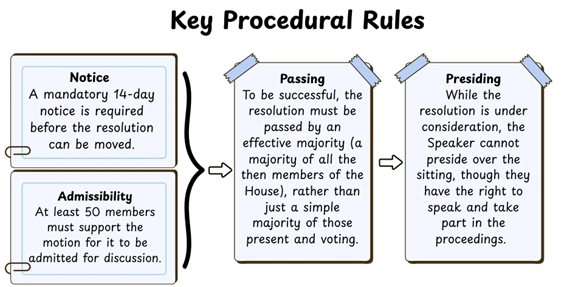
No-confidence motion is an important tool of parliament in India that is aimed at questioning the sustainability of the ruling government in the Lok Sabha. A no-confidence motion is a formal resolution that was proposed in the Lok Sabha to indicate the mistrust that the House has in the Council of Ministers. It lacks applicability in the Rajya Sabha. It has a constitutional underpinning in the Indian Constitution, in Article 75(3) of the Indian Constitution, which states that the collective responsibility of the Council of Ministers lies with the Lok Sabha. In case a majority votes on the motion, then the government has to resign. The motion can be instigated by any member of the Lok Sabha, but must be backed by at least 50 members to be accepted to discuss. There is a tradition of such motions, though seldom, but effective
Past Incidents in Lok Sabha
The Indian Lok Sabha has never in its history recorded more than four occasions where a formal resolution was moved to remove the Speaker. These are technically known as removal resolutions under Article 94(c) of the Constitution because in the Council of Ministers, the term no-confidence motion is used extremely rarely.
- G.V. Mavalankar (December, 1954): The first Speaker of the Lok Sabha, G. V. Mavalankar, was the first to face this because of the opposition led by J.B. Kripalani. The resolution had it that he was acting in a partisan manner. It lost to the House after a two-hour debate.
- Hukam Singh (November 24, 1966): A resolution was moved against Speaker Hukam Singh, claiming he had intervened arbitrarily to disallow parliamentary questions by the opposition, so that the government could be saved. This motion was also denied.
- Balram Jakhar (April 15, 1987): The third case was against Balram Jakhar, whom the opposition accused of withholding the right of the members to raise valid constitutional and procedural issues by the use of adjournment motions. The resolution was defeated.
- Om Birla (February 10, 2026): The opposition (INDIA block) has given a notice of a no-confidence motion against the current Speaker, Om Birla. The letter, which is brought in by more than 100 MPs, mentions the behaviour of sheer partisanship and unfairness in the suspension of the opposition members.
|
Potential Results and Prospective Dynamics of this Motion
The results and dynamics of a motion depend entirely on its specific context, such as a physical object's movement, a legal proceeding, a biological process, or an engineering system. Even though the no-confidence motion against Speaker of the House, Om Birla, is statistically not going to win, the events that follow place a sequence of consequences that lie beyond the result itself.
The probable Parliamentary Result of NCM
This is likely to lose the motion, considering the numeric strength of the BJP-led coalition. The mentioned backing by 118-119 MPs is significantly lower than the 272 majority needed to have a majority in the 543-seat house. Nevertheless, the discussion will provide the opposition an avenue to present grievances related to the allegations of bias, suspension of members of parliament, and the alleged refusal to allow them to speak.
Broader Political Scenario in India
Symbolically, the movement strengthens the integration of the opposition block within the INDIA bloc and enhances the fears about the possibilities of fairness in parliament. Even in a defeat, analysts opine that the aftermath discourse may focus on clarifying the meaning of accountability and transparency amongst the populace. These changes, in their turn, can affect voter sentiment ahead of the 2026 state elections and the 2029 general elections, not to mention that the Speaker will be re-centred, and discourse about institutional credibility and democracy protection will be renewed.
Implications on Parliamentary Democracy in India
The fact that the Indian National Congress (Congress) has filed a no-confidence motion against Lok Sabha Speaker Om Birla, and has been supported by over 100 Members of Parliament (MPs), has a greater significance than the direct parliamentary action. Implications for India's parliamentary democracy involve a tension between its vibrant, constitutionally resilient nature and significant challenges, including potential executive dominance due to strong majorities, reduced legislative oversight, frequent disruptions hindering productivity, issues with anti-defection laws stifling dissent.
Symbolic Claiming of Responsibility by Opposition
The current ruling Bharatiya Janata Party (BJP) has a strong numerical majority and makes the successful pass of the motion unlikely; however, it carries a symbolic meaning. It is a rare test of the alleged neutrality of the Speaker, thus pre-empting criticism concerns on the denial of the privilege to speak and the suspension of MPs. The congress leaders stressed that 119 MPs had attached their signatures to the notice, and this example served as a sign of a strong level of opposition solidarity within the INDIA coalition.
Institutional and Democratic Impact
This movement highlights the existence of tension that is inherent between majority rule and minority rights in a parliamentary democracy. According to scholars, even failed challenges will help to refine the discussion in relation to transparency and accountability. The opposition has subjected the institutions of parliament to under-inquiry by appealing to the Rule prerequisite of Rule 94C of the Lok Sabha procedures, and given the neutrality of the Speaker question. As a result, the episode can potentially change the views of democratic fairness and trigger new calls toward reforms to ensure equal representation in legislative activities.
Conclusion
A case in point is the no-confidence motion against the Lok Sabha Speaker, Om Birla, facilitated by opposition allies, which is an interesting institutional pressure on the Indian parliamentary system. Although the fact of the numerical dominance of the ruling coalition decreases the likelihood of its actualisation, the symbolic appeal of the motion cannot be rejected. It confirms the unity of opposition, questions the neutrality of the parliamentary processes, and puts the Speaker in the centre of discussions on the issue of democratic accountability. Finally, the episode highlights the longstanding conflict between majority rule and minority rights, thus showing the vibrant transformation of the Indian parliamentary democracy.
Test your understanding
Questions from this article
Prelims practiceWith reference to No-Confidence Motion in Lok Sabha-Congress Moves against Speaker Om Birla, consider the following statements:
- Congress opposition formally submitted a no-confidence motion notice against Lok Sabha Speaker Om Birla on February 10, 2026 to the Secretary General of the House.
- The recent issue of a motion of no confidence by members of the Congress Party against the Speaker of the Lok Sabha, Om Birla, has gained much attention in the Indian parliamentary landscape.
- The notice was formally handed over to the Secretary-General by Chief Whip K.
View answer
Answer: 1, 2 and 3. Congress opposition formally submitted a no-confidence motion notice against Lok Sabha Speaker Om Birla on February 10, 2026 to the Secretary General of the House. Here why the opposition raised the move and its political implications.
Mains practiceExplain the key features of No-Confidence Motion in Lok Sabha-Congress Moves against Speaker Om Birla and examine its significance, major issues and wider implications.
Answer in 250 words.
View answer approach
- Define and place No-Confidence Motion in Lok Sabha-Congress Moves against Speaker Om Birla in context.
- Examine Context of the No-Confidence Motion.
- Examine Political Significance of this Motion.
- Examine Potential Results and Prospective Dynamics of this Motion.
- Conclude with a balanced assessment and an appropriate way forward.
Frequently asked questionsFrequently asked questions
Potential Results and Prospective Dynamics of this Motion?
The results and dynamics of a motion depend entirely on its specific context, such as a physical object's movement, a legal proceeding, a biological process, or an engineering system. Even though the no-confidence motion against Speaker of the House, Om Birla, is statistically not going to win, the events that follow place a sequence of consequences that lie beyond the result itself.
Implications on Parliamentary Democracy in India?
The fact that the Indian National Congress (Congress) has filed a no-confidence motion against Lok Sabha Speaker Om Birla, and has been supported by over 100 Members of Parliament (MPs), has a greater significance than the direct parliamentary action. Implications for India's parliamentary democracy involve a tension between its vibrant, constitutionally resilient nature and significant challenges, including potential executive dominance due to strong majorities, reduced legislative oversight, frequent disruptions hindering productivity, issues with anti-defection laws stifling dissent.