|
Key highlights
- Export Promotion Mission
- Income Tax Reform
- Next-Gen GST
- Outcome-Driven Governance
- Reform of labour code
- Rural Employment Reforms
|
The article “2025 Economic Reforms: India’s Leap toward Inclusive Growth” discusses the economic reforms that took place in India in 2025, which are aimed at building a nation of the future. It focuses on result-oriented governance, lean systems, and participatory growth. The main tools include unified labour codes that safeguard social protection, Next-Generation Goods and Services Tax (GST) that expands the base of taxpayers, an Export Promotion Mission that includes the support of micro, small, and medium enterprises (MSMEs) and new exporters, and rural employment reforms that assure 125 days of paid employment to help better equity and resilience.
|
Tips for Aspirants
This article is significant to the examination of the UPSC CSE and State PSC because it synthesises the 2025 reforms, and it provides the insights related to governance, labour, taxation, exports and rural employment, which are major themes of policy questions.
|
|
Relevant Suggestions for UPSC and State PCS Exam
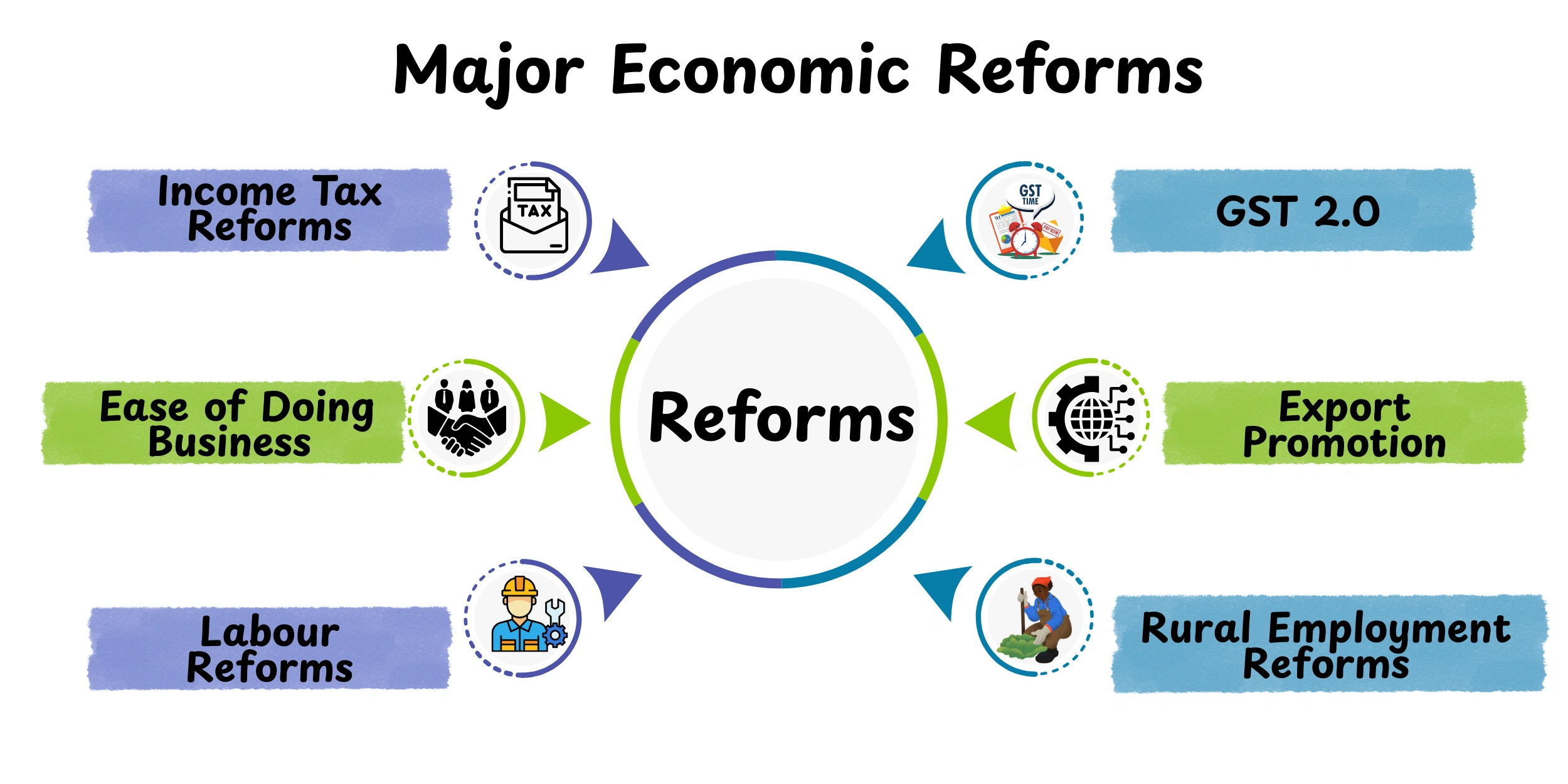
- Outcome-Driven Governance: results-oriented, streamlined systems, digital integration, and increased transparency to make it easier to do business.
- Reform of labour code: 29 laws were brought together into four codes of labour; social security increased to gig and informal workers, workplace safety and inclusivity.
- Next-Gen GST: Reduced two slab design; taxpayers have increased to 1.5 crore; accelerated refund and e-based compliance payment; better fiscal capabilities.
- Income Tax Reform: New Income Tax Act, 2025; increase in exemption of income to 12 lakh; harmonisation of customs duty.
- Export Promotion Mission: 25,060 crore program; support to MSME and first-time exporters; lessening compliance requirements; better market access.
- Rural Employment Reforms: 125 days of paid work per year: Cornerstone of rural infrastructure improvement and wage increase.
- Economic Impact: GDP is expected to rise by 8.2% in 2025, MSME is projected to rise by 18%; rural wages are projected to rise to 12%.
|
The year 2025 is one of the most important inflexion points in the Indian economy, as it is marked by an all-embracing set of reforms aimed at creating a nation of the future. These are not minor adjustments but a structural change to enhance its governance, productivity, and inclusiveness. The Parliamentary program is based on the principles of outcome-based governance and aims at simplifying the institutional arrangements, reducing the systemic inefficiencies, and creating a context in which it is possible to promote sustainable growth and innovation. One aspect of this is the merger of 29 fragmented labour laws into four sets of coherent Labour Codes, and renewal of workplace safety, and balancing flexibility and protective policies. In line with this is the introduction of Next-Generation GST Guidelines; compliance procedures become standardized, and the taxpayers' base is extended to 1.5 crore, resulting in increased fiscal potential. India's 2025 economic reforms are a comprehensive set of initiatives aimed at achieving inclusive growth through enhanced ease of living and ease of doing business. Equally important is the 25,060 crore Export Promotion Mission that provided extraordinary support to MSMEs in terms of financing and enabling compliance as well as market access. In addition, rural job reforms make sure they receive 125 days of paid jobs, hence guaranteeing social fairness and resilience even amongst the rural communities. All these measures are important to highlight the effort by the Indian Government on inclusive development, global competitiveness, and an open, strong, socio-economic infrastructure in the decades to come.
Result-Based Governance and Ease of Doing Business
The 2025 economic reforms in India can be seen as a bold movement towards governance based on outcomes, in that there is a focus on the measurement of outcomes, simplified mechanisms of administration and improved business operations environment. The major aims of these reforms would be the reduction of compliance costs, increasing transparency, and enhancing institutional trust.
Change in Governance
One of the notable aspects of the 2025 reforms is the change in a predisposition towards the expansion of regulation to the goal of determining measurable results. The modern form of government predicts operational efficiency, predictability and delivery systems that are citizen-oriented. According to the Government Year-Ender memorandum, the reforms were developed in order to smooth businesses and make them more transparent, creating trust in government institutions. This development trend on the grounds represents the changing nature of the paradigm of governance in India, whereby the institutional success is not measured by the number of regulations which are promulgated, but by the visible impacts of these regulations on economic growth and inclusive development.
Simplification of Systems and Compliance
A simplification of compliance architectures has been an imperative push of the reform agenda. During the pre-reform period, enterprises had to struggle with varying regulatory approaches, i.e. taxation, labour and licensing. These processes have been integrated into the 2025 reforms, thus removing the redundancies as well as the long approval cycles. The utilisation of electronic platforms of taxing and labour compliance has resulted in a significant decline in transaction costs. According to empirical data, the country has increased in the rank of the World Bank Ease of Doing Business surveys, which is attributed to reduced procedure delays and increased predictability.
Heavy Investment in Growth and Inclusivity
Included in the avenue of outcome-driven governance is inclusivity. The reforms make the economic environment livelier and business-friendly, making sure that the growth is registered as benefits to the marginalised populations. The examples comprise the introduction of simplified taxes, as well as the expansion of the definition of micro, small, and medium enterprises (MSMEs), which has enabled small firms and female entrepreneurs. India has created a more equalised environment of engagement in formal markets by matching the theme of governance with the emerging economic dreams.
Statistics and Economic Value
There is empirical evidence supporting the success of the reforms. In 2025, India had gross domestic product (GDP) growth rates of 8.2%, which is higher than the world's estimates. It was found that the taxpayer base was growing to 1.5 crore under the Next-Gen Goods and Services Tax (GST), where compliance and financial ability are enhanced. Additionally, there were direct taxation reforms which excluded taxation for annual earnings of less than 12 lakh and these relieved middle-income families of financial burden. All these steps have strengthened both macroeconomic stability and micro-level trust in the citizens as well as the businesses.
Reforms in the Labour code and increased Social Security
The Indian labour reforms of 2025 are a crucial shift in the employment and welfare system of India. The government has made efforts to streamline the regulatory provisions, expand the ambit of social security and strengthen the workplace through the consolidation of 29 independent statutes into four broad Labour Codes.
The Labour Laws
In November 2025, the unification of the 29 separate legislations into four governing labour codes; that is, the Code of Wages (2019), the Code of Industrial Relations (2020), the Code of Social Security (2020), and the Code of Occupational Safety, Health, and Working Conditions (2020). This stream of rationalisation simplifies compliance, limits legal grey areas and develops a unified system of employers as well as employers. This initiative has been described by the Ministry of Labour and Employment as the peak of the 2025 reforms, earning India a labour ecosystem that is in line with the global trends.
Social Security
Another characteristic that stands out remarkably about the reforms lies in the broadening of social security benefits to previously marginalised groups, such as platform and gig workers. The government initiated EPFO 3.0, thus allowing provident fund withdrawal directly through ATM and UPI services, and this has significantly increased access. Official statistics indicate that in 2025, the social security coverage reached 64 percent of the workforce, and more than 31 crore unorganised employees were registered on the e-Shram portal. This is an extension that portrays an effort to integrate the informal workers into the formal safety nets.
Inclusivity
The Occupational Safety Code introduced occupational health examination for workers who were older than 40 years, compulsory minimum wages in the workplace, and immediate payment of wages in all industries. Female employees were granted increased liberties, such as the approval to work night shifts with tight safety requirements. The reforms not only improve the equity in the workplace, but they also strengthen India's investment in global labour norms.
Employment and Financial Effect
The Pradhan Mantri Viksit Bharat Rozgar Yojana (PMVBRY), a programme that cost 99,000 crore rupees, was used to complement the reforms and ensure that 3.5 crore jobs were created and more than 235,000 firms were registered. The government has been trying to balance the flexibility of industries and the welfare of employees, unifying the labour laws and rewarding the creation of jobs. Employment potentials suggest that it has been growing consistently, including labour reforms that have added to resilience in both organised and unorganised labour markets.
Next-Gen GST
The tax reforms in India in 2025 launched a Next-Generation Goods and Services Tax (GST) system to ease the compliance cost, and expand the taxpayers and consumer demand. These actions reflect a radical shift in policy towards more transparency, operational effectiveness, and inclusiveness.
Streamlining GST Structure
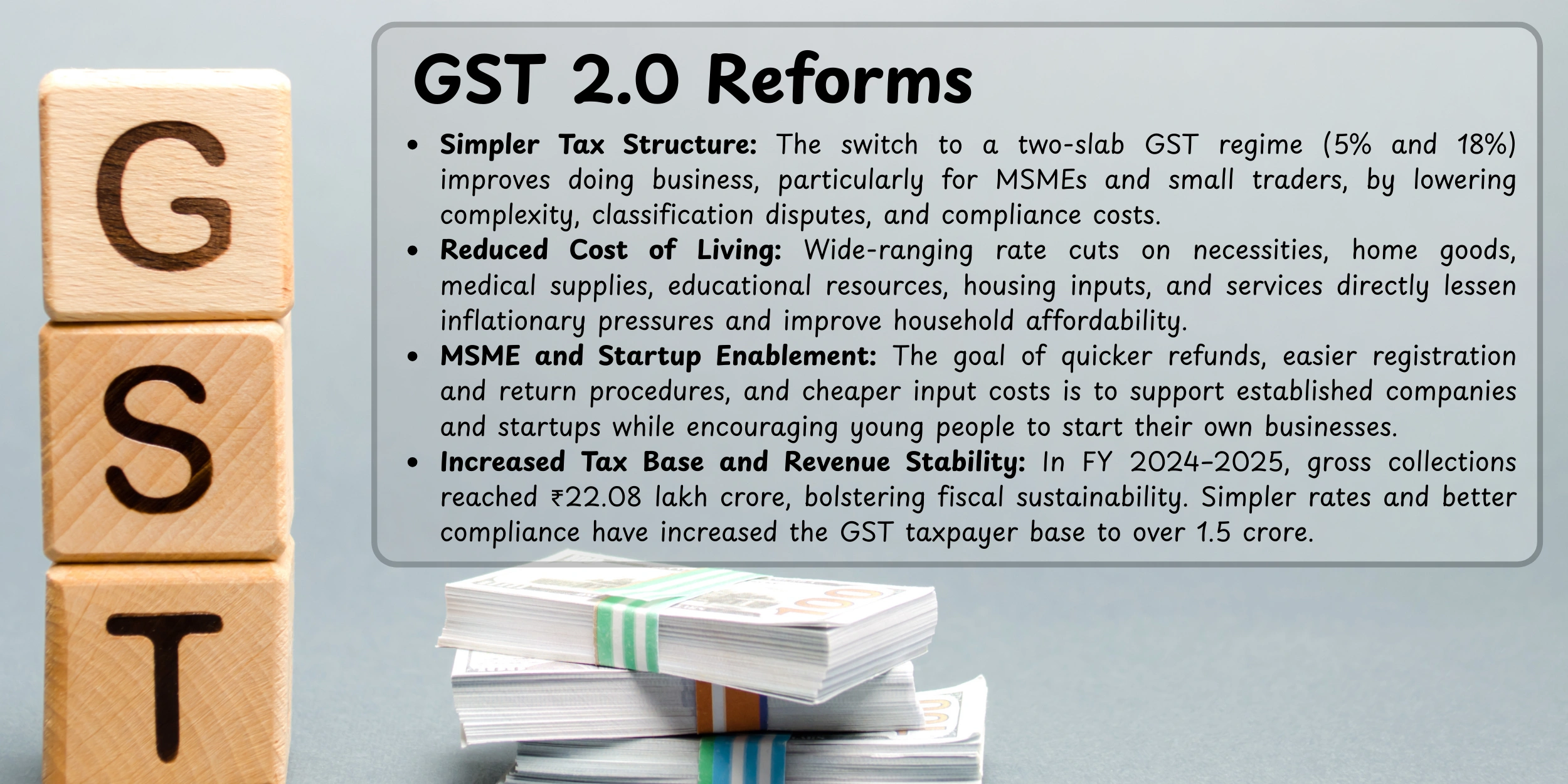
The reforms integrated the GST rate system into a two-bracket structure (5 percent and 12 percent), accompanied by a separate demerit rate of luxury and harmful goods. Such a rationalisation addressed counter-optimal duty regimes and unwarranted duties on basic commodities. Reports indicate that the GST rates on almost 375 goods and services are slated to be decreased by 2025, which will make daily consumption less expensive.
Expanding the Taxpayer Base
One of the highlights of GST 2.0 was the increased number of taxpayers registered in India to 1.5 crore (as stated by the Press Information Bureau). An automated system of registration of small taxpayers, faster refund, and invoice-based reporting systems reduced the compliance costs and encouraged them to participate voluntarily. This growth enhanced the fiscal capacity as well as reaffirmed the formalisation of the Indian economy.
Simplification of Procedures and Digitalisation
The reforms emphasised procedural ease by being a digital-first mechanism. With automated dispute resolution through the newly formed GST Appellate Tribunal (GSTAT) and increased levels of digital security and an easier process of filing returns, businesses became more predictable. The studies by BusinessWorld showed that these have been aimed at boosting demand amid global headwinds that have made sure that the country has remained robust amid resilience in its domestic market.
Income Tax
In conjunction with GST changes, a new Income Tax Act of 2025 replaced a 6-decade old one, the 1961 Act. The Exemption limit was increased to ₹12 lakh per year, which became a relief to the middle-income households. The complementary measures were more rebates in Section 87 A, time extensions in updated returns, and rationalisation of customs duties. Taken in totality, these reforms established a coherent tax ecosystem that has balanced revenue creation and welfare to the citizens.
Economic Impact
The reforms have been shown to be effective in an empirical study. The gross domestic product of India grew to 8.2 percent in 2025, which was based on increasing consumption and compliance. Compensation cess abatement and rationalisation of rates increased the competitiveness of micro, small and medium enterprises (MSMEs), whereas simplified taxation processes increased investor confidence.
Export & Rural Employment Missions
The 2025 economic reforms in India have brought two historic initiatives into the country, i.e., the Export Promotion Mission and the Rural Employment Reforms. All these aim at strengthening the external competitiveness and protecting social equity by providing guaranteed rural livelihoods.
Export Promotion Mission
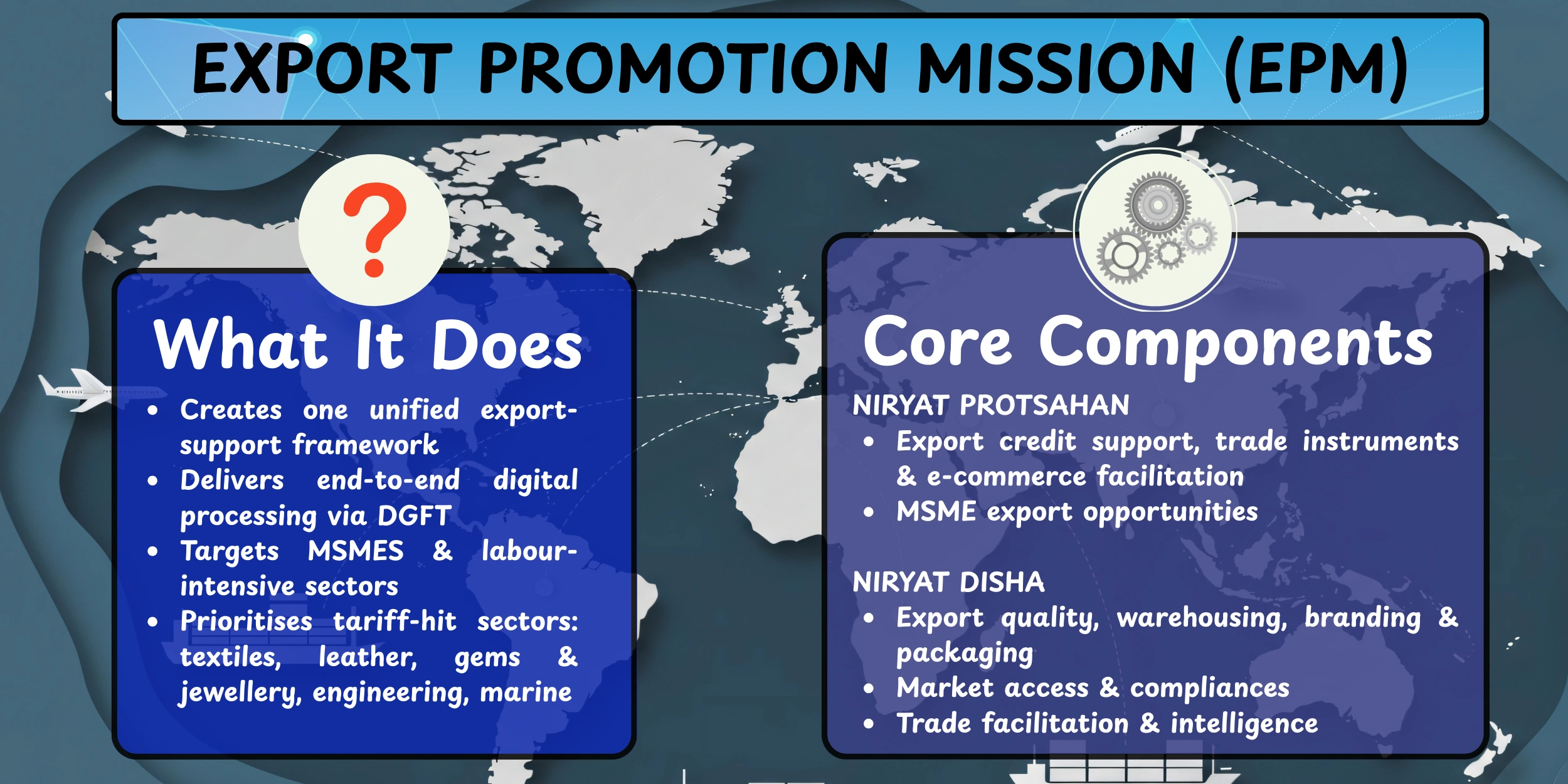
The Export Promotion Mission, which has a reported budgetary allocation of ₹25,060 crore, was introduced to empower the micro, small, and medium enterprises (MSMEs), as well as first-time exporters. It provides funding, compliance, and allows market access. Based on the statistics of the Press Information Bureau, the purpose of the mission is to increase the export of India by 2030, and the contribution of MSMEs is expected to be almost 45 percent of the overall exports. The initiative will increase the global competitiveness of India and bring smaller companies into the international value chains by facilitating better procedures and credit insurance.
Ease of Market Access and Compliance
One of the key elements of the mission is that compliance is made easier for the exporters. The processes of documentation, customs clearance, and certification are integrated through digital platforms. Studies have shown that streamlined compliance has contributed to decreasing the average time of export clearance by 30 percent in 2025, thus enhancing India's position in the world trade facilitation index lists. These steps allow first-time exporters, who are usually limited by the complexity of regulatory means, share in the world markets better.
Rural Employment Reforms
In addition to the expansion in exports, the rural labour reforms ensure that there are at least 125 days of paid labour per year, which is a higher extension of 100 days of labour that was provided by MGNREGA. The reform enhances the resilience of the community in a rural context, especially in agrarian communities, where unemployment occurs periodically. According to government statistics, over 7.8 crore households were estimated to take advantage of guaranteed job opportunities, and these households can be utilized in the rural infrastructure development, including road building, irrigation development, and renewable energy development.
Social Equity and Economic Impact
In the case of the dual emphasis on exports and rural employment, it reflects the balanced growth strategy. Though the Export Promotion Mission has been accompanying India into the global supply chains, the reforms of rural employment ensure that the vulnerable population cannot be neglected. The two enable both external competitiveness and internal equity. Observable data demonstrates that in 2025, the wage in the rural areas increased by 12 percent in one year, and MSMEs began to increase the level of exports by 18 percent more per year, which contributes to a real effect of reforms.
Conclusion
The 2025 economic reforms undertaken by India are a comprehensive, transformative agenda that would establish a robust, inclusive, and competitive economy in the world. The reforms are balanced by promoting efficiency and equity through enhancing outcome-based governance, facilitating taxation, consolidating labour regulations and enhancing export promotion and rural jobs. Their tangible influence is supported by the evidence of increasing GDP growth, increased participation of taxpayers, and increased coverage of social security. The measures not only modernise the institutional setups but also ensure that sustainability and inclusivity are ingrained in the pattern of development in the country. Therefore, the 2025 reforms are a bold move towards ensuring India is a future-ready economy with a strong socio-economic foundation.