|
Key highlights
- Sanchar Saathi App
- Debate on User Consent
- Legitimacy Test
- Concerns related to Surveillance
- Implications for Privacy
|
The controversy about Sanchar Saathi is based on its obligatory installation, which creates serious concerns over the agreement of users, as well as on privacy rights. The law experts believe that requiring people to install a state-operated app on their personal devices would violate the constitutional right to privacy. Those who criticize this issue highlight the risks related to surveillance, lack of transparency, and the need to engage voluntarily with its implementation with strong provisions.
The Sanchar Saathi portal and its associated app have become the focal point of a significant constitutional debate in India, balancing the state's power to ensure security against citizens' fundamental right to privacy.
|
Tips for Aspirants
The article is vital in both the UPSC CSE and State PSC exams since it connects the governance, the right to privacy, constitutional law, and the digital policy, which are paramount concerns when studying ethics, polity, and current affairs.
|
|
Relevant Suggestions for UPSC and State PCS Exam
- Sanchar Saathi Background: The application was created by the government to help reduce telecom fraud and also to identify fake SIM cards and machines.
- User Consent Controversy: The controversy of user consent is caused by having mandatory installation, which pre-empts the issue of user autonomy and the need to have informed consent in the realm of digital governance.
- Constitutional Structure: Justice KS Puttaswamy vs. Union of India (2017) confirmed that privacy is one of the basic rights under Article 21.
- Tests of Legitimacy: Legitimacy of state interventions is also open to stringent tests, and the tests include necessity, proportionality, and all-around legitimacy. Based on such criteria, the Sanchar Saathi decree was disputed.
- Surveillance Issues: Critics expressed concern that the sanctification will make it easy to misuse and undermine confidence in the state technology.
- Policy Reinvention: The government abandoned the mandatory installation because of a backlash, thus highlighting the ability of people to resist the trend as a protection.
- Broader Applications: The case may impact the voluntary adoption principle, open safeguards, judicial courts, and their compliance with international privacy regulations, including the GDPR.
- Relevance to Exam: The discussion connects governance, ethics, polity, constitutional law, and current affairs, which are critical to GS II, GS IV, and the essay paper.
|
The rapid expansion of the digital governance system in India has provoked wide discussions regarding the balance between state and personal interests. One of the most recent projects, a platform called Sanchar Saathi, which was developed to track the mobile connection and limit fraudulent behaviour, has come out as the focal argument. As the government explains its usefulness in strengthening security and responsibility in the telecommunications industry, the mandatory inclusion of the application in personal devices has raised significant arguments in the area of user consent and constitutional rights. In the heart of this controversy is a question of whether the forced introduction of one state-owned application encroaches the basic right to privacy, as established in the historic case of Justice K.S. Puttaswamy v. Union of India (2017). Informed consent is also one of the principles that are embedded in democratic government and the code of conduct within digital spaces. This principle seems to be diluted in the cases when a person is not given the freedom of self-directed decision-making. Legal scholars contend that such actions need to be in compliance with the constitutional demands, that is, the necessity requirement, the proportionality requirement, and the legitimacy requirement.
Background and Objective of Sanchar Saathi
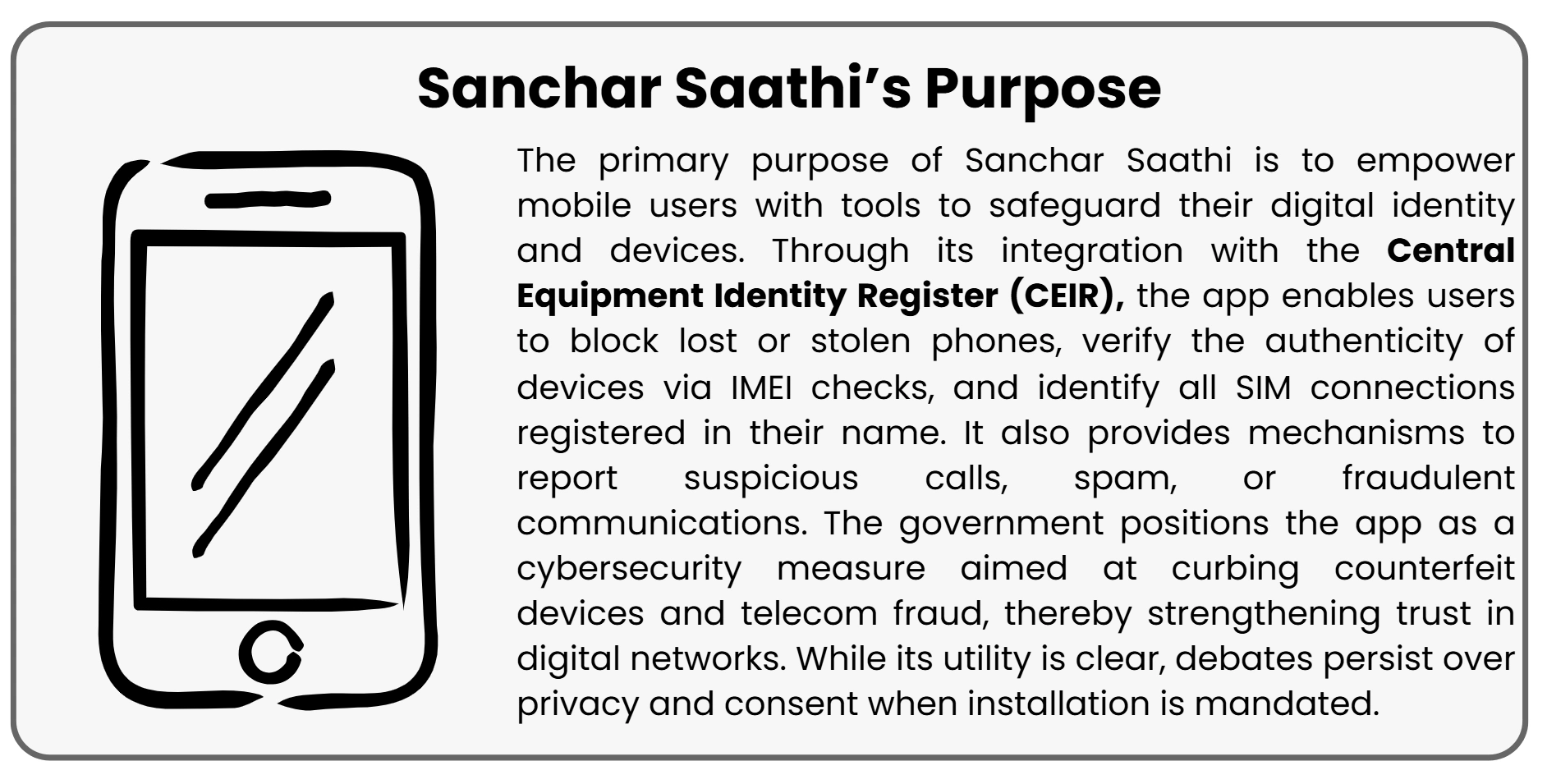
The Sanchar Saathi portal, an initiative by India's Department of Telecommunications (DoT), is designed to combat mobile phone fraud, theft, and identity misuse by empowering citizens with security tools. Its operations have sparked debate regarding constitutional rights, specifically the right to privacy, due to past directives about pre-installation and data access. The introduction of Sanchar Saathi, a mobile-based application that is a mandatory one by the state, has raised intense controversy in India. However, despite seemingly achieving its alleged goal of protecting users, the requirement of the compulsory installation of the application predicts serious constitutional and ethical issues.
Sanchar Saathi: Historical Background
The Telecommunications Department (DoT) had originally introduced Sanchar Saathi as a telecommunications security-based platform that is citizen-centric. It mostly aimed to allow users to track SIM connections, the authenticity of devices, and fraud governance. As it progressed, the platform was no longer a voluntary web portal, but a mandatory mobile application, and this change is due to the rising interest of the government regarding cybersecurity and fraud prevention. Such a shift, however, has changed the discussion of utility to compulsion, hence inviting the scrutiny of legal scholars and the players in civil society.
Rationalization and Pursuits in Government
The compulsory installation of Sanchar Saathi is a national security issue justifiable by the government. Connecting the application to the Central Equipment Identity Register (CEIR), the authorities will identify stolen or cloned IP phones to prevent patients from spamming and enhance better management of digital identities. Cybercrime and mobile-based fraud are on the rise, and according to officials, such measures cannot be done without them. The application is introduced as a preventative measure to protect the citizens, increase the accountability of the telecom networks, and ensure that mobile connections are traceable and secure.
Individual Consent
Sanchar Saathi has sparked criticism, even though it is advantageous, as it is mandatory. Theorists of law and activists of privacy argue that the privacy in question is being undermined by the fact that the principle of informed consent, which is the cornerstone upon which democratic governance is built, must be enforced. That the app cannot be shut down or deleted is potentially a source of concern with regard to surveillance and invasion of personal autonomy. This clash of the state security needs and the rights of an individual places Sanchar Saathi in the context of the wider discussions of constitutional protection of privacy.
Ethics and constitutional aspects
This discussion is consistent with the landmark court decision in the Supreme Court in Justice K.S. Puttaswamy v. Union of India (2017). It stated privacy as a fundamental right and any action by the state, therefore, limiting the freedoms of individuals, will have to meet the standards of necessity, proportionality, and legitimacy. In its present form, opponents argue that Sanchar Saathi will be at risk of defaulting on such standards in the constitution. The discussion is therefore not limited to technology, but it is also an issue of the ethical basis of governance and the place of consent in digital citizenship.
User Consent and Autonomy
The Sanchar Saathi platform presents a constitutional crossroads regarding user consent and autonomy, with recent government directives to pre-install the app on all smartphones sparking a significant debate. Critics argue this mandate infringes upon the fundamental right to privacy. User consent and autonomy are one of the pillars of democratic digital governance. The dispute surrounding the Sanchar Saathi initiative can be used as a case in point of how the features of the mandatory state-approved technology may harm the fundamental rights and constitutional protection of the individual.
Digital Governance and User Consent
The consent to share personal data or to embrace certain technological solutions on a voluntary basis of the individuals is called user consent. Informed consent requires a clear explanation of the purpose, an open risk declaration, and free will of refusal or withdrawal. This key requirement of user choice was successfully fulfilled by the directive of the Department of Telecommunications (DoT) to pre-install Sanchar Saathi. Failure of users to deactivate or limit the features of the application constituted a significant issue of coercive taking by the state, which undermined the point of ethics in digital governance.
Autonomy and Individual Rights
Digital autonomy means that the citizens will not be deprived of control over their devices, data, and contact with technology. The state threatens to strip this freedom with the installation of Sanchar Saathi. Constitutional scholars have argued that autonomy is not an abstract philosophy but a tangible guarantee that is present in the provisions of Article 21, which protects the freedom of individuals. The debate, therefore, places Sanchar Saathi in a wider question of how much state authority can be used to interfere in personal freedoms in the name of security.
Constitutional Probe and Privacy Issues
The historic case of the Supreme Court, Justice K.S. Puttaswamy v. Union of India (2017) has recognized privacy as an inherent right and subjected any intervention imposed by the state to a strict test, namely, necessity, proportionality, and legitimacy, of any intervention in the domain of private life. The insistence of Sanchar Saathi has been criticized for not meeting these requirements, as the policy seems to be skewed to the alleged goal of preventing telecommunications fraud. A good example of the coercive nature of the policy would be Clause 7(b) of the directive, which required manufacturers to ensure that the application was visible by default and not disabled.
Turnaround and Reflections to Autonomy
To the general outcry, the government had to revoke the mandatory order and had to explain that Sanchar Saathi would be optional. This reversal points out the importance of civic resistance in maintaining autonomy and isolates the importance of transparency, protective measures, free choice, and autonomous regulation in future digital projects. The episode conclusively proves that user consent goes beyond formalities in the procedure, hence forming a constitutional requirement in the dynamic digital governance model of India.
Constitutional test on privacy
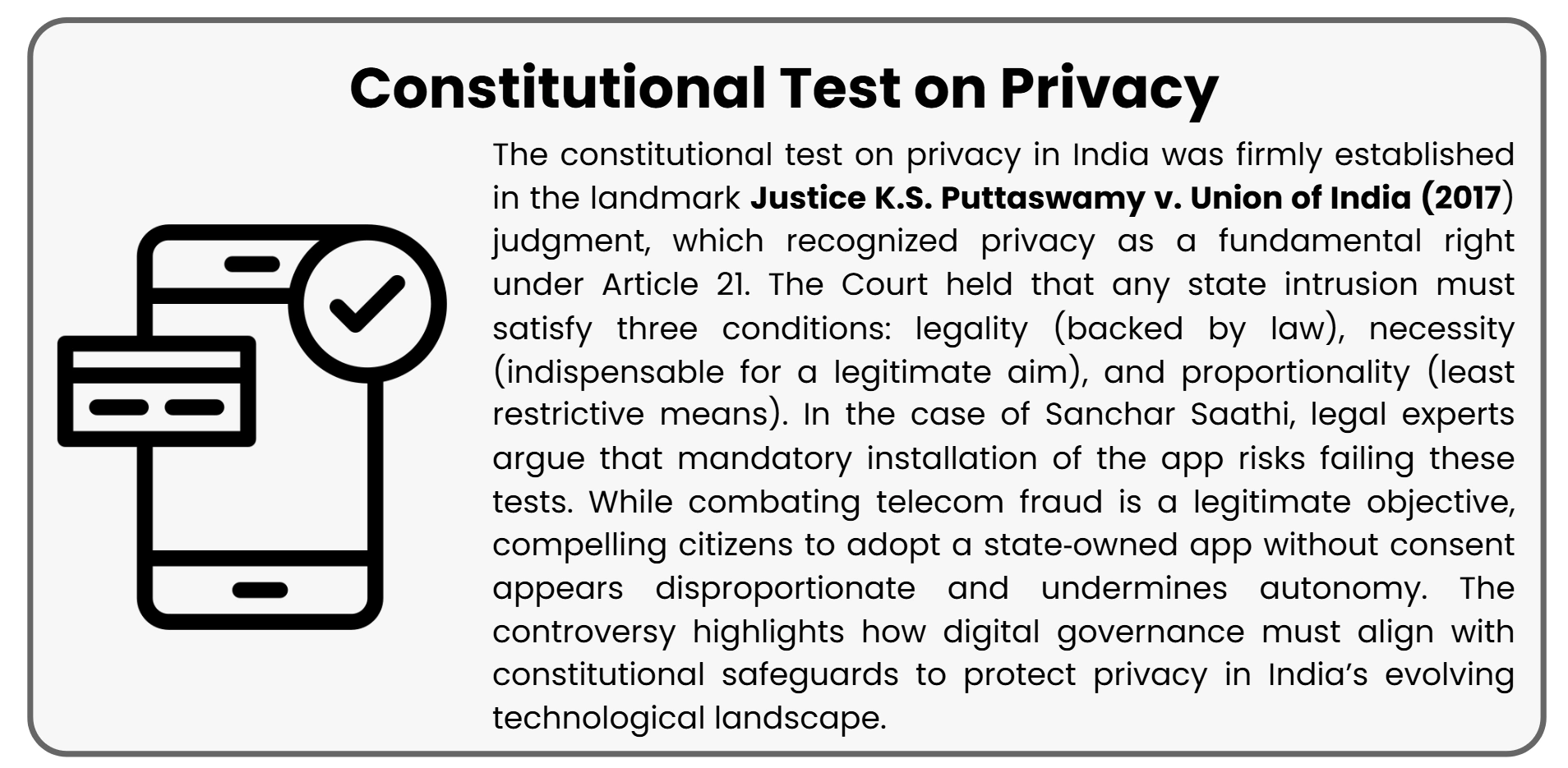
The Debate of the Sanchar Saathi is the tension between the necessities of state security and the constitutional commitment to privacy. To counter this controversy, it would be necessary to apply the constitutional test created by the Supreme Court strictly, as per this test; state actions are examined based on the brevity of the constitutional legality, necessity, and proportionality.
Privacy as a Fundamental Right
In the Justice K.S. Puttaswamy vs. Union of India case, the Supreme Court categorically stated that privacy is a fundamental right. The Court believed that the intrusion by the state into personal autonomy should meet the needs of legality, necessity, and proportionality. The Sanchar Saathi requires the pre-installation of a state-controlled application, since it includes installing the technology of state into personal devices without the explicit permission of the user.
The Test of Necessity
The necessary requirements are that the state behaviour should be irreplaceable in the achievement of a justifiable end. Sanchar Saathi has been rationalized by the government to combat telecommunication fraud and fake gadgets. However, legal theorists argue that similar effects can be achieved by less obtrusive measures - that is, voluntary adoption, or educating the public. The directive is below the need standard in the absence of argumentative persuasion of indispensability.
The Test of Proportionality
The principle of proportionality proposes that the benefits of the action of the state should be more than the infringement of individual rights. According to critics, the imposition of Sanchar Saathi on mandatory installation presents an undue pressure on the freedom of the individual in comparison with the alleged advantages of the same. Coercive enforcement can be seen through the aspect of clause 7(b) of the directive, which directs makers to ensure that the application is not disabled. Such measures stand to create a surveillance backdoor, which will compromise the trust of the People towards governance.
Implications and Future
The Sanchar Saathi is beyond privacy issues. It has larger consequences on the issue of digital governance, citizen trust, and constitutional accountability, which explains why it may be necessary to reconsider the technological policy path of India.
Consequences on Digital Governance
The fact that the Sanchar Saathi is required to be installed is indicative of the kind of threat that any state intervention can have on the domain of digital governance. Coercive measures deny the legitimacy of state initiatives, although such practices are allegedly advisory in limiting fraud and improving the security of telecommunications. Experts argue that the government ruled by force undermines democratic principles and undermines the plausibility of future digital reform. This scandal also shows that interventions which technology provides must not be against the principles of the constitution, as it will alienate citizens and will lead to legal difficulties.
Trust Deficit and Surveillance Concerns
The most pronounced implication of the Sanchar Saathi episode is the loss of trust of the people. There is a growing concern among citizens that compulsory application can be used as a form of surveillance, which thus creates a cattle retreat effect on internet usage. Privacy lawyers warn that placing state technology on individual gadgets without an agreement has the potential to push the culture of intrusion. This lack of trust is not a simple violation of the telecommunications regulation, but it also raises questions about the wider scope of e-governance endeavours, such as the digital identities and smart-city projects.
Judicial Checks and Balances
The scandal highlights the necessity of judicial checks and balances in digital policymaking. The case of Puttaswamy placed privacy as a fundamental right. The directive of the Sanchar Saathi, which does not adopt such requirements, depicts the importance of constitutional responsibility. Judges and other independent regulators should play a more proactive role in examining technological requirements in order to ensure that innovation does not replace freedom.
Way Forward
The way lies in the transparent protection and self-disciplinary implementation. Opponents of the latter approach should consider opt-in frameworks, a rigorous data-protection regime and independent audits of state technology. The adoption can be beneficial by encouraging it through campaigns that communicate the importance of participation to the population, and accountability can be enhanced by parliamentary control. The digital governance of India should be globalised to match with other countries of the world, including the EU General Data Protection Regulation, whereby more trust is built, and the constitutional rights are secured. Finally, the Sanchar Saathi is an important lesson which teaches that technological advancement should be measured against the respect of autonomy and privacy.
Conclusion
The case of Sanchar Saathi supports the complexity of state security concerns versus constitutional rights of privacy. Although the initiative is brought as an anti-telecom fraud measure by the government, its mandatory deployment has left soaring questions in terms of informed consent, user autonomy, and proportionality under the provisions formulated by Justice K.S. Puttaswamy v. Union of India (2017). This episode shows that technology governance should be based on the transparency principle, free will acceptance, and judicial principles to maintain people's trust. Finally, any advancement in this sector depends on balancing innovation with constitutional responsibility, which in its turn will make certain that the digital changes will improve security without limiting the basic rights on which the core concept of democratic citizenship in India is founded.