|
Key Highlights
- Africa Summit
- First on African Soil
- African Union as a Permanent Member
- Core Themes
- Key priorities
- India’s Contribution
- Johannesburg Leader’s Declaration
- Why it matters
|
The G20th G20 Africa Summit 2025, which held in Johannesburg South Africa, was a historic occasion because it was the first to hold a G20 conference in South Africa. The main outcomes of the summit were arrival of the African Union’s permanent membership of the G20, high-profile focus on climate finance, extended debt relief, inclusive industrialization, and reformation of global governance systematically. Also, the Johannesburg Leaders Declaration was adopted with a priority given to solidarity, equality, and sustainability.Under the theme “Solidarity, Equality, Sustainability,” the summit centred Global South priorities and secured the adoption of the G20 Johannesburg Leaders' Declaration.
The G20th G20 Africa Summit 2025, which held in Johannesburg South Africa, was a historic occasion because it was the first to hold a G20 conference in South Africa. The main outcomes of the summit were arrival of the African Union’s permanent membership of the G20, high-profile focus on climate finance, extended debt relief, inclusive industrialization, and reformation of global governance systematically. Also, the Johannesburg Leaders Declaration was adopted with a priority given to solidarity, equality, and sustainability.Under the theme “Solidarity, Equality, Sustainability,” the summit centred Global South priorities and secured the adoption of the G20 Johannesburg Leaders' Declaration.
|
Tips for Aspirants
The article is most specifically applicable to the UPSC CSE and State PSC exams because it strengthens the intellectual base on how the world is governed, how climate funds are distributed, how debts are relieved, and the role Africa plays in international policy arenas.
|
|
Relevant Suggestions for UPSC and State PCS Exam
- Historic Firsts:
- African soil (Johannesburg, 2025) is the first to host a G20 Summit.
- The African Union was given permanent membership in the G20.
- Its Leaders Declaration was embraced at their beginning and not their end.
- Core Themes:
- Sustainability, Equality, and Solidarity as Driving Principles.
- Reform efforts on both financial institutions and trade regimes around the world.
- Placing funding on climate resilience and energy transition.
- Key Priorities:
- Debt relief and financial governance of the structures.
- Bringing climate finance to play and coming up with strategies to adapt.
- Improvement of humanitarian crisis response and risk readiness.
- Advocacy of fair governance systems of critical minerals.
- Progress along renewable and inclusive industrialization.
- India's Contributions:
- Creation of a Global Traditional Knowledge Repository.
- Adoption of the G20 and Africa Skill Multiplier programme.
- Coordination to curb drug-terror networks.
- Declaration by Johannesburg Leaders:
- Dedication to reduce inequality, climate crisis and debt distress.
- Why It Matters:
- Raises the significance of Africa in the structure of world governance.
- Re-emphasises the concept of multilateral cooperation, projecting the interests of the Global South.
|
The 2025 G20 Africa Summit gathering in Johannesburg marked the cutting edge of globalization as it defines how Africa is gaining importance in the sphere of international economic and political dialogues. The G20 received permanent membership in the African Union for the first time ever, and this would henceforth institutionalize the voice of Africa on one of the most powerful multilateral platforms in the world. The main themes of the summit, solidarity, equality, and sustainability, reflected the development goals of Africa, along with the problems of the Global South. The discussions were mostly pegged on the areas regarding debt relief, climate finance, inclusive industrialization, and the reform of international financial institutions, which have a direct effect on the resilience and long-run growth trajectories of African economies. The Declaration of the Johannesburg Leaders made an official commitment to face systemic injustice and promote climate adaptation policies and tailor equitable accessibility to fundamental resources. In addition, the summit highlighted the strategic position of Africa in the energy transition process on the planet, especially on critical minerals and renewable technologies. Placing Africa at the heart of the G20 agenda, the summit not only resembles the unparalleled paradigms of international cooperation but also strengthened the idea of integrating African priorities into the framework of sustainable development and Global policymaking.
Understanding the Significance of the G20 Africa Summit 2025- Historic First
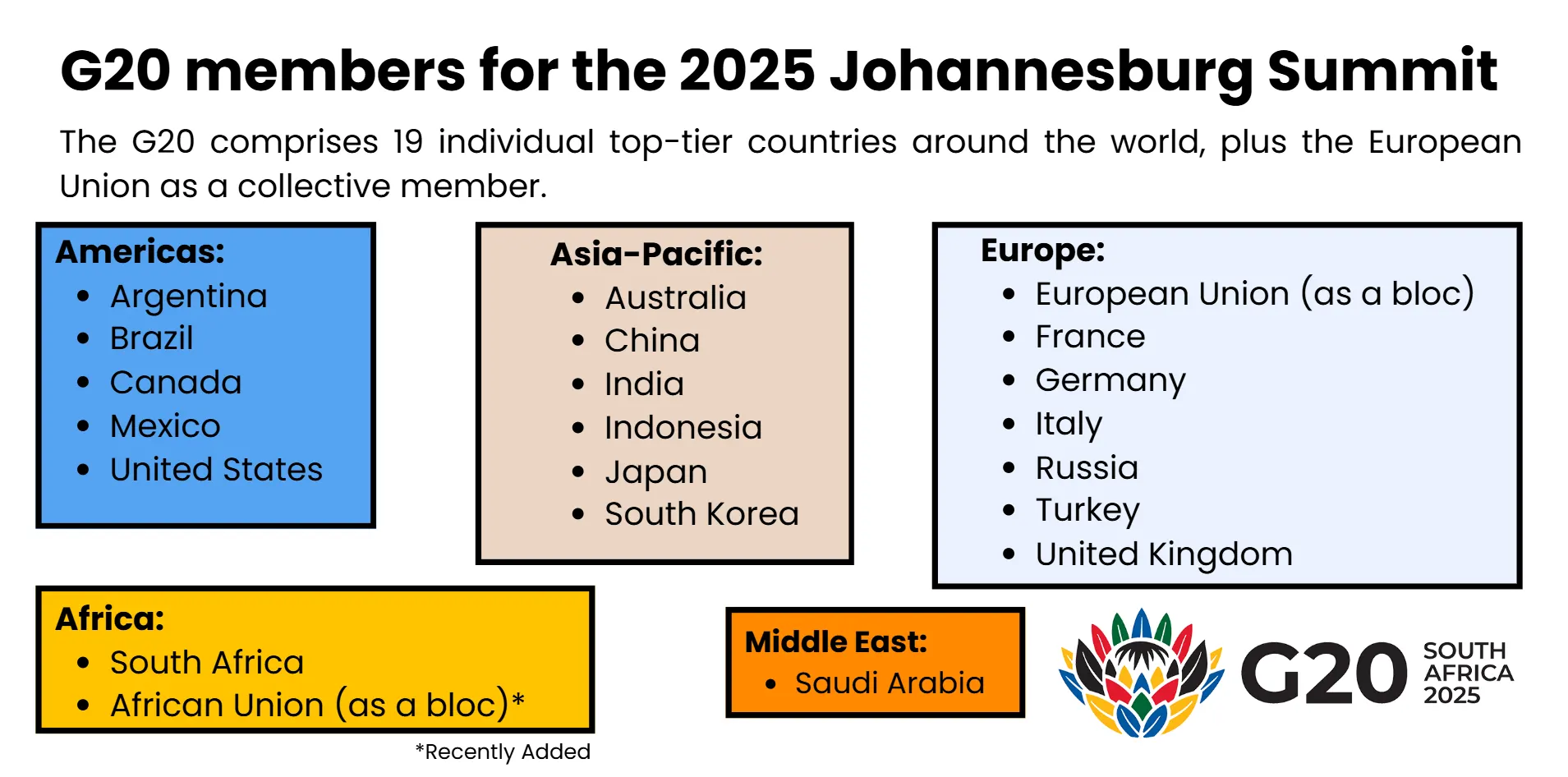
The 2025 G20 Johannesburg summit was the twentieth meeting of the Group of Twenty (G20), a Head of State and Government meeting held at the Johannesburg Expo Centre, Johannesburg, South Africa on 22–23 November 2025. It was the first G20 summit to take place on the African continent.The G20 Africa Summit 2025 presented a decisive turn in the history of the regulation of the world, which will be characterized by numerous firsts that are set to have a far-reaching impact on global cooperation in the future. In the first place, it is the first meeting of the G20 on the African continent, in which Johannesburg was a symbolic venue. This was a momentous decision since the focus of Africa as not only a player but as a forum in the global agenda was finally realized. What was also significant was the formal inclusion of the African Union into the G20 as a permanent member. This change of institution provided that the collective interests of fifty-five African states would be heard in one of the most prominent decision-making bodies, which would manage a long-standing historical inequality in global representation. The G20 comprises 19 countries (Argentina, Australia, Brazil, Canada, China, France, Germany, India, Indonesia, Italy, Japan, Republic of Korea, Mexico, Russia, Saudi Arabia, South Africa, Türkiye, the United Kingdom, and the United States), the European Union, and since 2023, the African Union.
The summit was also the first where the Leaders Declaration was embraced at the beginning of a process and not the end, an indication of a conscious intent on consensus and priorities. Through foregrounding issues of debt relief, climate resilience, and access to vital resources fairly, the summit has helped to set new grounds in issues of management of a global problem. These historic maidens highlighted the rise of Africa as a hub of debate in international relationships and reconsidered the lines of multilateral collaboration.
Core Themes
The G20 Africa Summit had several themes underlying it that not only represented the developmental agenda of the continent but also the problems facing the international community at large. G20 Summit 2025 highlights Africa's first G20 meet in Johannesburg, focusing on climate finance, debt relief, digital cooperation:
- The most important element in the discussions was that of solidarity and that there is a need to move as a single voice in order to deal with systemic inequalities, and that the voice of Africa be incorporated in world decisions.
- This was followed by the theme of equality, which emphasized the need to reform the international financial institutions and trade regimes so as to establish a more balanced and inclusive global order.
- Another important subject of focus was sustainability, especially in the circumstances of the energy transition and climate change. Leaders accentuated the vulnerability of Africa to climate shocks in addition to the geopolitical aspects of Africa as a source of resource-rich minerals that are critical in renewable technologies.
- The summit came up with more favourable proposals in improving climate finance, restructuring debt, and investing in resilience infrastructure, thus connecting sustainability with the economic transformation.
- All these themes were an expression of a vision of development that goes beyond growth orientation and social justice, and environmental responsibility. Through foregrounding solidarity, equality, and sustainability, the summit tried to rebrand the boundaries of collaboration on the planet and to make Africa a key player in creating a more just and sustainable world order.
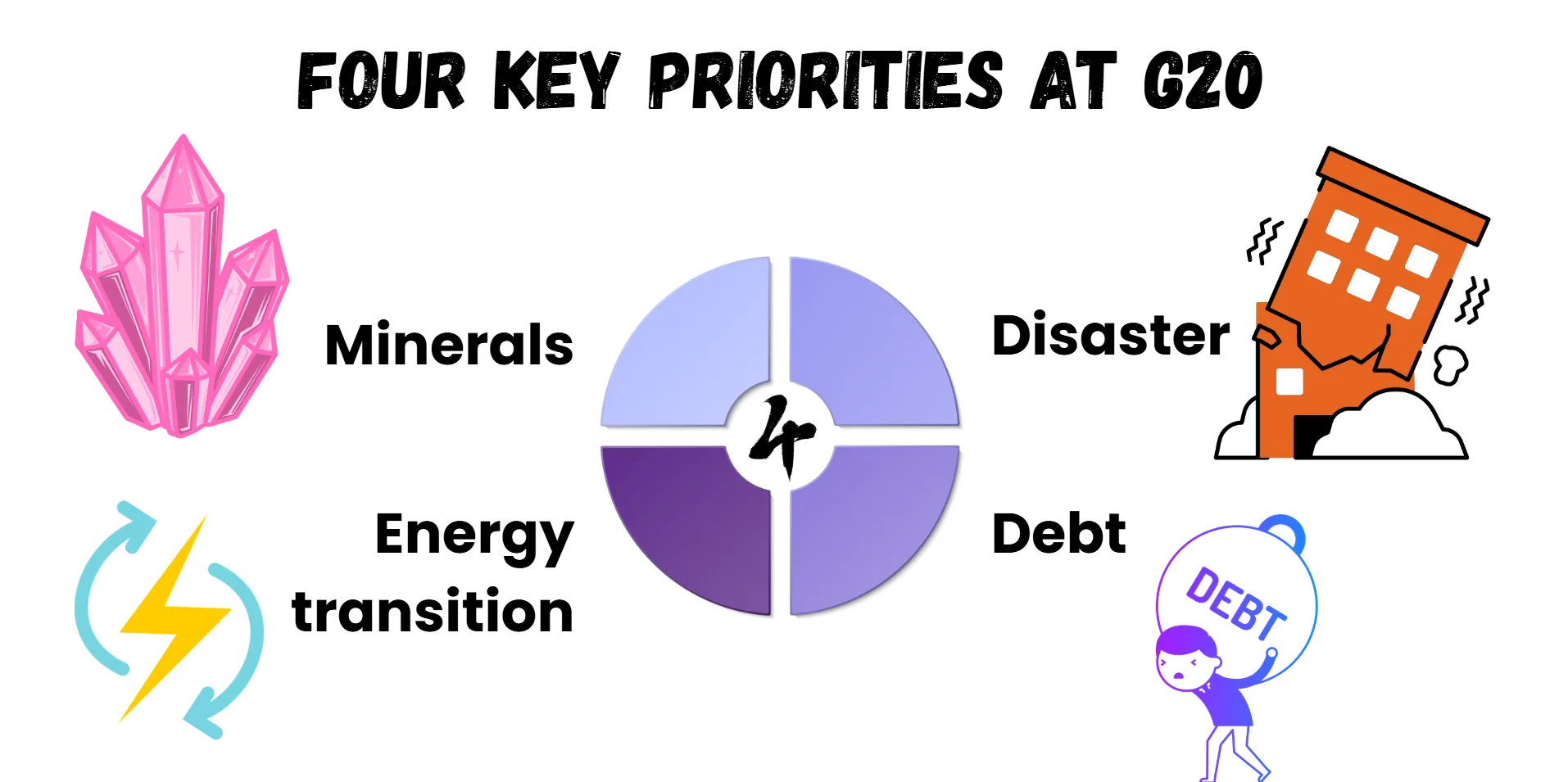
Key Priorities Identified at G20 Africa Submit 2025
At the G20 Africa Summit, which was held in Johannesburg, the growing power of Africa in the arena of global governance was emphasized. The representatives stressed the necessities of solidarity, equality, and sustainability, and no matter the fact that they transformed these directives into a row of practical priorities that tried to cover the current needs, as well as future horizons.
Debt and Financial Reform- All heading should be
One area of major concern arose about debt relief of developing economies, especially the African states that are loaded with unsustainable debt arrangements. The summit emphasized the need to reform the international financial institutions to come up with more equitable lending procedures and more balanced access to capital. Restructuring debt was not only a necessity, but it was shown in a way that it was a moral duty so that countries could be able to channel their resources to other areas like health, education, and infrastructure. Through the rallying of systemic change, the meeting was aimed at breaking down structural inequalities in the international financial system.
Finance and Adaptation to Climate
The second priority was focused on climate finance and climate change adaptation. The vulnerability of the African continent to climate-related disasters, including droughts and flooding, was recognized as one of the urgent matters. The leaders pushed forward the improved funding mechanisms to maintain adaptation provisions, resilient infrastructure, and renewable energy endeavours. The summit argued that climate finance should go beyond commitment and meet real disbursement, which provides vulnerable populations with direct benefits. This priority made Africa not just the victim of a changing climate, but also the driver of energy change in the world.
Disaster Response and Disaster Resilience
The third priority included fortification of the disaster resilience and humanitarian response systems. The summit acknowledged that African societies are disproportionately affected by climate-related calamities, pandemics, and conflicts. It was determined that establishing resilient early-warning systems, strengthening the collaboration among regions, and investing in health infrastructure can be considered the necessary measures. This priority reflected a holistic vision, which integrated disaster preparedness and sustainable development, and human security. Through the inclusion of resilience in the structures of governance, the summit aimed at reducing vulnerability and ensuring stability on the continent.
Minerals and Energy Transition
The fourth priority dealt with vital minerals and Africa in the energy transition of the globe. Africa has large reserves of the minerals needed in renewable technologies, such as cobalt, lithium, and the rare earth elements. The summit highlighted the fact that there was the need to have equal resource management where African countries get the benefit of their natural resources and to be free of extractive dependency. Leaders promoted relations that would enable local value addition, technology transfer, as well as fair trade practices. The choice was made as crucial to the future of the clean energy supply chain around Africa.
Inclusive Industrialization
Lastly, the summit placed a value on inclusive and sustainable industrialization. On the idea that industrial development is one of the key foundations of economic change, representatives demanded policies that ensure the creation of employment, technological advancement, and equality between the genders. Industrialisation was not only defined as economic growth but also seen as a medium of accessibility to social justice, which ensured that the poor in society were considered in the development activities. By converting the idea of industrialisation and sustainability, the summit promoted the idea of sustainable growth that is not only fair but also ecologically friendly.
India's Contributions in G20 Africa Summit 2025
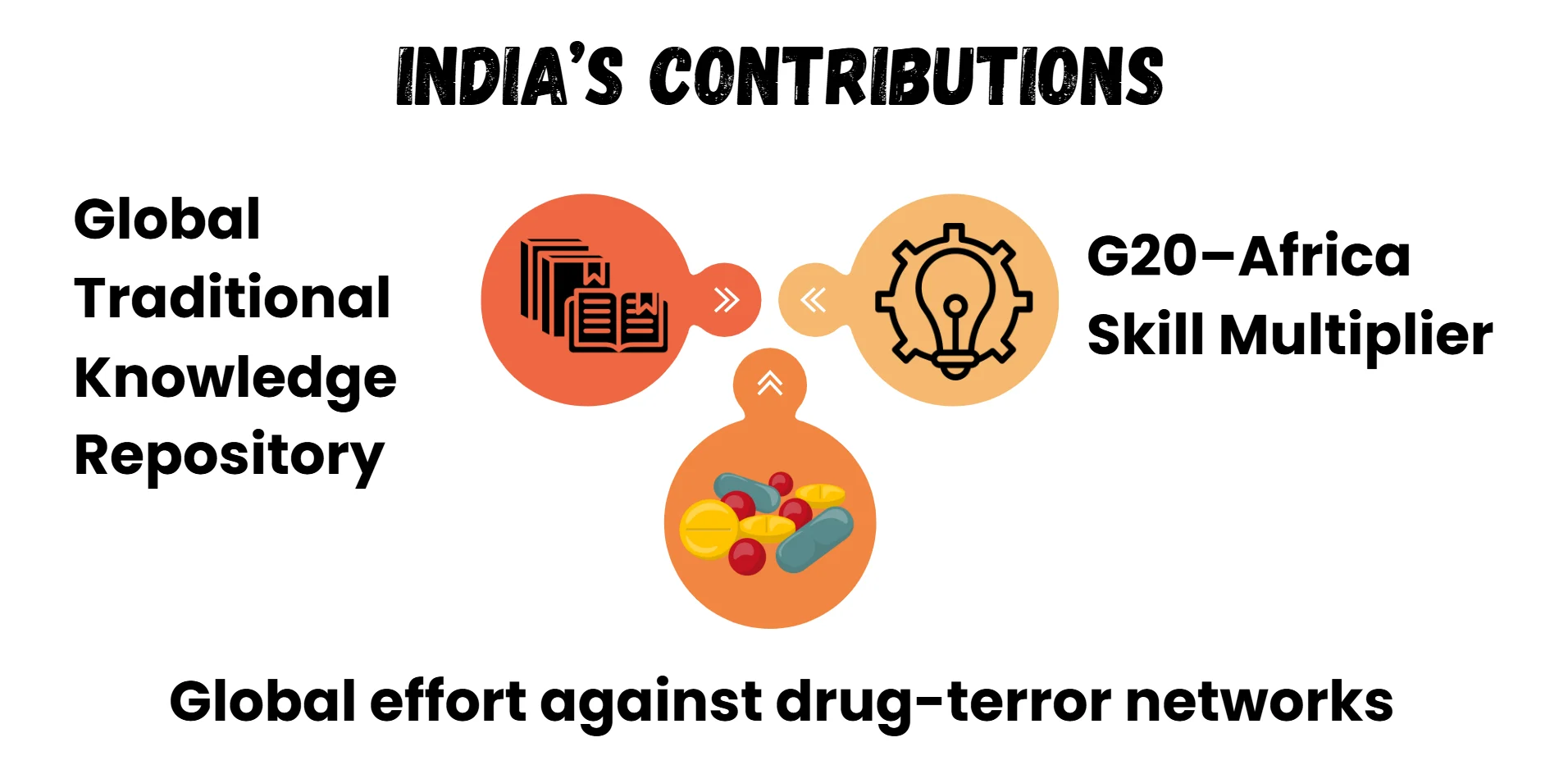
India has been central to the G20 Africa Summit 2025 by playing an important role in promoting ideas that are based on its developmental philosophy as well as its endeavour to ensure South-South cooperation. Prime Minister Narendra Modi identified three key initiatives that were aimed at enhancing the role of Africa in global governance and sustainable development.
- Firstly, he suggested the creation of a Global Traditional Knowledge Repository that would maintain the indigenous activities and encourage traditional heritage-based innovation.
- Second, he declared the G20-Africa Skill Multiplier, which is an initiative aimed at advancing vocational training and developing capacity building to match the youths of Africa with skills that are in line with the emerging industries.
- Third, India demanded a coordinated international action to fight drug-terror networks because of the destabilizing effect of illicit traffic on peace and security.
Such contributions highlight the future vision of the inclusive growth, resiliency, and shared prosperity of India, and strengthen the position of India as the bridge between Africa and the rest of the international community.
Johannesburg Leaders Declaration
Acknowledging the Johannesburg Leaders Declaration, which was passed at the G20 Africa Summit 2025, was a huge change of tradition, whereby finalised at the outset of discussions, not the end. This procedural break had the symbolism of a great dedication to consensus and collective responsibility. The statement heralded three umbrella principles of solidarity, equality, and sustainability, with which the agenda in the summit was framed and represented the developmental agendas of Africa. It promoted immediate modifications in the global financial organizations in a bid to rectify structural imbalances, especially the situation when it comes to debt-stricken economies found in the Global South.
As one of the main issues, climate change was mentioned, and leaders dedicated more to supporting adaptation, resilience, and equal access to climate funds. It was also declared that they should embrace inclusive industrialization, equitable trade of strategic minerals, and amplify the disaster relief infrastructure. The Johannesburg Declaration, by incorporating the issues of Africa into the international system of governance, helped to reform the criteria of cooperation and gave an indication of the transition to a more equal and representative global order.
We endorse the G20 Ministerial Declaration on Debt Sustainability by our Finance Ministers at their October 2025 meeting.
Why is the G20 Africa Summit 2025 Matters?
The declaration from the first G20 summit held on African soil strongly reflected its regional context, placing greater emphasis on the priorities of Africa and the wider Global South. Even with the U.S. boycott, the document was successfully adopted, signalling a growing shift toward G20 cohesion on development, climate action, and institutional reform within an increasingly multipolar world.The G20 Africa Summit 2025 has a deep meaning to Africa and the international community at large. When the G20 took the step to host the summit on African soil and the African Union's permanent membership, the continent had been recognized as the key to global governance. This institutional change will guarantee that the priorities that Africa has defined, such as debt relief and climate resilience, are enshrined in the decision-making institutions of the most powerful economies in the world. The summit also underlined the strategic nature of Africa in the global energy change, especially in its reserves of important minerals and technologies useful in renewable energy.
In addition, the Johannesburg Leaders Declaration was an implementation of a mutual agreement on how to transform international financial systems and how to solve systemic inequalities. Basically, the summit restored order to the limits of cooperation by making solidarity, equality, and sustainability take center stage in the global agenda. Its results are significant since they keep Africa from the periphery to the mainstream of global policy making, and that redefines the designs of sustainable development.
Conclusion
The G20 Africa Summit 2025 in Johannesburg was a landmark in the history of international governance as Africa became the point of convergence in the international policies debate. Through introducing historic firsts, staking thematic promises and defining clear priorities, the summit made it clear that there is an urgent necessity to address the distress of debt, vulnerabilities to climate and structural inequalities. The active participation of India and the formal acceptance of the Johannesburg Leaders Declaration were the additional steps to strengthen the will to seek solidarity, equality and sustainability. Finally, the summit transformed the outlines of multilateral engagement such that the development aspirations of Africa will be interwoven in the institutional framework of global decision-making and sustainable development.