|
Key highlights
- VB-RAM G Act 2025
- MGNREGA: Success and Drawbacks
- What has been Changed
- Rural Asset Creation
- Skill development and Capacity building
- Transparency and Accountability
|
This Article discusses the recent G RAM G Act 2025, which is a reform agenda aimed at re-inventing the Mahatma Gandhi National Rural Employment Guarantee Act (MGNREGA) as a catalyst to Viksit Bharat 2047. The analysis places the Act in the context of the larger Indian developmental vision, with an ear towards the change of wage-based relief into the creation of assets, training of skills, and application of technology, to rural empowerment and sustainable growth, which is in line with the objectives of modernization of the country.
|
Tips for Aspirants
The article is significant to the Examination of the UPSC CSE and State PSC, given that it inter-relates governance, rural development and policy reforms, which are critical for writing essays, as well as writing answers in General Studies papers.
|
|
Relevant Suggestions for UPSC and State PCS Exam
- Vision of Viksit Bharat 2047: India's development programme to become a developed, inclusive and sustainable country by the centenary of independence.
- MGNREGA Successes: reduction of poverty, guaranteed rural work, enhanced women's participation, and creation of infrastructure.
- Limitations of MGNREGA: Nonetheless, MGNREGA is challenged with such issues as delayed payments, corruption, asset instability, the lack of skills integration, and bias in the implementation of the program at the state level.
- Genesis of G RAM G Act 2025: The G RAM G Act 2025 attempts to propose a wide-ranging-reform agenda, aimed to bring the modernization, and national development agenda-at-large.
- Structural Reforms: Structural reforms include online surveillance, blockchain-based salary payment, green alignment programs, and integration of infrastructural structures.
- Rural Asset Creation: Long-term assets such as irrigation systems and renewable energy facilities, and rural roads are used to create sustained productivity.
- Capacity Building & Skill Development: Capacity-building activities are concerned with vocational training, the development of entrepreneurship, and the strengthening of institutional solidarity in PRI’s.
- Transparency & Governance: Artificial Intelligence, Geographic Information Systems, social audit, participatory accountable planning.
|
The current developmental path of Viksit 2047 of India must assume a repositioning of welfare programs as tools of sustainable development and inclusion empowerment. The Mahatma Gandhi National Rural Employment Guarantee Act (MGNREGA) became law in the year 2005, which has been a pillar of guarantee of rural livelihoods since it ensures that millions of households have access to wage employment. It is indisputable that the interventions made by the program in the areas of poverty reduction and social protection have been immense; however, its transformational nature has always been stunted due to obstacles like asset longevity, leakages, and failure to combine skill training.
Impact of the VB-GRAM G Act on Rural Livelihoods and Entrepreneurship
The Viksit Bharat – Guarantee for Rozgar and Ajeevika Mission (Gramin) Act, 2025 (VB-GRAM G Act) is intended to strengthen rural livelihoods by enhancing the guaranteed employment to 125 days, creating durable assets, and promoting entrepreneurship through integrated rural development. The Viksit Bharat-Guarantee for Rozgar and Ajeevika Mission (Gramin) (VB-G RAM G) Bill 2025, in turn, may be viewed as a reformative structure, which is purportedly meant to streamline MGNREGA and make it consistent with the overall development perspective of India. The legislation will help to reposition MGNREGA as an agent of structural change in the rural economies by refocusing efforts from short-term employment generation to asset creation, skills development, and technologically-driven governance in the long term. It integrates electronic monitoring, infrastructure, green development, and skill development to increase efficiency and robustness. Therefore, the reform is not only a change in administration, but a new vision of rural employment as a foundation of national modernization.
Vision of Viksit Bharat 2047
The Vision of Viksit Bharat 2047 is the statement that reveals the desire of the Indian government to become developed by 2047, on the hundredth anniversary of independence. It is seen as an ideal framework, which harmonizes economic dynamism, social justice, active technological innovations, and environmental conservation. The vision underlines the ways in terms of transformation through the diversion of concentration to a growth-based paradigm, which, in the end, welcomes inclusiveness, resilience, and justice. Some of its priority areas include the eradication of poverty, access to quality education and medical care, full employment by developing skills, and increasing the involvement of women in the economic sector. It similarly sees India as the food security leader, renewable power, and digital innovator in the world. Notably, the vision focuses on good governance, transparency, and citizen engagement as fundamental pillars towards the attainment of these objectives.
Viksit Bharat 2047 (Developed India 2047) is India's national vision to transform into a developed nation by its 100th year of independence in 2047, focusing on inclusive growth, innovation, self-reliance, and sustainability, with key pillars being Youth (Yuva), Poor (Garib), Women (Mahilayen), and Farmers (Annadata), aiming for zero poverty. By promoting the nationally promising goals with global sustainability concerns, Viksit Bharat 2047 aims at fulfilling the aim of positioning India not just as a country that is economically powerful but as a society that is innovative, affirming equality, and ecologically responsible. Therefore, the vision is both a growth strategy and an ethical one for future generations, so that the development of India is inclusive, sustainable, and global.
The success and drawbacks associated with MGNREGA
The Mahatma Gandhi National Rural Employment Guarantee Act (MGNREGA) of 2005 is still one of the biggest social welfare programmes in the world that offers 100 days of guaranteed wage employment to rural families.
Success:
- The Act has boosted the purchasing power in the rural areas; reducing migration caused by distress, and provided a safety net towards out of agricultural seasons.
- The scheme has also enhanced social inclusion, where women and marginalised communities have significantly contributed to the scheme and therefore gender parity and equity have been achieved.
- In addition, MGNREGA has helped in the development of rural infrastructure like ponds, canals and roads, which have favoured agricultural productivity as well as community resilience.
Drawbacks:
- Corruption.
- Delay in wage payments.
- Ghost beneficiaries
- Lack of credibility.
- Most of the assets developed on the scheme are not durable
- The emphasis on manual work of unskilled labour has led to limited prospects of developing skills.
- Inefficiency within the administration.
- Inequity in its application across states.
Nevertheless, even though MGNREGA has achieved certain successes in respect to providing temporary relief and investment in livelihood, long-term outcomes of the program are subject to structural changes to maintain a permanent asset formation, technological adaptability, and merging of skill-based jobs.
Genesis of G RAM G Act 2025
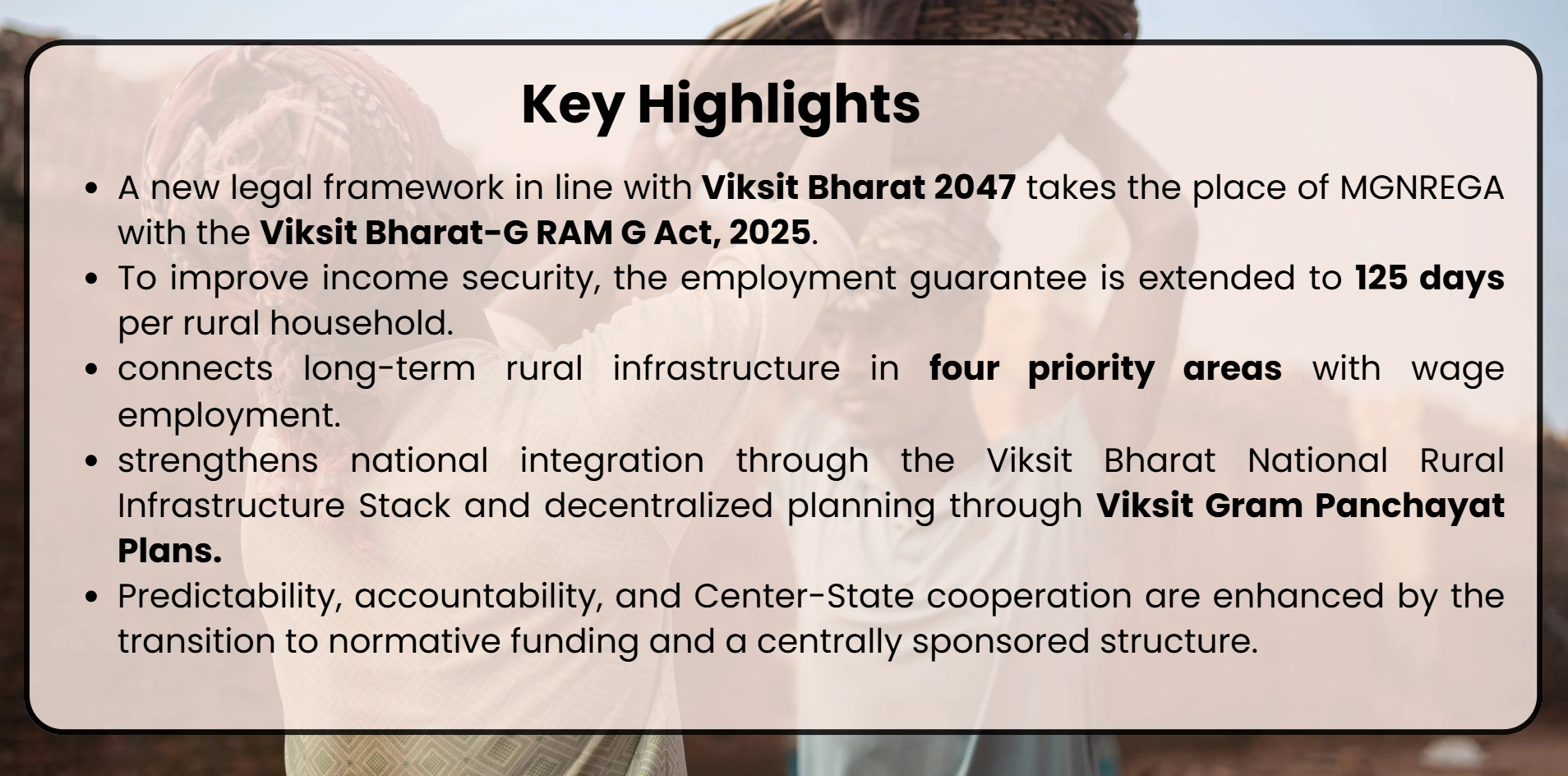
The G RAM G Act 2025 is a strategic reform agenda to reimagine the Mahatma Gandhi National Rural Employment Guarantee Act (MGNREGA) in accordance with India’s long term developmental blueprint of Viksit Bharat 2047. The origin of this Act lies in the awareness that even though MGNREGA has offered essential livelihood security, its emphasis on unskilled manual labour and temporary employment due to low wage labour has constrained its ability to contribute to structural changes in the rural economies. Policymakers realised the necessity to change the welfare-based model to a model that incorporates the generation of employment with the creation of assets that can be permanent, the development of skills, and the modernisation of technology.
The Act enhances the statutory wage employment guarantee to 125 days per financial year for rural households and seeks to advance empowerment, inclusive growth, convergence of development initiatives and saturation-based delivery, thereby strengthening the foundation for a prosperous, resilient and self-reliant Rural.
20 Years of MGNREGA
The Act was formulated based on ample policy discussions, comparing the experiences of twenty years of MGNREGA implementation to date and other experiences in the world regarding rural development. It puts a strong priority on convergence with national infrastructure programmes, renewable energy projects and digital systems of governance. The Act is aimed at making organisations inefficient and unaccountable, trying to reduce errors through introducing transparency tools, including GIS mapping, and AI-based monitoring. Moreover, it has proposed solutions that include vocational training and entrepreneurship, thus connecting the rural labour with the emerging areas of the economy.
Therefore, the G RAM G Act 2025 would be a remedial as well as a transformational intervention, which will help to rebrand MGNREGA as a pillar of inclusive economic development and sustainable modernisation of the countryside.
What is going to be changed?
It is the G RAM G Act 2025, which provides a number of structural reforms changing MGNREGA into a wage-support instrument and a catalyst for sustainable rural development.
- Most of the reforms have been centred on the incorporation of technology in governance and accountability.
- The use of digital platforms, GIS mapping,-and wage disbursement is suggested to reduce leakages, improve timely payments, and increase the levels of transparency.
- Convergence with national infrastructure and green development programmes is also a priority under the Act, and hence rural employment will be contrived towards broader objectives, including renewable energy, irrigation networks and climate resilient agriculture.
The other significant change is the transition towards skill-based work. Through vocational training and connecting workers with the rural industries, the scheme will provide opportunities to enhance mobility upwards and enter into entrepreneurship. The emphasis on creation of long-term assets such as rural roads, water conservation facilities and renewable energy facilities aims to substitute short term relief with long term productivity developments. Further, the Act suggests decentralised planning and community involvement, giving the Panchayati Raj Institutions the mandate to determine the projects that meet the needs of the locals.
The Key Features of Act Include:
- 125 days of wage labour on any given rural household annually will be guaranteed by the Act to all who choose to complete unskilled manual work.
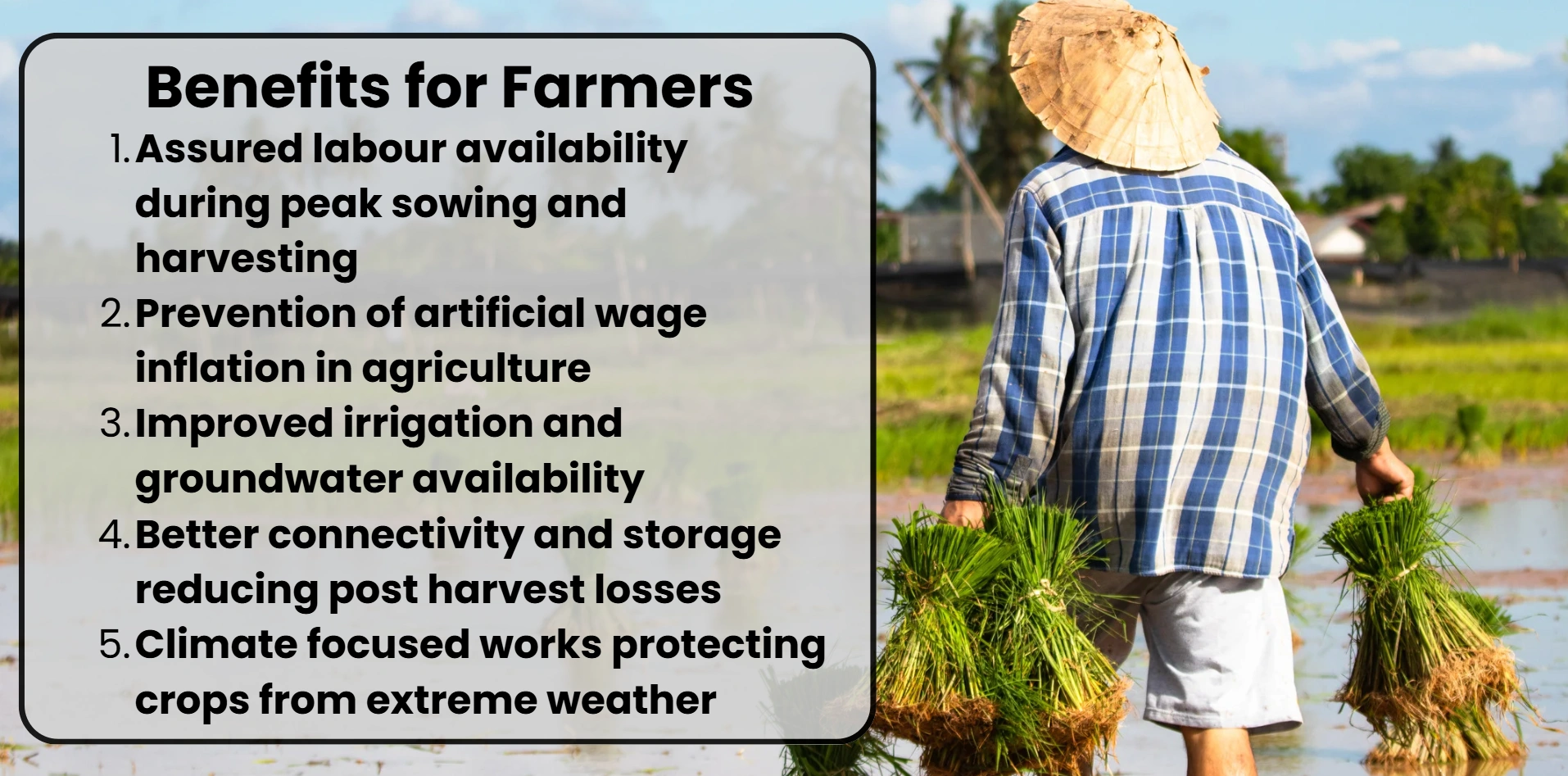
- The law has a 60-day no-work provision with the aim of maintaining the supply of agricultural labour during the sowing and harvesting seasons.
- Based on this, wage employment opportunities will be guaranteed to the workers on 125 days of the remaining 305 days of the calendar year, and this is beneficial both to the labourers and agricultural producers.
Moreover, the Act has provided that daily wages would be paid in weekly instalments or at a maximum of two weeks following the end
of the work.
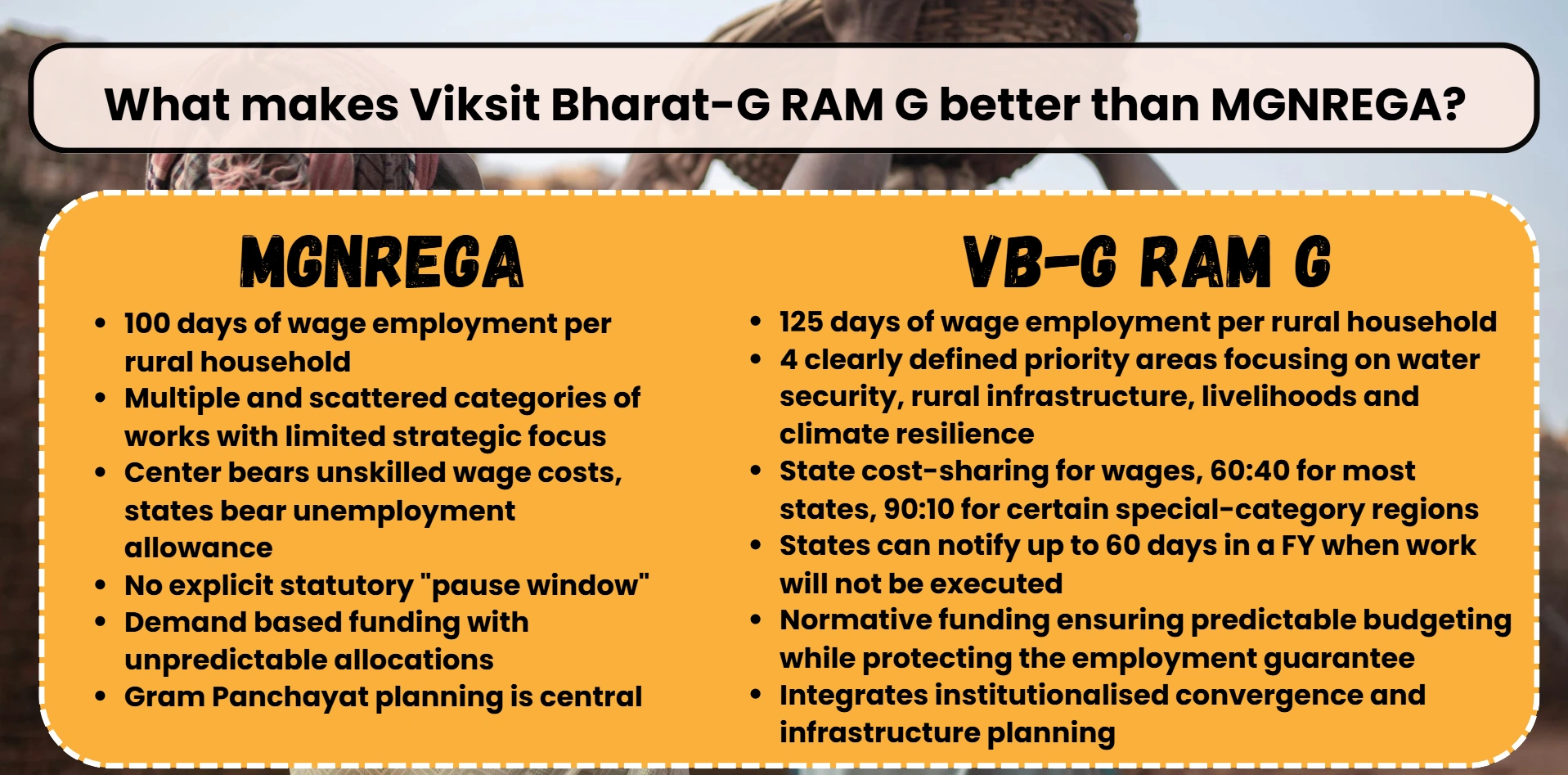
Together, all these reforms take G RAM G as an instrument of inclusive growth, leading to rural labour playing a significant role in the development agenda of Viksit Bharat 2047 in India.
How is this Act going to Help Rural Asset Creation?
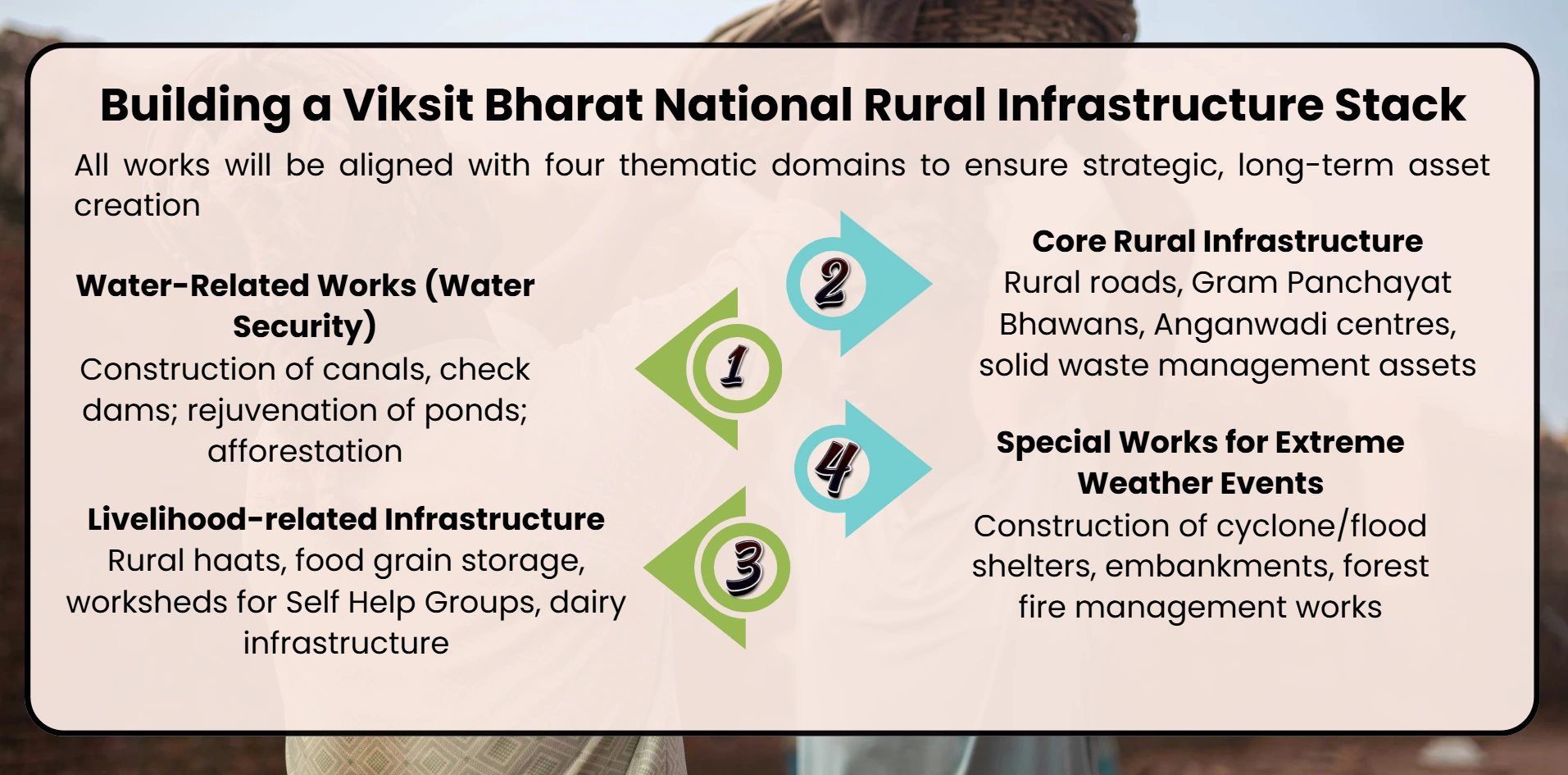
One of the key elements of the G‧RAM G Act 2025 is the reorientation of MGNREGA into long-term asset development in the rural areas. Historically, the scheme has been able to offer wage jobs; however, this scheme has been associated with low-quality or short-term assets. The new framework focuses on building infrastructure that directly increases rural productivity and resilience, such as irrigation systems, water conservation systems, renewable energy systems, and rural connections systems, e.g. roads and bridges. The Act aims to transform MGNREGA into a developmental program and not a relief-centred program since it focuses on the assets that have a high long-term utility.
The new Viksit Bharat- G RAM G Act 2025 (VB-G RAM G Act) helps rural asset creation by directly linking guaranteed work (125 days) to building durable, productive assets like water harvesting structures, rural roads, irrigation, storage, and climate-resilient infrastructure, strengthening rural economies. This emphasis on its creation of assets is also in line with national aspirations of sustainable agriculture, climate change adaptation, and industrialisation in the rural areas. An example is the investment in the watershed management and the afforestation process, which leads to the ecological balance, whereas the renewable energy projects promote the green growth.
Skill Development
The Act lays much emphasis on skill development and capacity building as a tool for increasing long-term effectiveness. Recognising that unskilled manual labour is not enough to support the transformation in rural areas, the Act incorporates the vocational training, digital literacy, and entrepreneurship programmes into the job market. The workers will be accorded the privilege of up-skilling in various fields such as construction, renewable energy, agro-processing and rural crafts, hence connecting them to get out of subsistence-level employment to productive and remunerative jobs.
Capacity building
Capacity building is done not only on individual skills acquisition but also on the expansion of local governments. The Panchayati Raj bodies, community organisations, are envisaged to play major roles in planning, monitoring, and implementation of projects, where training is provided on project management, financial control, and participation of decision makers. This two-pronged focus will see that individuals and institutions are empowered to maintain gains of development.
Transparent Governance and Technology
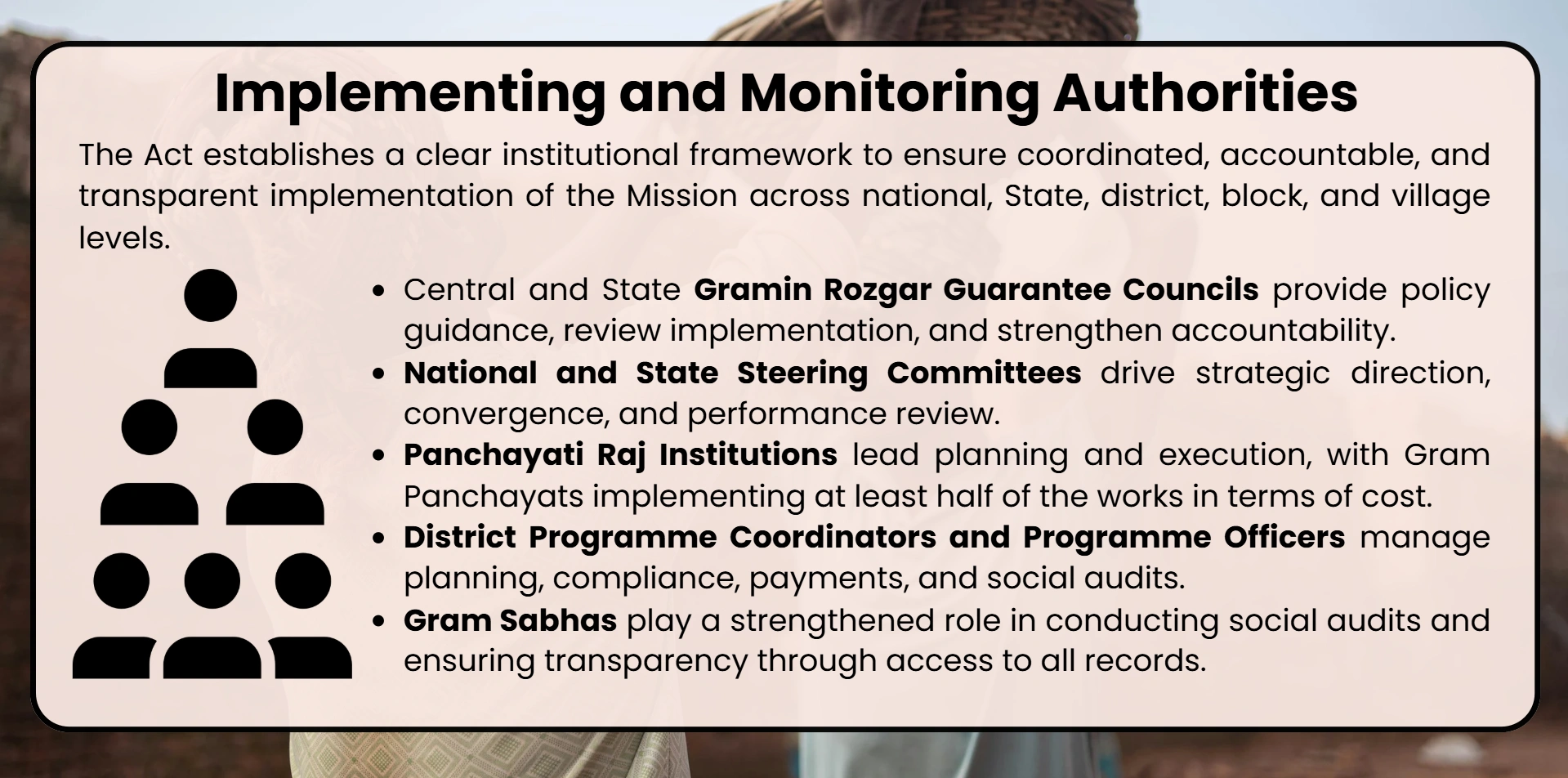
The Act puts transparency, technology and governance in the centre of its reform agenda since it recognises that a good implementation requires good accountability provisions in place.
Transparency
The problem that the scheme has been grappling with in the past has been characterised by late payment of wages, leakages, and poor monitoring. To solve them, the Act suggests embracing digital governance tools, such as real-time dashboards, asset mapping using GIS, and worker biometric authentication. These innovations are geared towards the right welfare of ensuring that beneficiaries get their wages in time, ensuring no duplication of beneficiaries and people’s trust.
Technology
It is seen that the introduction of
new technology in wage payments would establish records that are tamper-proof, and this would reduce corruption and enhance the accountability of the financial records. The idea of predictive analysis with the help of artificial intelligence and machine-learning tools is also suggested to make projects and resource allocation better planned. Moreover, the Act also underlines community-based governance and enhances the Panchayati Raj Institutions and encourages social audits so that participatory governance can be achieved.
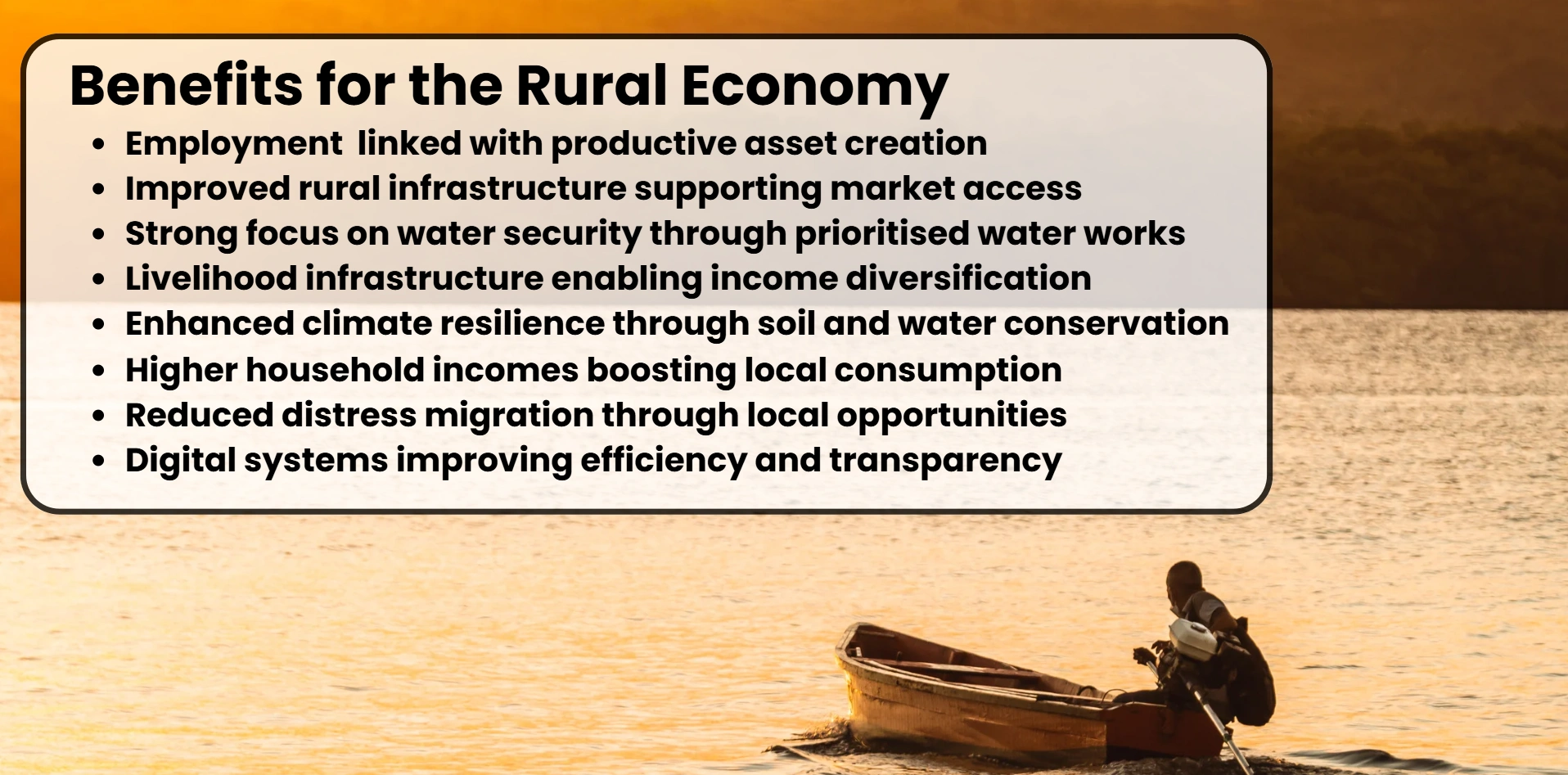
The G RAM G Act, 2025, attempts to make MGNREGA an exemplar of an effective process of providing public services by instilling transparency and technology into the governance frameworks. This is not only more credible, but it also allows rural employment schemes to be in line with the larger Indian vision of digital empowerment and inclusive development through Viksit Bharat 2047.
Conclusion
The G RAM G Act 2025 is a new paradigm in the direction of MGNREGA, where the programme has evolved from a wage-support tool to a full-fledged rural development tool. The Act incorporates structural changes, technological changes, skills training, and long-lasting asset development, thus aligning the scheme with the Viksit Bharat 2047 vision of the bigger picture of India. Its focus on transparency, participatory governance and sustainability means that rural employment plays a significant role in modernizing the country. Finally, the reform also highlights how the state will ensure there is inclusive growth, and in this regard, MGNREGA forms the basis of ensuring a robust, equitable and future-proof rural economy in the Indian centennial of independence.