|
Key Highlights
- China’s Trade Surplus
- Strong State-led Policies
- Trade tensions
- Global Supply Chain Vulnerability
- Limitations of WYO
- India’s Bilateral Trade Deficit
- Need For Global Corrective Measures
- India needs more diversification
|
The trade surplus of a whopping one trillion dollars recorded in China highlights its dominance in the manufacturing sector, which is largely contributed to by formidable exports of electronic goods, automobiles, and commodity goods, even though the domestic demand is low. Subsequent imbalance contributes to the tension in world trade, making the risks of protectionist policies heightened. In the case of India, the surplus makes its trade deficit worse, on top of China, asking the policymakers to encourage diversification, dependence, and support of corrective globalism.
|
Tips for Aspirants
The article is invaluable in the UPSC Civil Services Examination (CSE) and State Public Service Commission (PSC) examinations because it expounds on the nexus between global trade imbalance and the applied Indian economic policy, which in effect gauges analytical adequacy in international relations, economics, and governance.
|
|
Relevant Suggestions for UPSC and State PCS Exam
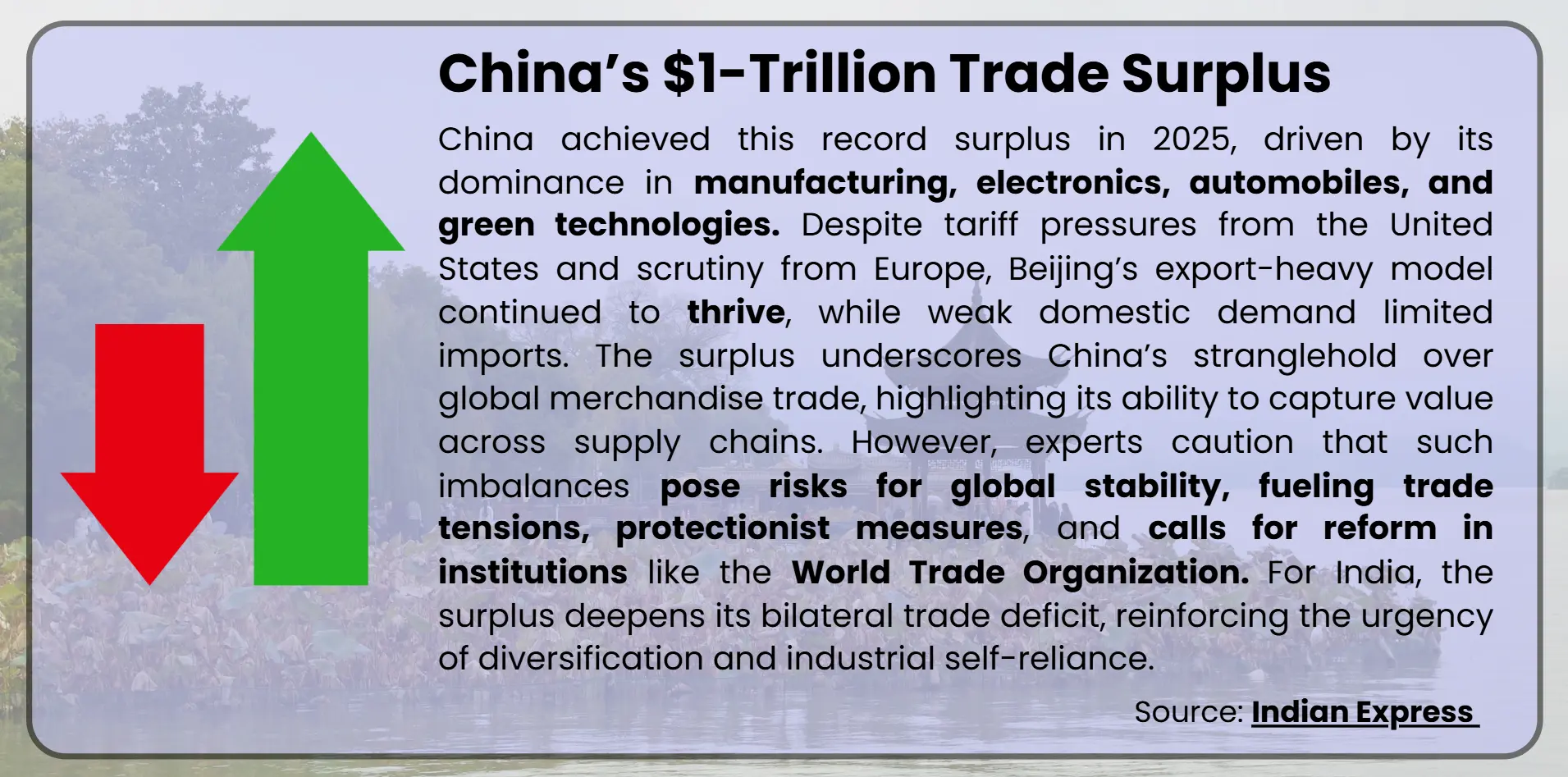
- The $1-trillion surplus export of China is anchored on its dominating export output in all manufacturing fields, electronic products, automobile manufacturing, and green technologies development.
- The excess is driven by the industrial policies of the state, specific subsidies, and a comparatively restrained domestic demand.
- Globally, the surplus breeds trade conflicts with the United States and European Union, strains supply chains, and is a source of increased protectionism.
- Its excess shows the inadequacy of the structure of the World Trade Organization and reinforces the necessity of substantive reforms in the multilateral trade governance.
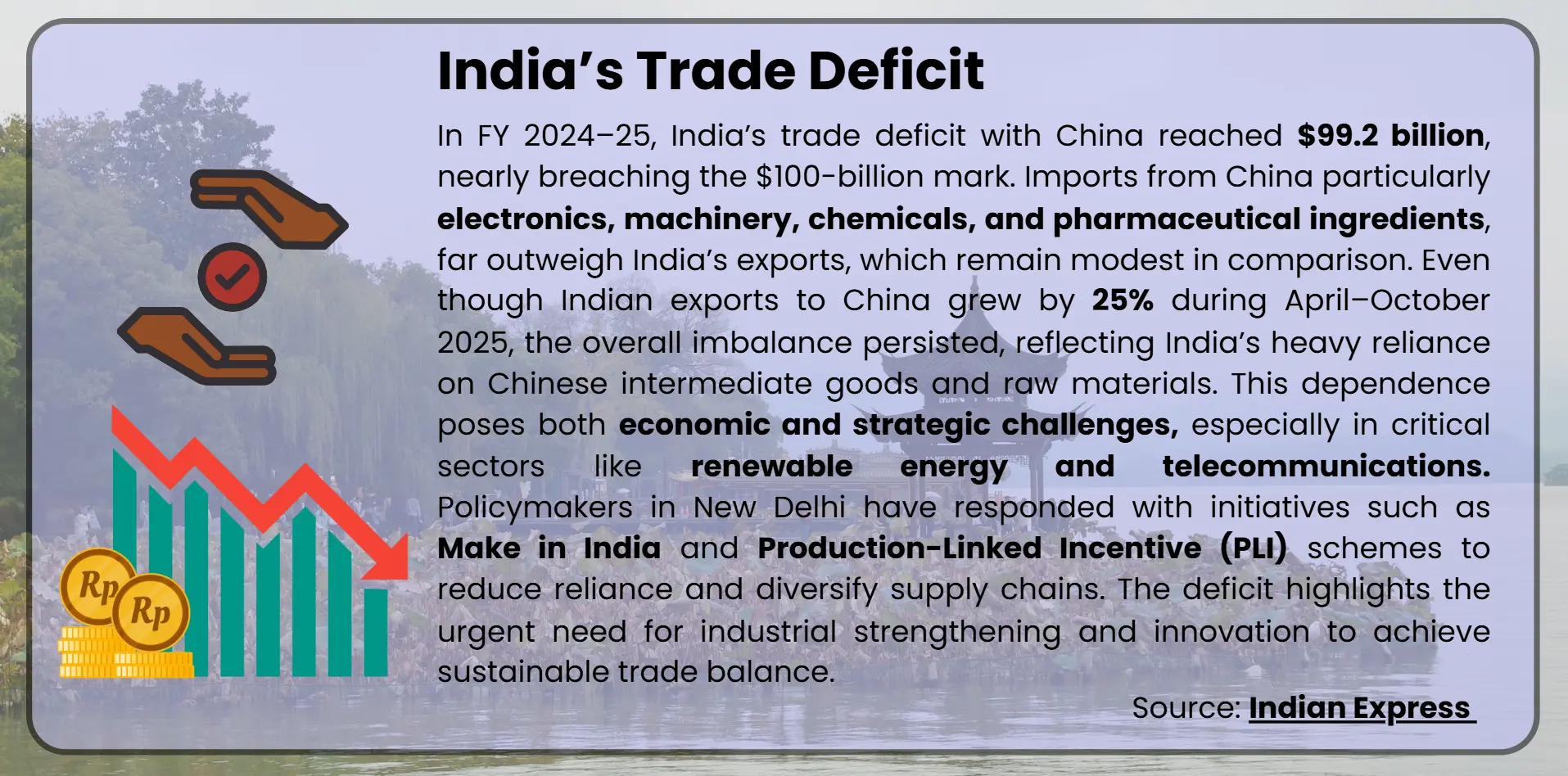
- India faces a systemic bilateral trade deficit against China, especially in electronics, machinery, and the pharmaceutical industries.
- Access to Chinese imports in vital sectors of the country generates a strategic vulnerability for India.
- The policies will include the Make in India program, Production-Linked Incentive (PLI) programs, and supply chain diversification.
- India supports the use of corrective mechanisms in the world that would foster fair trade and a balanced globalization process.
- The future perspective depends on long-term innovation, systemic stability, and developing collaborative systems.
|
The massive trade surplus of 1 trillion dollars, as reached by China, has become a key event in the modern world's economic situation. This excess, which is made easy by the presence of dominance in production, electronics, automobile production, and emerging green technologies, sums up both structural capabilities as well as the systemic disequilibria in terms of trade. Though the export-led growth model has established China as the manufacturing powerhouse in the world, the lack of domestic consumption and its vast levels of state-driven industrial development have added to its reliance on the external market. Such a scale of the surplus has consequently raised a lot of concern not only due to the strengthening of the competitiveness of China but also the issue of sustainability, fairness, and direction of globalisation.Of particular implication are the implications for India. Continual existence of a bilateral trade deficit, particularly in the key areas like electronics, machinery, and pharmaceuticals, has increased the strategic weakness, as well as limited the growth of the domestic industry.
This perception of Indian policymakers is that the trade imbalances led by China are structural and require swift redress.On the global front, the excess has increased trade tensions, enlarged the chances of protectionism, and aroused an incentive for institutional reform in the world's multilateral trade institutions like the World Trade Organization. Contextualised in such a manner, Indian acceptance of international rights remedies has been both economically realistic and strategically oriented, and we find the matter at the convergence point of trade, geopolitics, and development.China's massive trade surplus, fueled by low-cost, high-volume exports, pressures India to balance economic gains with strategic risks, prompting policies like "Make in India," tech scrutiny (app bans), border infrastructure buildup, FDI restrictions on Chinese firms, and promoting "China Plus One" supply chain diversification, all while navigating deep economic reliance and border disputes that underscore this managed rivalry.
Drivers of the Surplus
The trade surplus exuding about one trillion dollars is the resultant outcome of strategic and planned economic structures and the global market forces. The factors behind such excessiveness enlighten the strong aspects and natural imbalances in the economic model of the country.Drivers of a surplus (when supply exceeds demand or income beats spending) vary by context but generally involve increased supply (tech, efficiency), decreased demand (economic shifts, preference changes), effective cost control, tax increases, or unique factors like China's manufacturing boom, creating market imbalances (economic surplus) or financial excess (budget/trade surplus).
Manufacturing Products
The major cause of the Chinese surplus is its outstanding manufacturing capabilities. The country is now deep-rooted as the global hub of electronics, machinery, automobiles, and, increasingly, sustainable technologies, systems of batteries and photovoltaic panels. The economies of scale and efficient logistics, and highly integrated supply-chain infrastructure are the pillars of such export dominance. The ability to deliver competently priced products in various industries has ensured long-term demand by both developed and developing economies.
Industrial Policies
This is another defining factor that has led Beijing to adopt state-led industrial policy. Favoured capital sources that include subsidies, favoured financial leverage, and excessive capital inflow in key strategic areas have enabled the Chinese business operations to outpace the rest of the world. Meanwhile, the currency management strategies and trade facilitation programs have enhanced the competitiveness of exports. However, as much as these policies create an improved position of China in international trade, they also raise some concerns about fairness and sustainability in the long run on the international market platforms.
Weak Domestic Demand
The excess is also a reflection of the domestic weakness of the economy. The structural barriers to household consumption are great inequality of income, a high rate of savings, and poor social security systems. The difference between exports and imports is further stretched by reduced imports, which are caused by damaged consumer confidence and deflationary pressure. This active accentuates the paradox of the surplus in China: it is an indication of exterior vitality, and at the same time internal infirmity.
Global Trade Dynamics
Lastly, the large global trade landscape has also enhanced the surplus of China. With the United States imposing tariffs and an increased level of European control, China has been able to expand its export markets, stretching to Asia and across Africa and Latin America. The weakness in the traditional markets has been counterbalanced by its competitive advantage in low-cost commodities and advanced technologies. The excess, therefore, represents resiliency and strengthening of global imbalances to trade.
Global Consequences
The impact of the 1 trillion trade surplus by China has a long-standing effect that is not limited to the Chinese economy. The imbalance transforms the world of trade relations, increases geopolitical tension, and provides a challenge to keep multilateral structures sustainable.
Trade Tensions
The overcapacity has increased trade tensions between China and the leading economies, like the United States and the European Union. The readiness to cause continuous imbalances inspires charges against unfair trading habits, subsidies, and currency propping. Such a relationship has already led to tariff wars and retaliation, thus bringing skepticism to the international trade regime. The excess, in turn, turns out not only as a fact in the economy but as the source of geopolitical conflict.
Global Supply Chain
The leadership of China in manufacturing and exporting is a significant strain on the global chains. China relies on imports in major areas like electronics, pharmaceuticals, and renewable energy technologies, which leaves countries relying heavily on Chinese imports vulnerable in crucial sectors. The excess also indicates the ability of China to capture value in the supply chains, forcing other economies to fight on the diversification front. This interdependence prompts the question of stability, especially at the time of geopolitical tension or even pandemic-related disturbances.
Risk of Increased Protectionism
The scale of the surplus of China has provoked global arguments on protectionism. Those economies that are witnessing expanding deficits are turning to tariffs, quotas, and industrial policies to protect the domestic industries. Though politically convenient, these actions jeopardise world trade and undermine the effects of the ideals of a free-market transaction. In this regard, therefore, the excess is indirectly contributing to the demise of globalization and the rise of regional trade blocs.
Multilateralism
Lastly, the excess points to the drawbacks of institutions like the World Trade Organization (WTO). The frameworks in place are unable to deal with those systemic imbalances that have been created by the industrial policies of the state. Reform appeals, combined with even tougher implementation of fair-trade regulations, are increasingly being brought forward, and India and other developing economies are seeking remedial actions. Therefore, the excess shows that the world needs a change in institutions to provide fair opportunities in international trade.
Implications for India
The trade balance between China and India has a significant economic and strategic implication of this surplus being in the tune of 1 trillion. The resultant imbalance worsens the trade deficit in India, destabilizes the latent capacity of the domestic industry in India, and shapes the policy discussions in New Delhi.
Trade Deficit
The bilateral trade relationship of India with China is marked by a huge widening deficit. China's exports, mostly in the sectors of electronics, machinery, and pharmaceutical precursors, are far above domestic exports. This unqualified imbalance unravels the structural weaknesses in the manufacturing industry in India and fosters fears of long-term economic reliance.
Strategic Vulnerability
Trade imbalance subjects the nation to a set of strategic weaknesses in addition to economic ones. High dependence on China in key industries, such as telecommunications, clean energy, and pharmaceuticals, is a possible area of exploitation during geopolitical crises. The scale of the surplus in China also at the same time increases its bargaining power in the control of the region's economic processes, which makes India revise its industrialization and security structures.
Policy Response
The Indian policymakers observe the excess in China as a structural disturbance that ought to be remedied. Programs like Make in India, Production-linked Incentive (PLI) programme, and highly-focused efforts to win the support of foreign direct investment are aimed at boosting domestic manufacturing and reducing reliance on imports. At the same time, India has followed the international reform agenda of higher regulation of trade policies and ensuring fair competition, and hence economic pragmatism and strategic necessity.
India’s Role
The stance of India with regard to the Chinese surplus is also on the multilateral level. New Delhi strives to correct the institutional imbalances by promoting equitable globalization through reforms in the various institutions, like the World Trade Organization (WTO). The advocacy of the fair practice of trade is a place that puts India at the center of the emerging economies, making the country a key player in the global trading system as both a stakeholder and reformer.
Remedial Procedures & Future Perspectives
The trillion-dollar transgression balance of China has triggered the requirement of corrective paths at both national and global levels; the future perspective is dependent on organizational reform, diversifying approaches, and unified systems.
Multilateral Institution Reform
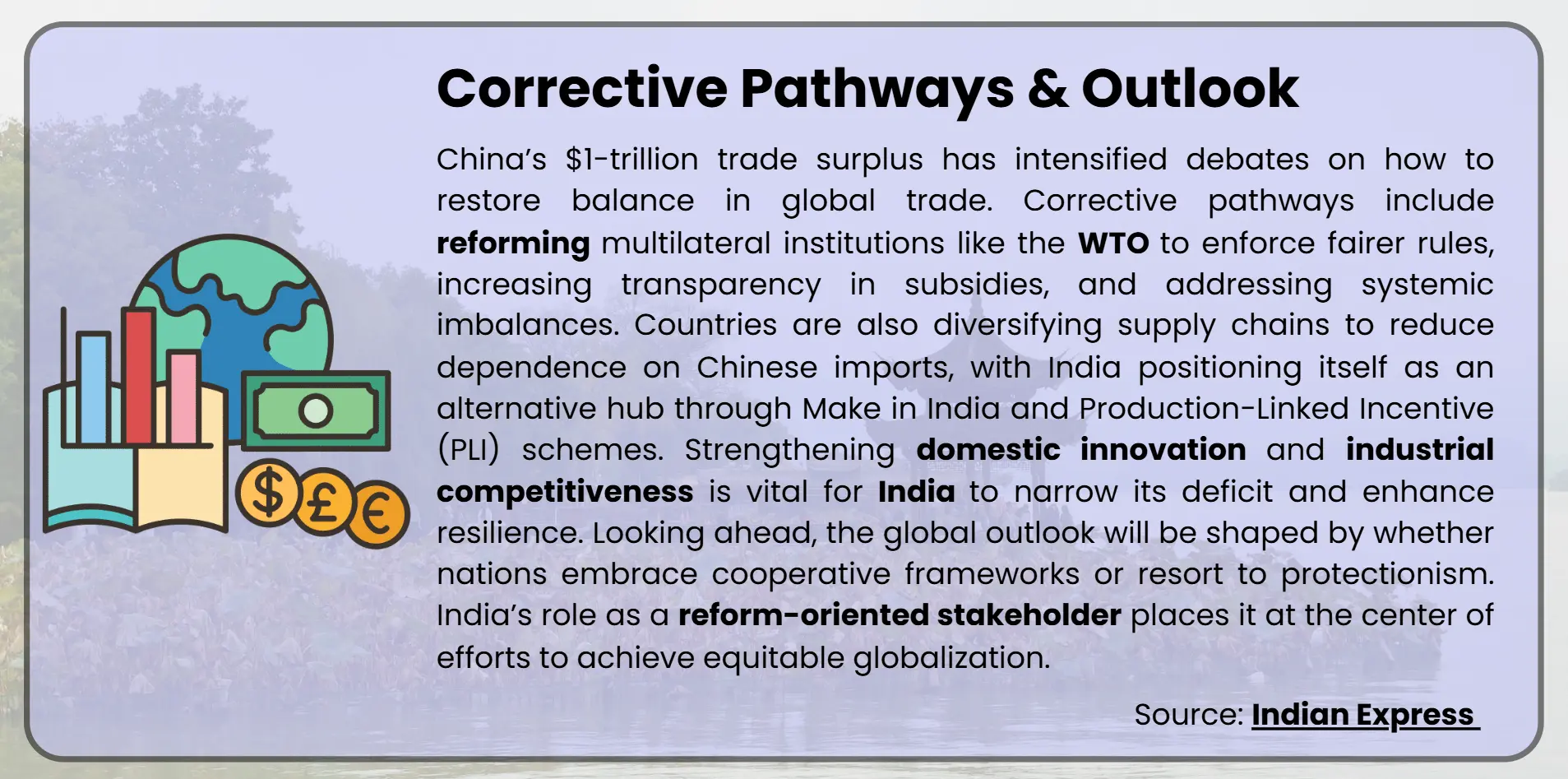
One of the main channels of correction is the strengthening and refurbishment of global organizations, especially of the World Trade Organization (WTO). The current systems have failed to redress systemic imbalances that have been fostered by state-led industrial policies and subsidies. India, among other rising economies, is an advocate of stronger and fair trade laws, increased subsidy disclosure, and developing systems to discourage distortions. The stated reforms cannot be dismissed as they would help to reinstate trust in international trade rules and assure a fair-minded playing field.
Strategic Supply Chain Diversification
Another corrective action is the diversification of the global supply chains. The economies that are still too reliant on Chinese imports are seeking alternatives in the international markets in Southeast Asia, South Asia, and Latin America. India is trying to make an impression as a reliable manufacturing destination by introducing programs like Make in India and Production-Linked Incentive (PLI) schemes. It is also not just a reduction of vulnerabilities but also enhancing the capacity to cushion against geopolitical shocks and disruptions occurring due to the pandemic.
Enhancing Domestic Innovation
The necessary alteration of priorities in relation to the domestic innovation and the industrial upgrading also requires the relevance of the corrective pathways. Investment in research, technology, and development of skills is the primary concern of India to reduce reliance on Chinese imports in the strategic sectors, such as electronics. Competitive industries will help India to reduce its trade deficit, and a more balanced economic order of the world will be created.
Collusion and Competition
In the future, it can be expected that both collaboration and rivalry will influence the course of international trade. Protectionist inclinations are likely to increase in response to the excess of China, but cooperative institutions, including regional trade blocs and groups that encourage equitable conduct, offer ways out. India has been placed on the status of a reform-minded stakeholder that is capable of shaping these discourses and creating a combination of national interests and global duties.
Conclusion
The example of the 1-trillion trade surplus of China is an illustration of both the good performance of the current world economy as well as its asymmetries. Though it has brought out the dominance of China as a leading producer and its provisions as a firm exporter, the excess also manifests the weaknesses in global supply chains, as well as accentuating the strains of trade. In the case of India, excess is in the form of a long-term bilateral deficit, the growing strategic reliance, and the desperate need to undertake corrective measures that include the fortification of the local industry and multilateral changes. The general global trend relies on whether states opt to pursue the strategy of cooperation or pull back to defensive attitudes. Finally, to alleviate such asymmetries, there is a need to innovate on a technological level and revitalize the institutions, in addition to displaying a will to collective challenge to a fairer and sustainable international trade regime.