The White Paper of Government “Democratisation Access to AI Infrastructure”, in which India is being urged to expand its computational and data capacity, viewing AI infrastructure as a public good valued as essential to the development of innovation, sovereignty, and competitiveness in the global market, has been in the talks recently. The access to AI has become recognised as the critical factor determining the country-level path of innovation, competition and autonomy. Effective management requires transparent AI governance, digital literacy, and strict ethical standards to safeguard electoral integrity.
|
Key highlights
- Democratisation Access to AI Infrastructure
- AI Access is Destiny for Governments
- Democratisation of AI as a Strategic Imperative
- Innovation, Security, and Economic Growth
- Global Stakes for AI Infrastructure
|
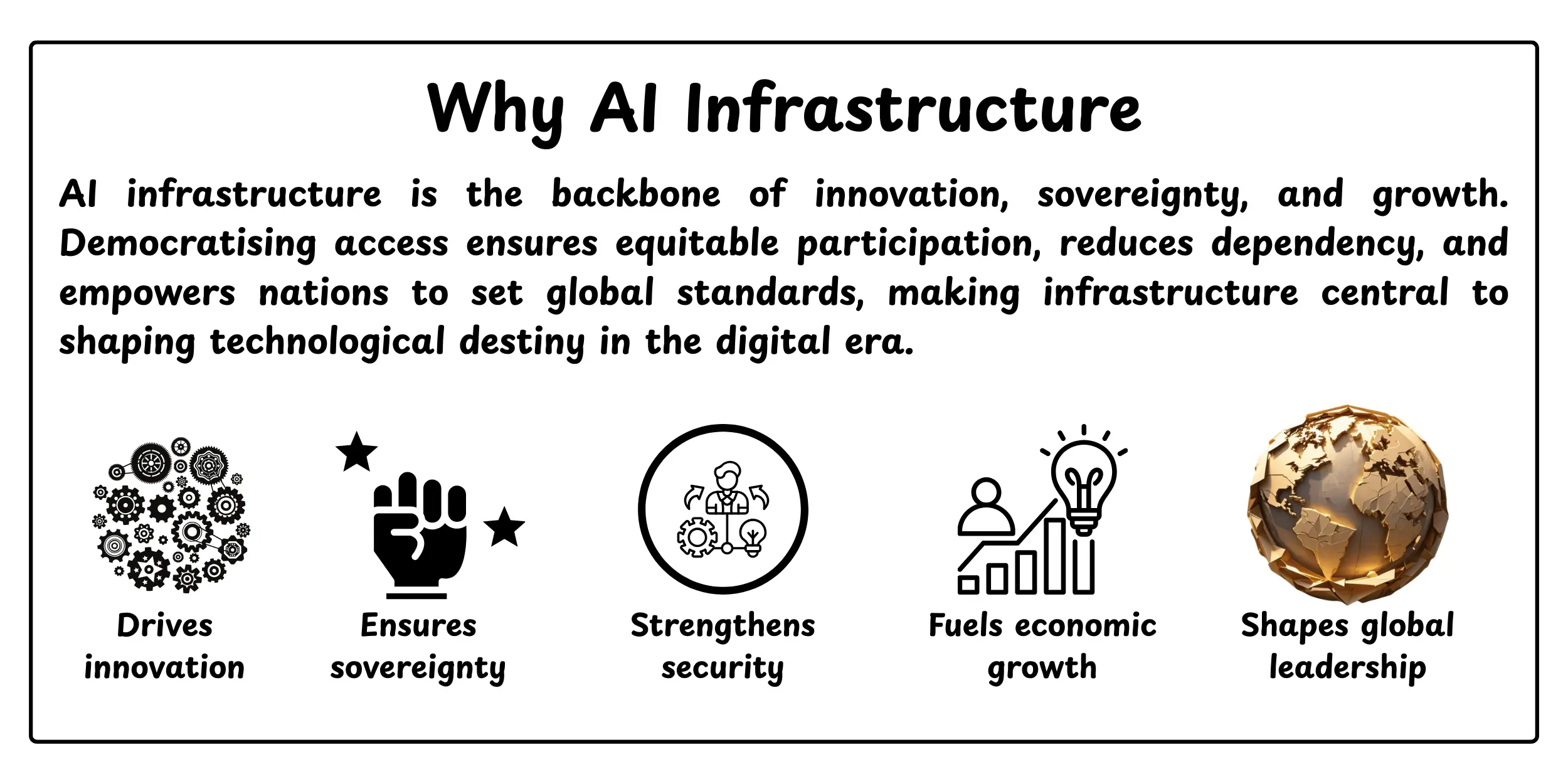
Artificial Intelligence (AI) has already claimed the position of the technology of the twenty-first century and has a significant impact on the trend of innovation, the format of governance, and economic competitiveness indicators. According to the white paper on democratising access to AI infrastructure by the government, the central argument is that access to AI infrastructure is not merely a technical matter per se, but a determining factor in the strategic fate of the nation. The states that invest in the democratisation of computational power, data stores and platform ecosystems will be at a better position to foster more inclusive innovation and to uphold technological sovereignty. Conversely, all those who continue to be reliant on external infrastructure are prone to marginalisation in the global knowledge economy. The recent debate questions the increased importance of the infrastructure of AI and outlines the paradigm shift in the powers and improvements of its democratisation.Artificial Intelligence (AI) infrastructurecomprising computing resources (GPUs/TPUs) vast datasets, and foundational modelsis rapidly becoming the new grid of progress, fundamentally altering how democratic societies operate, compete, and deliver services.
AI Access is Destiny for Governments: Why AI infrastructure matters more
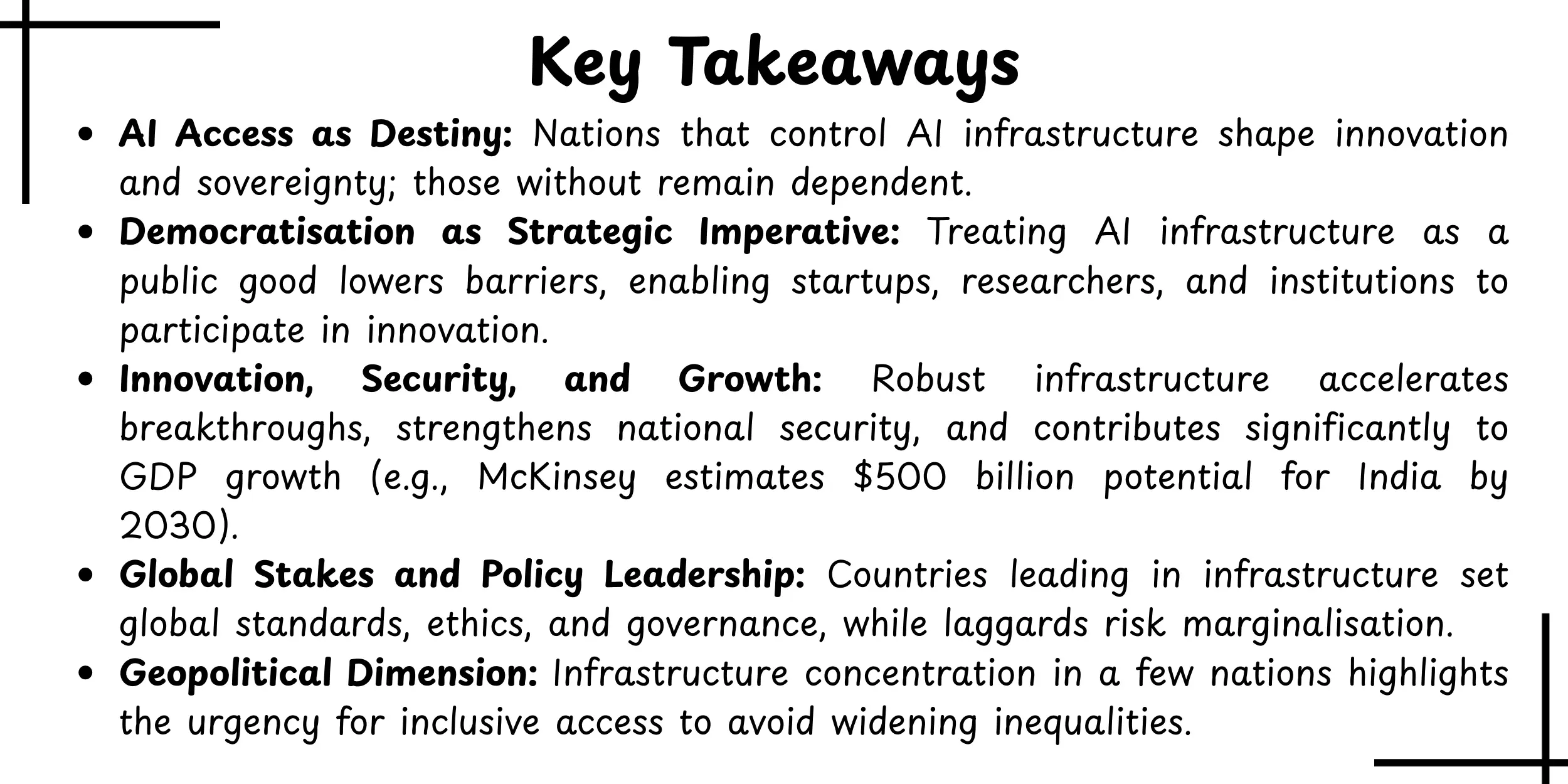
AI infrastructure enables the development, training, and deployment of AI systems.The access to AI has become recognised as the critical factor determining the country-level path of innovation, competition and autonomy. The white paper emphasises how infrastructural resources and not algorithms determine leaders in the era of digitisation. Based on recent insights from 2025–2026, the sentiment that AI access is destiny for governments highlights that control over AI infrastructurecompute power, data, and modelsis now a core determinant of national competitiveness, sovereignty, and public service efficiency.The central insight of the government's white paper, Democratising Access to AI Infrastructure, is simple but profound: AI access is destiny. Nations that control and democratise AI infrastructure will shape innovation; those that do not will remain dependent.
What does AI Access is Destiny means?
The slogan of AI access is destiny is the idea that sovereignty in regard to execution of compute pace, data conduits, and platform architectures dictates the pace of innovation. Similar to the radicalising changes of electrical grids in the Industrial Revolution, modern AI infrastructure is the basis of future economies and technologies. Without fair access, countries turn out to be dependent on external sources, thus limiting their ability to be innovative on their own.
Innovation at the core of AI in Governance
According to empirical data provided by UNCTAD (2025), in 2023, some 2/3 of the countries are expected to have their national AI policies established, yet only 6 least-developed countries have similar structures. Such indicators of extreme inequality illustrate how the lack of infrastructure creates a lack of innovation. Countries with strong AI infrastructure foster entrepreneurship, research ecosystems, and applications in the public sector, and other countries lack as many resources to do so.
Economic Implications of AI in Governance
The India AI roadmap anticipations analysed by McKinsey projects that the nation is likely to increase its gross domestic product of around USD 500 billion by 2030, under the condition that AI can overcome bottlenecks in the nation. The projections help to emphasise the fact that it is not merely something in the abstract world because it has a palpable impact on economic development, employment, and competitiveness. States which invest in infrastructure at the ground level reduce dependence on external players, enhance resiliency, and protect sovereignty in the key areas Ai in healthcare, climate modelling, and defence.
Global Stakes of AI in Governance
The race in the AI infrastructure has its geopolitical aspects. The states that open access to democracy are in a position to set international standards and influence ethical frameworks. On the contrary, failure to do so could lead to technological isolation, economic stagnation, and loss of international relevance. Based on this, access to AI represents an ultimate determinant of destiny on the national level.
Democratisation of AI as a Strategic Imperative
Democratisation of artificial intelligence (AI) infrastructure is now being increasingly viewed as a strategic requirement, in terms of ensuring that innovation, sovereignty, and equal development are not monopolised by a small group of states or corporate actors.
Democratisation of AI as a National Priority
In the white paper of the government, “Democratising Access to AI Infrastructure”, it is argued that it is important to treat AI infrastructure as a public assetin order to be able to grow inclusively. Democratisation minimises entry barriers encountered by start-ups, universities and government institutions, hence increasing heterogeneous involvement in the process of innovation. With the lack of such access, technological advancement would probably be concentrated in elite groups, thus increasing inequality within and across national boundaries.
AI Infrastructure Bridging Gaps
India is a producer of nearly 20 percent of the entire world's data and owns 3 percent of the world's data centre capacity. This asymmetry, which is marked in the Hinduby Pravin Kaushal, explains why democratisation is needed: a lack of enough computing and storage resources means that India is bound to become dependent on foreign providers. An extension of domestic infrastructure would ensure that the data available in the country can be utilised to help local innovations instead of outsourcing to external solutions.
Economic Advantages of AI Infrastructure
To build capacities to democratise graphical processing unit (GPUs) access to both researchers and industry participants, India is compiling a provision of 3,000 next-generation graphics processing units (GPUs). Through such projects, the expense, the speed at which new inventions are created, and the sovereignty over key sectors, including healthcare, agriculture, and defence, are reduced.
AI Infrastructure leading to Innovation, Security, and Economic Growth
The availability of strong AI infrastructure has a strong connection with innovation, security, and the development of economies, making its growth and its democratisation one of the main priorities of the national development planning.
Introducing Change through AI Infrastructure
The AI infrastructure facilitates innovation by allowing researchers, start-ups, and businesses to test out advanced models on a large-scale basis. According to NASSCOM (2025), the number of AI start-up ecosystems in India has grown by 30 percent a year; however, access to expensive compute resources is a constraint. Democratised infrastructure reduces costs and breeds diversified innovation in the healthcare, agricultural and educational sectors, whereby breakthroughs would not be restricted to elite institutions.
Security and Sovereignty through AI Infrastructure
Technological sovereignty is becoming more vital to national security. OECD (2024) also discovered that 70-percent of countries with domestic AI infrastructure were relatively resistant to cyber threats when compared to remaining dependent on outside vendors. Domicile compute clusters and data centres ensure minimal vulnerabilities and safeguard confidential information because countries can decide the applications at their discretion and in the domain of military and governance.
Growth Potential through AI Infrastructure
The AI infrastructure is an economic multiplier, too. One study by McKinsey Global Institute (2025) estimated that the potential contribution of AI to global GDP will be USD 13 trillion in 2030, and the critical element was the accessibility of infrastructure. In the case of India, the removal of infrastructural barriers may enable the USD 500billion of GDP, which creates jobs and enhances competitiveness in manufacturing, services, and digital sectors.
Global Stakes for AI Infrastructure
The race to build AI infrastructure across the world does not remain within the statistical aspects of technology, but presupposes geopolitical aspects that define which countries set the standard, influence the ethical standards, and exercise dominance in the new digitalised order.
AI Infrastructure as Geopolitical Capital
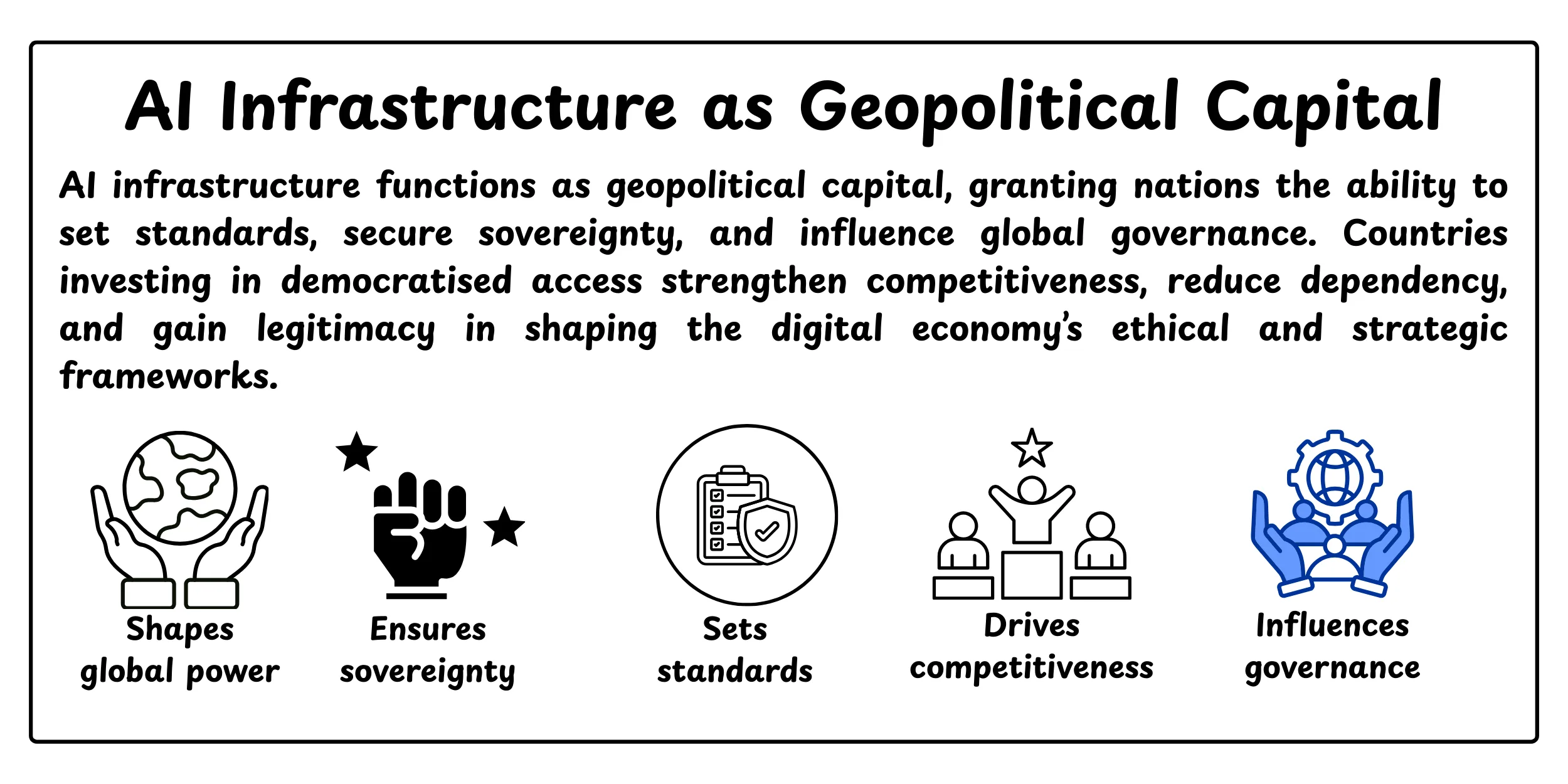
The state of the AI infrastructure has become a geopolitical capital. Countries which are equipped with highly compressed compute clusters and data ecosystems have an unequal impact on the determination of international norms. The World Economic Forum (2025) pointed out that more than 60 percent of all AI patent are concentrated in five countries, a fact that highlights the power concentration that is also related to infrastructure concentration.
Policy Leadership in AI
Thought of as secluded as infrastructure control, policy leadership in AI is impossible without it. Democratising access may allow states to be at the forefront to draw up ethical frameworks, interoperability standards and governance paradigms. According to the Organisation for Economic Co-operation and Development (OECD, 2024), states with national AI infrastructure plans had two times the chances to engage in global forums of AI governance, with the relationship between domestic investment and global governance leadership.
AI Infrastructure Dependency on Others
Countries with infrastructural deficiency are susceptible to technological hopelessness. The logic and economy of computing and data storage with third-party sellers is undermining firewall sovereignty and limiting bargaining ability on a global scale. The UNCTAD cautioned that a developing nation lacking AI infrastructure may end up losing up to 1.5 percent of its GDP every year because of limited innovation and external dependency.
Conclusion
The white paper of the government emphasises the fact that AI infrastructure is not a peripheral issue but the starting point of innovation, sovereignty and fair development. Opening up the door would mean different states are able to use their data, mobilise various stakeholders, and minimise reliance on third parties. With the growing global competition, infrastructure-based policy leadership will define the ethical leaders, as well as economic development. Therefore, access to AI is inalienable, and its democratisation is the strategic need that will determine the future of countries.
Frequently asked questionsFrequently asked questions
AI Access is Destiny for Governments: Why AI infrastructure matters more?
AI infrastructure enables the development, training, and deployment of AI systems.The access to AI has become recognised as the critical factor determining the country-level path of innovation, competition and autonomy. The white paper emphasises how infrastructural resources and not algorithms determine leaders in the era of digitisation. Based on recent insights from 2025–2026, the sentiment that AI access is destiny for governments highlights that control over AI infrastructurecompute power, data, and modelsis now a core determinant of national competitiveness, sovereignty, and public service efficiency.The central insight of the government's white paper, Democratising Access to AI Infrastructure, is simple but profound: AI access is destiny. Nations that control and democratise AI infrastructure will shape innovation; those that do not will remain dependent.
Democratisation of AI as a Strategic Imperative?
Democratisation of artificial intelligence (AI) infrastructure is now being increasingly viewed as a strategic requirement, in terms of ensuring that innovation, sovereignty, and equal development are not monopolised by a small group of states or corporate actors.
AI Infrastructure leading to Innovation, Security, and Economic Growth?
The availability of strong AI infrastructure has a strong connection with innovation, security, and the development of economies, making its growth and its democratisation one of the main priorities of the national development planning.
Global Stakes for AI Infrastructure?
The race to build AI infrastructure across the world does not remain within the statistical aspects of technology, but presupposes geopolitical aspects that define which countries set the standard, influence the ethical standards, and exercise dominance in the new digitalised order.