The military exercises that China conducted around Taiwan at the end of December 2025 have received international attention, essentially playing out as the simulation of a blockade and thus increasing the tensions across the strait. There has been an increase in concern on the part of the United States and its allies and an additional measure of defense preparedness by Taiwan, as the region was plunging to greater heights.
|
Key highlights
- Rising Tension in the Taiwan Strait
- China and Its Strategic Intentions in the Taiwan Strait
- American Reaction to China’s Action in the Taiwan Strait
- Taiwan’s Military Modernisation
- Effects of the Taiwan Strait on the Globe
|
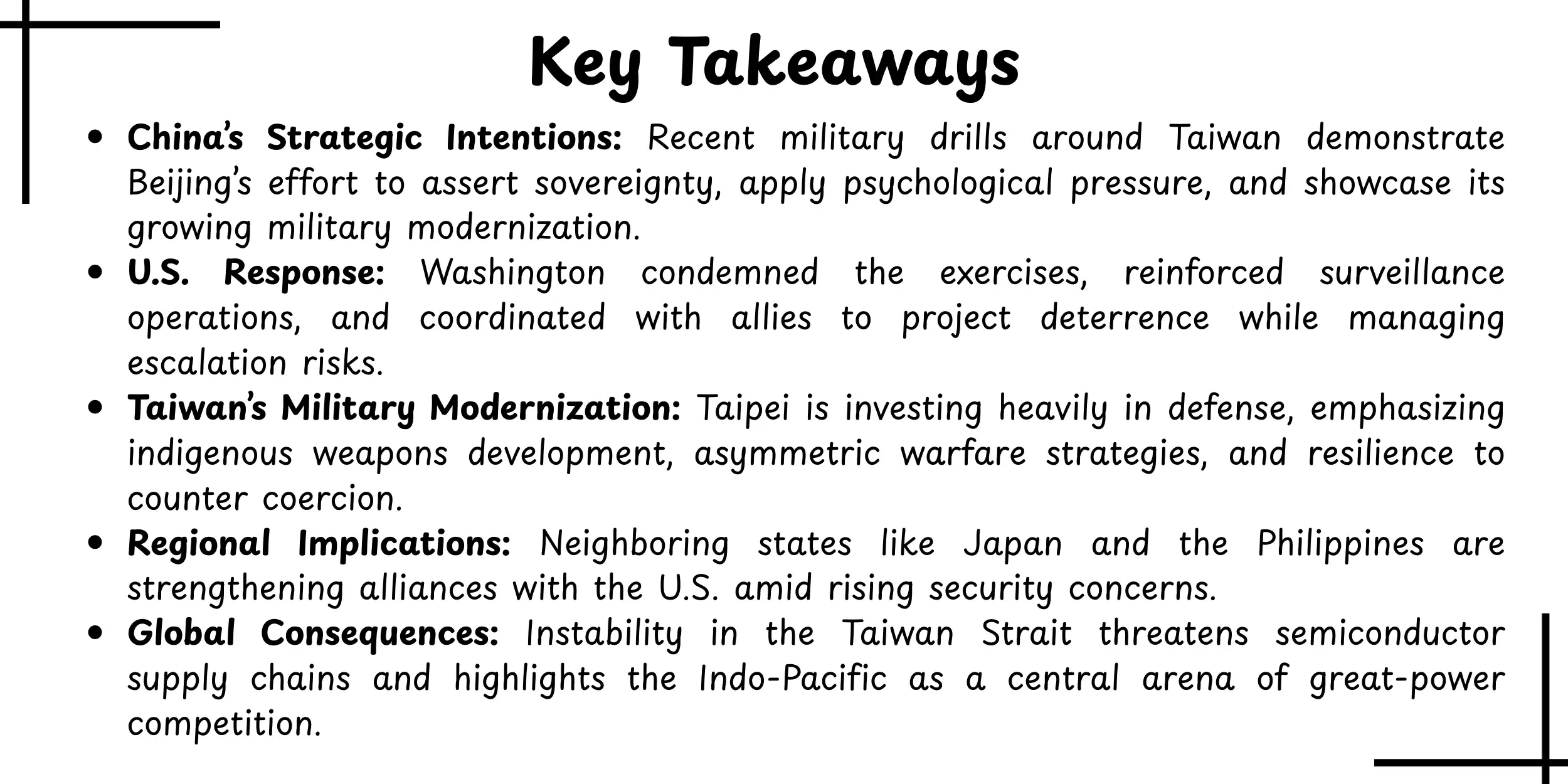
The recent military drills by China in the area of Taiwan have brought back to the global circle of conversation on the issue of security in East Asia. These exercises, which can be perceived widely by the world as applications of force, emphasize the desire by Beijing to both have its claims of sovereignty and, at the same time, warn against any outside interference. The US has reacted diplomatically and in a measured military action, thus reasserting its ideology of stability in the region and alliance guarantee. In the meantime, Taiwan is still pursuing modernization of its defense, with a focus on asymmetric warfare and self-sufficiency as a way of countering the coercion threat. This three-way sphere of interaction underscores the dynamic nature of the balance of power and the enlargement of the inferences of the international security and geo-political order in the Indo-Pacific.
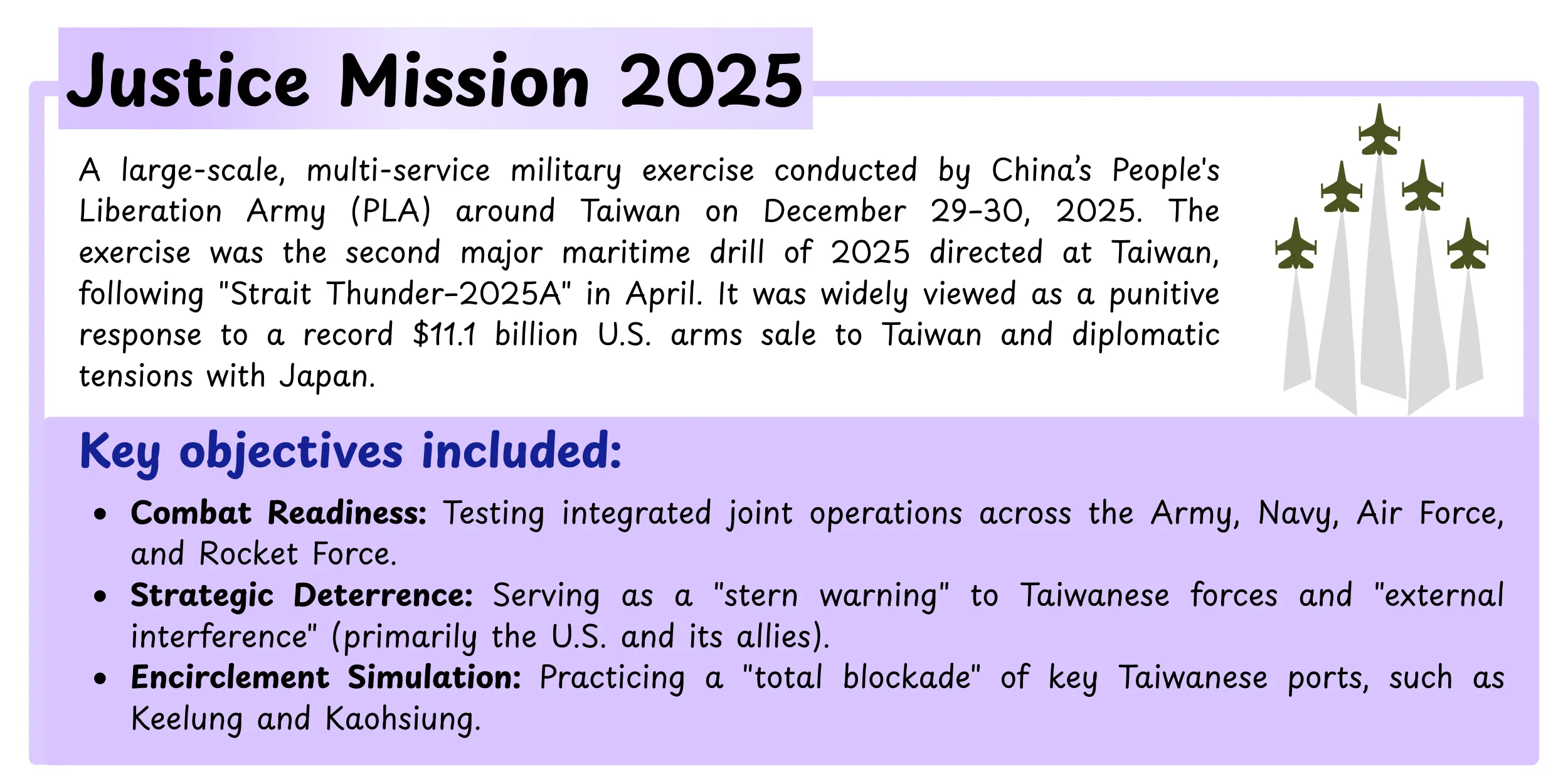
China increased military exercises around Taiwan, such as the "Joint Sword" and Justice Mission drills, are transforming regional security by establishing a pattern of coercive, gray-zone tactics. These maneuverssimulating blockades and strikesforce the U.S. to bolster deterrence and urge Taiwan to adopt a "porcupine strategy" of asymmetrical defense.Taiwan Strait tensions stem from China's claim over Taiwan and its increasing military pressure, met by Taiwan's self-governance and US support, leading to frequent Chinese drills simulating blockades and invasions, particularly after pro-independence leaders (like Lai Ching-te) are elected, raising global security and economic concerns about potential conflict.
China and Its Strategic Intentions in the Taiwan Strait
The latest Chinese military exercises near Taiwan, especially those of the Justices Mission 2025 exercises, are a rational combination of deterrence, coercion, and strategic signalling to redefine the security landscape in the region.
Sovereignty by China in the Taiwan Strait
According to Beijing, these drills are unavoidable to protect the sovereignty and unity of the nation. The Ministry of National Defence has been keen to point out that the exercises were bound to discourage the Taiwanese separatist forces and foreign intrusion. The closeness of the naval, air, and missile forces shown by China around Taiwan is evidence of its ability to introduce a blockade and confirms the arguments that the country puts forward on Taiwan, stating that the island is still an inseparable part.
Coercion Experienced by Taiwan
The exercises have been shown to be not only tactical but also a larger approach of restrained coercion. Analysts observe that Beijing makes such drills institutionalized in order to damage the confidence of Taiwan and bind its strategy. The circumscription tactics act as a form of psychological pressure, indicating to Taipei and Washington that China can raise the terms anytime it wishes, easily, without necessarily engaging in an actual battle.
Army Modernization by China in the Taiwan Strait
The drills also point out the fast modernization of the army in China. Eastern Theatre Command has encompassed various branches in the joint operations arming army, navy, air force, and rocket force, and thus demonstrates comprehensive superiority. This multidimensional strategy conveys to the local actors, such as Japan and the Philippines, the idea that China is ready to exert a consistent trend of military pressure within the Indo-Pacific.
Strategic Imperative of China for the Taiwan Strait
Lastly, such measures maintain the strategic flexibility of Beijing. Scholars argue that China does not want to invade at once but prefers to shape it with the help of coercion that includes diplomatic isolation, economic pressure, and military exercises; China prefers to shape the environment without taking the risk of premature escalation. Therefore, the drills serve two purposes, which include, on the one hand, strengthening domestic legitimacy and,on the other hand, sending a transnational message of Chinese willingness to quash U.S. dominance in Asia.
American Reaction to China’s Action in the Taiwan Strait
The response of the United States to the transition exercises of the Chinese program of “Justice Mission 2025”, during which exercises were held on the territory near Taiwan, reflects the approach of strategic balance between deterrence and diplomacy.
Diplomatic Condemnation bythe US on Chinese Action
The administration declared a diplomatic denunciation of the exercises, describing them as destabilising and intimidating. The U.S. Department of State again claimed that it was opposed to the unilateral changes in the existing status quo and restated that it believed in preserving the peace on the other side of the Taiwan Strait. This action of diplomacy emphasises the consistency of the U.S. policy: the upholding of the self-defence of Taiwan and the discouragement of Beijing to engage in provocative military actions.
Increased Military Surveillance in the Taiwan Strait by the US
The U.S military significantly increased its surveillance activities during the exercises. History has been detailed about how American reconnaissance planes and naval stations could trace the movements of the Chinese in real-time, and this is one way of proving that Washington would have been able to respond very fast. These moves are important signalling behaviour, where the US takes the initiative to maintain the stability of the region and avoid coercive policies.
Alliance Co-ordination by the US
In addition to the Taiwan case per se, the United States organised the allied states, especially Japan and Australia, in supporting collective security. Analyses show that the presence of joint surveillance and naval patrols that were done during the drills conveyed a broader Indo-Pacific preventive system. The international policy approach would communicate the idea that not only the U.S would scrutinise Beijing, but the regional community would respond in a hostile way to its actions as well.
Taiwan’s Military Modernisation
The military modernisation process of Taiwan is the ideal representation of a calculated move that would uplift deterrence and resistance to increasing Chinese pressure. The common characteristics of the strategy include native innovation, asymmetric war, and augmented defence funds to protect long-term existence.
Taiwan Increasing Defence Budgets and Strategy
A special defence procurement programme in Taiwanis taking place. The Taiwan government has introduced a specialised procurement programme worth USD 40 billion between 2026 and 2033. This program, within the scope of which President Lai Ching-te announced the goals, attempts to shift the Taiwanese military posture towards an emphasis on deterrence and resilience. The programme reaffirms the cognisance of the government that long-term investment is the key principle against the growing military advances of China.
Indigenous Weapons Development by Taiwan
One cornerstone of such modernisation is the emphasis on local defence manufacturing. Taiwan has a procurement plan of precision artillery, long-range missiles, unmanned platforms and counter drones. Not only does this increase the levels of self-reliance, but it also builds the strength of the domestic defence industry, which guarantees the ability to produce during wartime but also reduces reliance towards foreign vendors.
Resilient Defence Plans by Taiwan
The 2025 National Defence Report, which Taiwan released, indicates the shift to asymmetric tactics, which have concentrated on mobility, survivability, and the ability to survive a long-term offensive. The report highlights the multi-layered deterrence, which incorporates force structure, training, and equipment to keep up with the changing threats. This resilience doctrine is an expression of Taiwanese desire not to give an easy win to China and to make them heavily pay in the event of a conflict.
Effects of the Taiwan Strait on the Globe
This recent exercise of military action by China near Taiwan gives ripple effects outside the Taiwan Strait, which takes a toll on the security calculation in the region, susceptible enough to highlight short-term risks and long-term strategic effects.
Alliance Dynamics in the Taiwan Strait against China
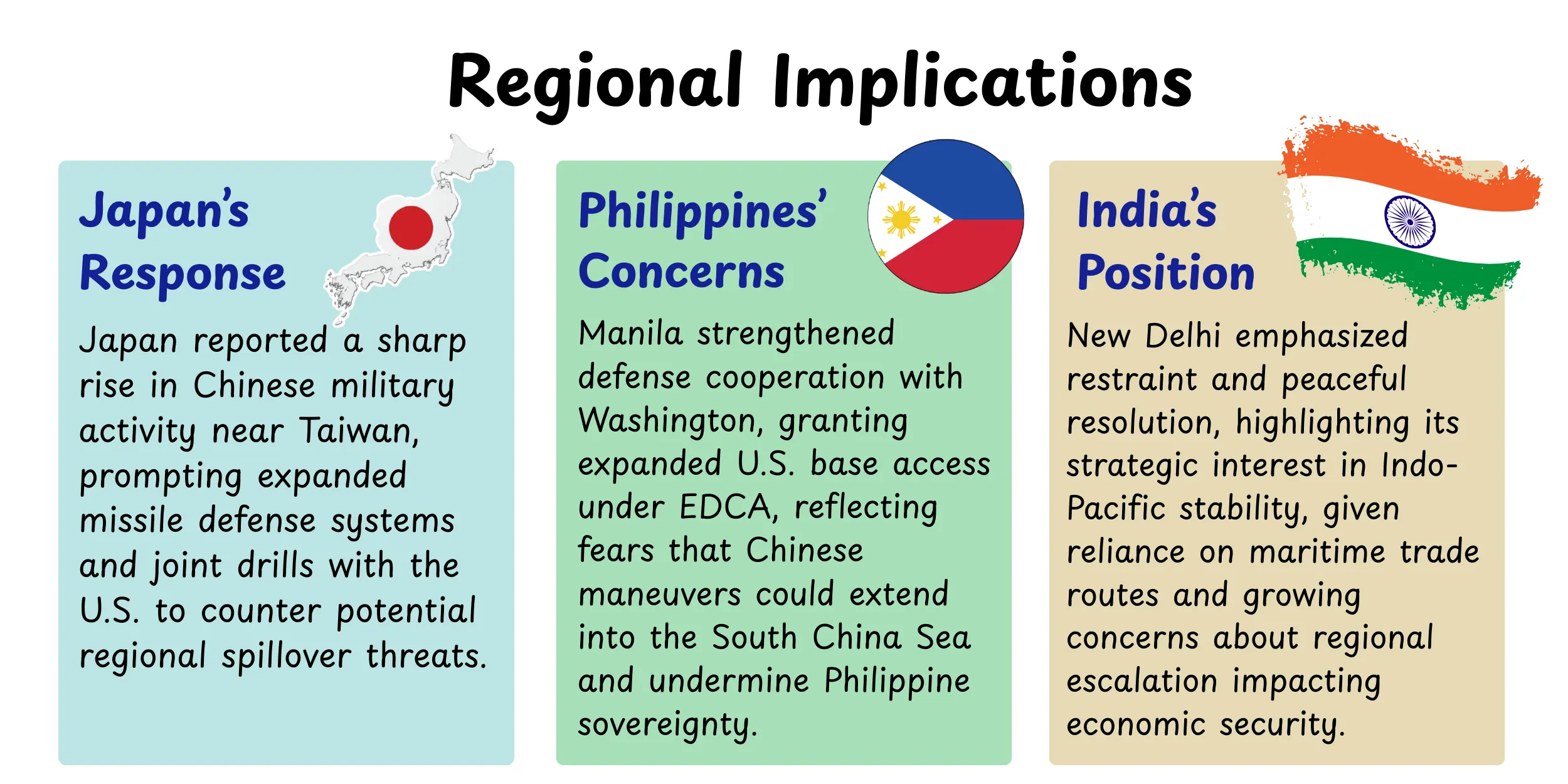
The activities increase security concerns in the region among adjacent players like Japan and the Philippines, which have increased the balance of defence efforts with the United States. According to the 2025 Defence White Paper by Japan, more than 30 percent military activities were conducted by the Chinese military in the areas surrounding Taiwan, and therefore, an increase in the level of threat perception. These advancements strengthen the bonds in the region and contribute to common military exercises aimed at countering the Chinese aggressiveness.
Trade Vulnerabilities in the Taiwan Strait
Taiwan holds a strategic role in the semiconductor supply chain in the world, and the instability in the Taiwan Strait threatens the economic security of the world. According to a study by the Peterson Institute of International Economics, the blockade scenario resulted in the disruption of over 60 percent of the global export of chips (this will have significant impacts on sectors such as electronics and automotive, among others). Therefore, the exercises carried out by China have an economic implication that is far-reaching outside the continent.
Taiwan Strait’s Effects on Global Politics
On the international level, the actions of Beijing indicate that it is ready to challenge the U.S. influence and redefine the existing international norms. The exercises remind us that the Indo-Pacific has been transformed into the epicentre of the great-power conflict. Analysts argue that consistent military pressure escalates the risk of miscalculation, thus making it more likely to lead to unintended escalation with international consequences.
Conclusion
Overall, the competition for dominance in the Indo-Pacific region is gaining momentum due to the military exercises conducted by China around Taiwan. The US is retaliating through a calculated use of force and strengthening alliances to meet the schemes of coercion by Beijing, whereas Taiwan is engaging in modernisation of its armed forces as a way of responding to these efforts. The result of these dynamics is a balance that is very weak and where the effects of the strategic signalling, the economic vulnerability, and the geopolitical competition intersect. Constant diplomatic communication, coupled with and backed by credible deterrence, is thus the necessary step so as not to miscalculate and as a way of maintaining global security in the region, which is increasingly becoming intricate.
Frequently asked questionsFrequently asked questions
China and Its Strategic Intentions in the Taiwan Strait?
The latest Chinese military exercises near Taiwan, especially those of the Justices Mission 2025 exercises, are a rational combination of deterrence, coercion, and strategic signalling to redefine the security landscape in the region.
American Reaction to China’s Action in the Taiwan Strait?
The response of the United States to the transition exercises of the Chinese program of “Justice Mission 2025”, during which exercises were held on the territory near Taiwan, reflects the approach of strategic balance between deterrence and diplomacy.
Taiwan’s Military Modernisation?
The military modernisation process of Taiwan is the ideal representation of a calculated move that would uplift deterrence and resistance to increasing Chinese pressure. The common characteristics of the strategy include native innovation, asymmetric war, and augmented defence funds to protect long-term existence.
Effects of the Taiwan Strait on the Globe?
This recent exercise of military action by China near Taiwan gives ripple effects outside the Taiwan Strait, which takes a toll on the security calculation in the region, susceptible enough to highlight short-term risks and long-term strategic effects.