|
Key Highlights
- Nanjing Massacre (1937)
- Narrative Controversy
- Sensitivities of Diplomacy
- Opinion of People
- Regional security issues
|
The 1937 incident of the Nanjing Massacre, in which over 300,000 Chinese civilians were killed, still serves as one of the points of contact regarding Sino-Japanese relations. According to China, the event has become a trauma that has to be recalled, and yet Japan was inconsistent in its reactions by issuing formal apologies, denying it, and placing a deniable curve on its historical record in school texts. The unsettled historiographical conflict has an impact on diplomatic activities, the general sentiment of societies, and the security relations within the region, and thus continues to have an implication of the atrocity in the bilateral relationships.
|
Tips for Aspirants
The article can be used in the study of the UPSC CSE exam and State PSC exam because it offers an insight into international relations, historical memory, diplomacy, and regional security- fundamental topics in the General Studies and essay writing.
|
|
Relevant Suggestions for UPSC and State PCS Exam
- Historical Atrocity: The Nanjing Massacre (1937) is a mass killing and crime committed by Japanese soldiers; the Chinese estimated that close to 300,000 were killed.
- Collective Memory: China institutionalizes the remembrance in education, memorials, and discourse by the masses, hence reinforcing national identity and claims of justice.
- Narrative Controversies: The ambivalent reactions of Japan, such as apologies, denial, and textbook scandals, create mistrust and heighten challenges in the reconciliation.
- Sensitivities of Diplomacy: Most bilateral negotiations often have the massacre mentioned; during the commemoration of the massacre, the tensions are increased and impact the diplomatic behaviour.
- Public Opinion: Chinese people consider remembrance to be justice, and the Japanese society is still divided, thus making the formulation of foreign policies complicated.
- Regional Security: Bitter memories influence the changes in strategies; China associates the failure by Japan to address its past with issues of militarism.
- Significance of the Exam: The text brings out the complement between history, diplomacy, nationalism, and security, key themes in GS Paper II and the essay writing.
|
One of the most devastating events of the Second Sino-Japanese War is the Nanjing Massacre of December 1937. During a six-week span, Japanese military troops committed numerous acts of horror, including mass massacre, methodical sexual assault, and extensive devastation; according to Chinese sources, there were more than 300,000 deaths, casualties among the civilian population, and prisoners of war. Although the incident is comprehensively placed in the historical framework of World War 2, its effects still resonate in the modern lines of the Chinese-Japanese relations. The massacre is not just the story of the past; it is an indicator of an indistinct trauma, disputed shared memory, and longstanding political sensitivity. China is using the incident continuously as empirical data to demonstrate the wartime aggressiveness of Japan, but the reactions of Japan, which include formal apologies and downplaying or refusing, have increased tension between the two nations.
The Nanjing Massacre: A Defining Moment in Asian History
The problem goes beyond the bilateral exchanges affecting the security of the region, the attitude of people, and the idea of historical justice. In turn, the Nanjing Massacre is a tragedy of the ancient world and a living political dilemma that shapes the accounts of the national identity and complicates the process of reconciliation. The long-term salience of this atrocity requires us to consider the subject of collective memory, some alternative interpretations of historiography, and the relationship between history and diplomacy at the East Asian level.The 1937 Nanjing Massacre casts a long and complex shadow over Asia, evolving from an immediate atrocity into a deeply contested historical event that continually influences Sino-Japanese diplomacy.
Past Atrocity
The Nanjing Massacre of December 1937, when Japan engaged in large-scale killings and atrocities, is one of the historical traumas that have remained a cornerstone in history. It has been playing a continued impact on creating collective identity and on the relationship between the two states in their diplomatic interactions because of how it is commemorated.
Atrocity as Historical Trauma
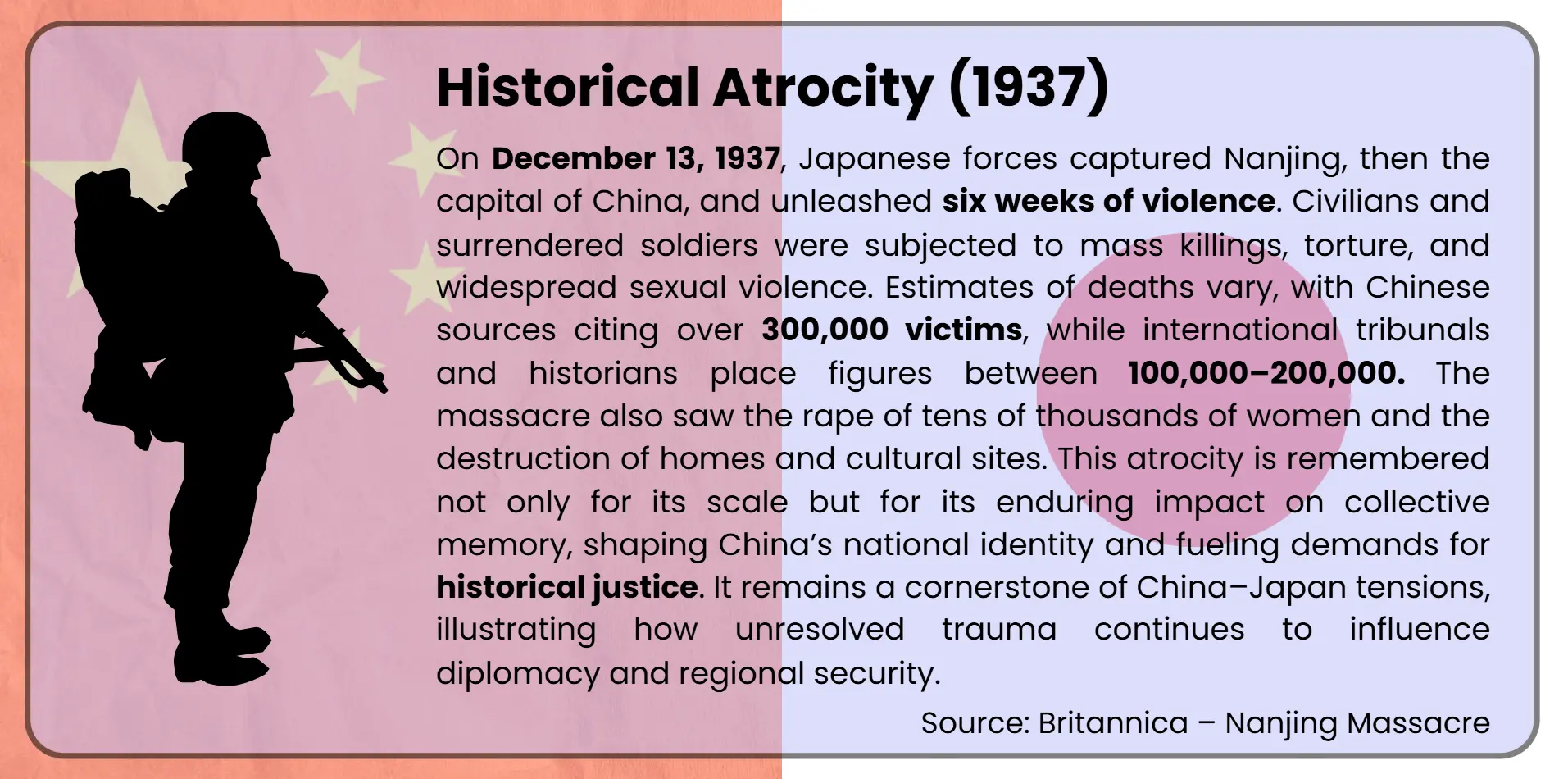
The Nanjing Massacre is often considered to be one of the most gruesome incidents of the Second Sino-Japanese War, which saw coordinated executions, rampant cases of sexual violence, as well as property destruction. Estimates of Chinese archives reveal that in excess of 300,000 civilians and prisoners of war were killed, and thousands of women were sexually assaulted. This scale of violence has seen to it that the massacre is being remembered not only as a war experience but as a permanent national trauma. The atrocities that were administered to the people of Nanjing are now synonymous with the torture that befell China under Japanese rule.
Communal Memory and Nationality
The massacre memory takes up a central space in the building of the Chinese identity as a nation. The annual anniversary of the event is marked in memorial services and museum exhibitions that make it more significant. In the case of China, remembering serves as a form of giving tribute to the victims and providing an assertion of historical justice. The massacre is canonised into educational programs, mainstream discourse, and cultural discourse and, thus, makes sure that new generations view it as both a symbol of endurance and victimhood. The memory institutionalised strengthens the need by China to be recognised and made ashamed by Japan, but also, it helps in cementing its resistance process of foreign conquest.
Debate over Narratives of History
Japanese reaction to the massacre has also been varied, i.e., Apology, denial, or minimisation. The content of the textbooks, political statements, and revisionist interpretations is one of the issues involving heated debates between the two countries, which have complicated the mistrust between the two countries. Any effort to mitigate the atrocity by China is considered an insult to historical fact and group honour. This narrative disunity highlights the dynamism versatile to collective memory and how political agendas influence the expression of collective memory to suit modern agendas. The escalating diplomatic tension is what comes along with this contestation, thus hindering the reconciliatory process.
The Diplomatic Instrument
The Nanjing Massacre still serves as a political tool in the relations of China-Japan. To remind us of the aggression of Japan in the war, Chinese policymakers refer to the atrocity as a reminder of the reappearance of militarism. Collective memory defines the views of the masses in China, and where there is a need to be alert and accountable to the people, Japanese society is still sharply divided on how to deal with the past. As a result, the memory of the massacre does not conclude with the study of history, but impacts the security of the region, the relations with other countries, and the level of credibility. The lasting nature of memory is a testimony to how past atrocities can involve cultural and political facts many years into the future.
Controversies on the History
The Nanjing Massacre has remained one of the most disputed events in the history of East Asia. The tension between scholarly inquiry, political interests, and collective memory is also highlighted in matters of disagreement over its interpretation.
Conflict of National Viewpoints
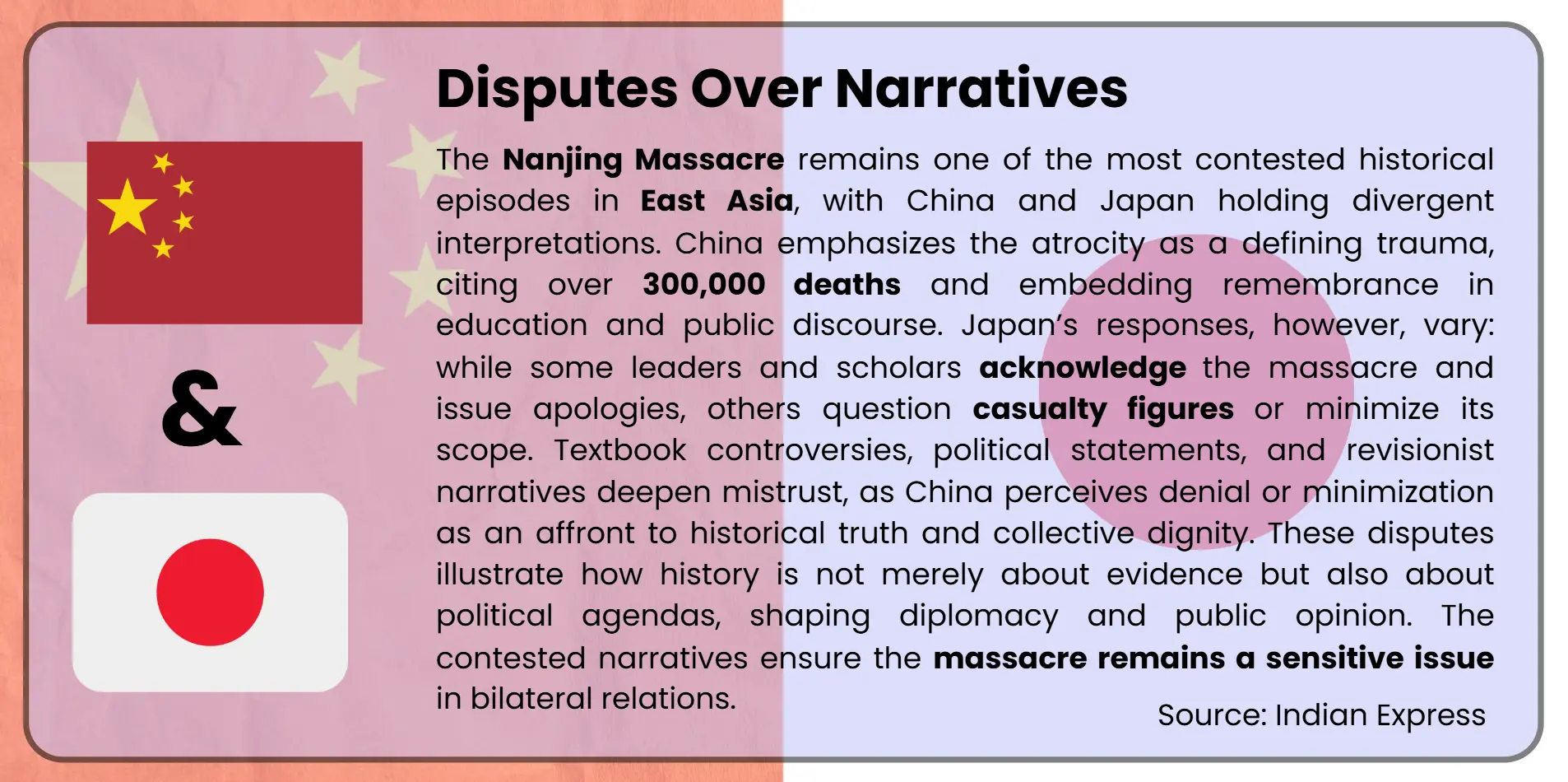
The massacre in China is foreshadowed as a trait of trauma where the figures go well past 300,000 dead with reference to a wide atrocious event; this story tells the national identity and their right to be morally heard in the world. However, this is not so in Japan, where varying reactions are witnessed: some officials and scholars acknowledge the violence, but some refute the number of casualties or undervalue its effects. The introduction of such divergences creates an epistemic rift between the two states.
Controversies
One of the prominent sources of conflicts has become pedagogical resources. In Chinese school curricula, the massacre is commonly placed as verifiable misery in wartime, but Japanese schoolbooks sometimes blanked out on the incident or trivialized it. These pedagogical imbalances strengthen divergent community memories: the omission signifies denial, whereas the inclusion in Japan regularly unleashes domestic discursive debates of national pride gone against national responsibility.
Political Statements and Revisionism
Statements by political figures make even greater ways of reconciliation more obscure. The Japanese offerings of apology in China often receive negative responses, as they are felt to be weak or contrived, with revisionist utterances made by the right-wing politicians immediately after them. China views such revisionist explanations, which dispute the magnitude or historical truth of the massacre, as attempts to whitewash historical truth. This tendency proves that the history-writing tales are conditioned by the empirical facts as well as the political expediency.
Diplomatic Consequences
There are direct diplomatic consequences of the contestation of these narratives. Memorial anniversaries of the massacre are often the cause of increased tensions, and Chinese leaders use the event to caution against Japanese militarism. The lack of willingness of Japan to completely repay its past undermines the trust in the country and makes it difficult to cooperate in regional security affairs. As a result, the issue of historical accounts goes beyond the field of scholarly discourse and has a significant impact on the realities of modern-day international relations and the masses.
Political and Diplomatic Sensitivity
The Nanjing Massacre is still a very delicate topic in Sino-Japanese matters. It is not limited to the study of history, but it keeps defining diplomatic relations, political discourses, and local security politics.
Human Capital Formation
Education strengthens human capital because it provides a person with skills, knowledge, and competencies that are necessary to take part in the economy to productively participate. An educated workforce encourages innovation, boosts production as well, and increases responsiveness to technological alteration. Thus, the economic growth becomes not concentrated in elite groups, but dispersed throughout society in extended circles. Education creates a wider level of parity in the labor markets by decreasing skill disparities and enhancing a more even GDP growth.
The Diplomatic Memory of History
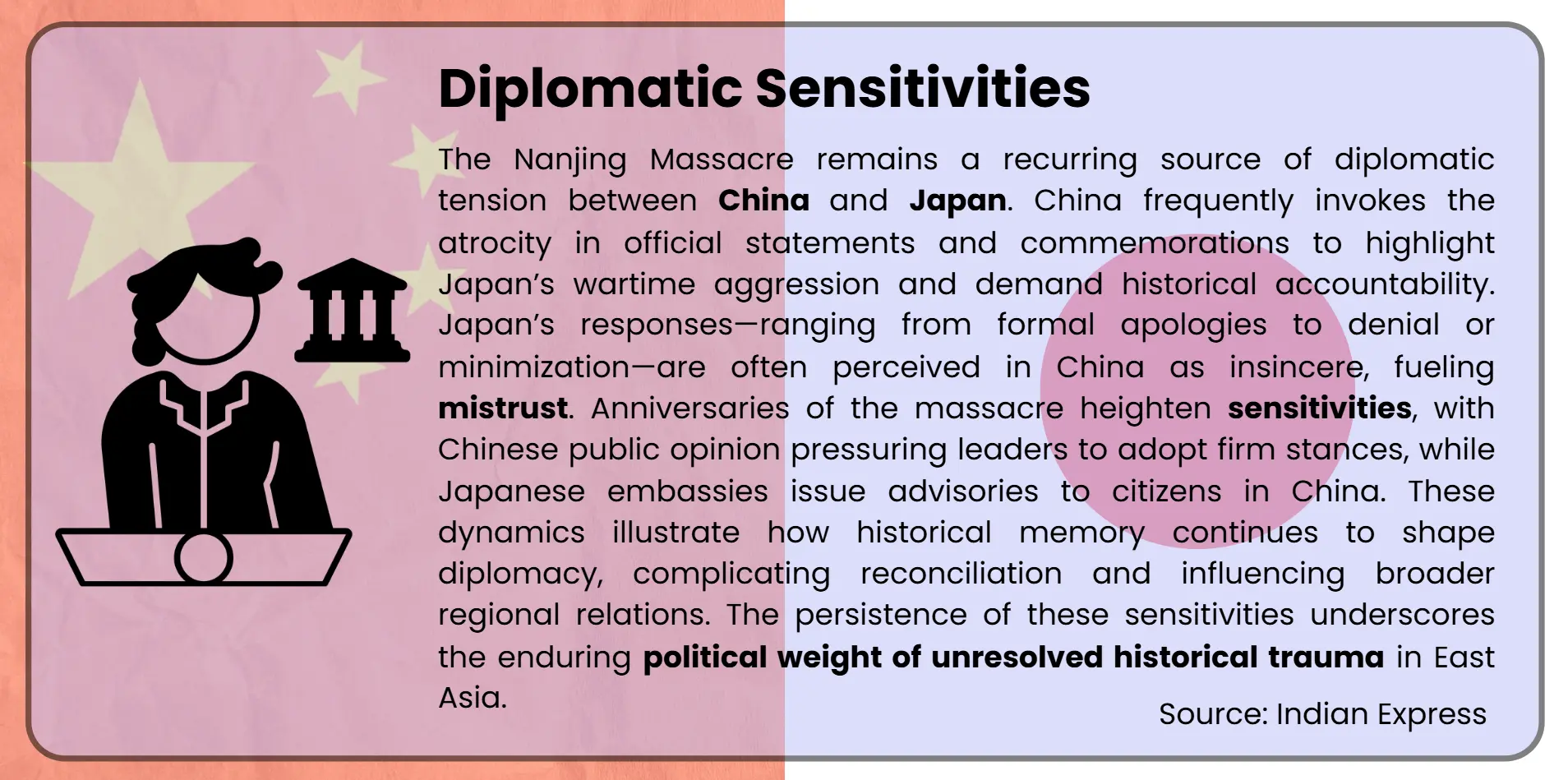
The Nanjing Massacre is one of the events that China uses in its diplomatic rhetoric to remind the aggressiveness of Japanese forces in wartime and to strengthen security against the revival of militarism. The official commemorations, memorial ceremonies, and the actions of the people remind us of the unresolved historical grievances. This focus is such that the massacre is a constant point in mutual negotiations, thus making the reconciliation and trust-building efforts challenging.
Political Statement and Nationalism
The words spoken by the Japanese political leaders tend to heighten sensitivities. Although some of the officials have made up-fronts, other leaders have contested death numbers or downplayed the atrocity, with many in China creating a sense of disingenuity in the leaders. Right-wing politicians make revisionist comments that are seen as provocations and strengthen the fears of the Chinese about the political direction of Japan. It is not just domestic rhetoric, but these statements have an echo across the world and impact people and the diplomatic reaction.
Anniversaries and Sentiment of the People
The anniversaries of the massacre often create a state of tension. During memorial times, the anti-Japanese mood in China is also likely to increase, and Japanese embassies take up the risk of advising their citizens on safety measures. These cases show that historical memory has an intersection with modern politics, in which citizens can make a tangible impact on the diplomatic behaviour. Such anniversary events are especially close, and it is important to underline the emotional aspect of the deep emotional meaning that has been carried with the massacre.
Implications of regional security
The legacy of the unresolved massacre also affects the security interests of the region in general. China interprets the unwillingness of Japan to fully address its history as an admonition to future militarism and the memory of history to its present geopolitical conflicts, such as Taiwan. The diplomatic pressures caused by the massacre not only extend beyond bilateral relations, but also have implications on East Asian stability as well as the wider regional collaboration. The fact that this sensitiveness is still present is a tribute to the ability of historical trauma to shape a strategic calculation in a matter of decades following the incident.
Legacy in Social Opinion
The legacy of the Nanjing Massacre is more than just a historical memory, as it has had a long-term effect on the societal mind of the Chinese people, Japanese people, and it has shown its impact in the way security is shaped in East Asia.
Public Opinion in China
In China, the Nanjing Massacre is deeply imprinted on the memories. This reminds the generations of history that is perpetuated by the annual observances, museums, and the inculcation of the massacre into school curricula that together strengthen the images of victimhood and strength. Therefore, the popular culture is always linked to the aggression of Japan in war times; viewed denial or downplay of the crime is accompanied by mass outrage. This sort of domestic feeling exerts pressure on Chinese leaders to seek absolute diplomatic standpoints, thus maintaining the historical grievances in the heart of the bilateral relations.
Splits of the Japanese Society
Japanese society still displays a strong sense of division over the way the reactions towards the massacre should be. Some academics and certain citizens seek to receive recognition and reparation, but some nationalist groups question the number of losses in the war and want to diminish the horrors of the war. The internal division has a noticeable effect on the policy-making process of Japan, as the leaders are forced to balance internal and external demands. These delays in reaching an agreement have continued to fuel mistrust and hence hamper substantive efforts towards reconciliation with China.
Regional Security
The remaining negative legacy of the massacre also sheds light on regional security interests. China habitually attributes uneasiness about military aggressiveness and expansionism to the reluctance of the Japanese to fully answer the call to make amends for their past. In this regard, past wrongs are tactically offered negotiatively on defense collaboration, maritime agreements, and alliances. Thus, the massacre serves as a symbolic catalyst of the dangers that are posed by an un-redeemed history, thus having an impact on strategic decision-making in the East Asian regions.
Diplomatic Sensitivities
The intersection of the mass consciousness with the memory of the past makes the massacre a regular diplomatic center stage. The anniversaries often contribute to the situation, aiming at the Chinese authorities using them to give warnings on Japanese behaviour. The measured reactions of Japan refer to the sensitivity of national existing divides and the long-term global criticism. The continued relevance of these sensitivities testifies to the continued role of historical trauma on the diplomatic practice, popular will, and the stability of the region in general, even decades after the atrocity.
Conclusion
The Nanjing Massacre of 1937 was one of the defining historical traumas that still continue to affect the relations between China and Japan. Its legacies still live in the collective recollection, dissenting accounts, and politically relevant sensitivities, thus making sure that the atrocity remains part of the present, and it is bound into the modern diplomatic rhetoric. The timelessness of historical grievances is supported by the social attitude in the two countries, as the arguments about the security of the region are shaped by the unsolved conflicts. This, therefore, makes the massacre a historical experience as well as a current political phenomenon, hence illustrating the role of memory and history in constituting international relations and complicating the reconciliation processes in East Asia.
|
Sources:
- Indian Express – How the 1937 Nanjing Massacre impacts China-Japan relations today
- The Print – Japan issues safety advisory in China ahead of Nanjing Massacre anniversary
- OSU Resource Center – Nanjing Massacre haunts China-Japan relations
- Cambridge University Press – Changing Contours of History and Memory in Japan, China, and the U.S.
|