|
Key highlights
- India’s Foreign Policy
- From Non-Alignment to The Global South
- Economic and Technological Diplomacy
- Global Leadership
- Future Trajectory
|
The practice of diplomacy in India has been transformed to that of strategic autonomy, balancing both ties with the major powers while asserting influence in Indo-Pacific. The economic power, technological forwardness, and climate policy leadership increase its image at the international level. Through its activism for the interests of the Global South and promoting changes to the multilateral institutions, India positions itself as a resilient, inclusive leader that is defining a new manner of international politics and world governance.
|
Tips for Aspirants
The article is an important source of study for UPSC CSE and State PSC examinations, as it explains the changing diplomacy, world leadership, and governance of India as the main areas in International Relations and General Studies.
|
|
Relevant Suggestions for UPSC and State PCS Exam
- Historical Foundations: The foreign-policy pursuits in India developed out of Nehru's non-alignment doctrine to a pragmatic model of strategic independence and thus balancing between idealism and realism.
- Cold War/Post-Cold War Changes: The 1971 treaty with the USSR, the 1974 nuclear tests, and the 1991 liberalisation of the economy are some of the key milestones.
- 21st century alignments: India has been aiming to have a multi-alignment strategy involving linking itself increasingly to the United States, Russia, and the members of ASEAN, and taking up an active role in the Quad, BRICS, SCO, and G20.
- Economic Diplomacy: The trade diversification, the energy security, and the G20 leadership of India improve its economic position in the world.
- Technological Diplomacy: The new projects of digital India, artificial intelligence, cybersecurity, and renewable-energy aim to position India as an up-and-coming knowledge economy.
- Global Leadership: India insists on reforming the United Nations Security Council, climate diplomacy, increased vaccine coverage, and the interests of the global south.
- Future Trajectories: Striking a balance between the great powers, leveraging soft power, and enhancing the standing of India in the multipolar Global governance.
|
There is no doubt that the course of Indian diplomacy has been changed over the last few decades, as it has been influenced by domestic needs as well as being remade in the context of the global process. The foreign policy of India was historically based on the doctrine of non-alignment; the country aimed to maintain independence and promote the principles of peace, justice, and economic development. Nonetheless, the post-Cold War and the appearance of multi-polarity have forced India to adjust its strategy and change its moralistic position to a pragmatic attitude to development and strategic pressure. This shift is clear in the active involvement of India in the multilateral forums like the United Nations, BRICS, G20, and the Quad, where India attempts to even out the great-powers competition and advance its national interest. At the same time, economic growth, technological innovation, and climate diplomacy have become the new strategies of intervention that allow India to demonstrate its leadership in geopolitically conventional contexts.
Diplomacy, Strategy, and Strategic Autonomy Explained
India's journey to global leadership involves a powerful shift from post-colonial recipient to innovator and major economic force, driven by digital transformation (UPI, IT hubs), strong R&D, economic reforms, and active foreign policy championing climate action, AI governance, and self-reliance (Atmanirbhar Bharat), building a unique legacy of blending moral principles with pragmatic interests to shape a multi-polar world. The shifting nature of world politics, which involves the challenges of the competition in the Indo-Pacific, the emergence of the Global South, and institutional change demands, has created an opportunity for India to re-establish its position as a responsible stakeholder and upcoming leader.
Historical Background and Development
The diplomatic path of India has gone through a smooth transition of idealistic basis to pragmatic interaction. The foreign policy of the country has been based on the traditions and experience of the forces of civilizations and the struggle for independence, which reacted to the changing world powers or local needs constantly. India's journey to leadership and legacy is rooted in ancient governance ideals (welfare states like Mauryas, local Panchayats), through powerful empires (Maurya, Gupta, Mughal) and the formative British Raj, culminating in independence and democratic nation-building.
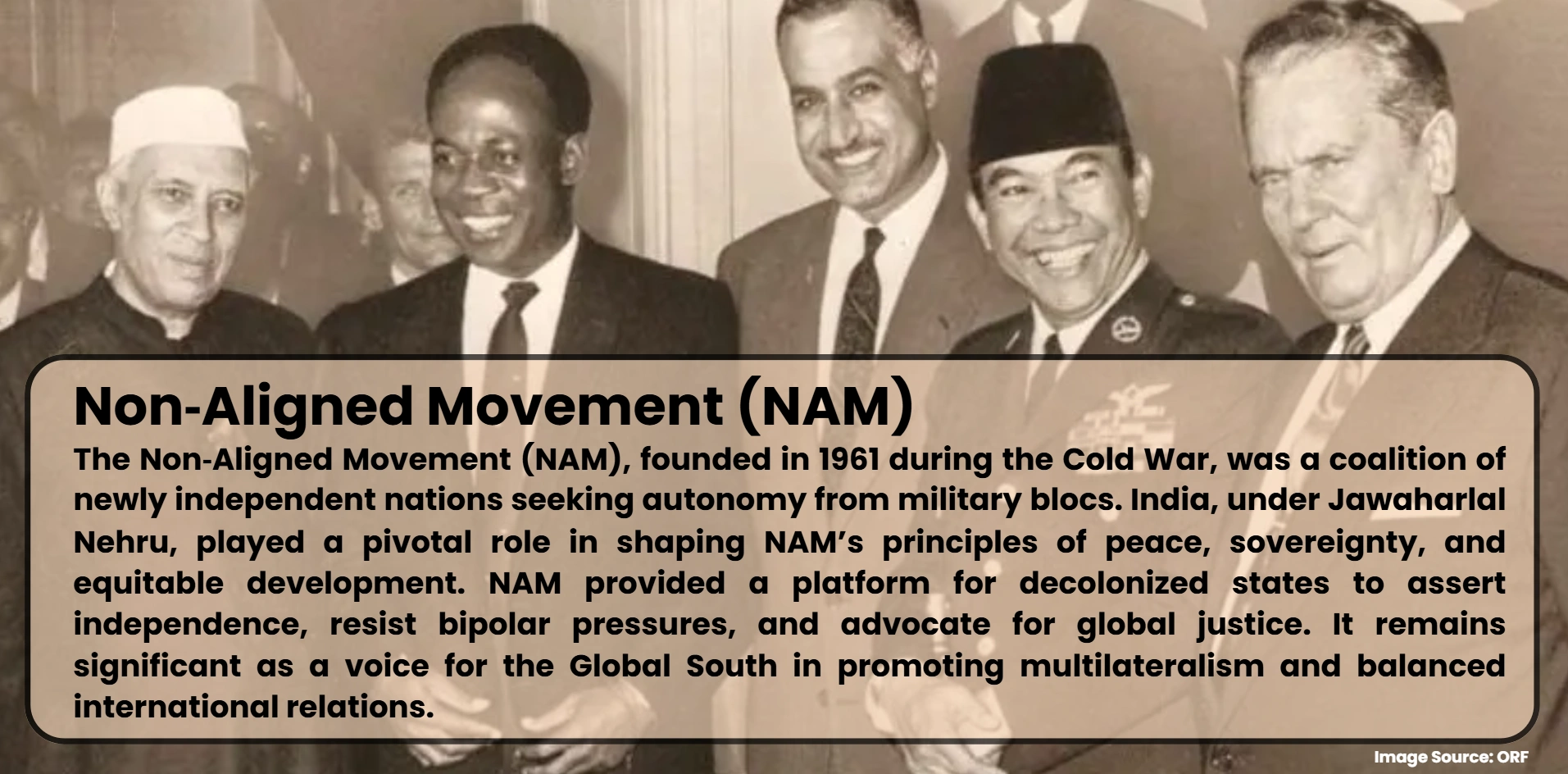
Nehruvian Vision and Non-Alignment
When the country achieved independence, Prime Minister Jawaharlal Nehru presented a foreign policy based on non-alignment, which focused on sovereignty, peace and opposition to bloc politics. Formally established in 1961, the Non-Aligned Movement (NAM) became the foundation of India's global identification, allowing it to dominate issues of decolonization, disarmament, and fair development but avoiding being caught up in the Cold War conflicts. Shaped India's post-independence journey, establishing it as a leading voice for newly independent nations, championing and anti-colonialism through the by advocating for , peaceful coexistence, and autonomy during the Cold War, even while facing challenges like and balancing ideals with to build a democratic, sovereign, and influential global role.
Pragmatism and Strategic Autonomy during the Cold War
Even though India declared that it was not aligned to a specific country, its diplomacy took on a certain degree of flexibility. Pragmatic alignment was seen in the 1971 demonstration of the Treaty of Peace, Friendship, and Cooperation with the Soviet Union, which dominated national security concerns. The Indian nuclear tests of 1974 have also contributed to the realization of the idea that India strived to achieve strategic independence, which reflects the equilibrium between moral rhetoric and the proclamation of hard power. India's Cold War journey was defined by Pragmatic Strategic Autonomy through its Non-Aligned Movement (NAM) policy, balancing post-colonial sovereignty with superpower rivalry, fostering leadership among developing nations (Global South), and shifting from idealism (Nehru) to pragmatic multi-alignment (Indira Gandhi) post-conflicts and economic changes, establishing a lasting legacy of independent foreign policy and global engagement.
Post‑Cold War Reorientation
In the 1990s, the fall of the Soviet Union and the emergence of globalization forced India to realign its foreign policy. The economic liberalization, which began in 1991, increased India's involvement with Western powers, especially the United States, with Russia having a long history. The Look East Policy was the signal of the strategic change to Asia, showing the significance of the regional integration and maritime security. It was the time when India transformed into a reactive and not a proactive participant in the international system because it started becoming aware of the economic and strategic weight of the decisions it was taking.
Modern Assertiveness
The twenty-first century Indian is adopting multi-alignment, where India deals with multiple power centres at the same time. Being a member of the BRICS, the G20, and the Quadrilateral Security Dialogue (Quad), India also demonstrates the desire to influence the system of global governance without having to be dependent on the United States, Russia, or China. The impact of India in the way of climate diplomacy, technological collaboration, and involvement of the diaspora has expanded the influence beyond geopolitical frontiers. This change highlights the fact that the Global South no longer holds a moral voice but is an aggressive stakeholder in multi-polarity formation.
The 21st Century Strategic Realignments
The 21st century Indian foreign policy portrays a form of sharp reversal of non-alignment dogmatism to the pragmatism of multi-alignment. The shift is conditioned by the long-term economic growth, the changing needs in security, and the quality of fluidity of world trends of power. India's 21st-century journey towards global leadership involves strategic shifts from traditional non-alignment to pragmatic multi-alignment, leveraging economic power (digital, IT, manufacturing), technological prowess (space, defence), and a proactive foreign policy focused on the Indo-Pacific and 'Neighbourhood First'.
Intervention with Major Powers
India has re-weighted its relationships with the United States, Russia, and China in an attempt to maintain strategic autonomy and maximize its national interests. The U.S.A’s relationship with India has evolved in the field of defense, technology and trade which is illustrated by the agreements, including the Civil Nuclear Deal of 2008. India, at the same time, maintains defense relations with Russia, thus making a diversification of its dependencies. The ties between China are still complicated, where there exists intense interdependence in the economic sphere, but they are also strained along the borders, and India is divided between competition and a careful approach. India's journey to leadership involves transitioning from a developing nation to a global power, leveraging its democracy, economic growth (especially in tech/digital), and strategic vision, exemplified by its G20 role and "Global South" advocacy, all while managing internal challenges and fostering innovation, aiming for a non-hegemonic, cooperative global role, and building on historical figures and a strong civilizational ethos.
Indo-Pacific and Maritime
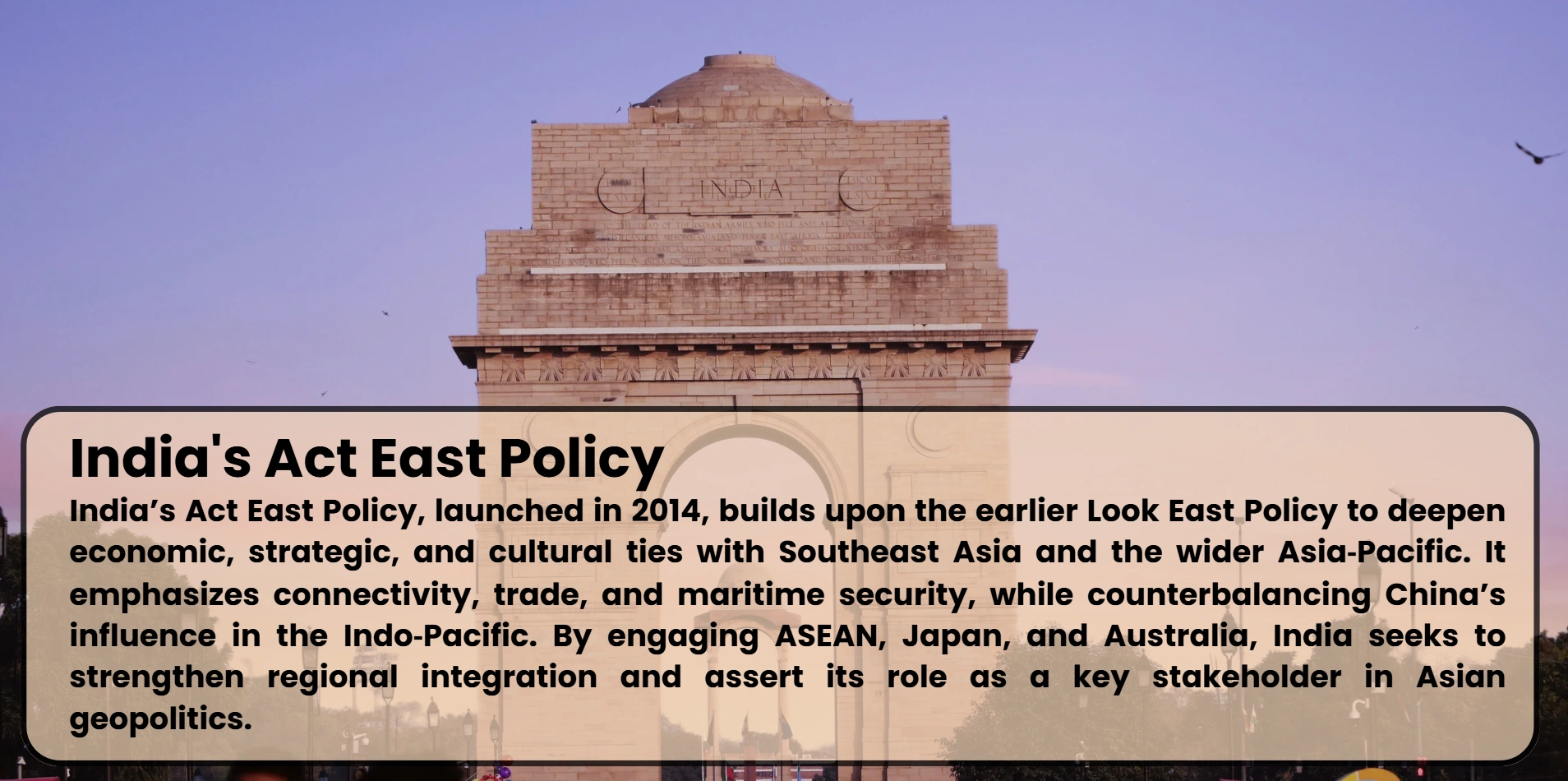
The strategic reorientation of India has taken centre stage in the Indo-Pacific. India is trying to balance the aggressiveness of China by initiatives like the Act East Policy and being part of the Quad (along with the United States, Japan, and Australia), along with encouraging freedom of navigation and regional stability. The sea lanes have marine diplomacy, such as partnerships with ASEAN and even states of the Indian Ocean, which highlight the fact that India has acknowledged that the sea lanes are components of its economic and security interests. India's journey toward Indo-Pacific leadership centers on leveraging its strategic maritime location, promoting a rules-based order, enhancing regional connectivity, and addressing shared security challenges through initiatives like the Indo-Pacific Oceans Initiative (IPOI), solidifying its role as a key security provider and economic partner in a region vital for global trade and stability
Emerging Forums and Multilateralism
The participation of India in the multilateral platforms like BRICS, G20, and the Shanghai Cooperation Organisation is an indication of its aspiration to influence global governance. It is through these forums that India gets chances of projecting leadership in matters touching upon financial stability and climatic change. The multi-aligned strategy by India consists of using partnerships and alliances without compromising Sovereignty. This initiative works to the benefit of India as an agent between India and developed countries.
Soft Power, Economy and Technology
Liberalization of the economy and technological innovation are now tools of diplomacy. The presence of the digital economy, renewable energy projects and leadership in pharmaceuticals enhance the global image of India. Besides, the Indian diaspora is a channel of soft power, strengthening the cultural and economic relationships throughout the world. These dimensions are a complement to hard-power strategies, thus allowing India to project power in various domains.
Economic and Technical Diplomacy
The foreign policy in India in the twenty-first century gives more and more focus on both economic and technological aspects. These tools of statecraft allow India to increase influence, gain access to resources, and project leadership in world governance mechanisms.
Trade and Economic Partnerships
Economic diplomacy of India aims at the construction and establishment of strong trade networks and the flow of investments. Bilateral agreements with the United States, the European Union and the ASEAN member states indicate diversification of the markets and overcoming dependency. It has taken energy diplomacy, notably in the oil and renewable sectors, to the forefront of sustainable growth. India is also a member of the G20, which indicates that it is determined to influence the global financial stability as well as promote fair models of development.
Technology as a Strategic Strength
Technological innovation has proven to be one of the important pillars in the diplomatic repertoire of India. Projects like the Digital India and Indian net projects, like artificial intelligence, cybersecurity, and space exploration, give the idea that India intends to transform into a knowledge economy. India's rise in partnership with developed economies, such as the United States and Japan, builds a stronger technological foundation for India, as well as builds more strategic trust. This technological diplomacy not only contributes to the modernization of the country but also makes India a reliable tool in solving the global challenges in the digital world.
Climate and Energy Diplomacy
The integration of both economic and technological diplomacy can be seen in the case of India, which has been a leader in renewable energy talks and climate talks. India is a country that takes the initiative to ensure that it promotes sustainable energy; the International Solar Alliance, which was launched together with France, is a good example of this action of the country. Through the use of technology to make clean-energy transitions, India is putting itself in a position of being a responsible stakeholder in tackling climate change. This scheme builds the Indian credibility on the part of the developing countries and complies with the sustainability goals across the world.
Aspects of Diaspora and Soft Power
The Indian diaspora is an important contributor to economic and technological diplomacy. Remittance, entrepreneurial networks, and professional competence in fields related to technology complement the presence of India around the world. The existence of the Diaspora communities also serves as an innovation partnership and cultural diplomacy, which strengthens India's soft power even more. This is the synergy between its economic power and cultural capital, which makes India more able to negotiate good results in the multilateral arenas.
The Future Trajectories of Global Leadership
The new era of India has been characterized by a foreign policy that portrays an intentional desire to transform into a global leader, rather than just a regional power. This aspiration is determined by the politics of multi-polarity, accelerated technological development, and the rise of the Global South.
Multilateral Institutions Reform
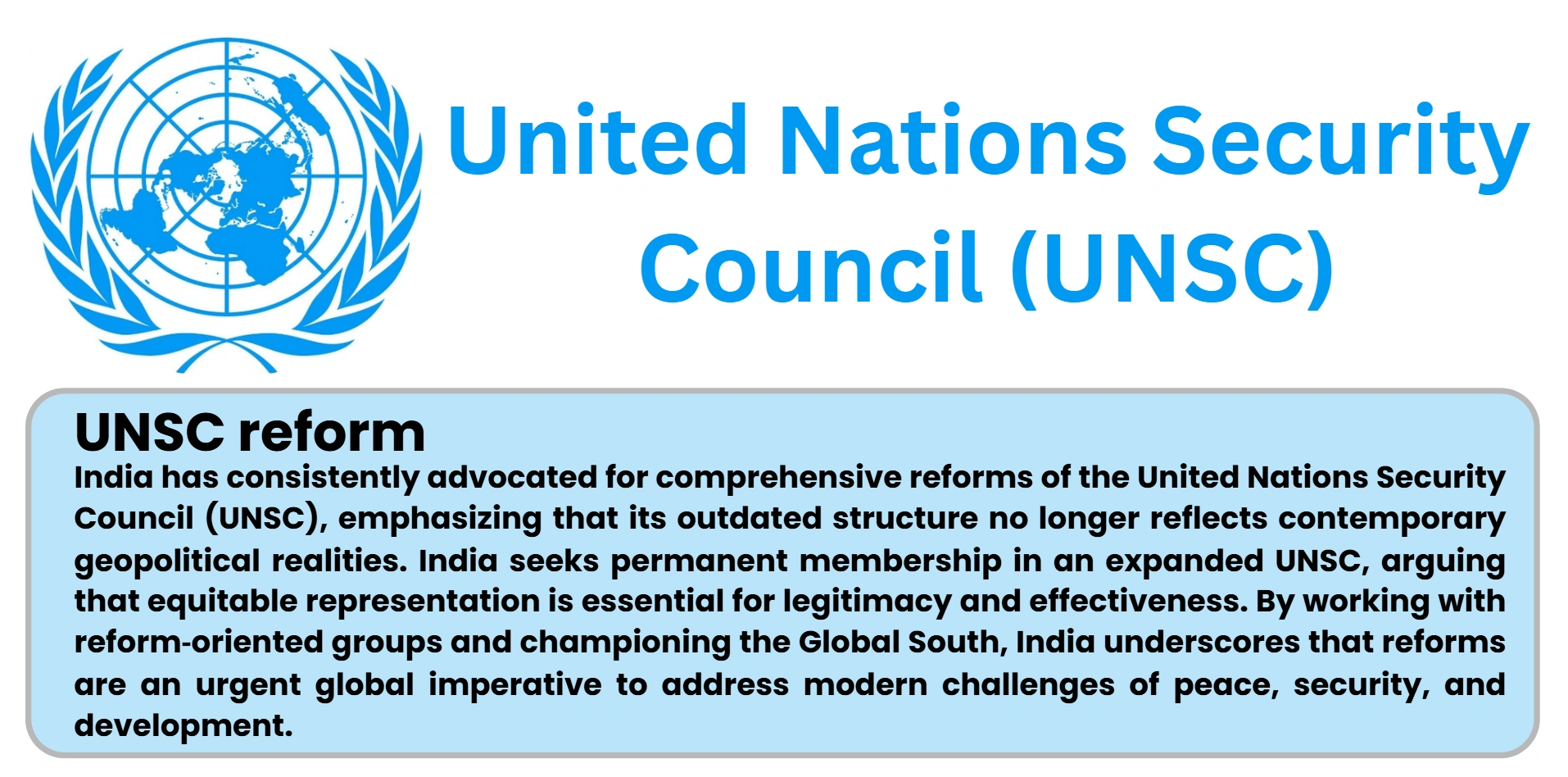
India has continued to pressurize the adoption of reforms in major world institutions like the United Nations Security Council, the World Trade Organization, and the World Health Organization. Its desire to join the UNSC permanently highlights a search to gain recognition as a responsible stakeholder. Through the promotion of equal representation, India wants to be a voice of the developing countries by trying to democratize world governance and achieve an inclusive process of making decisions.
Global South
The leadership of India is becoming more pronounced in expressing the concerns of the Global South. The roles India serves in providing public goods include vaccine diplomacy in the context of the COVID-19 pandemic, offering digital public infrastructure, and climate activities. By making use of the BRICS and G20, India advocates sustainable development, health equity, and financial stability, which adds to its persuasiveness that it serves as a connecting entity between developed economies and developing countries.
Innovation Strategy and Security Horizons
The presence of the Prime Minister Narendra Modi, External Affairs Minister S. Jaishankar, and National Security Advisor Ajit Doval as the leadership triad has transformed the Indian involvement in the world. Their strategy is a combination of political will, diplomatic oneness, and security vision, and allows India to operate in the intricate challenges of the Indo-Pacific and beyond. The strategic innovations, such as multi-alignment and proactive maritime diplomacy, also strengthen the role of India when it comes to either defining regional or global security architecture.
Future Trajectories
The future of India is determined by its ability to reconcile all the great-power competition and pursue inclusive agendas. Core values will continue to be economic resilience, technological innovation, and climate leadership. The future of India is marked by the increased focus on education, digital governance, and renewable energy, which promises to become a soft power supplemented with hard power.
Conclusion
The development of India as a diplomatic nation is a perfect case of transformation between non-alignment and multipolar alignment, still showing the continuation of the same trend in the past, as well as undergoing the modernity of innovation. Through a balance of relations with the major powers, a leadership of the Indo-Pacific, and economic and technological diplomacy, India has made itself a central player in global governance. It has great normative leadership, further strengthened by its call to institutional reform and its dedication to the Global South. Going forward, India will rely on its ability to maintain economic resilience, increase technological innovation, and be climate responsible in order to strengthen the position of a responsible stakeholder and a rising global leader in a multipolar world order.