|
Key highlights
- Repealing and Amending Act, 2025
- Amendments made to various statutes
- Section 213 of the Indian Succession Act
- Minimum government, maximum governance
- 1,562 obsolete laws eliminated since 2014
- Increased governance and judicial efficiency
- Need for institutionalised statutory review procedures
|
The article “From Redundancy to Relevance: Streamlining Laws through the 2025 Act” examines the Repealing and Amending Act, 2025, as a national housekeeping statute. It reports on its involvement in the abolition of out-dated laws and making discreet textual amendments to improve administrative effectiveness. The article highlights the role that the Act played in minimizing redundancy in the legal system, enhancing transparency, improving compliance, and bettering the business climate, and evaluates the drawbacks with a critical eye, setting out the merits of a methodical, periodic review of the laws to maintain an up-to-date legal system.
|
Tips for Aspirants
The article has a lot of relevance to candidates of the Union Public Service Commission civil services examination and state public service commission exams, as it enhances the understanding of the governance changes, the process of statutory clean-up, and legal modernisation, and the policy which is citizen-focused; they are the central themes in the realms of polity and governance.
|
|
Relevant Suggestions for UPSC and State PCS Exam
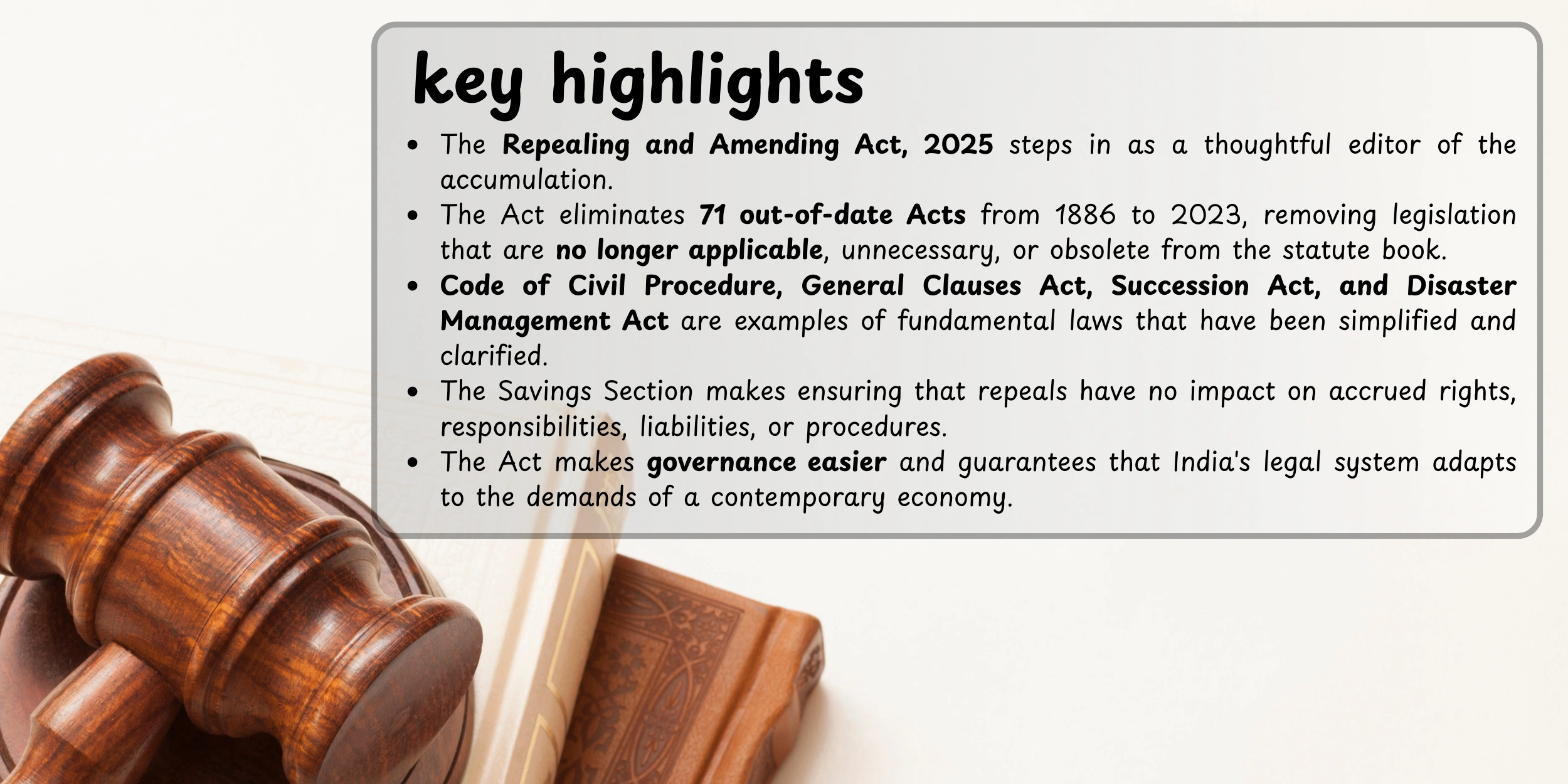
- Repealing and Amending Act, 2025, repeals seventy-one out-dated statutes, of which sixty-five are now amendment Acts already in force, incorporating primary legislation.
- This Act presents some of the amendments made to various cornerstone statutes, i.e., the General Clauses Act, 1897; the Code of Civil Procedure, 1908; the Indian Succession Act, 1925; and the Disaster Management Act, 2005.
- Section 213 of the Indian Succession Act has been repealed by operation of law, and the much-needed probate, which included elements of the colonial Probate, has been eliminated, leading to ease in inherent processes and limitation in litigation expense.
- The Act indicates the governance philosophy of the Indian in the form of “minimum government, maximum governance”, which emphasized on the essentiality of legal clarity and citizen-focused reforms.
- The legislative agenda has seen the repeal of over 1,562 obsolete laws eliminate 40,000 compliance requirements since 2014, which sets an example of a systematic approach to statutory clean-up.
- These reform implications include increased judicial efficiency, a reduction in compliance pressure on enterprises, increased transparency, and increased ease of doing business.
|
The 2025 Repealing and Amending Act is a landmark step towards the continuing process of rationalisation and modernisation of the statutory corpus in the Indian state. These Acts are enacted based upon the constitutional requirements, clear, accessible, and coherent, which riddle obsolete, redundant, or unwanted laws that no longer respond to the current governance exigencies. The statute in India over the decades has built a huge accumulation of enactments, most of which have lost their relevance over time through social and economic change, judicial reinterpretation, or through multiple generations of legislative development. Therefore, the Act should not be viewed as a mere procedural exercise that only pays service to the role played by the state as a steward of the law by making sure that the provisions in the Act or those that are contrary to norms do not hinder governance. The Act eases legal clutter by removing anachronistic provisions and offers small textual nuances that enhance the transparency process and make the compliance process more straightforward for both citizens and businesses and institutions alike. The act also underscores the fact that law should be a dynamic tool that is subject to changing realities and is suited to democratic principles.
The article holistically evaluates the Repealing and Amending Act, 2025, which traces its historical roots, explains its provisions, and discusses its substantive consequences. It makes the act much more of a part of an overarching discussion of statutory reform and the search towards an integrated Indian legal order. The Act removes 71 outdated Acts from 1886 to 2023, clearing obsolete, redundant and no longer relevant laws from the statute book. Simpler, clearer legislation with targeted corrections to core laws like Code of Civil Procedure, General Clauses Act, Succession Act, and Disaster Management Act.
Introduction and Context: • Impact of the 2025 Act on Governance and Ease of Compliance
The Repealing and Amending Act, 2025, is an exemplary point in India where the statutory housekeeping is long-standing with respect to the said act and the state's commitment to modernize its legal framework.
Historical Repealing
India has a time-honoured history of passing Repealing and Amending Acts in order to consolidate its statute book. Since independence, Parliament has on occasion repealed obsolete legislation, including much of that which was made during the colonial era. Those enactments serve as a tool of housekeeping of the law, so that provisions of law that have lapsed permeate governance or judicial interpretation. The practice emphasizes the principle that the law is to remain a living instrument and that it has to respond to the changing socio-economic realities.
The 2025 Act
In the Lok Sabha, the Repealing and Amending Bill, 2025 was introduced on 15 December 2025, and both Houses passed it in three days on 20 December 2025, and the president signed it on 20 December 2025. The Act abolishes 71 Acts, comprising 65 amendment Acts whose provisions have already been incorporated within the main legislation. Notably, it also presents specific amendments to the building legislations like the General Clauses Act, 1897, the Code of Civil Procedure, 1908, and the Indian Succession Act, 1925.
Important Reform
The most prominent is the reform where Section 213 of the Indian Succession Act is omitted, which stipulated probate of the will in several cities, such as Mumbai, Chennai, Kolkata, etc. This shift gets rid of an obstacle that existed during the colonial days, making it easier to transfer an inheritance, and it reduces litigation costs. The legal experts say that this amendment will change estate planning and administration significantly and will make the succession law more available to citizens.
Contextual Significance
The 2025 Act does not just constitute a technical practice but is a larger governance agenda. With the omission of old laws, the government maximizes facilitation of business, minimizes compliance, and boosts transparency. The repeal of 71 acts is evidence of a systematic process of clearing out the statute book in India, and this is in line with the best practices in the world, where, after a certain period, a review of the statutory process is institutionalized. Stepping even further, the act shows how legal reform could have a direct effect on citizens, either easing requirements on succession procedures or in terms of codifying procedures.
Key Provisions of the 2025 Act
The Repealing and Amending Act, 2025, represents a statutory instrument that streamlines the law in India by means of the elimination of no longer useful statutes, and adjustments of a minor scale with non-minor textual modifications to the core legislation.
Repeal of Obsolete Statutes
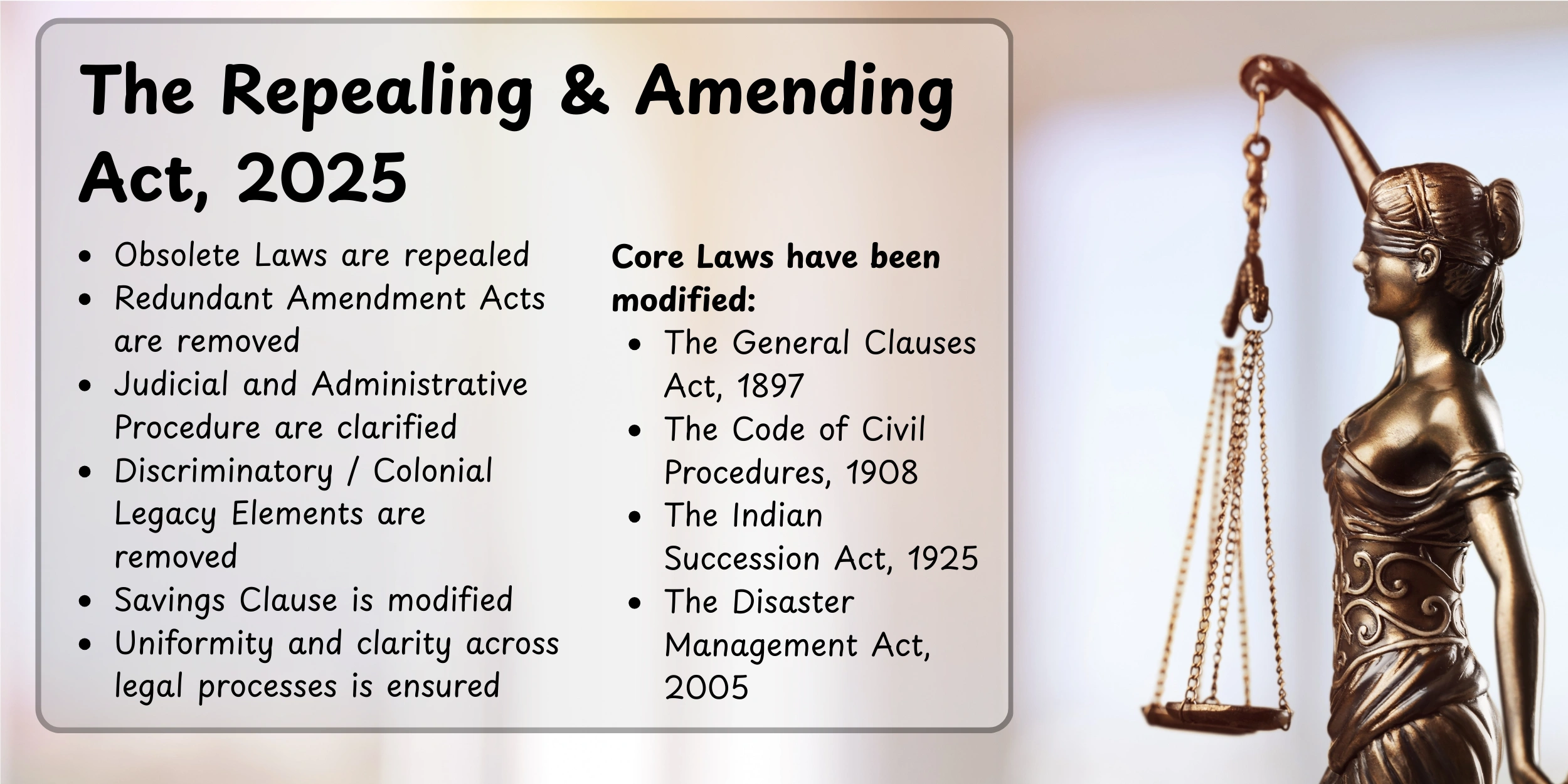
The Act repeals 71 Acts, including 65 Amendment Acts, the provisions of which have been renewed into major acts. Some of the repealed ones include the Indian Tramways Act, 1886; the Levy Sugar Price Equalisation Fund Act, 1976; and the Bharat Petroleum Corporation Limited (Determination of Conditions of Service of Employees) Act, 1988. These repeals represent the larger effort by the government to de-clutter the statute book and omit the laws that are no longer in functional use.
The Foundational Laws have been amended.
In addition to the repeals, the Act also has specific amendment of four key legislations:
- General Clauses Act, 1897 - revised terms in the communications section of the postal, substituting the old terminologies of referring to registered post with new terms.
- Code of Civil Procedure, 1908- The Code of Civil Procedure has undergone updates in text to modernize these guidelines according to current practices in communication.
- Indian Succession Act, 1925 - removal of Section 213, which used to require probate of wills in some jurisdictions, and thus made the process of wills easier.
- Disaster Management Act, 2005 - some slight amendments to make the statutory language consistent.
Succession Law Reform
This removal of Section 213 of the Indian Succession Act is especially remarkable. Wills in cities like Mumbai, Chennai and Kolkata had to be probated prior to enforcement, another pre-colonial requirement, which often led to delays and court disputes. Its exclusion is expected to make the process of procedural requirements lean and simple, improve the succession law accessibility, and save citizens resources.
Governance Philosophy
The Act is a reflection of the government's philosophies of minimum government and maximum governance. Over 1,562 obsolete acts have been abolished and 15 revised since 2014 and 40,000 compliance requirements have been eliminated. The 2025 Act continues this trend and will further enhance citizen-centric policymaking and enhance India through its ease of doing business scores. It makes statutory clutter more efficient to the judiciary, clearer to the administration, and compliant with businesses.
Governance, Economic, and Citizen Implications
The implications of the Repealing and Amending Act, 2025, are not explained only by the technical correction of the situation; this enactment determines the governmental efficiency and experience of the citizens by simplifying the statutory liability and updating the Indian legal system. In 2025, India introduced several major legislative reforms to streamline its legal landscape, which include the Income-tax Act, 2025, the Securities Markets Code, 2025, and the Banking Laws (Amendment) Act, 2025.
Governance Efficiency
The Act reduces the complexity of administration by repealing 71 out-dated statutes and 65 amendment acts, which are already part of major laws. Such simplification helps government departments and the judicial system to avoid anything that is contradictory and obsolete. According to official data, there have already been over 1,562 redundant laws repealed and over 40,000 compliance requirements removed since 2014, which proves a continued effort to ease the burden of governance.
Influence on Citizens
The immediate advantage in terms of the citizens is the impact of the Indian Succession Act, 1925, which eliminated the probate condition in Section 213 of the will in a few jurisdictions. This amendment limits litigation expenditure, expedites inheritance practices, and makes succession law more accessible. Citizens thus overcame colonial era setbacks that had disproportionately affected urban dwellers in Mumbai, Chennai, and Kolkata, hence furthering egalitarian estate management.
Business
The Act also supports the Ease of Doing Business agenda in India. Businesses are now exempted from out-dated laws like the Levy Sugar Price Equalisation Fund Act, 1976, which rendered them immaterial to comply with. The simplified legal codes not only result in the minimization of transaction costs but also create a sense of security among the investors. A study conducted by NITI Aayog has shown that a reduction in the amount of regulatory burden has a direct relationship with increased levels of entrepreneurial activity and enhanced global competitiveness in indexes.
Accountability and Democratic Transparency
Clean-up periodically through statutory means improves the transparency of operation by ensuring that both the citizens and institutions act under relevant and available laws. By making the statutes more streamlined, a clearer book of rules provides a boost to the rule of law, strengthens the rule of law, and increases accountability in governance. This coincides with the policy of the government of “Minimum Government, Maximum Governance” that views legal transparency as a precondition of being a democratic citizen.

Critical Reflection and Future Horizons
The 2025 Repealing and Amending Act is a major milestone in the current legislative rectification efforts in India; however, an assessment question regarding its broad impacts is necessary to gauge the achievement as well as failures with regard to the legal modernisation agenda. Critical Reflection and Future Horizons" refers to the process of deeply analyzing past experiences, challenges, and knowledge to understand their meaning, identify personal/professional growth, and strategically plan for future actions, innovations, and goals, especially in rapidly changing fields like technology or education, bridging what was learned with what can be achieved next.
Cosmetic Reform versus Substantive Reform
Descartes thought the Act received the repeal of 71 statutes together with 65 amendment provisions; the critics argue that most of these repeals are more often cosmetic in nature. The sheer fact that there are more extant laws that, in their effect, have already become defunct before being repealed is of substantive concern to whether or not such legislative interventions can truly be effective in any way in actual assistance of reform. A more constructive line to modernize legal status would involve a substantive questioning of the old main law, thus setting aside a preponderantly technical and procedural one.
Succession Law Amendment: A Good Initiative
The inclusion in the Indian succession of Section 213 was omitted in the Indian Succession Act of 1925, and simplifies the issues of probate, which consequently saves costs of litigation. The amendment has a direct benefit to the citizenry by simplifying such procedural requirements so that the democratic processes of inheritance benefit the citizenry. However, experts assert that the current succession model continues to imply new structural adjustments to deal with the endemic uncertainties of the testamentary succession and provide equal opportunities under different social conditions.
Institutionalised Review Mechanisms
The contemporary strategy of statutory purging of Indians is still sporadic and is caused periodically by legislative attempts. According to comparative research, states like the United Kingdom or Australia have created institutionalised Law Commissions which carry out systematic reviews of old statutes. There have been definite incidents where the Law Commission of India has supported the repeal of certain statutes, but without the statutory mechanism of regular review being established, there is still a high chance of reform being intermittent, as opposed to ongoing.
Transparency
Although the government officially declares that 1,562 out-dated laws and the removal of 40,000 compliance requirements since 2014 took place, independent empirical studies have found that a significant number of out-dated regulations still run in the state sphere. Without a coordinated effort between the State and the Union legislation, the flow of statutory clutter will hinder the efficiency of governance and citizen access to justice.
Way Forward
- The desired road to meaningful reform has been seen in the institutionalisation of statutory review by having a permanent, systematic process that ensures that repeals are not just cosmetic affairs.
- Their effect can be significantly improved by increasing the transparency of the process of identifying out-dated statutes, increasing their participation with the stakeholders, and keeping these practices consistent with the digital governance reforms.
- At the same time, during the implementation of statutory cleaning operations, the alignment of the initiatives with the overall legal modernisation measures, i.e., the streamlining of the procedural codes and harmonisation of the state laws, will ensure the reforms undertaken will be substantively well, citizen-oriented, and durable in the long term.
Conclusion
The Repealing and Amending Act of 2025 is an exemplary commitment to the ongoing effort of Indian policy-makers to modernise the statutory repertoire, as well as to increase the effectiveness of the governance arrangements. The Act and its repeal of the out-dated laws and creation of the strategic amendments have significantly reduced redundancy of the law, ensured transparency, and enhanced the ease of access to justice for citizens. Although the changes to the succession law are a major progress in the legal field, the general direction of this effort is the generalisation of the systematic review of the statutes, which acts as a method of maintaining the continuity and the richness of the law reform in general. In this respect, the Act endorses the axiom that the law should be kept dynamic, responsive, and democratically sensitive, thus helping to come up with a de jure, user-friendly, and strategically-focused legal regime in India.