The Thwaites Glacier, often referred to as the "Doomsday Glacier," is critically important because it is a rapidly melting, massive ice formation in West Antarctica that acts as a linchpin for global sea levels.Thwaites Glacier has drawn notice amongst scientific circles because it has been proven to have been melting faster than it was initially estimated, and is now being estimated to contribute about 4% towards the annual sea-level increase.
|
Key highlights
- Why Thwaites Matters?
- Global Climatic Significance of Thwaites Glacier
- Increasing Global Sea Level Threat due to Thwaites
- Geopolitical and Economic Consequences of Melting Thwaites
- Scientific and Policy Needs for Thwaites
|
The Thwaites Glacier has the world's widest glacial interface with the ocean, extending roughly 75 miles (120 km), and the collapse of this glacierLocated in West Antarctica, Thwaites Glacier has now been a point of reference in the modern climatology literature, due to its accelerated destabilising nature, and the relevance of the implications to the rest of the world. More commonly known as the “Doomsday Glacier”, it is the archetype of how vulnerable ice shelves in polar caps are to human warming and to disruption of oceanic circulation patterns. The potential melting of this ice block is one of the substantive causes of sea-level increase, and it poses real threats to the economies and communities at cores of the world. In addition to its environmental consequences, Thwaites also serves as an experimental laboratory both to understand the dynamics between ice and oceans and also to improve the efficacy of mitigation, adaptation and sustainable development policies since a bevy of its path is essential to the development of effective policies.The previous global missions not being able to instil measures, thus highlights the natural uncertainty of the glacier and the need to monitor it on a constant basis. The glacier might melt away entirely, thus triggering massive submersion of coastlines, hence making it a climatic risk.
Global Climate Significance of Thwaites Glacier
The Thwaites Glacier in West Antarctica, often called the "Doomsday Glacier," is critical to global climate stability because its rapid, climate-driven melting is responsible for about 4% of current global sea-level rise.Thwaites Glacier has taken up a central role in the global climate study because its increased rate of retreat has demonstrated how polar ice sheets are responding to the atmospheric warming as well as the thermal oceanic forcing.
Melting Thwaites an Indicator of Climate Change
Thwaites Glacier had shrunk significantly during the last forty years, with a geographic area as large as Florida or Great Britain. Owing to the International Thwaites Glacier Collaboration (ITGC) resulting in the creation of data, assessing intensified melting, it is reported that predominantly warm glacial ocean currents make the glacier a salient indicator of climatic instability.
Thwaites Contribution to Sea-Level Rise
At present, the glacier is adding about 4 % per year to the worldwide rise of the sea level. In case the ice mass accumulation is completely broken down, it is projected that an increment of up to 65cm will occur, and this will pose a threat to global urban centres along the coastlines. The sheet of ice is also very thick, about 2,000m, and this draws light to the sheer scale of the possible impacts.
Thwaites: Scientific and Policy Relevance
Recently, research teams of the United Kingdom and South Korea have undertaken drilling activities to obtain previously unheard-of datasets that are used to describe the sub-glacial melt processes that are instigated by oceanic waters. This kind of empirical data is crucial in the optimisation of climate forecasts, as well as in the international policy of emissions mitigation and adaptation policies.
Increasing Global Sea Level Threat due to Thwaites
The Thwaites Glacier, often referred to as the "Doomsday Glacier," is currently recognized as one of the most significant and alarming threats to global sea levels. Located in West Antarctica. The Thwaites Glacier is not merely a local irregularity; the destabilization of the glacier is a problem with implications concerning the global sea-level elevation as well as the groups that feature along the coastlines of the entire globe.
Scale of Potential Impact of Thwaites Glacier
Commonly referred to as the Doomsday Glacier has the size of area of about 192,000 sq. km (close to the area of Florida or Great Britain); the glacier has accumulated enough ice mass that can raise the water levels in the world by as much as 65 cm in case the glacier melts completely. Even a partial recession would submerge lowlands, resettle millions of residents on the coast, and redistribute the geomorphology surrounding the coast.
Doomsday Glacier’s Present Contribution to SeaRising
As the International Thwaites Glacier Collaboration (ITGC) suggested, the glacier currently contributes approximately 4% of the total yearly rise in sea level across the world. Observation of satellites, which was carried out by the University of Manitoba in 2025, has shown that fracturing in its eastern ice shelf is accelerating, implying greater instability and an accelerated pace of ice loss.
Long-Term Dangers of Melting Thwaites
This is despite the fact that a complete meltdown of the glacier cannot be predicted in the near future, but according to ITGC studies, the withdrawal of the glaciers will continue to increase in the 21st and 22nd centuries. This envisaged trend increases the call to develop global adaptation measures by building resilient infrastructures and putting in place emissions-reduction policies, to reduce the socio-economic impacts of sea level rise.
Glacial Melting and Volcanic Systems
Glacial melting, accelerated by climate change, reduces the immense weight (lithostatic pressure) on the Earth's crust, destabilizing underlying magma chambers and potentially triggering increased volcanic activity. This Glacial melting process, known as glacial unloading, enables magma to rise and triggers a dangerous feedback loop: volcanic eruptions emit greenhouse gases that speed up further ice loss, especially in regions such as Iceland, Antarctica, and the Andes.
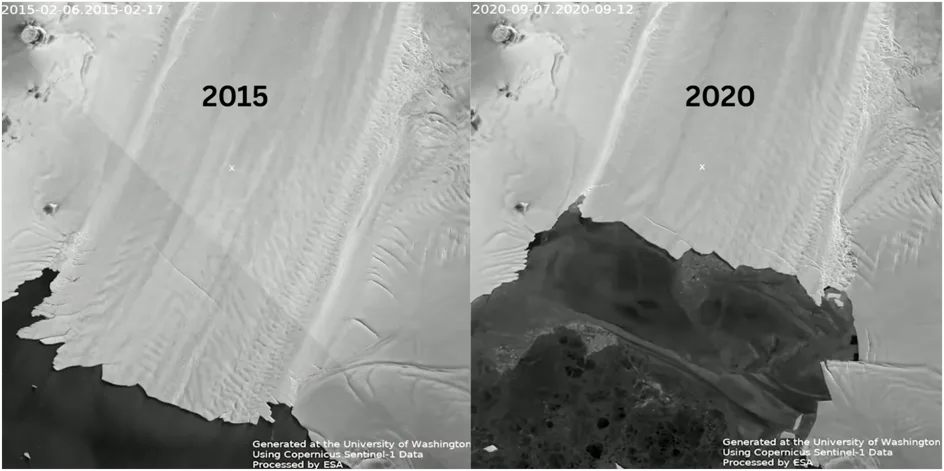
Geopolitical and Economic Consequences of Melting Thwaites
The rapid melting of the Thwaites Glacier in West Antarctica, often called the "Doomsday Glacier," is a critical climate tipping point with severe, long-term geopolitical and economic consequences.The disintegration of Thwaites Glacier is not only an environmental crisis but also a geopolitical and economic problem of widespread impact on a global scale.
Effect of Thwaites on Trade Routes and Coastal Infrastructure
Rising ocean levels (as a consequence of the melting of Thwaites) pose a threat to large cities, including New York, Shanghai, and Mumbai. These urban areas are important hubs in global trade systems, and their heightened exposure can upset shipping, financial markets, and international commerce.
Migration and Security Challenges due to Thwaites
Continued melting is likely to leave millions of people homeless in low-lying areas, as reported by the International Thwaites Glacier Collaboration (ITGC), by the end of the century. Such a scale of migration caused by climate is expected to boost the tension at the borders, create pressure on the humanitarian system, and change geopolitical alliances.
Economic Costs Caused by Thwaites
By 2050, climate-related flooding, according to the World Bank, is likely to cost the coastal economies in the measure of hundreds of billions of dollars. The opening of research installations on Thwaites, as demonstrated in 2026, is an indication of economic interest being recognized worldwide, and it goes to show that the world needs to integrate monitoring and adaptation initiatives.
Scientific and Policy Needs for Thwaites
Scientific and policy efforts regarding the Thwaites Glacier in West Antarctica are focused on understanding and mitigating its rapid, potentially irreversible, and globally significant ice loss. Scientific analysis of Thwaites Glacier is a pressing subject since its melting reflects the urgent issue of the environment and the policy of global climate management.
Scientific Understanding on Thwaites
Thwaites is melting more quickly than expected as a result of the warm ocean currents replacing the ice shelf, as evidenced by the International Thwaites Glacier Collaboration (ITGC), a joint UK-US program. Drilling missions during 2025 have had the benefit of yielding baseline melting information that has never been present before, and this information is crucial to the optimization of ice-ocean interaction models.
Thwaites’ need for Policy Solutions
As the results provided by ITGC show, the complete collapse is not expected to happen within the next few decades, but the process of the rapid recession in the 21st and 22nd centuries is probable. This path highlights the importance of having immediate policy solutions, such as a reduction of emissions, coastal resilience, and global collaboration on climate resilience.
Global Cooperation for Thwaites
The destiny of the glacier raises the issue of inculcating scientific evidence in the global climate negotiations. Providing a connection between the results of research and the practical measures will help policymakers more accurately predict the socio-economic consequences and develop sustainable frameworks to regulate the long-term risks.
Conclusion
The combination of science, environment, and policy in the climate crisis exemplifies Thwaites Glacier. The speed with which it is receding indicates that the threats to the world's sea level, coastal infrastructure, and human security are imminent. Scientific evidence is critical in governing a myriad of international climate processes, and research highlights the importance of including the dynamics to observe its evolution. Thwaites should be interpreted as the poignant lesson that prompt, collaborative action is the only thing that can avert the long-term effects on the planet.