|
Key Highlights
- World Inequality Report
- GDP vs. Distribution
- Global Economic Inequality
- Education as a Driver of Growth
- The Policy recommendations
|
This article will explore how growing GDP masks steep income inequality, highlighting that the World Inequality Report 2026 reveals that the top 10 percent of the global incomes take an unusually large proportion of national incomes compared to others, who account for 90 percent. It argues that this unequal allocation dilutes the education of the masses by limiting access as well as accessibility of the same to economically underprivileged groups of people. The educational system fortification is inalienable in reducing inequality and achieving inclusive, sustainable growth.
|
Tips for Aspirants
The article is particularly important to the candidates of the UPSC Civil Services Examination and to the aspirants who are preparing to take the exams of the State Public Service Commission, since it clarifies the main themes related to the policy of governance, social justice, and the challenging evaluation of sustainable development.
|
|
Relevant Suggestions for UPSC and State PCS Exam
- World Inequality Report 2026: The 10 percent income earners in the world have a comparatively high share of the entire world income, which is beyond 90 percent.
- GDP vs. Distribution: Aggregate GDP often obscures distributional disequilibrium at the aggregate level, which then solidifies inequalities of a structural nature.
- Access to Education: Inequity leads to poor investment in education, bad infrastructure, and limited opportunities among the marginalised groups.
- Social Mobility: Education enables people to experience upward mobility, break the poverty cycle, and empower the poor.
- Democratic Participation: Education empowers the citizenry, which reinforces the governance systems, accountability systems, and social integration.
- Political Requirements: Progressive taxation schemes, redistributive welfare, universal access to education, and quality-oriented reform are all essential to improve the systems.
- Sustainable Development: by reducing inequality through educational interventions, ensuring equitable growth of GDP, and creating resilience in the long run.
|
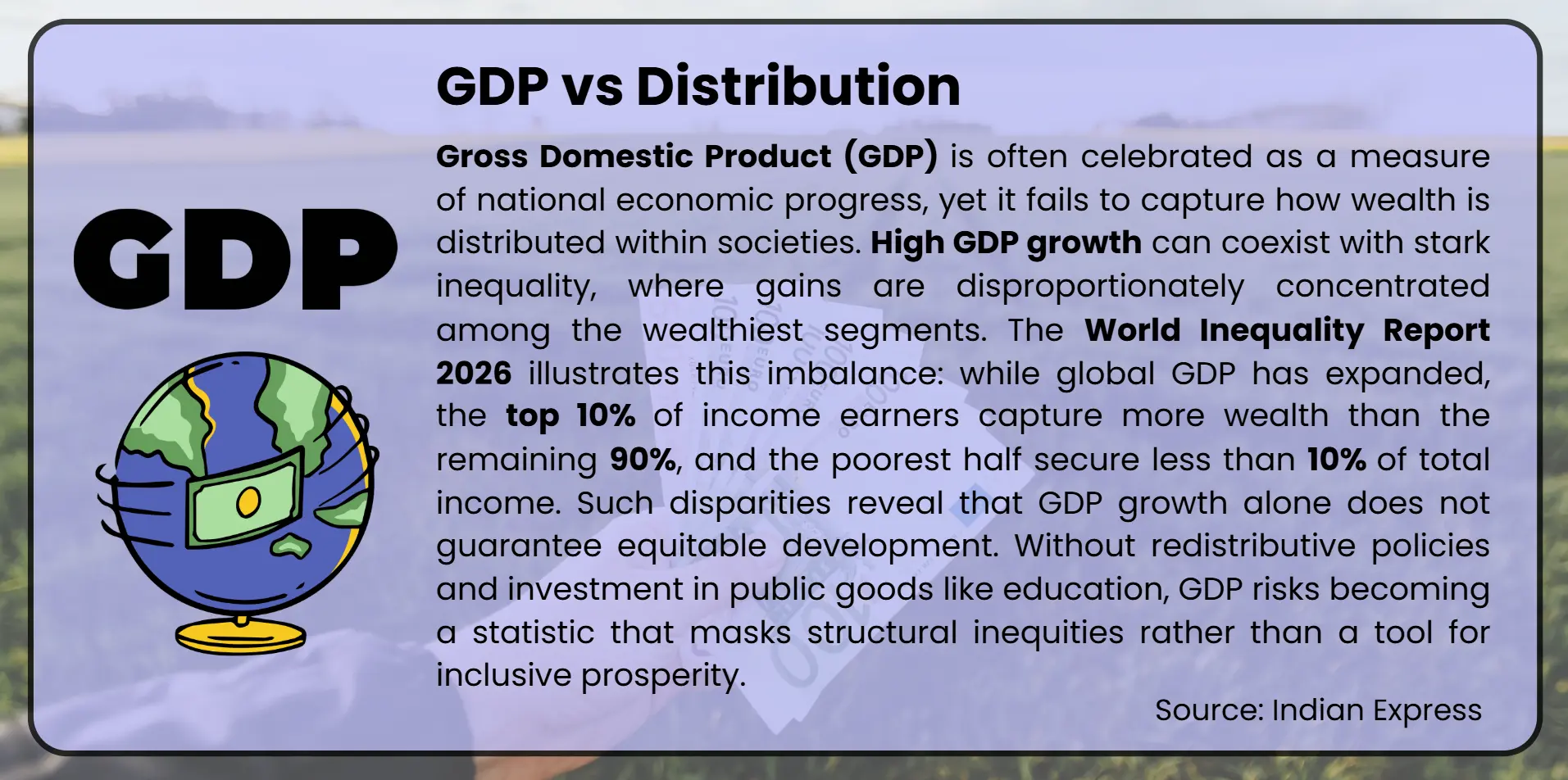
Traditionally, Gross Domestic Product (GDP) has been regarded as the major proxy of economic performance, but its suitability as a reflection of the experienced lives of the people has been a topic of academic discussion. This paradox is amplified in the 2026 World Inequality Report, which stated that the top ten percent of the world's income earners take more of the wealth than the sum total of the remaining ninety percent of the population and that the bottom half of the global population earn less than ten percent of total income. This kind of excessive imbalance highlights the structural imbalance between macro-economic growth and decent resource allocation. In this context, communal education becomes one of the major sources of inequality as well as the focus of its possible alleviation. Having quality education is not just a social good but a factor of the science of continuing economic engagement, acquisition of human capital, and inclusion of development. However, the truth of allocation of resources, disproportionally slow institutions, and systemic adherence often delay the redistributive efforts of education.
The World Inequality Report 2026 identifies large and permanent worldwide inequities in gender, wealth, and income as well as significant differences in the effects of climate change. The World Inequality Lab's report, released on December 10, 2025, highlights that these gaps are not predictable but rather the result of institutional and political choices.
Understand How Education Inequality Impacts GDP Growth
Education inequality significantly harms GDP growth by creating a less skilled workforce, stifling innovation, reducing overall human capital, and perpetuating poverty cycles, leading to lower productivity, reduced competitiveness, and slower economic expansion, as unequal access to quality learning limits potential and widens income gaps.This article focuses on the complex connection between GDP, inequality, and public education, in which the sustainability of economic development depends on resolving educational inequalities. With education as the core of redistributive policy, the society will be able to replace GDP as a measure of aggregate wealth with a process of promoting equity, social mobility, and democratic sustainability.The "hidden cost" of the education divide on GDP and inequality is a self-reinforcing cycle of disadvantage, where unequal access to quality education entrenches income gaps, limits social mobility, and ultimately stunts broad-based economic growth.
The Global Income Inequality
Global income inequality is still among the most burning problems of the modern economic discussion, as it shows a stable imbalance in the ways of wealth distribution and provides opportunities in the countries and communities.
Increasing Inequality of Wealth
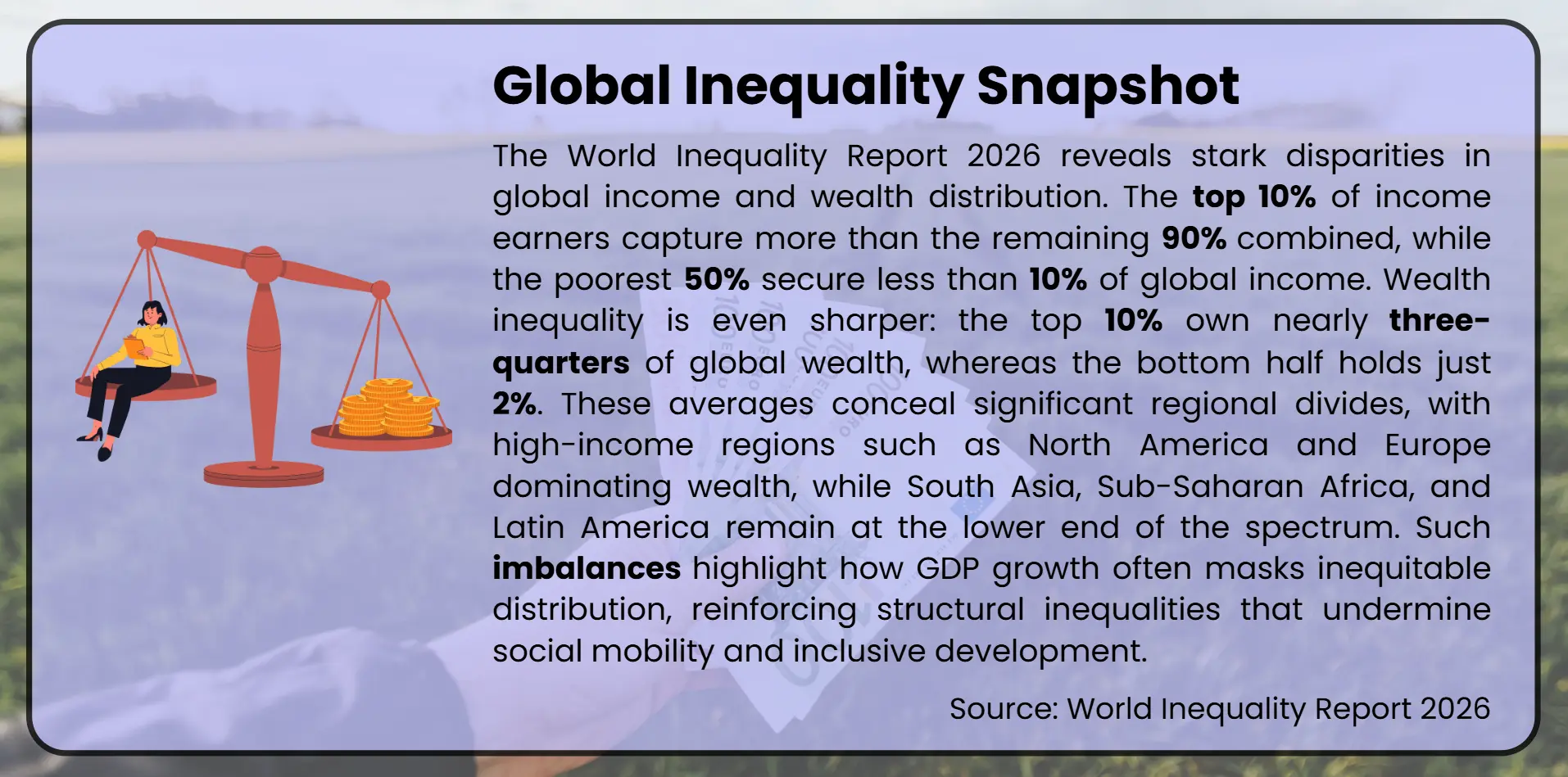
The report on World Inequality 2026 notes that the top ten percent income-earners in the world round up more wealth than the bottom ninety percent, and the poorest half of the population has less than ten percent of the total wealth. This centralization of resources reveals the increasing gap between the wealthy population and disadvantaged groups. One area is even worse, inequality in wealth; the top ten percent control close to three-quarters of the world's wealth, leaving the remaining half with only two percent. Such numbers are used to explain that inflation in aggregate GDP can actually obscure underlying distribution inequalities.
Income Inequality within Geographical Areas
International means obscure, big regional differences. Wealthy areas such as North America, Oceania, and Europe control the top income distribution areas; other populous areas like South Asia, Sub-Saharan and some parts of Latin America continue to grapple with low incomes per capita. Such inequalities are not just economic but also social and perpetuate poverty cycles and restrict access to basic services like healthcare and education. Unequal income distribution between the regions shows how inequalities that are structural persist even after globalization and integration of the economies.
Consequences of Social Mobility
Social mobility is directly affected by inequality in income, which limits the ability of people with a disadvantaged upbringing. With wealth concentrated in a few hands inthe elite, there is inequality in access to quality education, medical facilities, and jobs. This further fuels intergenerational poverty as children who are born into poor families arestill systemically disadvantaged with respect to those who can rise to better their lives. As highlighted in the report, inequality is not some statistical element but is a reality that is experienced by the prospects of billions of people around the globe.
Research and global governance
It is important that the issue of global income inequality can be tackled only through joint policy measures at the national and global levels. With progressive tax, welfare based on the redistributive element, and investing in the public good like education and healthcare are all most important in the reduction of the gap. Additionally, the international systems of governance should focus more on the concept of inclusive growth and sustainable development so that the growth of the GDP can be equated to the equitable outcomes. Otherwise, inequality may destroy democratic institutions, create social unrest, and diminish the legitimacy of economic systems.
Inequality and Access to Public Education
Income inequality has a huge effect on the avenues to and the standards of societal education, with a systematic effect on accessing learning opportunities with equality and disparity affecting the survival of new generations as long as poverty persists.
Inequality in the Distribution of Resources
The public education systems rely on government funding, which is paid in accordance with the region's economic strength. In wealthy areas, the funds are allocated to the schools in better structural forms and better teachers, and educational resources. Conversely, even schools in low-income areas are constantly underfunded, overcrowded, and lack access to technological resources, which only contributes to inequality and deprives the people living in disadvantaged areas of access to the same educational opportunities as their more financially stable peers.
Social Economic Blocks to Access
Income inequality has a direct impact on the ability of households to attend to the educational activities of their children. Families with low incomes face under-the-counter expenses such as transportation, uniforms, and additional learning resources, and they often end up leading rural pupils to increased dropout. Besides, children of those families that have lower economic status are more likely to engage in child labor or domestic work, further restricting their educational access and reducing their chances of a high socioeconomic status in the future.
Quality of Learning
Inequality is a significant phenomenon that affects the quality of education. Poorly resourced schools cannot afford well-trained teachers, up-to-date curriculum, and extracurricular activities, resulting in low standards in learning. Marginalized students are often faced with discrimination and exclusion, which only adds to the disadvantages of achieving academic success. On the other hand, the elite privately operated institutions provide more enriched environments in preparing students for academic higher education and the competitive work market, delivering more stratification in the social classes.
Development Consequences
The consequences of inequality in educational activities of people are not limited to the individual learners, but that of society at large. Limited access to quality education obstructs the development of human capital, the exploitation of productive capabilities, and maintains inequalities in income distribution. Without having fair systems of education, countries stand a chance of losing social mobility and democracy. It requires specific policies, including progressive taxation, teacher training, and access to quality schooling, to guarantee that these issues are addressed to identify and remedy them, and promotes inclusive growth through prioritizing education as a social good.
Education: Driver of Growth
It is a common fact that education is one of the primary pillars of inclusive development that enables the process of economic growth to be converted into fair opportunities and sustainable development at unequal levels of social and economic prosperity.
Human Capital Formation
Education strengthens human capital because it provides a person with skills, knowledge, and competencies that are necessary to take part in the economy to productively participate. An educated workforce encourages innovation, boosts production as well, and increases responsiveness to technological alteration. Thus, the economic growth becomes not concentrated in elite groups, but dispersed throughout society in extended circles. Education creates a wider level of parity in the labor markets by decreasing skill disparities and enhancing a more even GDP growth.
Enhancing Social Mobility and Recurring Inequality
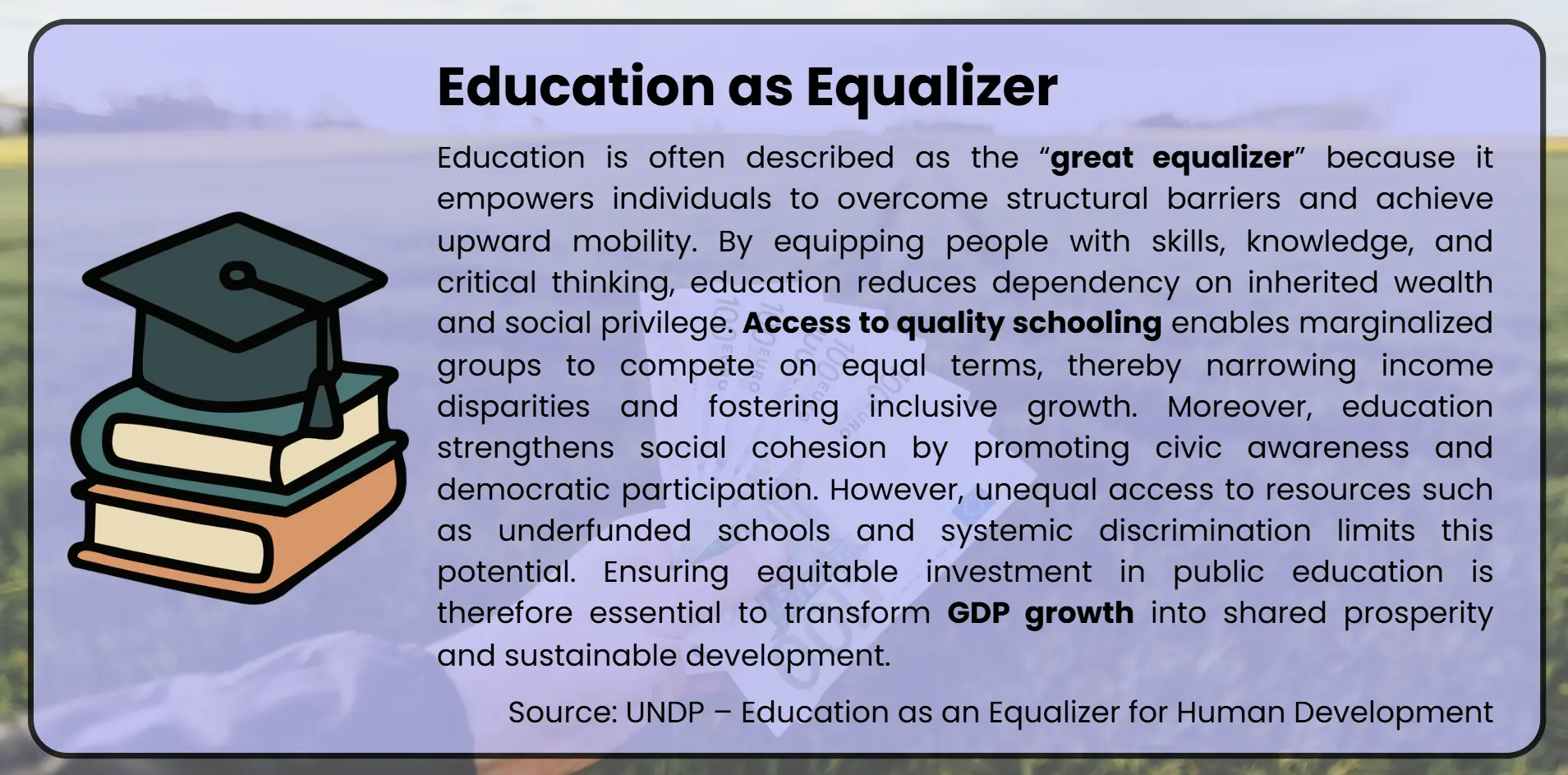
The right to high-quality education is an effective equalizer in the sense that it helps people with disadvantaged backgrounds overcome the structural factors and achieve horizontal mobility. With proper funding of the education systems in the populace, there would be a provision of access to the marginalized groups to compete at equivalent levels with the privileged. This mechanism reduces the disparity in income and makes a more equal distribution of the increment in dividends. Therefore, education serves as a redistribution tool and reduces the gap between the wealthy and the less fortunate.
Enhancing Democratic Participation
Inclusive growth is related not only to economic but also to social and political aspects. Education enables citizens to have a sense of rights, responsibilities, and how governance works. An educated and sensible population is more likely to participate in democratic bodies, enforce accountability, and oppose usury activities. This civic engagement strengthens social unity and makes growth plans incorporate general interests as opposed to the selfish interests of the elite users.
Policy Requirements of Inclusion Growth
Governments should focus on universal access, quality improvement, and equity when distributing resources in order to make education a boost to inclusive growth. Educational disparities can be addressed by implementing policies that include progressive taxation, teachers' training and development, and the development of digital infrastructure. In addition, instances of inclusive education that consider the wide range of abilities and backgrounds result in integration into society and reduce exclusionary attitudes. Through institutionalizing education into national development policies, the states will be in a position to ensure that a growth in GDP will be translated into sustainable social and economic development.
The Policy Recommendations
Closing the gap between inequality and formal education in society requires deliberate policy action, which should not only be anticipatory concerning equity but also provide the means of redistributing resources, along with ensuring all have equal access to high-quality learning opportunities somewhere along a continuum of socio-economic statuses.
Redistributive Fiscal Policies
Progressive taxation and equal distribution of the budget are inseparable tools for reducing the imbalance in educational financing. The governments ought to redistribute the income of the affluent groups to the development of the education infrastructure, especially in the marginalized areas. Through fiscal redistribution, it is possible to have proper school infrastructure, teaching facilities, and technological tools in the disadvantaged communities. These and other measures not only mitigate inequality but also enhance the ability of education to work as an agent of inclusive development.
Universal Access and Equity in Education
Policies should ensure that education is made universal regardless of the socio-economic background, gender, or place of residence. Activities that are necessary to achieve this goal include specific subsidies, free access to vital learning resources, and school network expansion in rural and underserved regions. Political policies based on equity also require the eradication of systemic divisions like caste, ethnicity, and disability, therefore making the educational systems inclusive and representative of the various groups of people.
Empowering Quality and Accountability
In addition to access, the quality of instruction is also an imperative factor in determining educational results. Governments are to put significant funds into training of teachers, updating curriculum, and digital infrastructure to ensure that the learning environment in public schools becomes competitive. Responsibility structures, such as open tracking of the distribution of resources and strict assessment of performance, are imperative to eliminate waste of funds and ensure policies are changed into actual changes. The reforms that are driven in terms of quality can assist in closing the gap between the elite-based private institutions and the struggling state schools.
Coordination of Global and National Policies
Educational inequality is universal and does not depend on national borders, but is a manifestation of the larger economies of the world. Cooperation between countries on the international level provided by multilateral organizations may assist countries with low income in the form of financial support, exchange of information, and capacity building. On the national scale, policies like the National Education Policy (NEP 2020) in India value inclusion and equity and provide a full structure of bridging access and quality disparities. Efforts at both macro and microlevels thus cannot be done without integrating education with the overall aims of sustainable development.
Conclusion- World Inequality Report 2026 Released
These elements generated by the interaction of gross domestic product (GDP), income inequality, and education funded by the state provide significant emphasis on the self-limiting nature of economic growth when it is not tied to a fair distribution system. In the World Inequality Report 2026, results demonstrate that there are strong inequalities that defeat the transformational power of education, restricting access to it and sustaining intergenerational poverty. Properly funded and well-organized public education becomes an active agent in enhancing inclusive growth through capital enrichment of people, reducing disparities, and reinforcing democracy. These imbalances require the need to redress them with redistributive fiscal policies, universal access schemes, and quality-focused reforms. In the final analysis, sustaining development is pegged on achieving equity, matching the growth of GDP, such that education is one of the supporting pillars of equity as well as parity of the society and the economy.