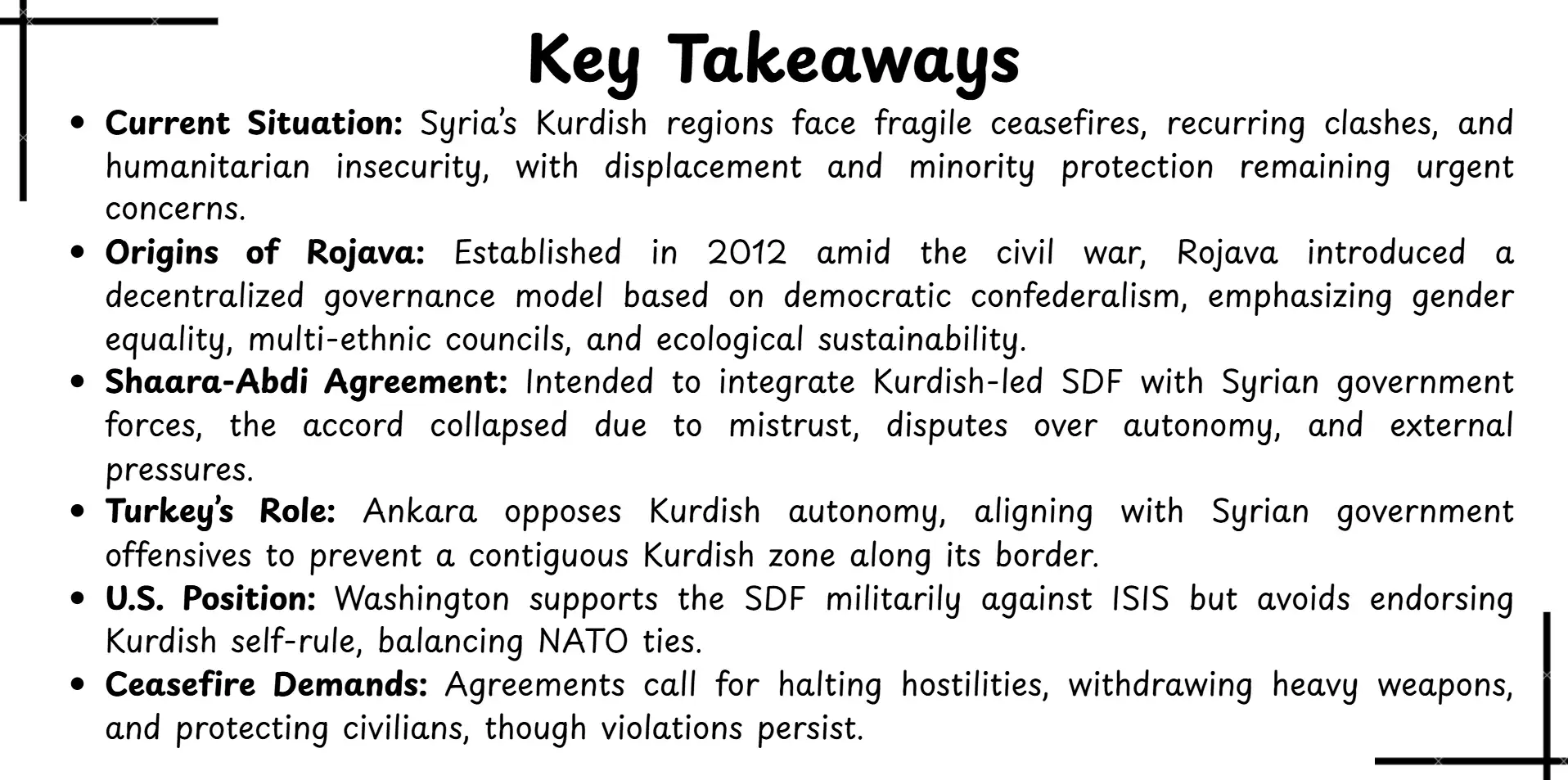
The recent outbreak of hostilities between state forces and the Kurdish-led Syrian Democratic Forces (SDF), the fragile ceasefire, and increasing concerns about the security of minority populations, the control over strategically valuable oil fields and custodial camps of those involved in the IS have drawn renewed attention to Syria and its Kurdish regions.
|
Key highlights
- Kurdish Regions in the Syrian Situation
- Kurdish Ceasefire Fragility
- Establishment and Origin of Rojava
- Compromises in Kurdish regions
- The Shaara‑Abdi Agreement
- International Dimensions of Kurdish Regions
- Demand for a Ceasefire in the Kurdish regions
|
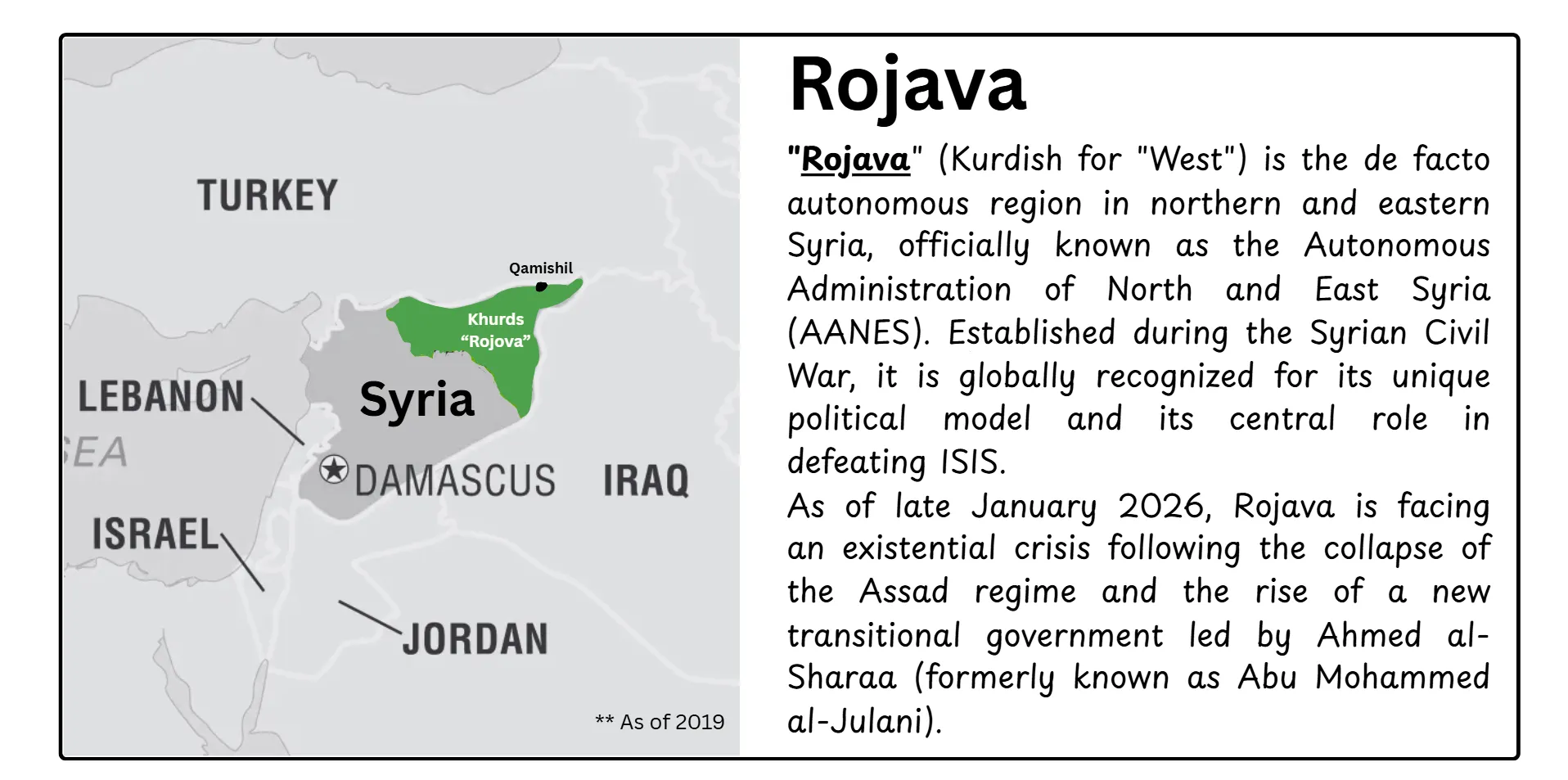
The Kurdish regions of Syria, specifically, the Democratic Autonomous Administration of North and East Syria (widely known as Rojava), have gained an epicentre in the intricate dynamics of the ongoing Syrian warfare. Projected in the times of the civil war, Rojava is an example of an experimental code of decentralized government with references to multi-ethnicity and gender egalitarianism. However, the course of its development has also been strongly predetermined by the weak alliances, unsuccessful agreements, and interventions. The collapse of the Shaara-Abdi pact, Turkish alliance with the pro-government forces in Syria, as well as the non-partisan stance taken by the United States, is an expression of the overall geopolitical rivalry. The current ceasefire conditions highlight the vulnerability and the important strategic aspects of the area.
Kurdish Regions in the Syrian Situation
The Kurdish regions of Syria remain one of the centres of geopolitical struggle that is being characterized by the temporary stop of hostilities, shifting alliances, and unfinished humanitarian issues. The combination of the resilience of the local society and the instability of the regional political situations can be seen in the most recent developments.
Security and Governance Problems in Kurdish Regions
North and East Syria remain under the control of the SDF, led by the Kurds, whose administration has continued to control areas of the region in the name of the Democratic Autonomous Administration. However, the control of the area is even more disputed by the offensive actions of the Syrian government troops and the Turkish-supported factions. In Qamishli, residents have established volunteer watchdog groups to guard neighbourhoods, hence presenting expanses of community-sanctioned attempts to maintain independence where there is no strong outer commitment.
Kurdish Ceasefire Fragility
An announcement of a four-day ceasefire on 20 January 2026 disrupted fights between the state-aligned forces and the SDF. However, attacks continued in places like Kobani, where artillery shelling was reported throughout the ceasefire. The signal of resumption of the ceasefire on 25 January 2026 raised anxieties over the prospects of violence returning to the country and the nature of some 7,000 former IS detainees incarcerated in SDF-controlled detention camps, with the United States Central Command seeing responsibility in their transfer to Iraqi custody.
Humanitarian Dimensions in Kurdish regions
The minority groups, such as Kurds and Yazidis, get more insecure despite the government activities that keep improving. The United Nations warned that fresh violence may disrupt the current transitional process in Syria, which is already weak, thus endangering the hope of resettlement of almost three million refugees who have returned to Syria in the previous year.
Implications for Kurdish regions
The situation brings the problem of fragile balancing acts between local autonomous governance and exterior intervention. With Turkey taking a stance against Kurdish self-determination and the United States taking a risk-averse position, the Kurdish lands are vulnerable to geopolitical stratagems as well as humanitarian emergencies.
Establishment and Origin of Rojava
The Kurdish communities established autonomy in the context of the Syrian civil war, which reduced the state's power, resulting in the establishment of Rojava. The way in which it was established reflects not only ideological innovation but also concrete answers to the instability in the region, which illustrates a meeting of abstract and concrete demands.
Historical foundations of Rojava
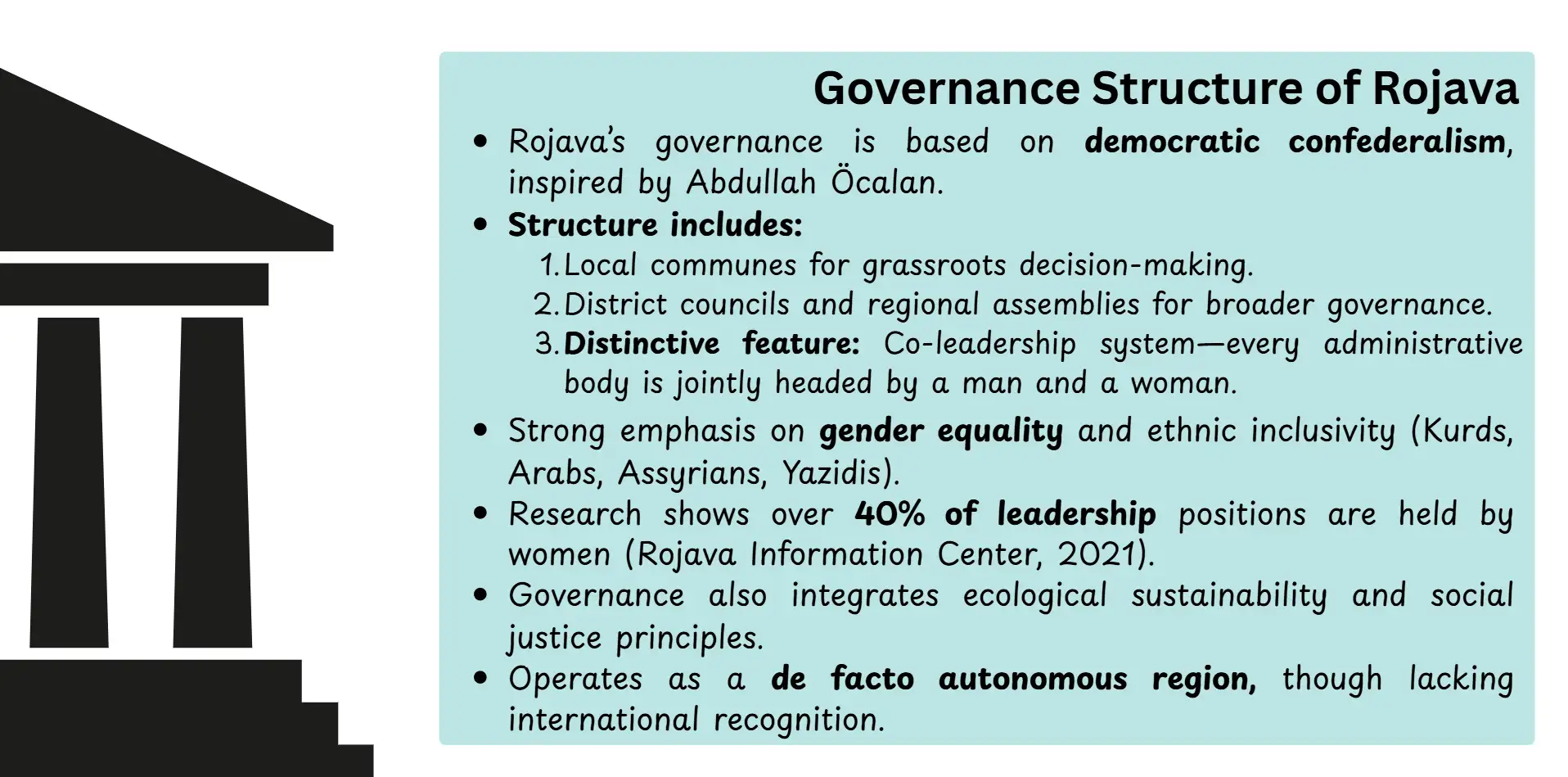
Formally known as the Democratic Autonomous Administration of Northern and Eastern Syria, Rojava was established in July 2012, and Kurdish-majority regions declared their autonomy from the Syrian government. This has been accompanied by the disintegration of state control in Syria that has come with the civil strife. Using the hypothesis of democratic confederalism as postulated by Abdullah Öcalan, the Kurds imagined a decentralised and participative style of governance. As per the Rojava Information Center, the organizational fabric of the state shifted to the commune and councils to stress the local choice-making and grassroots democracy.
Political and Social Preambles of Rojava
The administration legalized gender egalitarianism, multi-ethnicity, and ecological sustainability. Women were raised having councils and co-leadership settings to override the old patriarchal systems. According to empirical studies, in 2014, Rojava had developed functioning local parliaments and defense forces, including Kurds, Arabs, and Assyrians in its governmental system.
Governance in Rojava
The type of governance in Rojava was well-known on a local level, but it worked as a de facto autonomous state. Its administrative centeris Al-Hasakah. The area was commanding a significant amount of land and oil deposits, which gave it economic power by 2016. Historians believe that this independence also threatened the Turkish state and the Syrian government, which felt that Kurdish autonomy would not only be a source of national security in the country.
Significance of Rojava
The creation of Rojava is a unique experiment of grassroots democracy in a conflict zone. Its roots highlight the combination of effort between the vision of ideology and survival reality, thus creating one of the most striking political affairs in the modern Middle East.
Regional Choices and Political Compromises in Kurdish regions
Political agreements across the Kurdish states of Syria have steered the course of self-governance and warfare. Their instability and changing alliances demonstrate the changes that are too volatile in the government under regional and international challenges.
The Shaara‑Abdi Agreement
In 2019, the Shaara-Abdi agreement was signed to establish the Kurdish-led Syrian Democratic Forces (SDF) within the Syrian government in order to provide stability in the territory. The mistrust between Damascus and the Kurdish leadership, however, complicates the situation by the argument over resources controlled and military command, resulting in the failure of the agreement. Analysts note that the Syrian government was not interested in giving meaningful autonomy, whereas Kurdish leaders were worried about losing newly acquired self-governance.
Turkey’s involvementin the Kurdish Regions
Turkey has continued to counter this Kurdish autonomy on the basis of supposed links between the SDF and the Kurdistan Workers Party (PKK). It was shown that Ankara justifies its offensive military support to the Syrian government in its retaliation operations in northern Syria due to security reasons and the aim to avoid an adjacent Kurdish enclave bordering it. The militias that are supported by Turkey have also been at loggerheads with the Kurdish militias, hence making it difficult to enforce cease fire.
U.S. Ambivalence in the Kurdish regions
The US position has been two-sided; the US is willing to collaborate with the SDF to fight ISIS, but it does not directly endorse Kurdish autonomy. Records held by the Pentagon reveal that in 2015-2021, the U.S. trained almost 60,000 SDF fighters, but Washington refrained from political recognition.
Regional Alignments in Kurdish regions
Such dynamics depict a three-sided rivalry between Kurdish ambitions, centralization of the Syrian state and Turkish security demands. The collapse of the accords proves the challenges of the reconciliation between localized autonomy and regional power politics.
International Dimensions of Kurdish Regions
Kurdish territories of Syria are inextricably involved in international politics, where the arrangement of ceasefires and the involvement of third parties highlight the tense balance between the local and international interests of strategy.
Strategic Ambivalence of the U.S in the Kurdish regions
The U.S has been very instrumental in aiding the Syrian Democratic Forces (SDF) in countering the ISIS group by training close to 60,000 soldiers between 2015 and 2021. However, Washington has not been willing to support the autonomy of Kurds, adopting a more careful position in order to avoid estranging Turkey, which is a partner in NATO. This ambivalence underscores the conflict between counterterrorist goals and geopolitics in general.
Turkey’s position on the Kurdish regions
Turkey believes that the Kurdish self-rule poses a direct security threat because of certain perceived connections between the SDF and the PKK. Ankara has also encouraged the Syrian government in the north of Syria to erode Kurdish authority and has also been promoting buffer zones close to its boundary. This kind of alignment complicates the enforcement of the ceasefire and undermines the Kurdish hopes of permanent autonomy.
Demand for a Ceasefire in the Kurdish regions
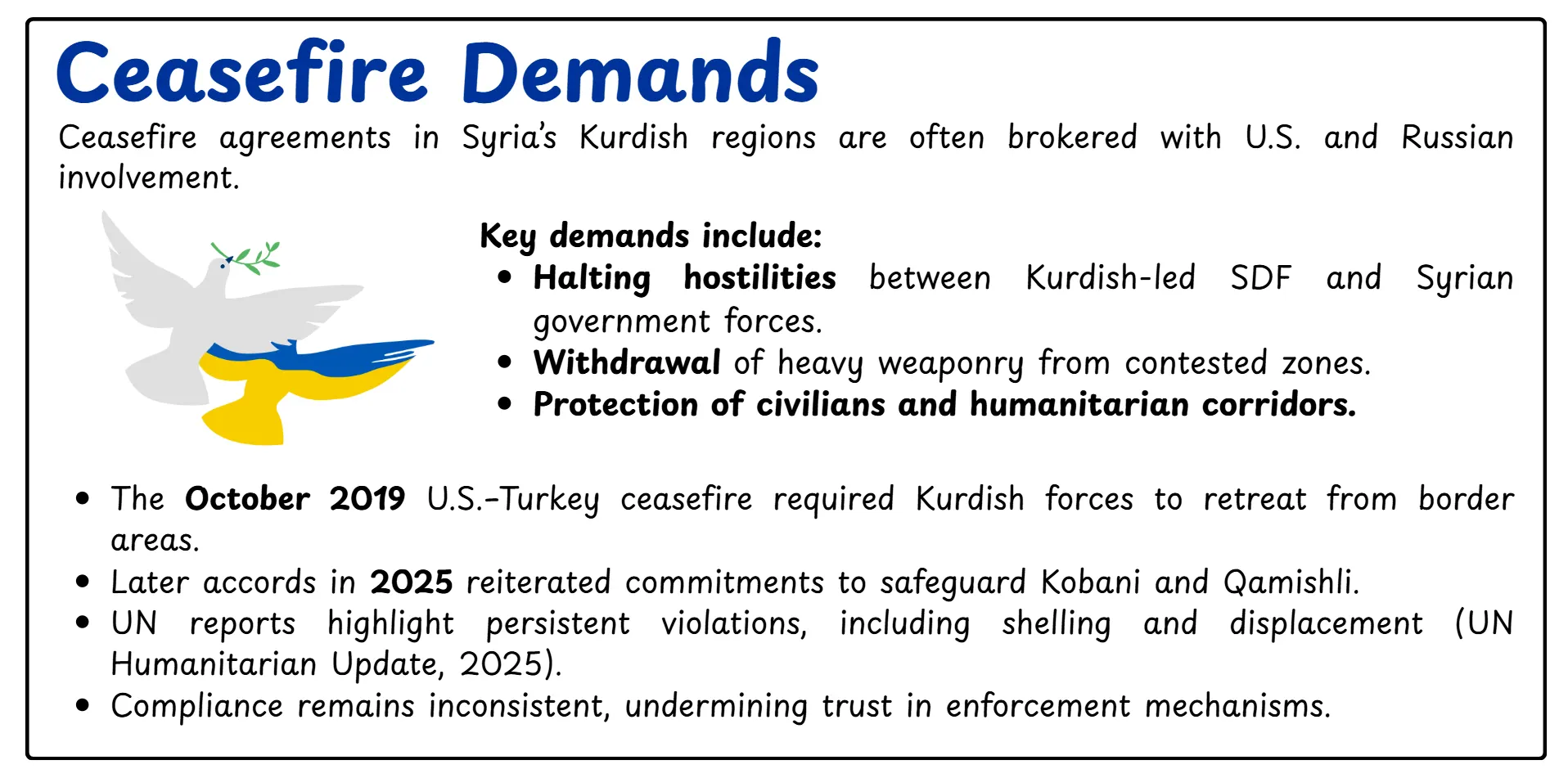
The latest ceasefire deals made with the help of the U.S. and Russia presuppose an end to hostilities, the removal of heavy weapons, and the safety of civilians. According to reports at the United Nations, the violations continue to exist specifically in Kobani and Qamishli, and this aspect raises concerns regarding the humanitarian fallout.The weakness of the ceasefire represents the wider battle of the international system: it is the need to balance the demands of Kurdish autonomy, Syrian sovereignty, and the security of the region.
Conclusion
Overall, the Kurdish enclaves of the Syrian territory can be discussed as an example of local power, regional and international strategic interests. Rojava, as a democratic intervention, has had to face increased obstacles due to the difficulties in settling on agreements, opposition from Turkey, and American ambivalence. Ceasefire requirements, no matter how stringent, are delicate in the presence of frequent violations and dangers to human lives. Finally, the course of North and East Syria highlights the impossibility of aligning grassroots rulemaking to bigger geopolitical needs, thus defining the destiny of Syria and the stability of the region.