The Election Commission of India (ECI) is an autonomous constitutional authority established under Article 324 of the Constitution to oversee and conduct fair elections. Its independence is vital to democracy it ensures that the will of the people is reflected faithfully in electoral outcomes.
|
Key Highlights
- Constitutional Foundations of ECI
- ECI as Basic Structure Doctrine
- Institutional Safeguards for ECI
- Judicial and Legislative Strengthening of ECI
- Modern Problems and Reforms Needed in ECI
- Electoral Roll Transparency
|
The autonomy of the Election Commission of India (ECI) is fundamental because it ensures that the will of the people is accurately captured without interference from the government of the day. Election Commission autonomy is in the headlines at present due to the unsavoury incidents that have characterised the special intensive revision of electoral rolls in twenty-two states and union territories, and an agenda of expelling the Chief Election Commissioner. The autonomy of the Election Commission of India (ECI) is the pillar that cannot be ignored in the democratic structure of the country. The Commission protects the right of legitimate representative government as the constitutional body mandated with the responsibility of organising free and fair elections. Its independence is not only administrative, but it is further established in the very structure of the Constitution, so that the elections are beyond the influence of partisanship. Articles 324-329 give far-reaching authority and institutional protection, whereas pronouncements by the courts have continued to support their objectivity.
The issue of independence has been put into perspective because of the controversies within appointments, the revision of electoral rolls and political influences. This calls forth the need to preserve the credibility of the Commission since it has a direct effect of maintaining loyalty of the people enhancing democratic institutions, and maintaining the integrity of the electoral system in India. These developments are important to bring up substantive issues on the role of political influence and transparency, hence highlighting the core role of the Commission in protecting free and fair elections in India.
What is Election Commission of India?
The Election Commission of India (ECI), established on January 25, 1950, is a permanent and autonomous constitutional body entrusted with conducting elections to Parliament, State Legislatures and the offices of the President and Vice-President. Election Commission of India (ECI) conduct free and fair elections by exercising superintendence, direction, and control over electoral rolls and the entire electoral process.
|
Constitutional Foundations of Election Commission of India ECI
The Election Commission of India (ECI), established on January 25, 1950, is a permanent and autonomous constitutional authority responsible for ensuring free and fair elections in the country. Its constitutional basis is firmly embedded in Part XV of the Indian Constitution (Articles 324 to 329), which specifically governs electoral matters. The autonomy of the Election Commission of India (ECI) is well entrenched in the constitutional system and is meant to ensure that democracy is not interfered with by the executive or any partisan interests.
ECI as Basic Structure Doctrine
The Supreme Court in Indira Gandhi v. Raj Narain (1975) recognised free and fair elections as one of the fundamental pillars of the Constitution. This doctrine guarantees that there can be no amendment that can in any manner positively weaken the autonomy of ECI, including any executive action, which in its turn is what safeguards the integrity of the electoral process as a principle of democracy that cannot be compromised.
Constitutional Provisions for ECI
Articles 324–329 confer upon the ECI the specific powers to supervise, direct, and control Parliament, State Legislature, and Presidential/Vice-Presidential elections. Article 324 gives the plenary power, whilst Article 326 gives universal adult franchise, which secures the reputation of the Commission as the protector of electoral rights.
Selection and Appointment of Election Commissioners
As of 2026, the Chief Election Commissioner (CEC) and the Election Commissioners (ECs) are appointed by the President on the recommendation of a three-member selection committee. The committee comprises the Prime Minister as Chairperson, the Leader of the Opposition in the Lok Sabha, and a Union Cabinet Minister nominated by the Prime Minister.
Tenure of Chief Election Commissioner CEC
There is security of tenure of the Chief Election Commissioner (CEC) and Election Commissioners. Removal of the CEC is possible only by similar means as the impeachment of a Supreme Court judge, which guarantees an individual against arbitrary termination. This protection is an indication of the intention of the framers to protect the Commission against political influences.
Comparative Analysis on ECs
Research indicates that India adheres to the independent electoral system, just like the democracies of the UK, Canada, and Australia, which also use commission systems, which are independent of the executive branch. This is a comparative framework of the commitment of India to institutional autonomy as a universal democratic norm.
Institutional Safeguards for Election Commission of India ECI
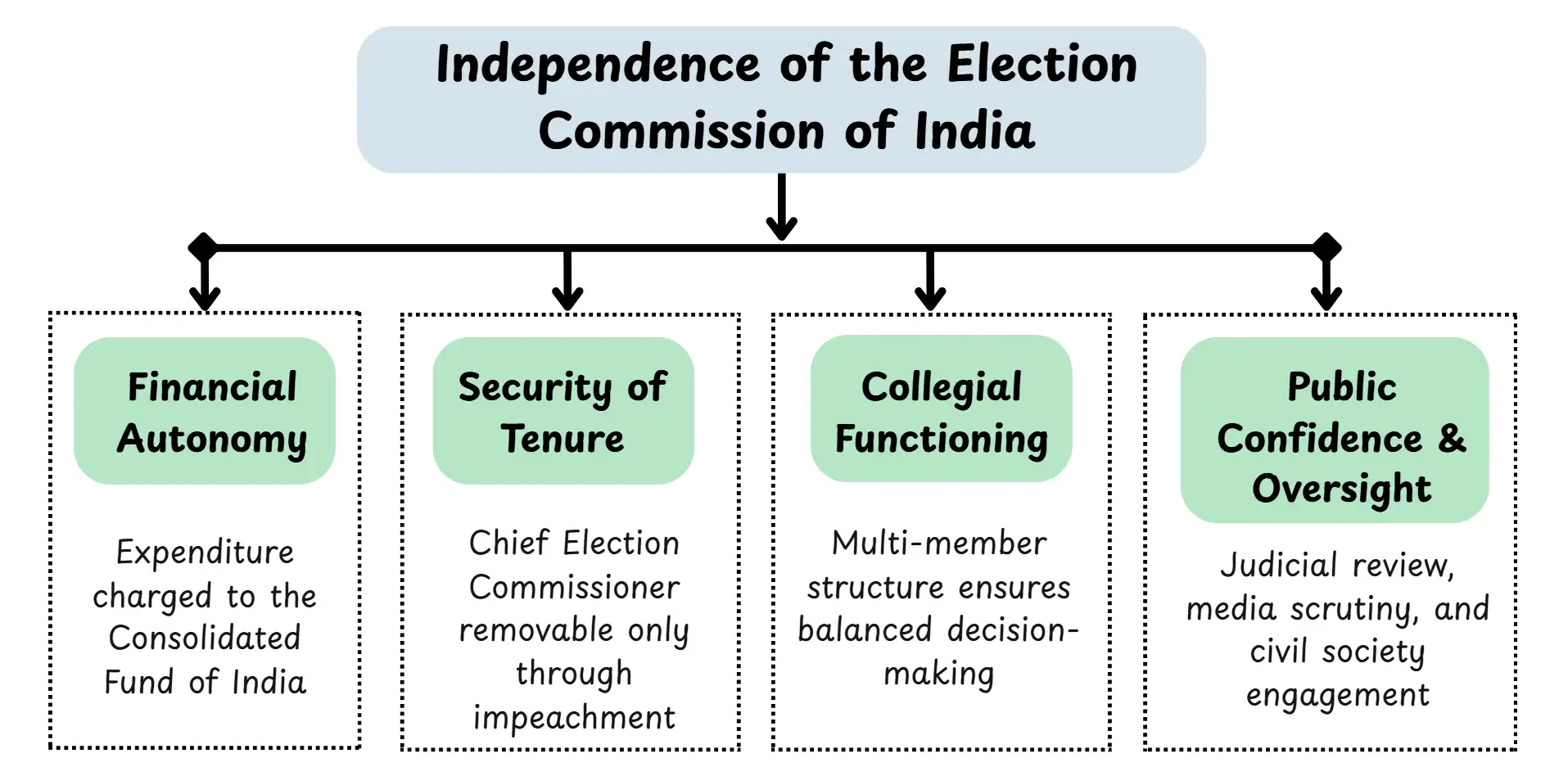
The Election Commission of India (ECI) is a permanent and autonomous constitutional authority established under Article 324 to conduct free and fair elections, with institutional safeguards intended to protect it from executive interference. Although these safeguards appear strong in principle, recent legislative changes, including the 2023 Act, along with certain administrative developments, have prompted concerns about how effectively they operate in practice. A combination of institutional measures shields the Election Commission of India (ECI) and enhances its independence, as well as enhances its credibility in the proper conduct of free and fair elections in the country.
Financial Autonomy of ECI
The expenditure of the ECI is solely done from the Consolidated Fund of India, so the establishment does not have executive interference. Such a financial structure will reduce the risk of frivolous budgetary downsizing and maintain the independence of operations. According to research, financial independence is a critical factor dictating the credibility of the Commission since it allows the institution to operate without any interference with the state resources.
Security of Tenure of Election Commissioners
The CEC can only be removed by a process similar to impeaching a judge on the Supreme Court, requiring a two-thirds majority in parliament to remove the Chief Election Commissioner (CEC). This protection is a defense against political retaliation. Tenure security is important in ensuring neutrality, especially at a time when election roll changes have become controversial.
Collegial Functioning
The multi-member structure of the Commission, which consists of the CEC as well as other Election Commissioners, promotes collective decision-making. Such an arrangement of cooperation dilutes the possible presence of unilateral bias and contributes to institutional resilience. According to studies, collegial functioning has prevailed in the past in enriching the legitimacy of the Commission during times of political questioning.
Public Confidence in ECI
Transparency and accountability help in institutional safeguards to achieve efficacy. The use of such mechanisms as public consultations, judicial review, and media scrutiny makes the Commission accountable and does not impinge on its independence. According to empirical studies, credibility depends on the confidence of the citizens in the electoral fairness and, thus, makes the role of oversight a supplementary control mechanism.
Judicial and Legislative Strengthening of ECI
The strengthening of the Election Commission of India (ECI) has been shaped by an ongoing interplay between judicial interventions and legislative measures, both aimed at safeguarding its independence and preserving the integrity of the electoral process. The autonomy of the Election Commission of India (ECI) is not only supported by the provisions of the Constitution but also by the decisions made by judicial cases and relevant legislation that support its integrity.
Judicial Pronouncements on ECI
The centrality of free and fair elections has constantly been emphasised by the Supreme Court. In Indira Nehru Gandhi v. Raj Narain, 1975, the court held that electoral integrity forms a part of the basic structure of the Constitution. Much more recently, in Anoop Baranwal v. Union of India 2023, the Court ordered the creation of a collegium system to apply in appointing Election Commissioners, noting that there was a need to bring about transparency and independence in the procedures to appoint the commissioners. These judicial rulings are examples of how the judicial system protects the Commission against executive control.
Legislative Framework for ECI
Statutes like the Representation of People Acts 1951 (1950 and 1951) have been passed by parliament, giving the statutory provisions concerning the electoral roll, the conduct of elections, and the disqualification of a candidate. The Chief Election Commissioner and Other Election Commissioners (Appointment, Conditions of Service, and Term of Office) Bill, 2023, includes some new appointment processes, which create an uncertain understanding of whether the reforms make appointments more accountable or make them more prone to politicisation.
Modern Problems and Reforms Needed in ECI
Modern challenges facing the Election Commission of India (ECI) arise from the changing dynamics of political campaigning, rapid technological disruptions, and persistent structural concerns such as criminalisation of politics and unregulated electoral funding. The Election Commission of India (ECI) is currently facing unprecedented issues that are putting a strain on its independence and integrity, and as such, require reforms, which are facilitated through institutional resilience and restoring credibility towards the organisation.
Electoral Roll Transparency
The most memorable event in the past was the Special Intensive Revision (SIR) of 2026, which raised alarm over the massive voter removals and the so-called disenfranchisement. It has been demonstrated that thousands of names were removed from the electoral register in the state of Bihar alone, and therefore, the clarity and responsibility of the roll-management process were subject to scrutiny by the Supreme Court.
Political Lobbying and Appointment of Commissioners
Issues regarding the process of appointment of many Election Commissioners are very controversial. Later on, in 2023, the Supreme Court order initiated the mandatory change of the collegium system, which is meant to limit the power of the executive; however, legislative changes made afterwards renewed the concerns over the influence of political figures. The empirical research shows that institutional neutrality gets eroded with political interference.
Technological Evolution in ECI
The increased use of the Electronic Voting Machines (EVMs) and Voter-Verified Paper Audit Trails (VVPATs) has not only increased efficiency in the procedures but also resulted in a certain level of scepticism. Actors in civil society seek more transparency in the digital processes, such as independent election technology audits. The Voter Verifiable Paper Audit Trail (VVPAT), also known as a Verified Paper Record (VPR), is a mechanism that provides voters with a physical confirmation of their vote when using an electronic voting system.
Reform Proposals for ECI
Reforms put forth by scholars and commissions include independent funding schemes, open modes of appointment, and stepping up of voter education programs. Comparative analysis suggests the best practices utilised in the well-established democracies, such as that of Canada, whereby there are autonomous oversight institutions that guarantee electoral integrity.
Conclusion
The sovereignty of the Election Commission of India cannot be compromised on the issue of the legitimacy of democratic governance. Based on constitutional provisions, supplemented by the judicial pronouncement and backed up by institutional protection, its independence ensures that elections are not subjected to partisan interference. The need to constantly reform can be supported by modern reality, where technological changes and political pressures are only some of the threats that require mitigation. It is therefore very much necessary to maintain the impartiality of the Commission itself as it directly fits the aspect of electoral integrity, enhances the trust of citizens, and guarantees the essential principles of Indian democracy.
Frequently asked questionsFrequently asked questions
Constitutional Foundations of Election Commission of India ECI?
The Election Commission of India (ECI), established on January 25, 1950, is a permanent and autonomous constitutional authority responsible for ensuring free and fair elections in the country. Its constitutional basis is firmly embedded in Part XV of the Indian Constitution (Articles 324 to 329), which specifically governs electoral matters. The autonomy of the Election Commission of India (ECI) is well entrenched in the constitutional system and is meant to ensure that democracy is not interfered with by the executive or any partisan interests.
Institutional Safeguards for Election Commission of India ECI?
The Election Commission of India (ECI) is a permanent and autonomous constitutional authority established under Article 324 to conduct free and fair elections, with institutional safeguards intended to protect it from executive interference. Although these safeguards appear strong in principle, recent legislative changes, including the 2023 Act, along with certain administrative developments, have prompted concerns about how effectively they operate in practice. A combination of institutional measures shields the Election Commission of India (ECI) and enhances its independence, as well as enhances its credibility in the proper conduct of free and fair elections in the country.
Judicial and Legislative Strengthening of ECI?
The strengthening of the Election Commission of India (ECI) has been shaped by an ongoing interplay between judicial interventions and legislative measures, both aimed at safeguarding its independence and preserving the integrity of the electoral process. The autonomy of the Election Commission of India (ECI) is not only supported by the provisions of the Constitution but also by the decisions made by judicial cases and relevant legislation that support its integrity.
Modern Problems and Reforms Needed in ECI?
Modern challenges facing the Election Commission of India (ECI) arise from the changing dynamics of political campaigning, rapid technological disruptions, and persistent structural concerns such as criminalisation of politics and unregulated electoral funding. The Election Commission of India (ECI) is currently facing unprecedented issues that are putting a strain on its independence and integrity, and as such, require reforms, which are facilitated through institutional resilience and restoring credibility towards the organisation.