|
Key Highlights
- Foundation of life
- Water Scarcity
- National and Global Challenges
- Economic and Ethical dimensions
- Preservation Strategies
- Technological Pathways
|
Clean Potable water is the basic component of biological sustainability, the critical concerns of which are the overall health of people, the work of agriculture, and the environment. The growing rates of consumption, climatic disturbances, and uneven patterns of distribution are, however, increasingly reducing availability. In addition to the economic aspect that is measurable, water is also directly linked with the issues of morality and justice, which is why it should be said that this concept deserves to be considered as an inalienable human right. This resource will survive on sustainable stewardship and management to ensure that future generations will be secure on intergenerational equity, which makes it extremely valuable in nature.
The statement "Why Potable Water is Beyond Price" highlights that access to clean, safe drinking water is a fundamental necessity for all life and is invaluable, even though in some areas it can seem inexpensive.
|
Tips for Aspirants
The article is related to the UPSC CSE and State PSC exams because it combines environmental, governance, ethical, as well as policy aspects of water, which thus helps to create an analytical discussion on the issue, write the essays, and understand it across disciplines.
|
|
Relevant Suggestions for UPSC and State PCS Exam
- Water as life-giver: a necessity to human existence, environmental balance, food production, and sustaining the culture.
- The problem ofscarcity: caused by climate change, excessive exploitation, pollution, and unjust distribution; as a result, billions of people will be impacted in the world.
- Survival and growth effects: water scarcity causes water-borne diseases, poverty, food insecurity, and gender disempowerment.
- Economic and ethical aspects: the issues of commodification and universal rights.
- Preservation measures: rainwater collection, efficient irrigation, recycling, and community-regulated watershed management.
- Policy intervention: integrated water resource management, fair distribution, pollution reduction, and cooperation across borders.
- Pathways: desalination, smart water networks, AI monitoring pathway, and renewable energy pathway.
- Ethical accountability: accepting water as a human right and succeeding in intergenerational equity.
|
It is often said that water is the elixir of life, the most valuable natural resource that can be used to support anthropogenic processes and provide ecological balance. Although the availability of drinkable water cannot be ignored in biological processes, it is also a key to the foundation of socio-economic development, food security, and the general health of people. The supply of safe drinking water, though in plenty in certain land and water bodies, has become one of the most pressing challenges of the twenty-first century. The sudden discovery of urban consolidation, industrialization, and climatic change has only heightened the stressor on freshwater catchments, leading to overexploitation, pollution, unfair allocation, and exploitation. This paradox lies in the duality of water, that is, it is a renewable commodity, but access to it is limited and can be abused by humans.
In turn, valuing potable water requires a multidimensional system of analysis that would integrate the ecological, economic, ethical, and cultural views of the issue. By doing so, this brings to global acceptance the fact that water is not simply a quantifiable utility, but is a very precious attribute that goes beyond money values and reflects intergenerational justice and the custodianship of the totality of humanity. The treatise attempts to provide a critical analysis of the importance of clean water, the accompanying barriers to accessibility, and the need for sustainability in its governance. Here it becomes clear that water must be viewed not as a commoditized product, but as a universal right without which there is no life and civilization at all.
Water as the Foundation of Life
It is generally accepted that water is the foundation of life, which supports life in biological, ecological, and socio-economic structures. It is necessary not only as useful but also as both material and symbolic, as it is needed in Mother Nature itself, and it is used and symbolized throughout civilizations.Water is the foundation of all known life on Earth, playing a critical role in biology, environment, and human society. Its unique chemical and physical properties make it essential for survival.
Biological Necessity
Water is a constituent of the physiology of all organisms. It is essential to the human body, which is almost 60 percent water, for nutrients to be transported to body organs and waste to be eliminated. It controls body temperature, helps in digestion, as well as cellular metabolism. Lack of water leads to breakdown of vital processes, hence making water indispensable in keeping us healthy and alive.
Ecological Significance
In addition to individual organisms, water provides sustenance to the ecosystem and biodiversity. Rivers, wetlands, and oceans are homes to a myriad of species, and ecological balance is guaranteed by the hydrological cycle. Water is a universal solvent and also a medium of transport, and facilitates the circulation of nutrients, energy within the ecosystem. It is important due to its background in maintaining planetary stability, as evidenced by the reason behind its ability to control climate and facilitate agriculture.
Socio‑Economic Dimensions
Water not only serves as a source of socio-economic development but also is a natural resource. Dependable water supplies are necessary to agriculture, industry, and the production of energy. Societies having access to clean water enjoy better health, alleviation of poverty, and quality education. On the other hand, inequality will be worsened with scarcity, the rise of conflicts, and migration. Therefore, water represents economic and ethical responsibility.
Cultures and Moral Approaches
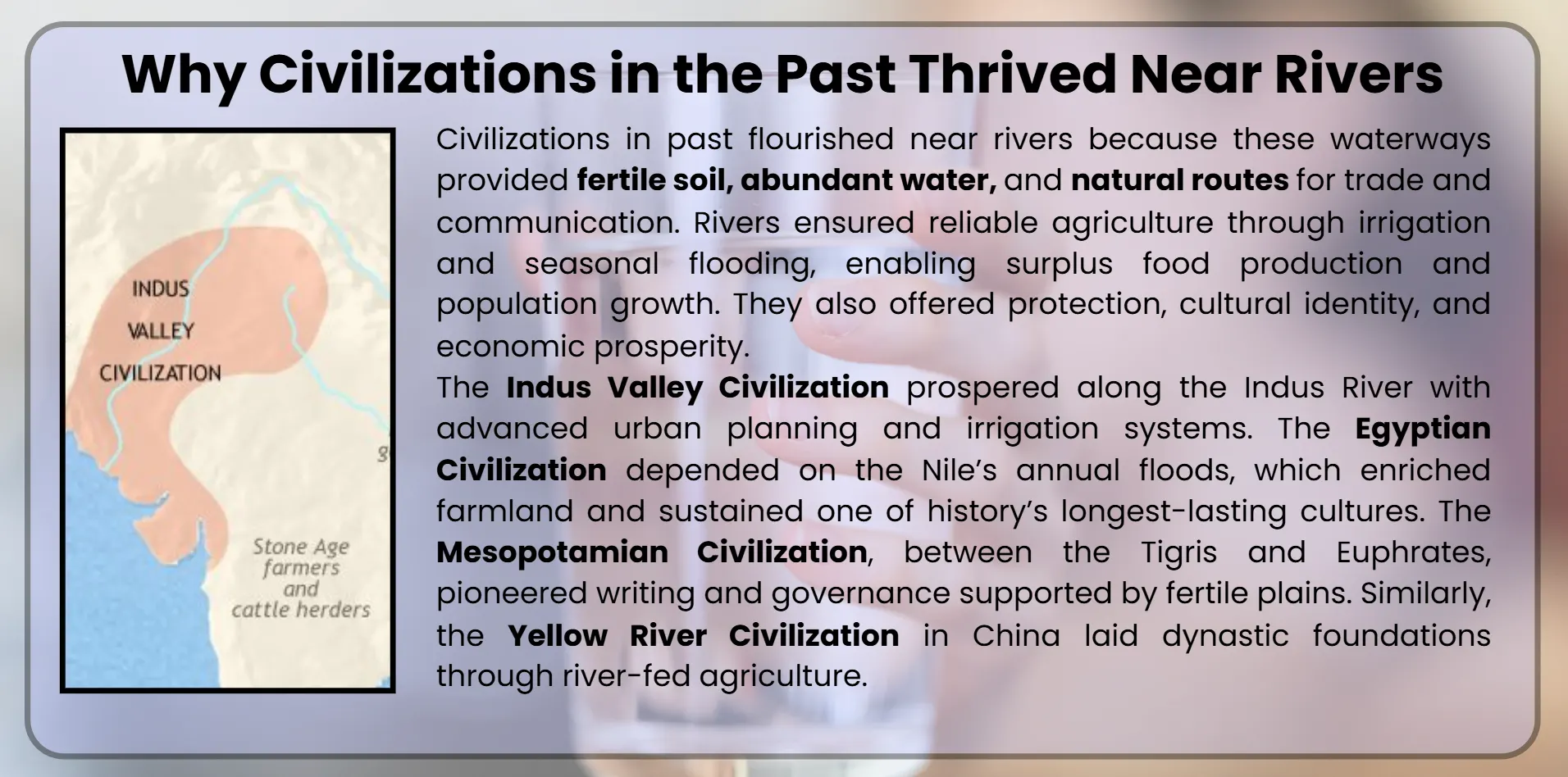
The water symbolizes purity, continuity, and renewal, among others, and has likewise been a source of symbolism throughout history. Civilizations in the past thrived near rivers, and the cultures tended to worship water as sacred. The potable water in modern-day society is progressively becoming a common human right. The commoditization of it is subject to ethical controversy, with social responsibility, intergenerational responsibility, and intergenerational fairness. Most importantly, the necessity to preserve water resources can be discussed as a technical necessity but a moral one as well.
Scarcity and International Problems
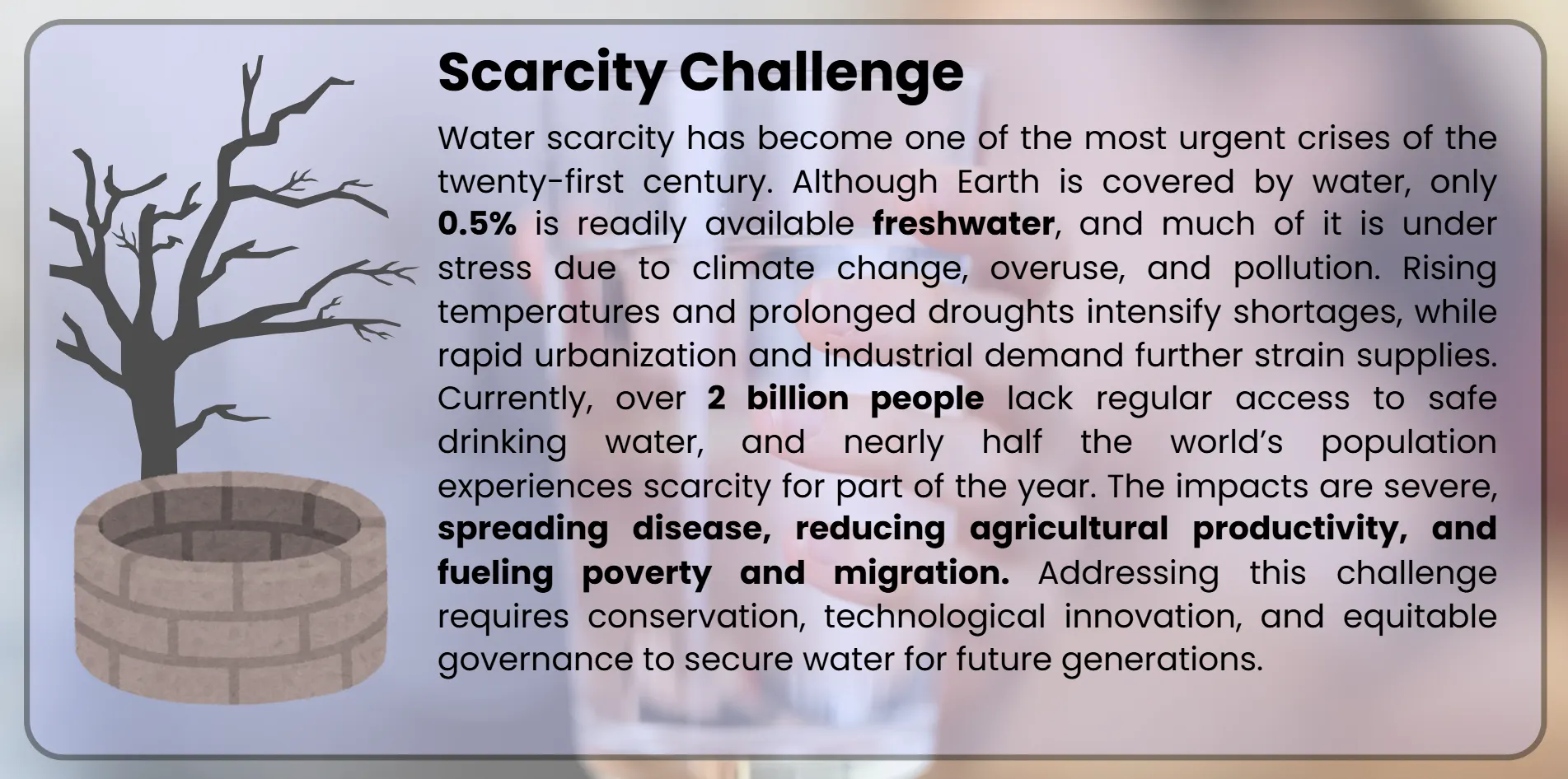
Water shortage has become one of the twenty-first-century problems. Even though the freshwater on Earth is plentiful, there is a limit to how much clean and drinkable water can be provided, and this is not uniformly distributed."Drops of Life: Scarcity and International Problems" refers to the global challenge of water scarcity, a critical issue with severe international consequences including health crises, food shortages, economic decline, and potential geopolitical instability.
Causes of Water Scarcity
The cause of water scarcity is the combination of both natural and human-induced processes. Climate change enhances periods of drought, alters the regimes of precipitation, and interferes with hydrological patterns. The pressure of human activity, such as over-drilling of groundwater, pollution of freshwater sources, and the use of ineffective ways to irrigate the land, aggravates shortages in supplies. In addition, the speed at which urbanization and industrialization are taking place increases demand, which often exceeds supply, and thus creates acute pressure on water systems.
International Aspects of the Crisis
The arid zones are not the only location where scarcity is registered, and the area has spread across a continent such as Africa, Asia, the Middle East, and even parts of North America and Europe. According to the global estimates, over 1.1 billion people do not have access to quality water, and 2.7 billion people have at least one month of water scarcity per year. This imbalance underlines the fact that the issue is universal, being beyond the geopolitical boundaries as well as socioeconomic classes.
Health and Developmental Effects
The water scarcity has severe implications. The lack of access to potable water promotes the spread of water-borne diseases such as cholera and typhoid. The communities that lack access to reliable water face increased poverty, food insecurity, and gender inequality as women and children bear the disproportionate burden of finding water. Also, the lack of water limits the productivity in agriculture, putting lives and economies of nations at stake.
Pathways to Solutions
Action to resolve the global scarcity of water requires coordinated approaches. Efficient irrigation, recycling of wastewater and use of desalination processes are some of the technological advancements that are solutions to the existing problem. It is also important that the country should be able to undertake reforms in governance that focus on equity in distribution, strengthening infrastructure, and community support. Transboundary water resources must be managed with international cooperation, as they are vital resources that have to be coordinated to avoid the chance of conflict and preserve sustainability.
Economic, Social, and Ethical Aspects
Water is not purely a physical resource but a multidimensional one in life whose economic, social, as well as ethical aspects determine the development of human beings, their governance, and sustainability. Its utility is expanded to equity and justice. "Drops of Life" is a broad concept that can be interpreted in various contexts, from water resources to a specific book or the general aspects of human existence. In a general context, the economic, social, and ethical aspects of life refer to the complex interplay of financial realities, societal structures, and moral principles that govern human decisions and well-being.
Economic Dimensions
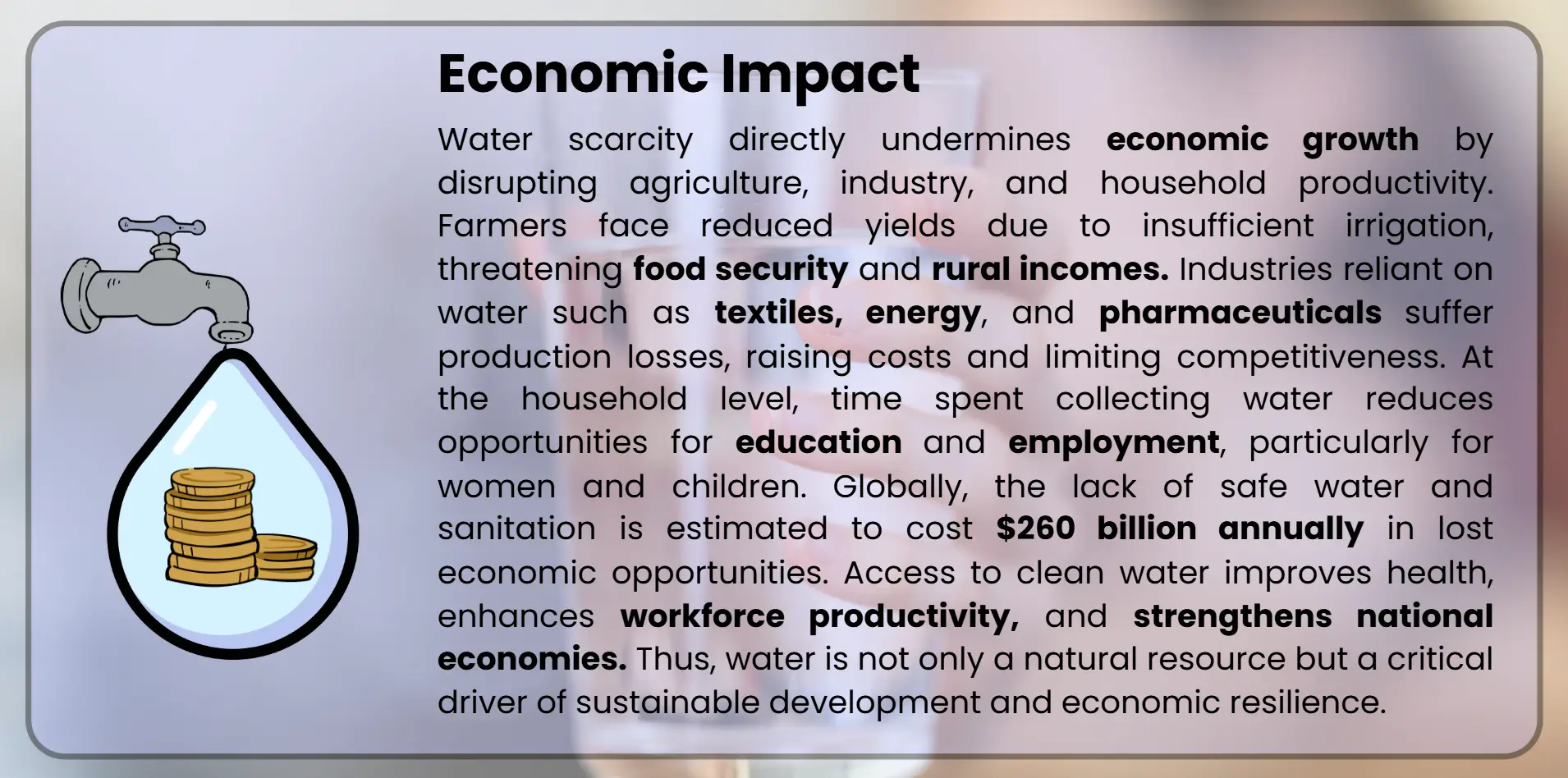
The role of water in economic growth and productivity is central. There is a high reliance on water supplies in the agricultural sector, industries, and energy sources. Food production is dependent on irrigation, and energy security is maintained by hydropower. Industrial activities, be it the textile or pharmaceutical industries, demand huge amounts of clean water. Resources like scarcity or contamination have direct effects on GDP and employment, and trade. Economists are putting more emphasis on water as a major issue in sustainable development, and they call on efficient pricing schemes and development infrastructures to create equilibrium of demand and supply.
Social Dimensions
Citizens need clean water, as it is one of the basic rights that are central to human health and well-being. Societies where water is abundant end up having fewer disease burdens, a better educational attainment, and level of gender equity, since in many cases women and children do the water collection. Water security is also associated with social stability; lack of water may cause, migration, war, and inequality. Therefore, water is not a resource, but a factor of social cohesiveness and human dignity.
Ethical Dimensions
Water has universal rights and duties economically. The controversy on commodification and acknowledgment of water as a human right can be projected as much larger issues of morality and fairness. The approach of water as an economic good could easily leave out the marginalized groups, whereas the recognition of it as a common heritage is reflected in stewardship and the need to take responsibility for the future generation. Ethics requires participatory governance, transparency, and adherence to ecological boundaries so that water management is within the confines of moral and ethical expectations of both the animals and the human.
Conserving, Decisions, and Prospects.
The need to sustain the supply of fresh, drinkable water to future generations requires an interdisciplinary approach that incorporates conservation measures, changes in policy, and novel avenues to sustainable management.The phrase "Drops of Life: Conservation, Decisions, and Prospects" refers broadly to the critical and interconnected issues of water conservation, biodiversity preservation, the complex decisions required to manage natural resources, and the future outlook for sustaining life on Earth.
Conservation Practices
Efficient use and reduction of wastage are what initiate water preservation. Practices like harvesting rainwater, recharge of groundwater water and recycling of wastewater are gradually becoming inevitable at both rural and urban levels. Drip irrigation and diversifying crops are examples of agronomic practices to increase the water-use efficiency, yet reduce the depletion. The local efforts in terms of watershed management represent an example of how local initiatives can protect water resources.
Governance and Policy Interventions
Water problems revolve around good governance. The national and regional policies should focus on equalization, pollution, and the development of infrastructure. The Jal Shakti Abhiyan in India is an example of conservation that focuses on the participation of communities in conservation, and the larger frameworks propose integrated water resource management. The issues of transboundary water disputes should also be a policy, where there should be cooperation between the states and nations. Accountability and resiliency are supported by transparent leadership based on scientific data and participatory decision-making.
Technology Revolution and Future Projections
Future avenues of water security depend on the development of technology. AI-monitored desalination, smart water grids, and innovative solutions to scarcity and contamination can be provided by artificial intelligence. Precise management of resources can be achieved through satellite-based mapping of aquifers, as is evident in India. Besides, the combination of renewable energy and water treatment technologies reduces the environmental footprint. Such innovations, coupled with an inclusion policy, give birth to sustainable models that are adaptable in various geographies.
Responsibility-Ethics
Sustenance of water resources does not only represent an issue of technical interest but also an ethical requirement. Identifying water in a universal manner as a human right shifts the policy debates to stewardship. Intergenerational equity requires the present societies to embrace sustainable behaviors in order to access the future. The cultural view of water being a sacred entity serves as a moral appeal to safeguard water, thus creating a holistic parameter blending science, policy, and ethics.
Conclusion
The worth of clean, potable water is not limited merely within the frame of the traditional economic parameters, but this is the foundation of human life, human health, and sustainable development. The lack of it, which is caused by climatic changes, shortages in governance, and inequitable distribution of it, indicates a desperate necessity for collective measures. Viewing the water as a natural right of man and as an environmental legacy that is shared by all makes a difference in policy and ethical rhetoric. Conservation, technological innovation, and participatory governance will always be necessary to protect intergenerational justice. Finally, water resources protection is not only a technical project but also a moral necessity, which requires the cooperation of the global community to safeguard the most precious resource of humanity in the current and future generations.