The Carbon Capture and Utilisation (CCU) technologies are crucial for India’s 2070 net-zero target, transforming industrial CO₂ emissions from difficult sectors such as steel, cement, and chemicals into valuable products like fuels and construction materials.
|
Key Highlights
- Why does India Need CCU?
- What is Carbon Capture and Utilisation (CCU)?
- The role that CCU will play in the reduction of emissions
- What is the EU Bio-economy Strategy?
- What is the Circular Economy Action Plan?
- Scaling Up CCU in India
|
The use of Carbon Capture and Utilisation (CCU) is among the primary targets of India, as mentioned in the 2026 Union Budget, which allocated 20,000 crore for the scale-up of CCU projects. This economic policy aligns the country's industrial policy with the European Union's carbon border tax policy and India's Net Zero commitment. India is proactively advancing Carbon Capture, Utilization, and Storage (CCUS) to achieve its 2070 net-zero target, rolling out a national R&D roadmap, establishing industrial testbeds, and setting up a dedicated National Centre of Excellence at IIT Bombay. Climate change has concentrated more on the international attempts to reduce the emission of greenhouse gases, with carbon dioxide (CO2) taking the largest portion. The development of Carbon Capture and Utilisation (CCU) technologies has been viewed as a new innovation that will not only curb emissions but also convert the captured CO2 into a useful product, including fuels, chemicals, and construction materials. CCU complements new energy transitions by focusing on the hard-to-abate, such as cement, steel, and chemicals.
The International frameworks, including the Bio-economy Strategy and Circular Economy Action Plan developed by the European Union, point out the need to make CCU a core part of sustainable production systems. In the case of India, increased use of CCUs is not only a climate imperative but also an economic opportunity, with decarbonisation of the industrial sector, promoting innovation, and fostering sustainability across the globe. CCU promises to be relevant as it will decarbonise the electricity, steel, cement, and chemical industries, thus promoting innovation in technology and remaining competitive in the world.
|
Why Does India Need CCU?
|
| The introduction of carbon capture and utilisation (CCU) technologies into India is urgently needed since the Indian system is very dependent on fossil fuels, and in industries like cement, steel, and chemicals, the nation produces significant emissions. CCU offers a potential route towards decarbonising these hard-to-abate industries and, at the same time, producing value-added products, such as fuels, polymers, and construction products. This policy complies with the Net Zero 2070 promise of India and prevents the fear of the Carbon Border Adjustment Mechanism within the European Union from introducing penalties on exports of goods with high carbon content. In addition, the NITI Aayog Energy Transition Report 2025 suggests that CCU can reduce industrial emissions by 15-20 percent if it is efficiently implemented at major clusters. In addition to direct climate benefits, CCU implies technological progress, supplying green jobs, and increasing the competitiveness of India in the international arena, thus becoming a strategic requirement for sustainable Indian development.
|
What is Carbon Capture and Utilisation (CCU)?
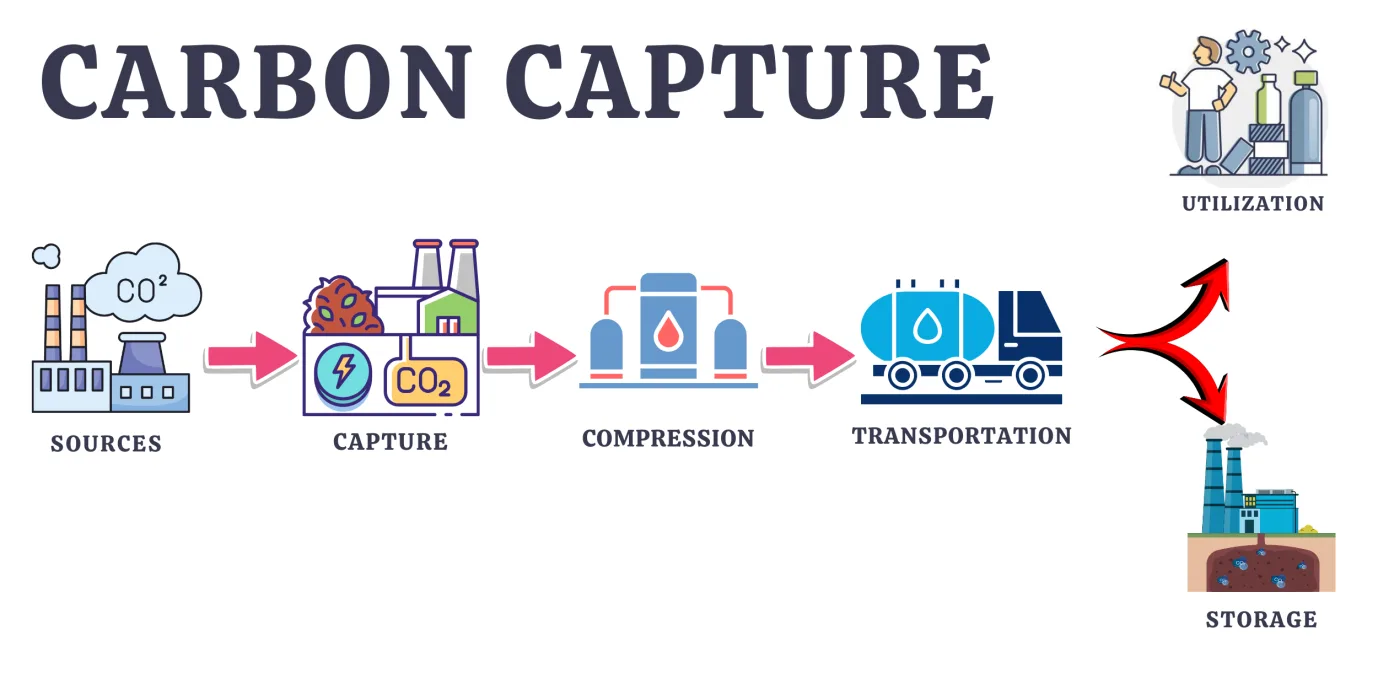
The Carbon Capture and Utilization (CCU) refers to the process of capturing carbon dioxide (CO₂) emissions from industrial sources such as power plants and factories, or directly from the atmosphere, and transforming them into useful products like synthetic fuels, chemicals, concrete, or plastics instead of releasing them into the air. Carbon Capture and Utilisation (CCU) is a revolutionary climate-mitigation initiative that blends both emission and reduction with economic novelty through the production of valuable products with captured CO2.
Definition and Core Process of CCU
CCU is a technology used to extract the CO2 sources in industry, bypassing direct extraction into the atmosphere and reusing the gas in fuels, chemicals, polymers, or building materials. Most significantly, in contrast to the permanent storage of CO2 deep underground, as enforced in Carbon Capture and Storage (CCS), wherein the environment is permanently sterilized against this gas, CCU involves the integration of captured carbon into useful processes, thus lowering the concentration of these gases in the atmosphere, but yielding an economic benefit.
Global Deployment and Data on CCU
The International Energy Agency (IEA) has estimated that there are about 45 commercial CCU/CCUS facilities all over the world that cover industrial processes, fuel transformation, and power generation. Such projects illustrate the scalability of CCU technologies and also show how they would enable the process of transitioning into low-carbon economies.
Pathways of CO2 Utilisation
The captured CO2 is converted into synthetic fuels, made out of plastic production, or mineralised into building materials. It was highlighted by a study conducted by the Joint Research Centre of the European Union (2025) as the CCU is not only going to minimize emissions of hard-to-abate industries like cement and steel but also support green chemistry innovations.
Relevance of CCU for Emerging Economies
In developing markets such as India, CCU has two advantages: to reduce the level of industrial emissions and to open new markets for green products. The inclusion of CCU in industrial clusters may stimulate the pace of decarbonisation, economic growth, and employment.
The role that CCU will play in the reduction of emissions
Carbon Capture and Utilisation (CCU) is an important process in curbing the emission of greenhouse gases in the atmosphere by diverting carbon dioxide from the atmosphere into constructive economic processes, thus making the climate and industries sustainable.
CCU for Curbing Industrial Emission
CCU directly works on the emissions of the hard-to-abate sectors like cement, steel, and chemicals. Uptake of CO2 at the source would help industries to produce a substantial carbon footprint with the efficiency of production. According to The Hindu, CCU will convert captured carbon to make fuels, polymers, and building materials, preventing it from being released into the atmosphere.
CCU for Net Zero
The World Energy Outlook 2024, published by the International Energy Agency, estimates that CCU will help in cutting as much as 5 percent of the global emissions by 2050, which demonstrates its complementary nature with renewables and energy efficiency.
Circular Economy Action Plan and EU Bio-economy Strategy
The European Union (EU) has made significant progress in overarching frameworks, the Bio-economy Strategy, and the Circular Economy Action Plan, in line with addressing sustainability, resource efficiency, and innovation to its climate-neutral developmental journey.
What is the EU Bio-economy Strategy?
The Bio-economy Strategy is geared towards substituting fossil resources with sustainable biological resources. It encompasses the biomass production, conversion into food, materials, and bioenergy, while addressing human-induced biodiversity loss and pollution. The new updated 2025 framework targets to move the industries to bio-based innovations faster, cut down on fossil dependence, and unlock the biological wealth of Europe into green opportunities.
What is the Circular Economy Action Plan?
The Circular Economy Action Plan is another strategy that supports the Bio-economy Strategy; it advocates the efficiency of resources, recycling, and the reduction of waste. It aims at disaggregating growth in the economy and its dependence on the use of resources so as to provide long-term resilience. The plan is focused on clean technologies and adopting the eco-design and sustainable patterns of consumption, which makes the EU a pioneer in regard to the regenerative economic model.
Integration with CCU Technologies
Both models align with the CCU by promoting the reuse of carbon and industrial innovation. The bio-based production systems can also incorporate the technologies of CCU by converting captured CO2 into fuels, chemicals, and construction materials, strengthening the objectives of circularity and climate neutrality.
Scaling Up CCU in India
The industrial growth, as well as climate-related promises of India, requires a fast uptake of the Carbon Capture and Utilisation (CCU) technologies that could, in turn, reduce emissions and offer new opportunities in the economy.
Policies and Investments for CCU in India
The Union Budget 2026 provided INR 20,000 crore for CCU projects in India, which indicates great support by the government. These funds seek to institute pilot plants, strike incentives into interest in the private investment, and inculcate CCU in national decarbonisation plans.
Research and Innovation Ecosystem for CCU
The development of the CCU scaling involves the cooperation of academia, industry, and government. Research on CO2-to-fuel and mineralisation has started in institutions like IIT Delhi and CSIR. As noted by the NITI Aayog Energy Transition Report, CCU has the potential of minimizing industrial emissions by 15-20 percent if deployed across cement and steel clusters.
Infrastructure and Industrial Cluster for CCU
It is essential to develop CCU hubs close to the high-emission industries. The western industrial and southern industrial belts of India, which are characterised by heavy concentrations of petrochemical and cement plants, present the best locations to be used to deploy CCU. CO2 transport and storage infrastructure will also increase scalability.
CCU and Social Inclusion
Adopting CCU should be inclusive and guarantee growth through the creation of green jobs, help the local populations, and be in line with the Indian commitment of Net Zero 2070. Partnership with the EU and Japan can accelerate the transfer and building of capacities.
Conclusion
Carbon Capture and Utilisation (CCU) technologies are an important cross-disciplinary environmental nexus. CCU ensures that renewable energy transitions are complete and production of hard-to-abate sectors is captured by converting CO2 to valuable products. The Bio-economy Strategy and Circular Economy Action Plan by the European Union offers the world guidelines on the implementation of CCU in production system sustainability. In the case of India, some of the benefits of scaling CCU include environmental requirements and developmental opportunities, which align the national growth with global sustainability goals and solidify its Net Zero 2070 commitment.
Frequently asked questionsFrequently asked questions
What is Carbon Capture and Utilisation (CCU)?
The Carbon Capture and Utilization (CCU) refers to the process of capturing carbon dioxide (CO₂) emissions from industrial sources such as power plants and factories, or directly from the atmosphere, and transforming them into useful products like synthetic fuels, chemicals, concrete, or plastics instead of releasing them into the air. Carbon Capture and Utilisation (CCU) is a revolutionary climate-mitigation initiative that blends both emission and reduction with economic novelty through the production of valuable products with captured CO2.
The role that CCU will play in the reduction of emissions?
Carbon Capture and Utilisation (CCU) is an important process in curbing the emission of greenhouse gases in the atmosphere by diverting carbon dioxide from the atmosphere into constructive economic processes, thus making the climate and industries sustainable.
Circular Economy Action Plan and EU Bio-economy Strategy?
The European Union (EU) has made significant progress in overarching frameworks, the Bio-economy Strategy, and the Circular Economy Action Plan, in line with addressing sustainability, resource efficiency, and innovation to its climate-neutral developmental journey.
Scaling Up CCU in India?
The industrial growth, as well as climate-related promises of India, requires a fast uptake of the Carbon Capture and Utilisation (CCU) technologies that could, in turn, reduce emissions and offer new opportunities in the economy.