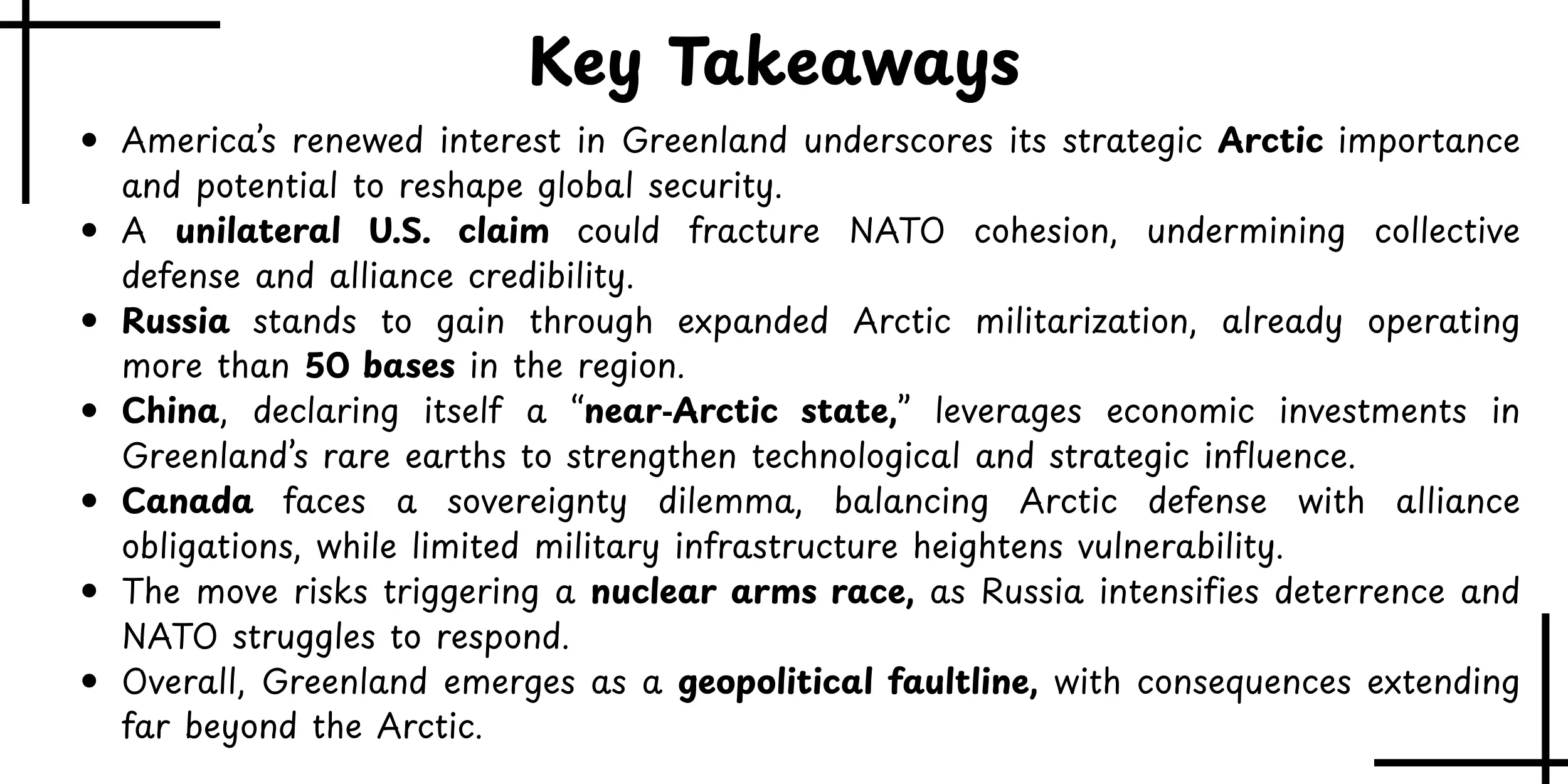
The modern-day American plan to annex Greenland has received a lot of media coverage, since it stands to leave NATO, arouses fears on the Canadian side, and is a strategy to embolden other countries in the region, such as Russia and China. Transatlantic security arrangements are posing a threat of destabilization by this development and, possibly, the emergence of a heightened nuclear arms competition in the Arctic.
|
Key highlights
- US Claim on Greenland
- Historical Background
- Implications for NATO
- Gains for Russia and China
- Its Effects on Canada
- Arctic Nuclear Race
|
The revitalized debate on the issue of the United States reviving its claim to Greenland has re-emerged as a choice agenda in the realm of international relations. The geographically favourable location of the Arctic is enhanced by a large resource endowment, making Greenland the center of the modern geopolitical struggle. An American unilateral invasion would not only test NATO solidarity as a trial but would also rebalance the strategic balance in favour to the interests of the Russians and Chinese. This gives rise to acute sovereignty concerns and difficult coordination of defence in the Arctic space for the Canadian policymakers. Based on this, the wider implications (particularly the threat of a nuclear escalation) of the current world order on global security are explored in the given article.
Historical Interest of the US in Greenland
The importance of American vested interests in Greenland dates back to the Arctic topography, which provides unmatched military and strategic advantages. The geographic location of the island has played a significant role in NATO defense calculus in the past and the wider approach of the United States to national security.
Earl US Engagement in Greenland
During the Second World War, the United States signed contracts with Denmark to protect Greenland against the invasion of the Nazis. This agreement was then incorporated into the 1951 NATO defense pact and, by doingso, gave Washington military prerogatives on the island. As a result, Greenland became a major strategic platform in the Cold War deterrence operations, being located on a border zone between North America and Europe.
Installations in Greenland by the US
The Thule Air Base(renamed Pituffik Space Base in 2023)is the military installation of the United States in the north. It is a very important element of the American nuclear deterrent architecture since it is used in missile early-warning systems and in space surveillance activities. During its peak, the United States had nearly fifty military installations in Greenland, thus making it a strategic island.
Contemporary Relevance of Greenland
The constant climatic change has reduced the Arctic Sea ice, thus opening new sea routes and resource extraction opportunities. This geo-environmental change increases the geopolitical importance of Greenland, and makes it a battleground in the new United States-RussiaChina larger struggle.
Implications of US claim of Greenlandon NATO
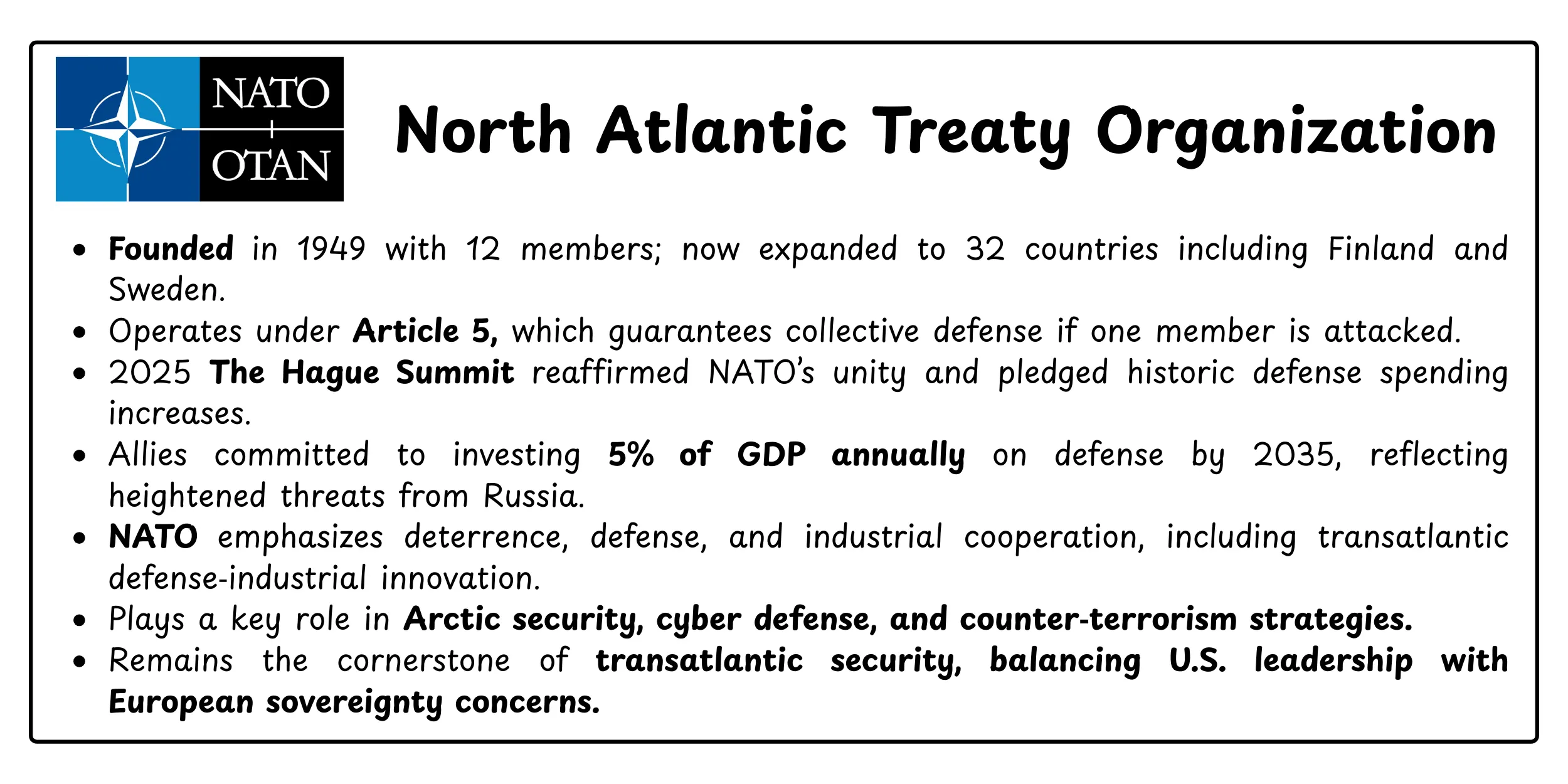
The weakness of the North Atlantic Treaty Organisation (NATO) is becoming more evident regarding the US ambitions over Greenland. One-sided claims of sovereignty will weaken the unity of alliances, burden transatlantic confidence, and empower the enemy forces that are already active in the Arctic arena.
Cohesion among NATO Members because of US
NATO was formed on the basis of collective defence as provided in Article 5, but lately the unilateral activities of the United States have created doubts over the unity of NATO. In 2023, a study by the European Council on Foreign Relations showed that over 60 percent of policy-makers in Europe worry that US irresponsibility is undermining the credibility of NATO. A claim that does not consult allied members on Greenland would encourage the view of American unilateralism and may divide opinion.
US caused Vulnerability to NATO
The position of Greenland in the heart of the NATO defence in the Arctic environment is strategic. The Arctic, according to the Strategic Concept of NATO,was considered a field of focused strategic competition. In case Washington takes unilateral action, the integrated deterrence system of NATO would collapse and expose the members of the European Union to Russian militarisation. Russia had already increased its liaison in the Arctic to over fifty military bases, in addition to which NATO would suffer a disproportionate force.
US influenced Tensions in Canada
Canada, being a member of NATO since its foundation, considers Arctic sovereignty to be at the top of the agenda. A claim on Greenland by the United States would marginalise the Canadian interests and undermine the operation of the defence in the North American region. Similarly, the European allies, especially Denmark, would view such action as a violation of sovereignty, which would further weaken the trust. Such political disintegration threatens to turn NATO into more of a divided alliance rather than a unified defensive coalition.
Gains for Russia and China by US claim of Greenland
Russia, as well as China, will enjoy immense benefits in case the United States trump decides to buy Greenland. This move would undermine the union of NATO and, consequently, create strategic possibilities for Moscow and Beijing in the Arctic.
Russia's Strategic Leverage in Greenland
As of 2021, Russia already extended its military presence in the Arctic and has over fifty bases and installations, such as sophisticated radar, nuclear-powered submarines, and air defence systems. A disintegrated NATO would give Moscow the latitude to establish hegemony in the High North and power projection across the North Atlantic. The Russian officials have rejected the threat scenario of Greenland as a myth, but on the other hand, have shown precautions, warning that the Western build-up in the Arctic is too risky. This two-sided rhetoric speaks volumes of the desire by Moscow to take advantage of the NATO division and strengthen its deterrent stance.
Benefits for China in Greenland
Despite this, geographically, China has already asserted itself as a near-Arctic state, has been investing a lot in Greenland in terms of rare-earth mines and infrastructure development projects thus becoming an important economic player in the area. The fact that Beijing collaborates with Russia in the work of Arctic patrol and shipping routes only strengthens its position. In case the unity of NATO is undermined, China may gain more influence in the Greenland resource industry and acquire key minerals that are necessary to build sophisticated technologies. Such economic power is converted into strategic power, which allows Beijing to fight the domination of the West in Arctic governance.
Combined Gains in Greenland for China and Russia
Together, Russia and China would gain from the weakness of NATO by absorbing the created security and economic gap. The military superiority of Moscow would be strengthened, and Beijing would gain access to the resources. Therefore, by claiming Greenland, the United States is putting itself at risk of hastening the formation of a multipolar Arctic regime that will not be beneficial to the western interests.
Vulnerabilities in Canada due to Greenland
The United States has deep ambitions in the Greenland region, which has presented Canada with a debilitating dilemma. The problem involves the sovereignty of the Arctic, the coordination of defense, and the credibility of Canada's commitments to NATO.
Sovereignty Threat due to Greenland
Until recently, Canada was making sovereign claims over its Arctic lands, which it viewed as part of its national identity and national security. Any United States acquisition of Greenland on a unilateral basis would cripple this stance, raising fears of a weakening of the Canadian influence in Arctic management. As per the report by the Canadian Global Affairs Institute,Arctic sovereignty is perceived as under threat by outside forces by almost 70% of Canadians,highlighting the sensitivity of the issue.
Greenland caused Weak Defense
NORAD and NATO are closely affiliated with the defence strategy of Canada. An American move on Greenland without consulting allies would exclude the contribution of Canada towards continental security. According to the study of the Conference of Defence Associations Institute, the Canadian military infrastructure in the Arctic is minimal, having just a few functional bases in the country, while Russia has a large network. This interdependence makes Canada dependent on the cooperation of the U.S., which might be lost due to independent American operations.
Risk of Nuclear Arms Race in Greenland (Arctic)
Trade-offs connected to a change in policy toward these are the concerns about a vicious nuclear arms race with the prospect of the United States unilateral domination of Greenland. The militarization of the Arctic may cause regional rivalry to turn into an international security dilemma.
Escalation Dynamics of Nuclear in the Greenland
The strategic position of Greenland makes it a major point in nuclear deterrence. A U.S. takeover would weaken the collectivity of the NATO security system, which might further encourage Russia to increase its Arctic nuclear positioning. The Strategic Concept of NATO has already declared the Arctic a growing sphere of strategic rivalry, and such unfettered action and unilateral behaviour are likely to hasten the process.
Russia’s rising Nuclear Posture in Greenland
Russia has developed its Arctic combat bases, such as nuclear submarines and long-range missile launchers. The escalation of Greenland by the West is highly dangerous, as warned by Moscow, with the NATO narrative being a myth, and simultaneously strengthening itsdeterrence capabilities. Such a bipolar policy would imply that Russia would use the delicate nature of NATO to justify further nuclear deployments.
China’s Greenland Leverage
China, though not a nuclear Arctic power, but will have indirect gains. By being able to expand economic and technological collaboration with Russia, Beijing acquires second-degree power in the control of the Arctic. Analysts note that investments by China in the rare earth resources of Greenland may serve to support military technologies and hence indiscriminately contribute to the nuclear rivalry.
Global Security Risks in Greenland
An arms race in the Arctic on the nuclear front would have worldwide repercussions. Loss of unity within NATO, which is coupled with the mobilization of Russia and resource advantage by China, will lead to a domino effect in nuclear modernization. Such a situation does not pose only a threat to the stability of the Arctic but also to the global non-proliferation regime.
Conclusion
The possibility of the US claiming Greenland is a typical example of the weakness of NATO, its strategic benefits to Russia and China, as well as the issue of sovereignty that Canada faces. The Arctic, which was perceived as peripheral, has become an epicentre of international rivalry. Unilateral American action threatens the cohesion of the allies, intensifies militarization, and may spark a fresh wave of the nuclear arms race. The episode shows that the geopolitics of the Arctic have the potential to reorder world politics, expediting international security and the need to form cooperative structures to prevent further escalation and help maintain the balance of the changing global system.
Frequently asked questionsFrequently asked questions
Historical Interest of the US in Greenland?
The importance of American vested interests in Greenland dates back to the Arctic topography, which provides unmatched military and strategic advantages. The geographic location of the island has played a significant role in NATO defense calculus in the past and the wider approach of the United States to national security.
Implications of US claim of Greenlandon NATO?
The weakness of the North Atlantic Treaty Organisation (NATO) is becoming more evident regarding the US ambitions over Greenland. One-sided claims of sovereignty will weaken the unity of alliances, burden transatlantic confidence, and empower the enemy forces that are already active in the Arctic arena.
Gains for Russia and China by US claim of Greenland?
Russia, as well as China, will enjoy immense benefits in case the United States trump decides to buy Greenland . This move would undermine the union of NATO and, consequently, create strategic possibilities for Moscow and Beijing in the Arctic.
Vulnerabilities in Canada due to Greenland?
The United States has deep ambitions in the Greenland region, which has presented Canada with a debilitating dilemma. The problem involves the sovereignty of the Arctic, the coordination of defense, and the credibility of Canada's commitments to NATO.
Risk of Nuclear Arms Race in Greenland (Arctic)?
Trade-offs connected to a change in policy toward these are the concerns about a vicious nuclear arms race with the prospect of the United States unilateral domination of Greenland. The militarization of the Arctic may cause regional rivalry to turn into an international security dilemma.