The article will discuss the military capture of President Maduro of Venezuela by the United States of America, especially the violation of the principle of sovereignty as a violation of international law, the dangerous political precedent of attacking an incumbent head of state, and issues of proportionality, human rights, and geopolitical interests connected to oil. It is a critical examination of the legal, ethical, and historical aspects of intervention in Latin America.
Key highlights
- Capture of Maduro
- Violation of Sovereignty
- Proportionality Concerns
- Human Rights Impact
- Geopolitical Aspects
- International Response
Sovereignty on Trial often refers to the landmark U.S. Supreme Court cases that shaped Native American law, defining Indigenous nations as "domestic dependent nations" under federal authority. On 3 January 2026, the United States attacked Venezuela, capturing Venezuelan president Nicolas Maduro and his wife Cilia Flores. The most recent United States military intervention that saw the arrest of President Maduro has once again brought controversy on the issue of sovereignty, the law of war, and the validity of unilateral interventions. The United States has historically operated in Latin America in a bid to achieve strategic and economic interests, especially regarding oil. Nevertheless, the fact that a sitting head of state is forcibly displaced is a qualitatively different escalation. At the heart of the debate is the violation of the sovereign rights of Venezuela under the Charter of the United Nations, which outlaws the exercise of force against the territorial integrity and political autonomy of a state. The critics refer to the fact that such an act is creating a very dangerous precedent, which undermines the existing standards of diplomatic immunity and non-intervention and could justify similar actions of other world powers. In addition, there are issues of proportionality and human rights since the intervention provokes the issues of due process, civilian casualties, and the decline of international norms of force. In addition to the legal aspects, the episode should be placed in a wider framework of geopolitical tendencies, where the struggle over resources and control of the strategic hegemony often clouds the lines between legality and power politics. This article aims to critically analyze these overlapping problems, and put the case of Maduro in historical, legal, and normative contexts of international relations.
International Law and Sovereignty
The United States troop seizure of Venezuelan President Nicolas Maduro has raised a fierce academic discussion relating to the topic of sovereignty and international law and led to questions of legitimacy, precedent, and the structure of international law.
The concept of Sovereignty
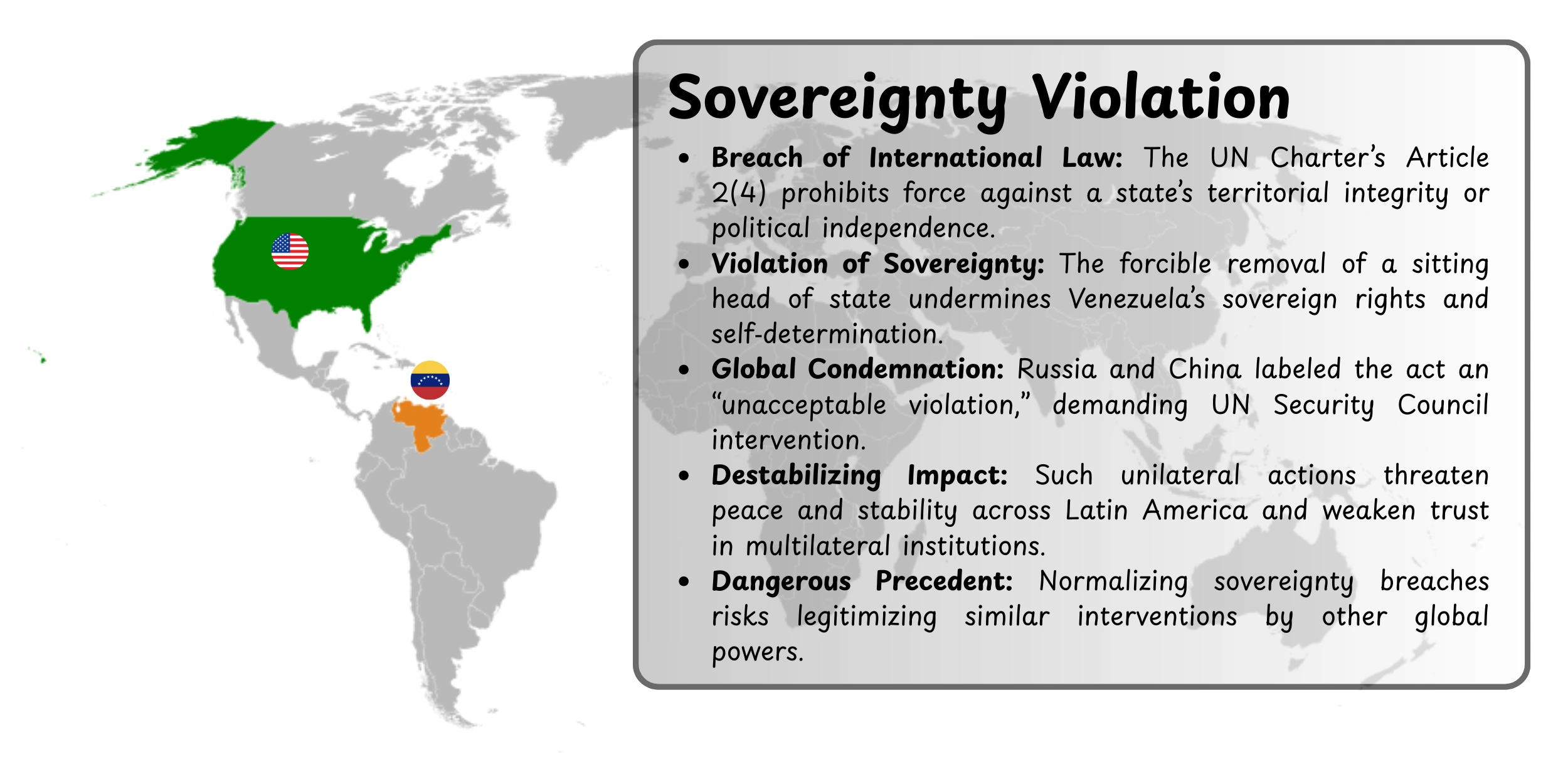
The foundation of international law is sovereignty, and this is expressed in Article 2(4) of the United Nations Charter, which declares that the use of force against the territorial integrity or political independence of a state is not allowed. The forcible ousting of an incumbent head of state is a direct violation of this tenet, making Venezuela unable to determine itself and whether to be governed by free will or through foreign coercion.
Non-Intervention Norms and International Law
The policy of non-intervention, which was reinstated by the International Court of Justice in Nicaragua v. United States (1986), argues that states are not allowed to interfere in the internal affairs of another state, especially by use of military force. The intervention of Latin America follows the history of American intervention in the region; the magnitude of the intervention in Venezuela, however, is on an unprecedented scale, taking a head of state. According to scholars, such unilateralism undermines the credibility of international organizations meant to resolve conflicts.
Violation of the Sovereignty
The international responses speak to the severity of the violation. The operation was labelled as armed aggression by Russia and China, and according to the United Nations experts, it constituted a severe violation of international requirements with destabilizing effects on local security. The International Federation of Human Rights (FIDH) also noted that the intervention in itself had effects on civilians and therefore, it amounted to aggression on the sovereignty of peoples. These responses are sovereignty offences, beyond bilateral conflicts, and cause damage to collective security arrangements.
Factors and Legal Implications
Reports by the United Nations indicated that the military build-ups of the U.S. in the Caribbean were over 5,000 in the form of manpower and naval equipment, which was an indicator of premeditated coercion and not necessity to defend. This disproportional use of force is contrary to expectations under the principle of proportionality in the operation of jus ad bellum, where military acts must be justified and fair to the danger. Through this, the United States has the risk of setting a precedent where the states justify interventions on disputed legal grounds through international adjudication and due process.
Precedent and Global Order
The military seizure of President Maduro of Venezuela has raised significant alarm over precedent and the international system as a whole to test established standards in international relations and place new debates on the issue of sovereignty and intervention.
Precedent in International Relations
Coupled with the removal of a sitting head of state by a foreign military through force, it creates a dangerous precedent as per international law. There is a long-standing traditional privilege of immunity attached to heads of state in customary international law, and capture compromises the value of sovereign equality. On a scholarly level, the power of multilateral institutions, and more so the United Nations, which was established specifically to interfere in disagreements and prevent a further breakdown, is undermined by such unilateral actions, according to scholars.
International Response
The destabilizing role of the precedent can be demonstrated by the international reactions. Other nations like Russia, China, France, and India condemned the act as a violation of international law, but some countries received the end of the Maduro regime with relative applause. The European Union promoted moderation, with great focus on observing the UN Charter. This division is an example of how unilateral actions are known to divide the international community, undermine the belief in the existence of collective security structures, and empower states to take similar actions without the international community setting an example.
Global Order
It has been reported that the United States deployed more than 5,000 military officers and sophisticated naval resources in the Caribbean during the Operation, and hence emphasized the amount of force used. These disproportionate actions can be challenged under jus ad bellum proportionality, which requires necessity and the proportionality of threat and response. In the event this precedent is established as the norm, it may serve to encourage the strong states to bypass the international adjudication, destabilizing the international system in the process by the normalization of coercive intervention of the weak states.
Long Term Threats
The precedent is a menace against the non-intervention standards, which have been cemented since second World War. The case of the United States undermining international law through its claim of having the authority to detain a foreign leader on contentious legal grounds. This weakens the ratification of treaties and conventions such as the UN Charter and can embolden other great powers to use the same to defend similar actions in their areas of interest. The result is a highly disjointed world order where there is the subjugation of legality by geopolitical interests.
Proportionality and Human Rights Issues
The US military action in Venezuela that ultimately led to the arrest of Nicolás Maduro has raised a lot of controversy regarding proportionality and human rights, therefore highlighting the conflict between strategic interests and internationally recognized legal standards.
Jus ad Bellum Proportionality
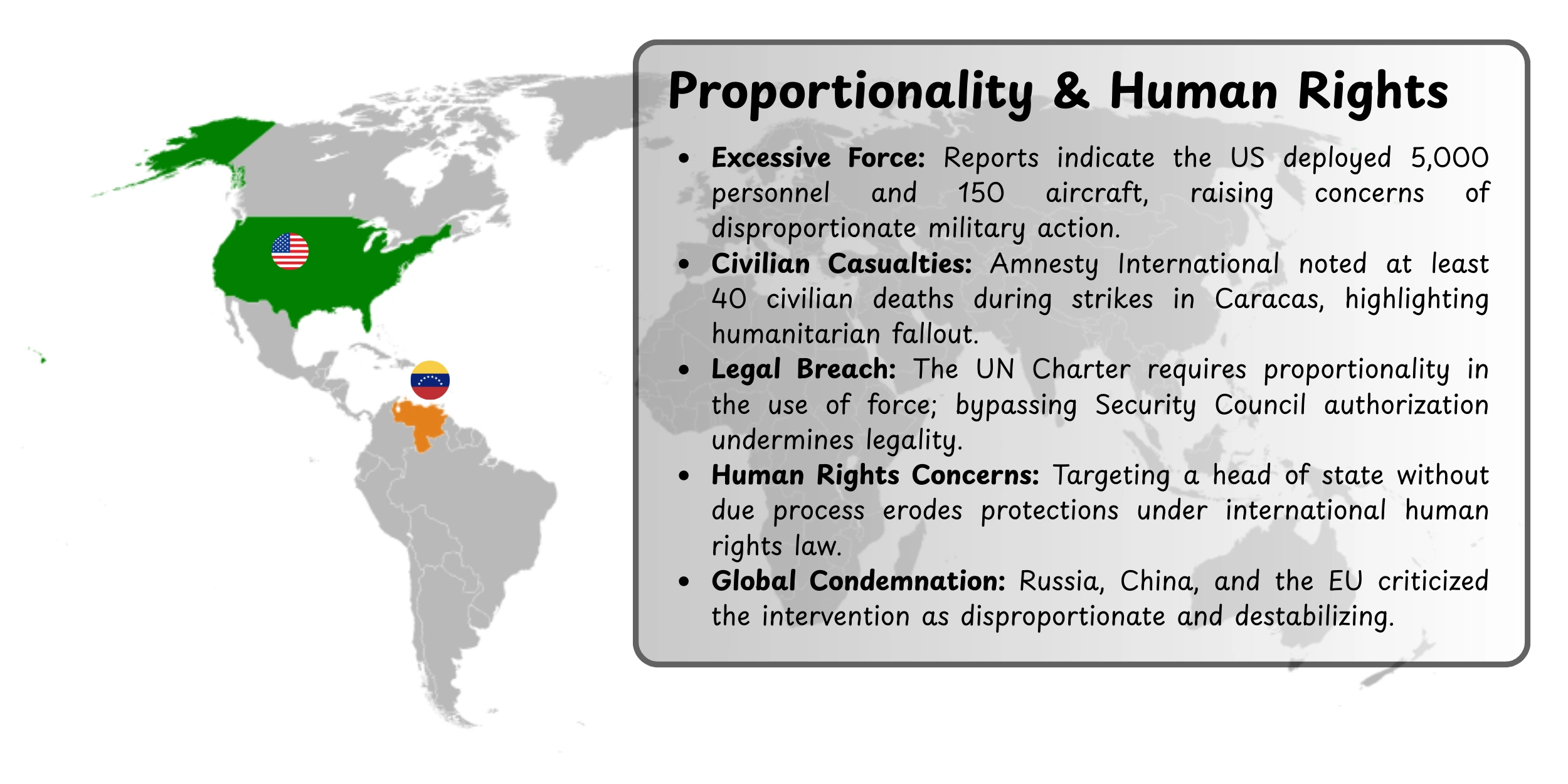
The concept of proportionality is a fundamental principle of international humanitarian law, since the use of force must be proportionate to the threat, as well as to the legitimate military purpose. Operation Absolute Resolve is said to have moved 150 aircraft and more than 5,000 troops. Critics believe that such a scale of operation is disproportionately huge when compared to the stated objective to capture Maduro. This imbalance is indicative of a violation of the standards of jus ad bellum and raises questions of claims to legal standards.
Civilian life and Human rights
The civilian casualties and the overall humanitarian consequences have elicited a very strong concern among human-rights organisations, such as Amnesty International. Initial death estimates reveal that at least forty civilians were killed in the Caracas attacks. Amnesty has cautioned that the intervention is mostly an act of clear breach of international law and may foster the birth of another surge of abuse of the Venezuelan civil society. Such developments are illustrations of the negative impacts of not having such disproportionate military actions undermining the protection clauses of the international human-rights law.
Legal and Ethical Aspects
The use of force, according to the Charter of the United Nations, is allowed only when the Security Council allows it to be used or if the state is acting in self-defence. Any form of circumventing these procedures brings up material ethical issues of unilateralism and selective law protection under international law. Researchers argue that the alleged target of a head of state without due process will diminish accountability and create a precedent, according to which human rights will be subdued by geopolitical interests.
Systemic Threats
These issues are serious, as indicated by international reactions. The strikes were condemned by Russia, China, and the European Union, with the Indian government terming the events as extremely worrying. These responses help shed light on how global coherence is disintegrating, how confidence is falling in the effectiveness of collective security systems, and how human-rights violation can become ordinary in the name of necessity.
Resource Dimensions and Geopolitical
The capture of the Venezuelan President Nicolas Maduro by the US government could not be viewed through legalistic spheres; it is deeply rooted in the geopolitical arguments and in the sphere of competition for resources, considering how large the oil deposits of Venezuela are.
Venezuela as a Strategy Resource Base
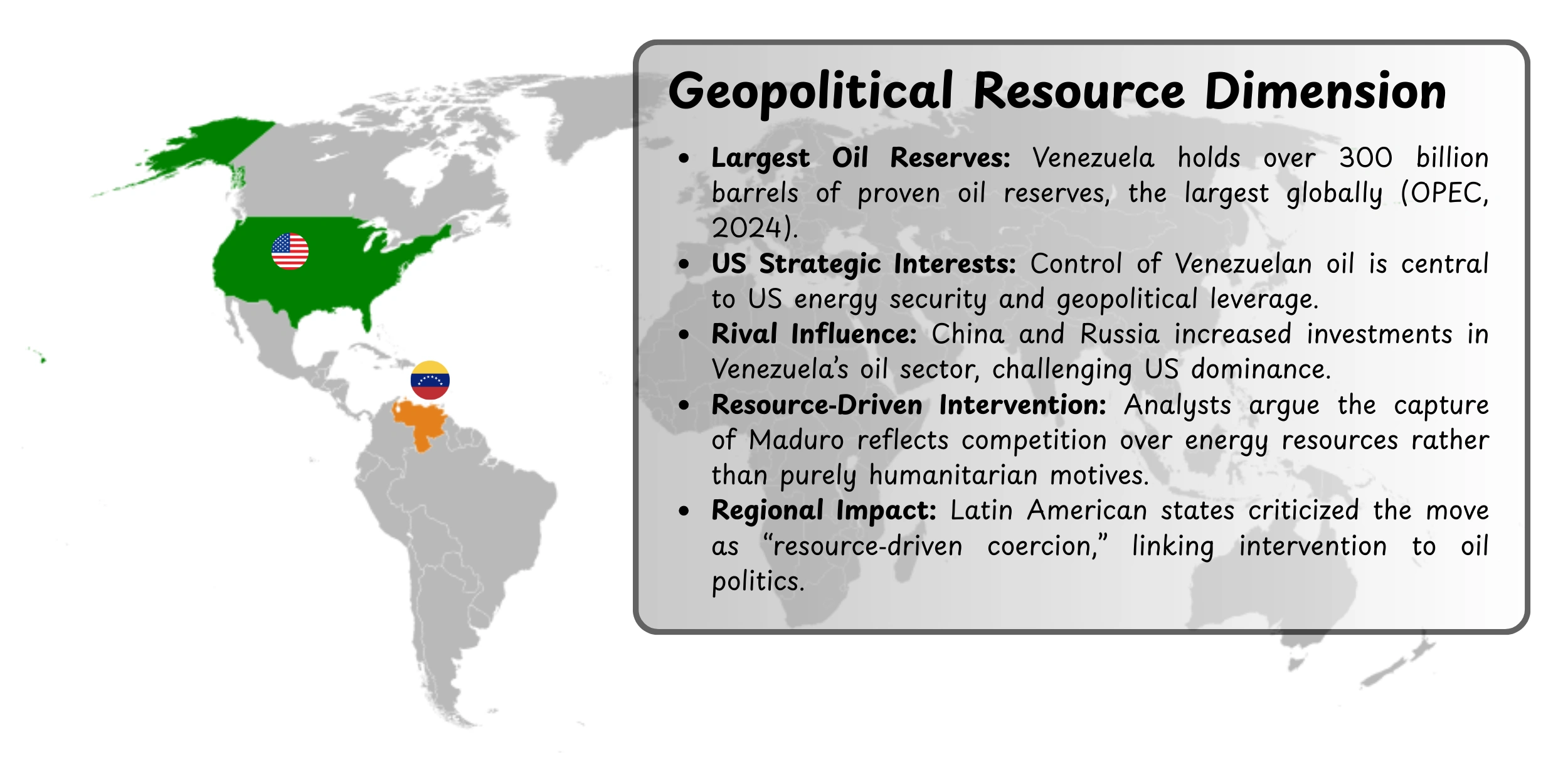
The nation of Venezuela harbours the largest documented hydrocarbon reserves in the world, of over 300 billion barrels (OPEC, 2024). The region has always been a center of energy politics in the world, mainly because of its richness. The US, which historically depended on Venezuelan crude, has tried to influence the ruling in Caracas to protect energy streams. In turn, the Maduro capture is not only a political conflict but also a resource demand.
US’s Geopolitical Interests
The intervention complies with the historical tradition of the Monroe Doctrine, according to which Washington imposes its will on Latin America so that it cannot allow the other powers to gain footholds. Analysts stated that this operation occurred as Chinese and Russian investments in the oil sector in Venezuela were on the rise. The action of ousting Maduro was aimed at preventing its proximate possession of the energy market and reinstating dominance in the perceived arena of influence by the United States.
Resource Competition
According to the data of the U.S. Energy Information Administration (2025), export of oil by Venezuela to China increased 40 percent in 2020-24, as Russian businesses developed joint ventures in the Orinoco Belt. The developments threatened the energy security and geopolitical strength of the U.S. Therefore, the military action could not be dissuaded with the rivalry over resources, where oil could give resource competence in the world market.
The Regional Reactions
The Latin American governments expressed the view that the intervention was not basically driven by democratic ideals but had resource reasons. Brazil and Mexico called the act a kind of resource-based coercion, and Russia called it an energy flow monopoly bid. These reactions highlight the fact that it is the politics of resources that make legal claims difficult, supporting the sense of intervention as a geopolitical action and not a humanitarian need.
Conclusion
The military seizure of the President of Venezuela, Nicolas Maduro, by the United States highlights a multilateral convergence of the notions of sovereignty, international law, proportionality, human rights, and rivalry for geopolitical resources. Breaking the old rules that no nation should interfere in the internal matters of another country and setting an extremely dangerous precedent, the move does nothing to stabilize the international order and generates a lack of trust in multilateral institutions as a whole. The imbalanced application of force and its effects on civilians only intensify the weakening of humanitarian protection. In the end, this episode shows that the law is often undone to the benefit of strategic interests, and thus, serious concerns are raised about the future of international law and the viability of collective security structures in an ever more competitive global environment.