|
Key highlights
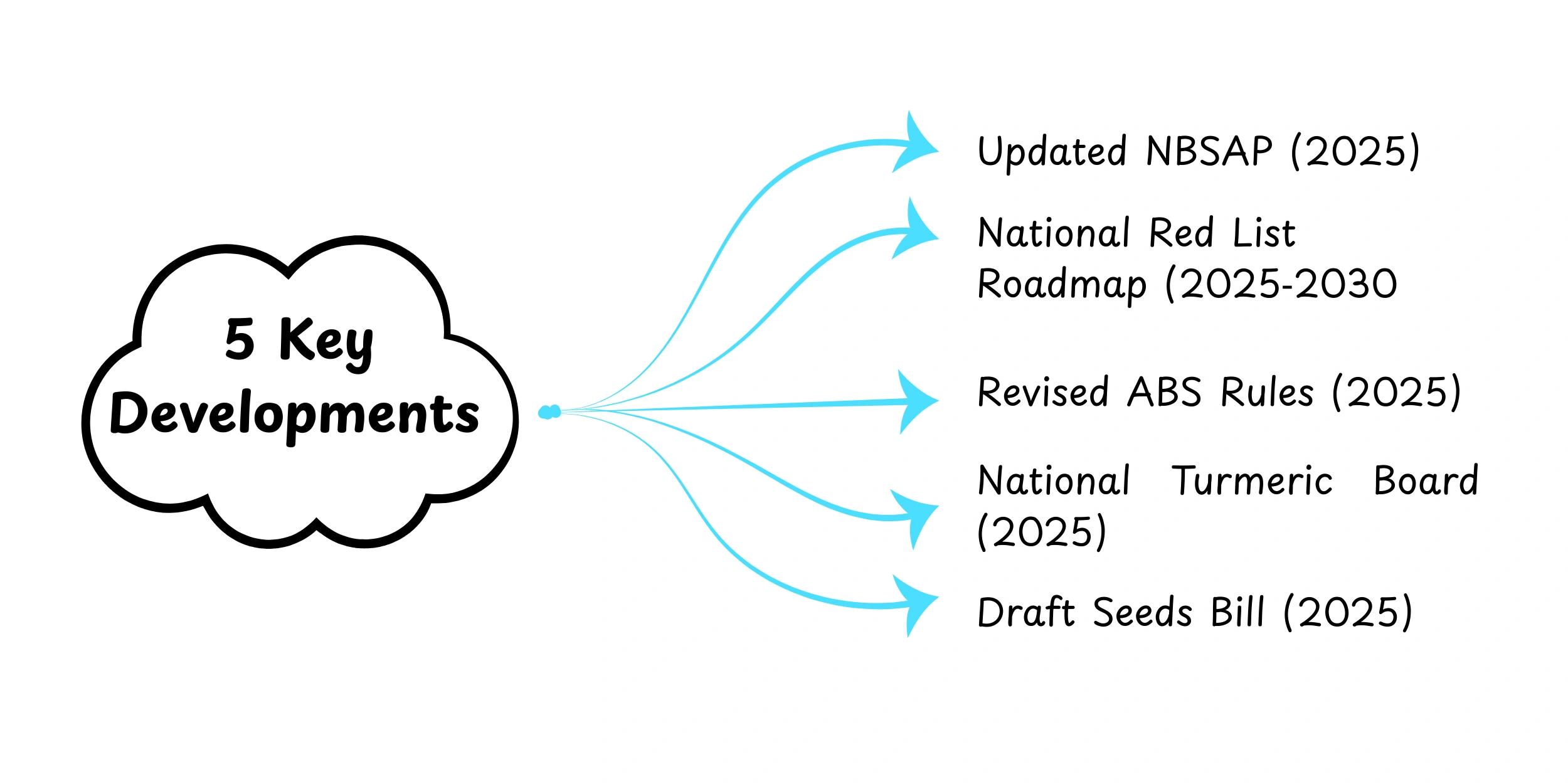
- Updated NBSAP (2025)
- National Red List Roadmap (2025‑2030
- Revised ABS Rules (2025)
- National Turmeric Board (2025)
- Draft Seeds Bill (2025)
|
The article 5 Key Developments in India’s Biodiversity and Governance 2025” considers 5 main initiatives that India has undertaken in 2025 related to governing biodiversity, including: a new National Biodiversity Strategy and Action Plan, National Red List roadmap, updated regulation on Access and Benefit Sharing, formation of National Turmeric Board, and the draft Seeds Bill. These combined actions demonstrate that India has been actively involved in conservation, sustainable development, and biodiversity management efforts, which are community-based.
|
Tips for Aspirants
The article is important for the UPSC CSE and State PSC Exams because it explains the basics of the 5 major developments done by India in the biodiversity framework and governance in India in 2025, which is important in the GS-3 paper and the current affairs section.
|
|
Relevant Suggestions for UPSC and State PCS Exam
- Revised NBSAP (2025): the biodiversity strategy of India has been designed in line with the Kunming-Montreal Global Biodiversity Framework, which outlines 4 high-level and 23 specific goals.
- National Red List Roadmap (2025-2030): In this approach framework, species will be systematically evaluated, and a National Red List Index will be introduced where the Indigenous knowledge systems are taken into account.
- Revised ABS Rules (2025): The regulations empower communities, create a fair distribution of benefits, and also provide protection of traditional knowledge against bio-piracy.
- National Turmeric Board (2025): The board facilitates agro-biodiversity, preservation of native types of turmeric, benefits the farmers, and also promotes global branding.
- Draft Seeds Bill (2025): The Bill controls the quality of the seeds, secures the native varieties, and balances biotechnological innovation and the freedom of farmers.
- Significance: Collectively, these efforts demonstrate how India has played a forefront in managing biodiversity with a connection between conservation, equity, and sustainable development.
|
India, one of the seventeen mega-diverse countries in the world, is at a critical crossroads in the year 2025 with its effort to strengthen biodiversity governance in tackling both global and national issues. Its ecosystems extend to the Himalayas to the Indian Ocean and accommodate thousands of endemic species, and thus, biodiversity in India provides a main framework of ecological stability and culture. However, the strain and stress of fast urbanization, climate change, and the untenable use of resources have made conservation an urgent need. The year 2025 was a breakpoint year, and India aligned its regulatory system with the Kunming-Montreal Global Biodiversity Framework (KMGBF) at the same time, making internal changes.
India hopes to integrate science, governing policy, and even community with the revision of its National Biodiversity Strategy and Action Plan and the launch of a National Red List Roadmap. Introduction of revised benefit-sharing laws, agro- bio-diversity plans like the National Turmeric Board and Draft Seeds Bill further demonstrate the Indian efforts in order to balance conservation priorities with the development agendas. These measures, in totality, are an indication of the initiative attitude of India towards governance of biodiversity, notwithstanding that it has been able to harmonise international frameworks with local realities, putting the spotlight on sustainable custodianship in the next few decades.
Updated NBSAP - Strengthening India’s Biodiversity Governance Framework in 2025
India is strengthening its biodiversity governance framework in 2025 through a multi-pronged approach, including the launch of a National Red List Roadmap, updated regulations for Access and Benefit Sharing (ABS), increased funding, and a focus on community-centric, science-driven conservation. India reached a decisive stage of governance of biodiversity in 2025 with the promulgation of the revised strategy and plan of action of biodiversity in the country which included the global conservation and sustainable use strategies with the national priorities and needs of the country.
Contextual Background
The National Biodiversity Strategy and Action Plan (NBSAP) is the major tool for the implementation of the Convention on Biological Diversity (CBD) in India. It is planned to be updated at the end of 2024 and operationalized in 2025 and represents a Whole-of-Government and Whole-of-Society approach, so that biodiversity issues are mainstreamed across a range of sectors, such as agriculture, forestry, fisheries, and urban planning.
Global Standards
The updated strategy is specifically consistent with the Kunming-Montreal Global Biodiversity Framework (KMGBF) having ambitious targets to determine and reverse the depletion of biodiversity by 2030. The NBSAP of India integrates all four KMGBF goals and 23 targets, which traverse the ecosystem restoration to a justifiable distribution of benefits.
Strategic Priorities
Key priorities include:
- Restoration of the degraded forest, wetlands, and coastal areas.
- Recovery programmes of the endangered species of flora and fauna.
- Providing environmental control and managing alien species as a way of protecting ecological purity.
- Community-based conservation, which puts a strong focus on local involvement and local knowledge.
Implementation
The revised NBSAP recommends that there are National Biodiversity Targets (NBTs), the progress of which is to be monitored and reported by the lead and supporting agencies. This structure of the institution makes it stronger in relation to accountability and the delivery of measurable results in biodiversity governance.
Significance for India
India has proven that it is dedicated to the need to balance the sustainability of ecology and the expansion of the economy by incorporating biodiversity into the developmental planning. The NBSAP 2025 makes India a dedicated agent of the international policy of biodiversity, as well as strengthening the country against climate and ecological disasters.
National Red List Roadmap (Vision 2025-2030)
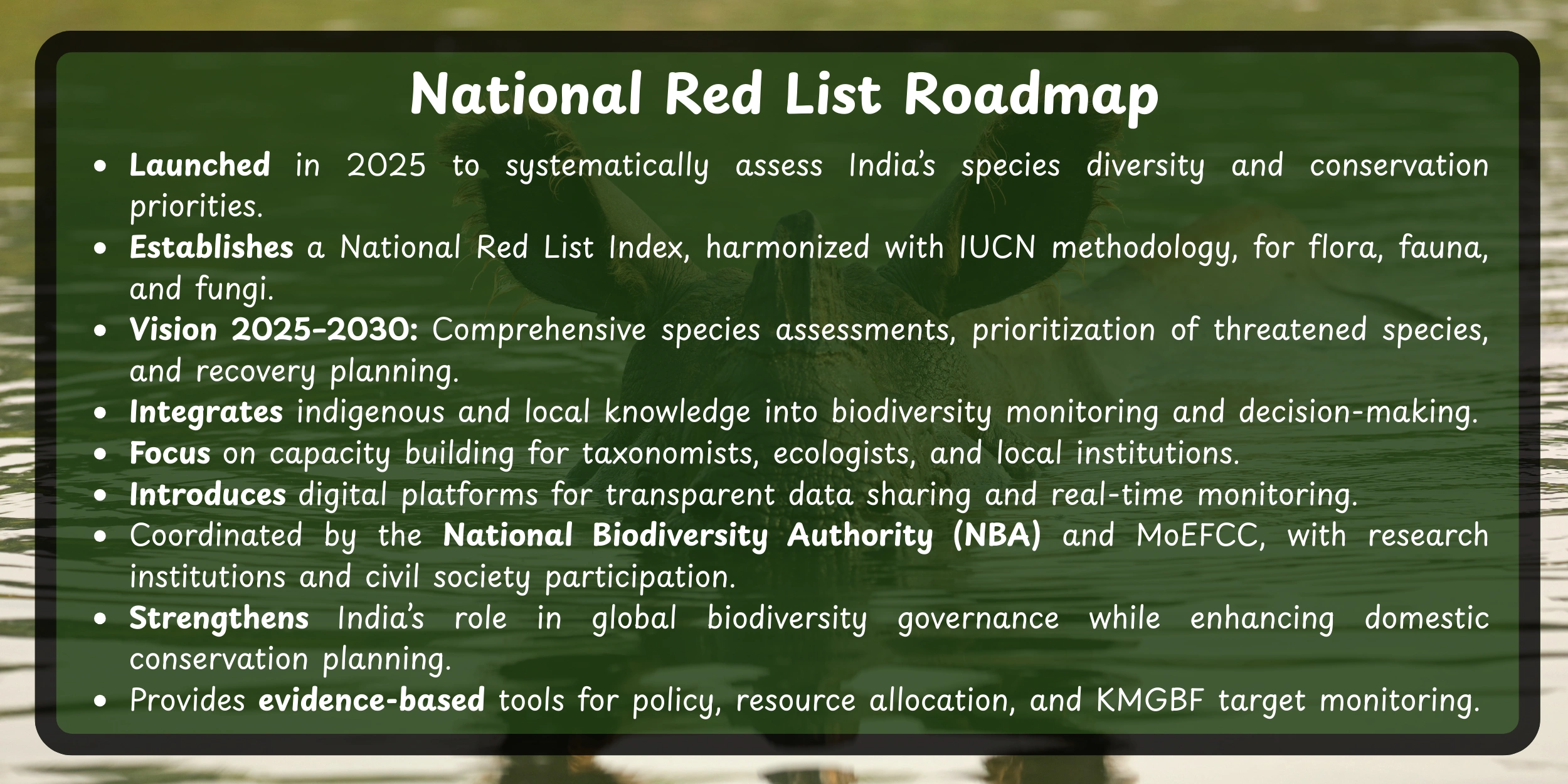
In 2025, a scale-up of the biodiversity governance in India was made possible after the National Red List Roadmap promulgation, which was a critical initiative aimed at systemically analyzing the species and focusing conservation measures throughout the nation.
Background and Rationale
In its adherence to the Kunming-Montreal Global Biodiversity Framework (KMGBF), the Red List Roadmap was launched. It is a reaction to the urgent needs of data that can be trusted on the issue of species status due to the growing threats associated with habitat destruction, climate warming, and unsustainable use. In setting up an organised process on species, India aims at closing the gap between science and policy.
Vision 2025‑2030
The roadmap outlines a five-year horizon (2025- 2030) comprising the development of a National Red List Index, which is consistent with the International Union for Conservation of Nature (IUCN) approach. It underscores:
- These are comprehensive species evaluations of flora, fauna, and fungi.
- Inclusion of the native knowledge in the conservation agenda.
- Capacity building among taxonomists, ecologists, and local institutions.
- Online systems that assist in clear data transfer and management.
Mechanism
The program is being led by the National Biodiversity Authority (NBA) along with the Ministry of Environment, Forest and Climate Change (MoEFCC) in conjunction with the institutions of research and the civil society. By making conservation priorities both scientifically sound and socially inclusive, this multi-stakeholder approach makes conservation relevant to everyone.
Significance for India
The Red List Roadmap strengthens the credibility of India in the international governance of biodiversity, as the contribution to global databases, as well as strengthening domestic conservation planning. It provides the policy-makers with evidence-based instruments to distribute resources, plan recovery programmes, and track the progress of the achievement of KMGBF goals.
The Access and Benefit Sharing Rules, 2025 (revised)
In 2025, a new regulation of Access and Benefit Sharing (ABS) was passed in India, which strengthened the rights of communities as well as the equitable distribution of the benefits obtained after using biodiversity and traditional knowledge systems.
Historical Context
The ABS framework is anchored in the Convention on Biological Diversity (CBD) and the Nagoya Protocol, which both provide for the fair and equitable distribution of benefits that are created based on genetic resources. Being a country with a variety of biodiversity, India has traditionally debated the issue of striking a balance between the commercialization of biological resources and protecting the rights of indigenous populations.
Key Features
A number of interesting innovations were presented in the amended rules:
- Community-focused sharing of benefits, whereby the communities in and around biodiversity-based industries get monetary and non-monetary benefits.
- Enforced legal measures to help stop bio-piracy and commercial exploitation of traditional knowledge.
- Streamlined procedural mechanisms with simplification of approvals of research and commercial use without loss of transparency.
- Also incorporating KMGBF, as a result, it aims to make national benefit-sharing mechanisms consistent with international biodiversity frameworks.
Institutional Mechanisms
The National Biodiversity Authority (NBA) and State Biodiversity Boards (SBBs) had been given improved mandates to oversee compliance. To ensure the participation of the grassroots, Local Biodiversity Management Committees (BMCs) were to be given greater powers to strike a benefit-sharing agreement.
Significance for India
The revised ABS rules highlight the Indian action in favouring equity and justice in the governance of biodiversity. The community rights would strengthen the moral and legal position of India in the international negotiations and instil trust between the policymakers, scientists, and indigenous people.
NTB: Government Launches National Turmeric Board
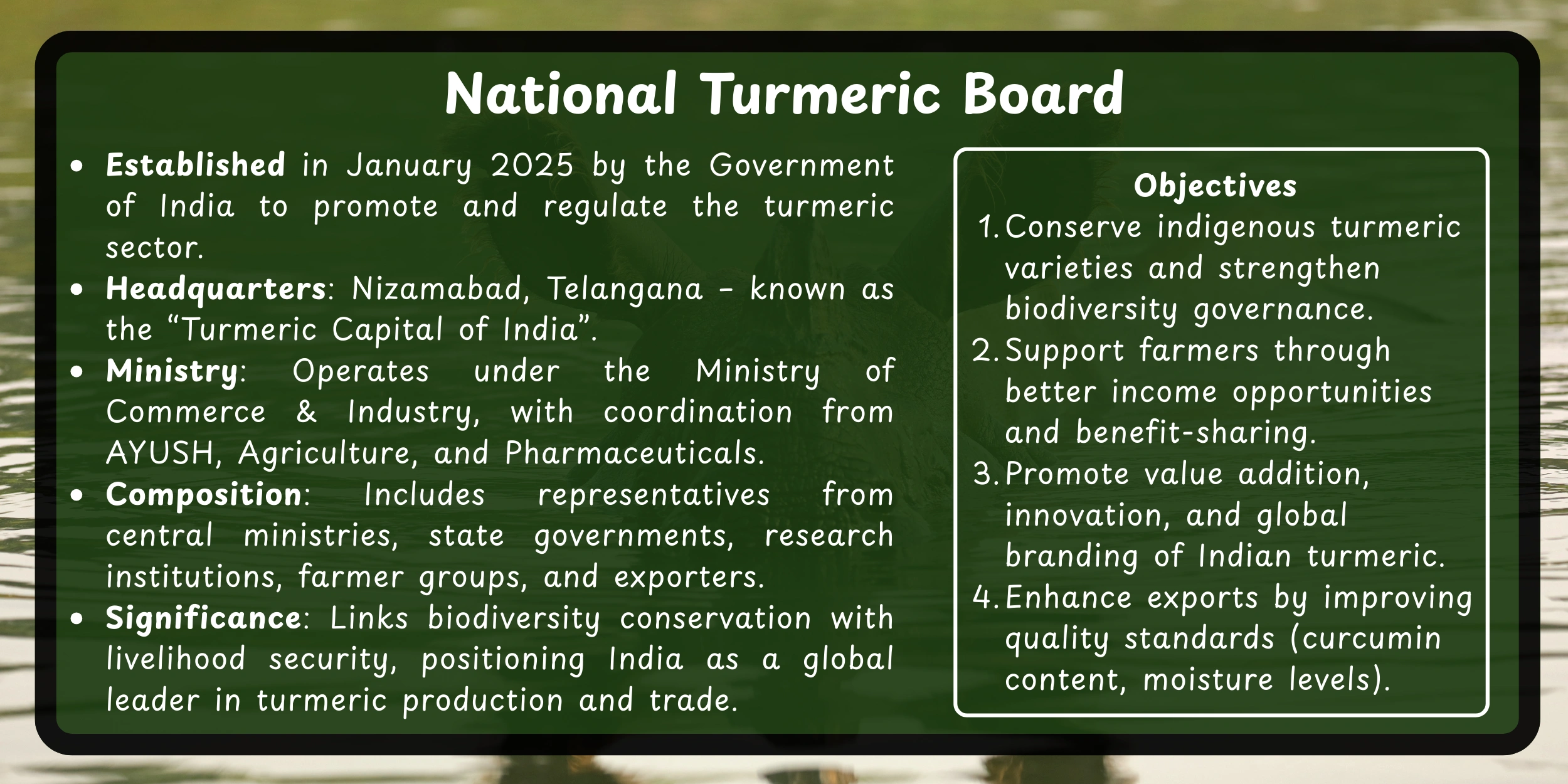
The Indian government established the National Turmeric Board in 2025, which constitutes an institution that acts as a focal point between biodiversity governance, agro-economics, traditional knowledge conservation, and the welfare of farmers, which will enable the conservation efforts and value- chain improvement. Strengthening India's turmeric ecosystem, the headquarters of the National Turmeric Board was inaugurated in Nizamabad, Telangana on 29 June 2025. The facility was inaugurated by the Hon'ble Union Minister of Home Affairs and Cooperation, Shri Amit Shah. Government Launches National Turmeric Board with ₹200 Crore Corpus in Telangana.
Background and Context
Turmeric, which is commonly known as “the golden spice of India”, does not just serve as a traded commodity around the world, but it is a symbol of agro-biodiversity and the cultural legacy of India. In recognition of the ecological and economic importance of turmeric, the Government of India declared in 2025 the creation of the National Turmeric Board that would support a sustainable production of turmeric and preserve genetic diversity, and extend to international markets.
Objectives of the Board
The scale of the mandate of the Board is not restricted to trade promotion, but includes biodiversity as a wider range; its objectives include:
- Preservation of the native strength of turmeric by means of seed banks and genetic mapping.
- Farmer-centric benefit-sharing systems, which will assure farmers' just returns.
- Research and development towards sustainable agriculture and value addition.
- The promotion of turmeric internationally and marketing of the export of turmeric products, and making India the leading manufacturer.
Institutional Function
The board operates under the umbrella of the Ministry of Commerce and Industry, and its area of operation overlaps with the biodiversity governance system through joint ventures with the National Biodiversity Authority (NBA) and agriculture universities; this institutional synergy would provide the internalization of the biodiversity management system in the overall economic development paradigm.
Significance
With the formation of the National Turmeric Board, India is establishing the concept of the governance of biodiversity and the protection of the livelihood; as the protection of the traditional crop diversity is also coupled with the improvement of the traditional farmer income level, India exemplifies the way in which the idea of agro-biodiversity can serve as an intermediate between the ecological sustainability and the socio-economic stability.
Draft Seeds Bill 2025: Key Features, Need & Farmer Benefits (2025)
The Draft Seeds Bill, 2025, introduced by India's Ministry of Agriculture, aims to replace the old Seeds Act (1966) by creating a unified, modern framework for seed regulation, focusing on quality, innovation, and easier business for the industry, with features like central registration, mandatory labeling (purity, germination), and stricter penalties for fake seeds. One of the most crucial interventions in the management of agro-biodiversity is the Draft Seeds Bill of 2025, which was promulgated by the Government of India, which attempts to strike a balance between the development of biotechnology and the safeguarding of the native seed varieties and safeguarding the rights of the farmers.
Context
Agricultural biodiversity includes seed diversity as one of its constituent parts, which has a direct impact on food security and ecological stability. Previous legislation, the Seeds Act of 1966 and its later amendments, were aimed at quality and certification regulation. Nevertheless, quick steps in the field of biotechnology and the increased interest in intellectual property and the freedom of farmers required an overall reformation. The Draft Seeds Bill of 2025 was the reaction to these difficulties, which also helps to modernise the governmental body and preserve the traditional seed variety.
Provisions
The introduction of the 2025 draft brings a number of interesting features:
- Control of quality and certification of seeds in order to make the markets transparent.
- Safeguarding the native varieties, requiring registration and preservation of the traditional seeds.
- Improved provisions for farmer rights, to provide the cultivators with a right to save, share, and reuse seeds, without undue restrictions.
- Regulation of biotechnology companies and adherence to the standards of biodiversity and biosafety.
Framework
The Bill enhances the effectiveness of the National Biodiversity Authority (NBA) and agricultural research institutions in surveying the seed diversity. It also creates a dispute resolution mechanism between the farmers and the corporations, thus entrenching equity in agricultural governance.
Implications
The Draft Seeds Bill provides crop access to agro-biodiversity by placing biodiversity issues in agricultural laws, which underline the efforts by India to conserve agro-biodiversity. It aims to balance innovation and sustainability at the same level so that technological advancements do not diminish the knowledge of tradition and the independence of farmers.
Conclusion
The biodiversity governance portrayed in India in the year 2025 shows an unambiguous move towards balancing ecological sustainability and socioeconomic demands. The new NBSAP is consistent with the goals of the Kunming-Montreal Global Biodiversity Framework, and the National Red List Roadmap gives a scientific basis to systematic species monitoring. With new regulations of Access and Benefit Sharing (ABS), the community rights are strengthened, and the introduction of the National Turmeric Board highlights agro-biodiversity as an initiating factor of livelihood formation. At last, the Draft Seeds Bill (2025) is a reunion in biotechnological regulation and farmer freedom, along with preserving native seed types. Combined, these initiatives highlight the fact that India is engaged in global biodiversity governance and equate to the synergy between conservation, equity, and development practice, and thus secure ecological stability.
Frequently asked questionsFrequently asked questions
Updated NBSAP - Strengthening India’s Biodiversity Governance Framework in 2025?
India is strengthening its biodiversity governance framework in 2025 through a multi-pronged approach, including the launch of a National Red List Roadmap, updated regulations for Access and Benefit Sharing (ABS), increased funding, and a focus on community-centric, science-driven conservation. India reached a decisive stage of governance of biodiversity in 2025 with the promulgation of the revised strategy and plan of action of biodiversity in the country which included the global conservation and sustainable use strategies with the national priorities and needs of the country.
National Red List Roadmap (Vision 2025-2030)?
In 2025, a scale-up of the biodiversity governance in India was made possible after the National Red List Roadmap promulgation, which was a critical initiative aimed at systemically analyzing the species and focusing conservation measures throughout the nation.
The Access and Benefit Sharing Rules, 2025 (revised)?
In 2025, a new regulation of Access and Benefit Sharing (ABS) was passed in India, which strengthened the rights of communities as well as the equitable distribution of the benefits obtained after using biodiversity and traditional knowledge systems.
NTB: Government Launches National Turmeric Board?
The Indian government established the National Turmeric Board in 2025, which constitutes an institution that acts as a focal point between biodiversity governance, agro-economics, traditional knowledge conservation, and the welfare of farmers, which will enable the conservation efforts and value- chain improvement. Strengthening India's turmeric ecosystem, the headquarters of the National Turmeric Board was inaugurated in Nizamabad, Telangana on 29 June 2025. The facility was inaugurated by the Hon'ble Union Minister of Home Affairs and Cooperation, Shri Amit Shah. Government Launches National Turmeric Board with ₹200 Crore Corpus in Telangana.
Draft Seeds Bill 2025: Key Features, Need & Farmer Benefits (2025)?
The Draft Seeds Bill, 2025, introduced by India's Ministry of Agriculture, aims to replace the old Seeds Act (1966) by creating a unified, modern framework for seed regulation, focusing on quality, innovation, and easier business for the industry, with features like central registration, mandatory labeling (purity, germination), and stricter penalties for fake seeds. One of the most crucial interventions in the management of agro-biodiversity is the Draft Seeds Bill of 2025, which was promulgated by the Government of India, which attempts to strike a balance between the development of biotechnology and the safeguarding of the native seed varieties and safeguarding the rights of the farmers.