The topic “Renewables to Lead, Nuclear to Stabilise” explains the long-term energy transition plan of India with the help of renewables by 2070, with the target to reduce the use of coal and other non-renewable sources. This transition is necessitated by the fact that it alleviates the sustainability and structural challenges of grid capacity, financing, and equity. This gradual integration of nuclear power will provide a stable base-load of carbon-free energy, making this transition a necessity to pursue climate goals and promote inclusive development. India is driving the global renewable energy revolution with ambitious targets, strong policies, green hydrogen.
|
Key highlights
- The Rise of Renewables in India
- Solar and Wind Expansion in India
- Green Hydrogen in the Indian Renewable Mission
- Organisational Issues that Stifle the Development of Renewable Energy
- The growing role of Nuclear as a renewable source in India
- Coal Decline and Just Transition in India in Renewables
|
India is pursuing a balanced, multi-pronged strategy to achieve net-zero emissions by 2070 where renewables take the lead through rapid, large-scale expansion of solar and wind power, and nuclear energy provides stability by delivering reliable, non-fossil baseload electricity. The energy transformation of India is slowly being presented in the framework of its net-zero promise by 2070, in which renewable energy is expected to dominate the national grid. It is a path of technological advancement as well as ambition in policymaking, but balanced out by the conflicts in infrastructure, funding and governance. With the decline in the role of coal, nuclear will see a gradual increase as a source of carbon-free base-load. The interconnection between renewables, nuclear energy, and the reduced coal industry highlights the complexity of the Indian energy future, where a holistic strategy should be implemented by focusing on sustainability, equity, and resilience. This introduction envisions the argument in long-term developmental and climate implications.
Renewable Energy Growth- The Rise of the Renewables in India
India is witnessing a remarkable flow in renewable energy, with remains fuel sources surpassing 51% of total installed capacity by late 2025 and meeting 51.5% of peak electricity demand. Powered by strong growth in solar (136 GW) and wind capacity, India now ranks fourth globally in total renewable energy capacity. Renewable capacity is surging in India and is an unprecedented move in terms of its energy transition, with solar, wind, and newer technologies becoming the centre stage of its 2070 net-zero initiative.
Solar and Wind Expansion in India
In 2025, India added almost 48,600 MW of renewable energy, with the total installed renewable energy of 258 GW by December 2025 as per the Ministry of New and Renewable Energy (MNRE). This expansion is indicative of high levels of policy continuity, reduction in the cost of technology and increased involvement by the state. The main pillars of this growth are solar and wind, with the help of international partnerships and local production plans.
India’s De-centralised and Participative Energy Systems
In addition to massive-scale initiatives, in the rural electrification process, decentralised models, including rooftop solar and community micro grids, are on the rise. These systems enable the marginalised communities by ensuring affordability and access, as well as minimising reliance on fossil fuels. This would not only make the renewable transition advanced and sophisticated but also equitable in the anticipated social sense.
Green Hydrogen in the Indian Renewable Mission
The National Green Hydrogen Mission has a target of producing five million tonnes of hydrogen in a year by 2030, with the assistance of 125 GW of new solar and wind energy projects. It is estimated that the program will result in INR 8 lakh crore (around USD 89 billion) investment, creation of 600,000 jobs and avert the release of about 50 million metric tonnes of greenhouse gases each year.
Organizational issues hindering Renewable Growth
The way in which renewable energy is developing in India is characterised by high goals; however, the progress is hampered by the systemic problems which negatively influence infrastructure, funding, and the state apparatus.
Grid Infrastructure and Technical Constraints in India
The grid constraints in India are still high, even with a fast increase in installed capacity. The presence of any bottlenecks in the transmission, limited storage capacity, and intermittency are all forms of hurdles to the smooth incorporation of the renewable resources. According to the Economic Survey 2025-26, delays in land acquisition and the lack of grid are suggested as the key obstacles and that unless the execution of the renewable part of the project is optimized, the pace of growth could risk stagnation.
Financial Constraints in India
Higher capital cost is one of the major obstacles. Renewable projects are often based on concessional funding, but the availability of affordable credit is not even in the regional jurisdictions. The Survey emphasizes the need for creative financing schemes and consistent regulation schemes to further promote the development of the industry.
Regional and Equity Concerns in India
Structural issues are not homogeneous. States that contain weaker distribution companies face challenges in merging renewables because of financially distressed situations and the inconsistency of policies. The study by NITI Aayog shows that renewable generation is small compared to installed capacity, showing inefficiencies at the systemic level.
India needs to balance between Growth and Reliability
Coal continues to account for around 74 percent of power generation, hence providing dependable base-load power. The move towards coal elimination should not only be based on technological creativity, but any changes must be backed by far-reaching social and institutional changes to make it reliable and inclusive.
The growing role of Nuclear as a renewable source in India
In India, it is foreseen that the transition of energy will incorporate nuclear energy as a complement to renewable energy, which will gradually increase its contribution at the same time that coal will decrease.
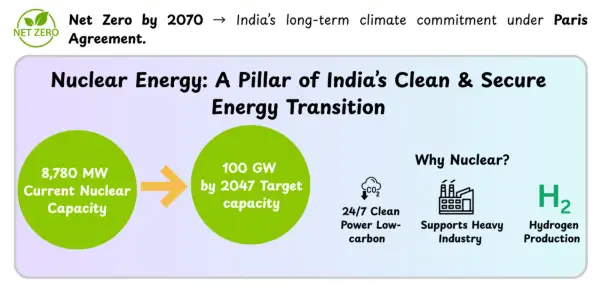
Gradual Capacity Expansion of Nuclear
As of today, 8 GW of nuclear capacity is operational in India, and the government has targeted 100 GW of nuclear capacity by 2047 as a part of the Nuclear Energy Mission, Viksit Bharat. It is estimated that this growth will give nuclear a base-load supply equivalent to or higher than 3 percent of the total electricity production of about 5-8 percent by 2070.
Institutional Support for Nuclear
The Union Budget 2025-26 allocated funds towards the development of the nuclear sector and made amendments to the Acts in the field, such as the Atomic Energy Act and the Civil Liability to Nuclear Damages Act, as a way to encourage private involvement. The key aspect of this roadmap is strategic investments in the native technology and global partnerships.
Technological Innovation for Nuclear
Small Modular Reactors (SMRs) are being promoted in India, and an approximation of 20 crore is being invested in research and development and prediction of five SMRs in operation by 2033. These reactors will offer better safety, flexibility, and scalability, hence countering these drawbacks as well as expanding nuclear applications.
Role of nuclear in Energy Security
Nuclear power development is no longer a de-carbonization goal but a guarantee of grid stability. Contrary to intermittent sources, nuclear power provides base-load power and thus reduces dependence on coal, hence enhancing India's long-term energy stability.
Coal Decline and Just Transition in India in Renewables
This energy transformation process in India is defined by the gradual reduction of coal use and consequently requires a fair and participatory model to address the interests of workers and communities.
Reducing Dependence on Coal
The Central Electricity Authority stated that coal continues to generate close to 74 percent of electricity in India, though the growing renewable generation capacity, stringent climate promises, and the increased health issues are increasingly diminishing its position in the market. India Energy Outlook 2025 by the International Energy Agency forecasts a decline to less than 50% by 2040, a pointer to the structural changes in demand pattern and policy environmental changes.
Ensuring Equity in Transition to Renewables
The de-concentration of coal poses some important socio-economic problems. A major percentage of the workforce, especially the one who works in coal-heavy areas, is facing high chances of job loss and consequent financial insecurity. According to NITI Aayog, a just transition requires novel, comprehensive reskilling programs, strong social safety nets, and geographical diversification of the regions to sustain livelihoods.
Policy Directions towards Inclusion
The de-carbonization path of India should be adjusted in such a way that it balances the priorities on climate mitigation and social equity. Promoting policies grants rewards to green jobs, directs capital to low-carbon industrial enterprises, and encourages general social involvement, which are inalienable measures to prevent a re-escalation of injustice with the loss of coal. On the other hand, all of these actions lead to holistic development.
What India needs to do to achieve net-zero status by 2070
Conclusion
The resourceful transformation of energy in India is both ambitious and ambiguous. Although renewables will take over the grid by 2070, the structural issues in the infrastructure, financing, and governance will also be important. The steady growth in nuclear power is a solution to provide a stable base-load free of carbon, which will complement the unpredictable renewables, and the decline of coal is a reminder of the urgency of a just transition to workers and communities. This balance needs to be achieved through a policy, technological advancement, and inclusion-based development approach in order to make India sustainable, resilient, and equitable over the long-term energy future.
Frequently asked questionsFrequently asked questions
Renewable Energy Growth- The Rise of the Renewables in India?
India is witnessing a remarkable flow in renewable energy, with remains fuel sources surpassing 51% of total installed capacity by late 2025 and meeting 51.5% of peak electricity demand. Powered by strong growth in solar (136 GW) and wind capacity, India now ranks fourth globally in total renewable energy capacity. Renewable capacity is surging in India and is an unprecedented move in terms of its energy transition, with solar, wind, and newer technologies becoming the centre stage of its 2070 net-zero initiative.
Organizational issues hindering Renewable Growth?
The way in which renewable energy is developing in India is characterised by high goals; however, the progress is hampered by the systemic problems which negatively influence infrastructure, funding, and the state apparatus.
The growing role of Nuclear as a renewable source in India?
In India, it is foreseen that the transition of energy will incorporate nuclear energy as a complement to renewable energy, which will gradually increase its contribution at the same time that coal will decrease.
Coal Decline and Just Transition in India in Renewables?
This energy transformation process in India is defined by the gradual reduction of coal use and consequently requires a fair and participatory model to address the interests of workers and communities.