The nuclear programof India is expanding beyond the state and national boundaries, as for India, the Indigenous Light Water Reactor (LWR) is becoming one of the priorities of the nuclear sector, and the Indian nuclear industry is opening its gates for the private sector, the global market export, and bargaining opportunities. This is a shiftfrom conventional dependence on Pressurised Heavy Water Reactors (PHWRs).
|
Key highlights
- India’s Shift towards LWR
- LWR Technology
- Strategic Significance to India
- Entry of the Private Sector
- Challenges & Way Forward for India
|
The direction taken by the strategy of nuclear energy in India is now undergoing a major shift, and the IndigenousLight Water Reactor(LWR) is the strategic focus. Traditionally relying on PHWRs, India started focusing on LWR technology to correspond with the international trends, expand the role of the private sector, and empower the export orientation. LWRs are favoured in further interests that relate to energy security, climate commitments, and technological self-reliance. Such a process places India into the context of the global nuclear discourse, in which LWRs will make up the largest portion of operating reactors, as well as creates an emphasis on the national purpose of focusing on combining domestic innovation with international technology in the nuclear sector.As India opens up its nuclear power sector to private sector participation and eyes a stake in the export market, the need to expedite the fabrication of an Indian Light Water Reactor (LWR) has been flagged as a priority within the nuclear establishment.
India’s Shift towards Light Water Reactor (LWR)
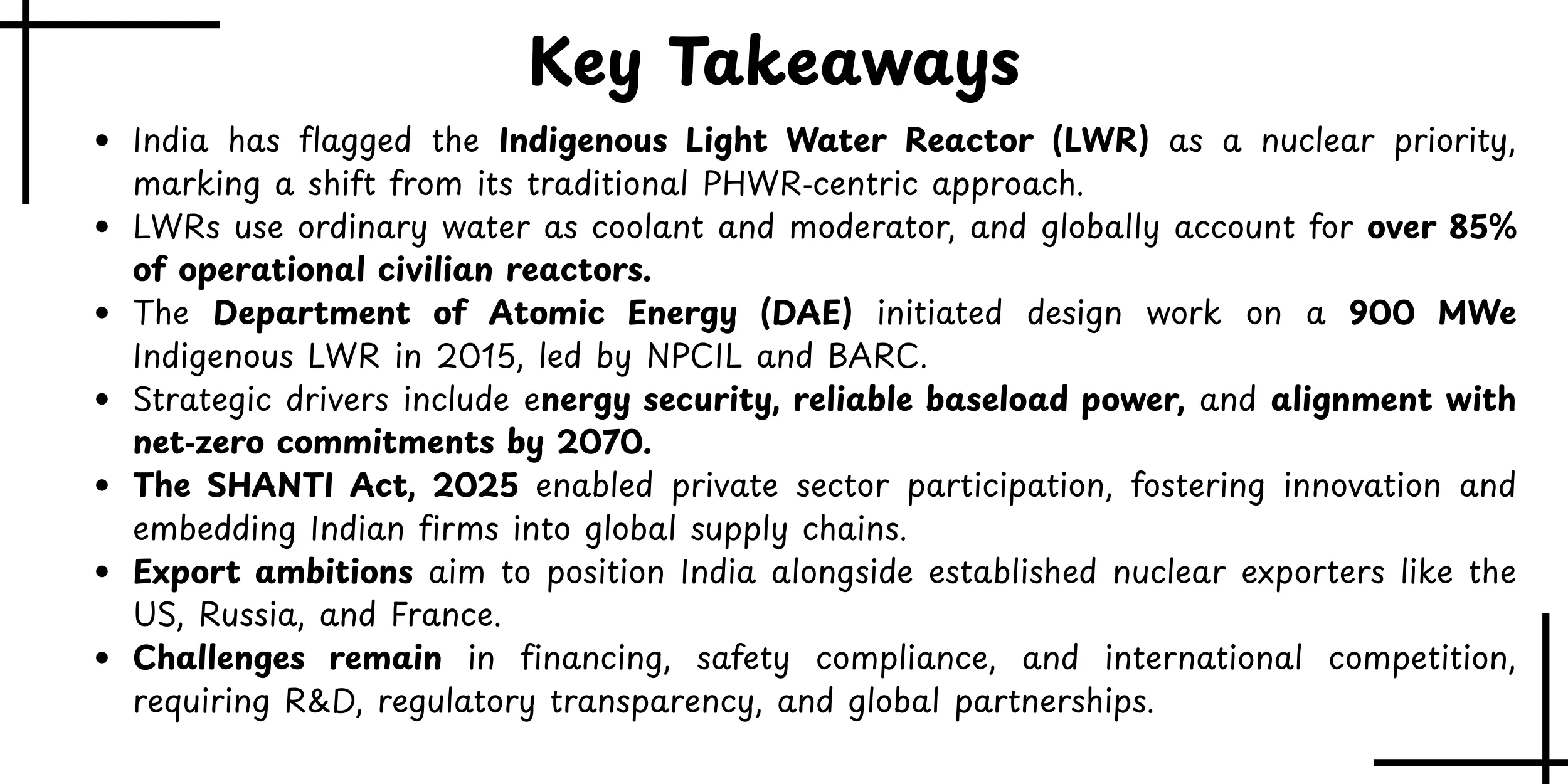
The Indian nuclear establishment has recently advanced the Indigenous Light Water Reactor (LWR) to the forefront, which represents a strategic move towards the long history of dependence of the Indians on the Pressurized Heavy Water Reactors (PHWRs). This step represents the concerns associated with energy security, involvement of the private sector, and competitiveness of exports worldwide.
Nuclear Program of India
The nuclear programme of India has always been designed in terms of the three-stage policy and PHWRs, hence constitutes the main component of the civilian production of energy. However, the Department of Atomic Energy (DAE) has moved 900MWe Indigenous LWR, whose design commenced in 2015. This is seen as a planned move to reactor technology diversification and internationalization, with LWRs representing over 85% of the world's civilian reactor mix.
Private Sector in the Indian Nuclear Program
The SHANTI Act of 2025 made the possibilities of private involvement in nuclear energy a major change from the state-oriented model. The policy of integrating the Indian firms into international LWR supply chains is also supposed to reinforce the bargaining position of India in its relations with global suppliers, as well as minimize the reliance on imports. This policy reorientation is an indication of the transnational vision that will combine both local innovation and international competitiveness.
Strategic Imperatives for India
The nuclear expansion programme of India is aimed at achieving a total of 100GW of capacity by the mid-century, and LWRs will be heavily used in this. Installed nuclear capacity currently is 8,780 Mw in 24 reactors plus 6,600Mw under construction. LWRs are perceived to play a crucial role in ramping capacity quickly, providing a trustworthy base-load capacity, and climate undertakings in the Paris Agreement.
Light Water Reactors (LWR) Technology
The most common type of nuclear technology that is used on the global stage is the Light Water Reactors (LWRs). The fact that India focuses on the creation of local LWR is a sign of technological adjustment, as well as a strategy in the aspect of nuclear energy.
Defining LWR Technology
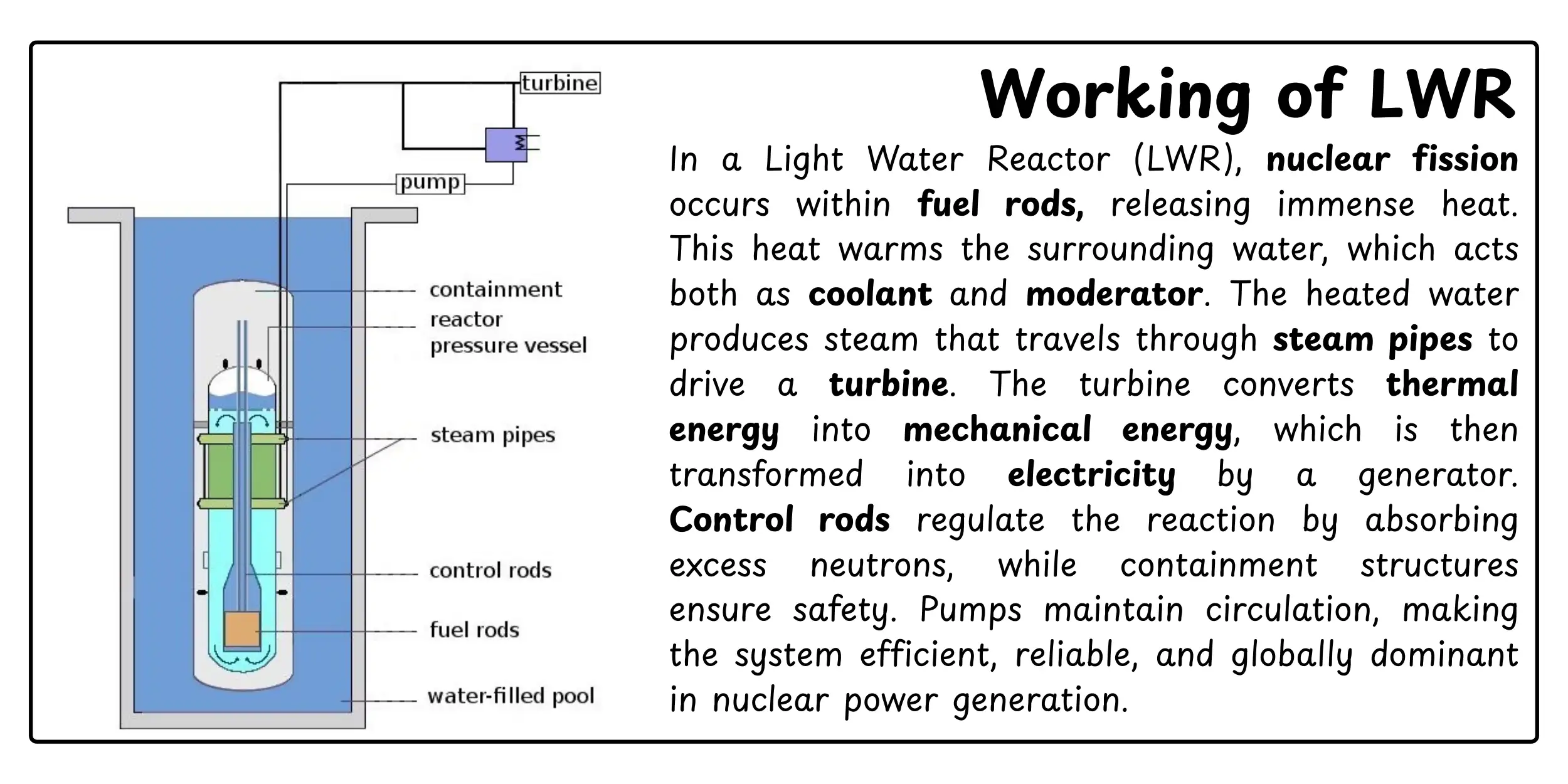
LWRs are unique in the sense that they use ordinary water to both moderate and cool the neutron unlike Pressurised Heavy Water Reactor (PHWRs) used by India. Their construction design allows them to be more efficient and be easily built, and match the world reactor fleet. In the entire globe, over 85% of civilian reactors are LWRs, which explains why they are the predominant nuclear energy systems.
Global Context and Indian Reality
In 2015, the Department of Atomic Energy (DAE) set out to design a 900MWe Indigenous LWR, with the aim of becoming part of global supply chains using Indian companies. It is a very essential initiative since, without local LWR ability, India would still not be able to export itself. This initiative is being spearheaded by the Nuclear Power Corporation of India Limited (NPCIL) and the Bhabha Atomic Research Centre (BARC), thus making India compete in a market dominated by LWRs.
Advantages of LWRs
There are several benefits of LWRs, such as the possibility to use them for large-scale electricity production, compliance with worldwide safety standards, and the simplicity of the fuel cycle in comparison with PHWRs. The fact that they can generate dependable base load power makes them core to India's goal of having 100 GW of nuclear capacity by the mid-century as a complement to renewable energy sources.
Strategic Significance to India Renewable Energy
The Indigenous LWR of India is a strategic realignment of its nuclear programme, where energy security, climate commitments, privatisation, export aspirations and so forth are brought together as a national priority.
Indian Energy Security
As shown by projections in the electricity demand of India, the market is expected to grow almost two times by 2040, which implies that the electricity should have a stable base-load supply alongside renewable energy. Nuclear energy, especially LWRs, is a stable output with minimal carbon output. The current nuclear power is 8,780 MW spread among 24 reactors, and another 6,600MW is being built. The international hegemony of the LWRs can provide India with a tool for rapid capacity upgrade and reduce the use of fossil energy.
Net-Zero Commitments of India
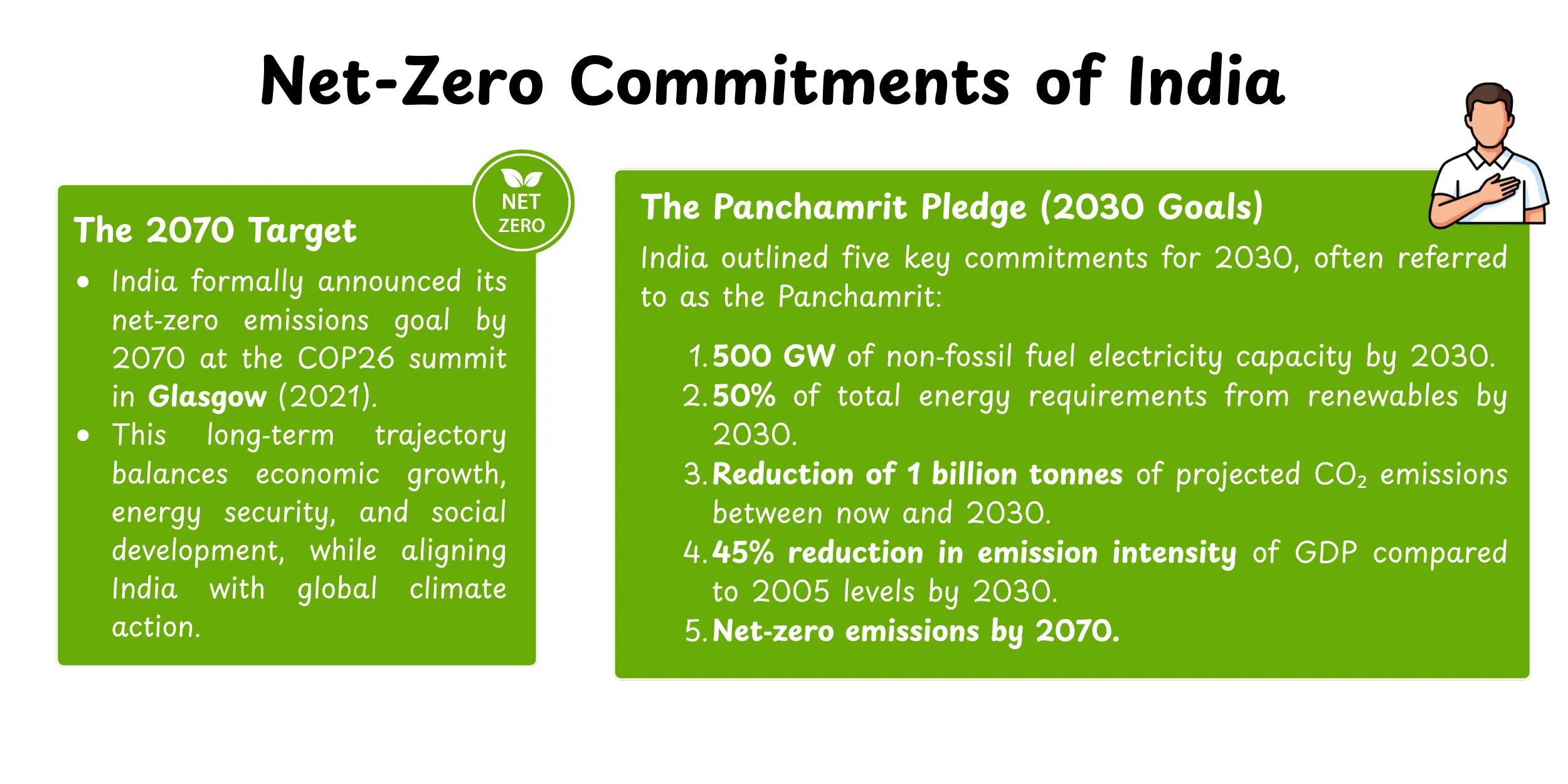
India has also undertaken achieving a net-zero emission by 2070, and nuclear power is a core point of focus in this movement. The fact that more than 85 percent of the total reactors worldwide are LWRs means that the domestic programme of India is well aligned with the international climate strategies. The deployment of LWRs will boost the credibility of India in international climate talks, making nuclear power a supplement to solar and wind energy.
Economic Growth in India
The SHANTI Act of 2025 opened nuclear energy up to the participation of the private sector, palming off the opportunity to the Indian companies, allowing them to get into the LWR development schemes and supply chains. This policy promotes innovation, reduces costs, and creates high-skilled jobs. The process of domestic companies being incorporated in the global LWR markets increases the bargaining power of India against foreign suppliers.
Strategic Strength for India
By means of the indigenisation of the LWR technology, India will be able to enter the world market of nuclear export, currently held under the influence of the United States, Russia and France. A home-grown LWR will upgrade India with bargaining power in global energy deals, including the one based on new nuclear negotiation talks with the United Arab Emirates.
Challenges & Way Forward for India
The use of the Indigenous Light Water Reactor (LWR) in India faces serious technological, financial, and regulatory issues; however, the country will also benefit by having a different path to become more energy-secure, tackle climate goals, and remain competitive in the world arena.
Technological and Safety Issues in India
The design of a 900 MWe Indigenous LWR requires an advanced reactor, careful control of the fuel cycle, and a high safety level. The nuclear programme in India is historically based on the Pressurised Heavy Water Reactors (PHWRs); any shift to the LWRs will demand new experience in the field of reactor physics and material science. Compliance with global safety standards, and especially those set by the International Atomic Energy Agency (IAEA), has remained a key barrier.
Institutional hindrance in India
The cost of capital nuclear power undertakings in India is high, averaging 20 crores rupees per megawatt; therefore, making the funding of LWRs especially intense. Despite its expected impact of allowing the private sector to take part and reduce the pressure of investments, it is expected that, due to the prolonged gestation period and the popularity of the nuclear safety concerns among the population, investor confidence can be hindered.
Global Concerns for India
The export ambitions of India depend on the incorporation of local ventures into international LWR supply chains. Nevertheless, the possibility of being challenged by highly established actors like the United States, Russia and France is quite significant. India may be marginalised in the global nuclear markets without a faster process of indigenisation.
Way Forward
India ought to overcome such obstacles by:
- Enhance research and development in the form of synergistic activities between the Nuclear Power Corporation of India Limited (NPCIL), Bhabha Atomic Research Centre (BARC), and the private industry-partners.
- Enhance regulatory openness so as to build trust in the population.
- Find international partners to assist in the transfer of technology.
- Must use LWRs at an equivalent pace as climate promises, looking to 100 GW of nuclear power in the mid-century.
Conclusion
The fact that India is focusing on the Indigenous Light Water Reactor (LWR) demonstrates a turning point in the nuclear policy pathway in India. The LWR initiative supports energy security by incorporating technology innovation, involvement of the private sector and export aspirations, along with being consistent with international climate pledges. Even though there are different obstacles associated with the programme in terms of finances, safety, and the global functionalities, the programme highlights the idea that India is keen on becoming a plausible nuclear nation. Finally, LWRs reflect a sort of domestic need and also a strategic tool for India in its global nuclear endeavour.
Frequently asked questionsFrequently asked questions
India’s Shift towards Light Water Reactor (LWR)?
The Indian nuclear establishment has recently advanced the Indigenous Light Water Reactor (LWR) to the forefront, which represents a strategic move towards the long history of dependence of the Indians on the Pressurized Heavy Water Reactors ( PHWRs ). This step represents the concerns associated with energy security, involvement of the private sector, and competitiveness of exports worldwide.
Light Water Reactors (LWR) Technology?
The most common type of nuclear technology that is used on the global stage is the Light Water Reactors (LWRs). The fact that India focuses on the creation of local LWR is a sign of technological adjustment, as well as a strategy in the aspect of nuclear energy.
Strategic Significance to India Renewable Energy?
The Indigenous LWR of India is a strategic realignment of its nuclear programme, where energy security, climate commitments, privatisation, export aspirations and so forth are brought together as a national priority.
Challenges & Way Forward for India?
The use of the Indigenous Light Water Reactor (LWR) in India faces serious technological, financial, and regulatory issues; however, the country will also benefit by having a different path to become more energy-secure, tackle climate goals, and remain competitive in the world arena.