|
Key highlights
- Formalisation of the Gig Economy
- Inclusion in the system
- Worker protection and social security
- Labour Code Reforms
- Policy significance
|
Formalisation of the Indian economy is critical in ensuring sustainable growth as it increases productivity, improves adequate mechanisms of tax compliance, and improves international competitive advantage. These kinds of formalisation are aimed at providing workers with a strong social security system, more job security, and less precariousness. Despite the fact that the introduction of the new labour codes marks a substantive progress in the incorporation of informal and gig-sector actors into the system, there are continued issues of guaranteeing a substantive access to the protective mechanisms, which contributes to increasing the gap between the normative status of the rights and the actual welfare provision.
|
Tips for Aspirants
The article has relevance to the problem of economic formalisation, labour codes, social security, and inclusion of gig-workers, which are central subjects in the context of governance, policy development, and inclusive development in UPSC CSE and State PSC Exams.
|
|
Relevant Suggestions for UPSC and State PCS Exam
- Formalisation as Growth Imperative: It improves productivity, including tax compliance and the integration into global value chains; less informality, as well as the increase in fiscal ability.
- Social Security and Worker Protection: This would offer pensions, health insurance, and maternity benefits; that would minimise precarity and lead to human capital.
- Labour Codes Reform: Reform of 29 labour laws into four codes (Wages, Industrial Relations, Social Security and Occupational Safety): simplifying compliance and reconciling welfare with simplicity of doing business.
- Gig Economy Inclusion: Under the Code on Social Security, 2020, gig and platform workers are legally recognised; Portability, funding and delivery of benefits continue to pose a challenge.
- Policy Significance: Policy Formalisation is at the centre of inclusive growth, social justice and resilience of the Indian labour market and therefore is an important issue of policy consideration in the discourse of governance and development.
|
The formalisation of the economy has become a key project in the Indian developmental discourses, thus highlighting the need to shift from a highly informal labour market to a strictly organized and governed one. Since almost eighty to ninety percent of the Indian labor force is still in the informal employment sector, a long-standing lack of legal coverage and subsequent social security, influenced by the lack thereof, has continued to render the labor force vulnerable, limiting the productivity of workers and creating fiscal inefficiencies. Formalisation, hence, does not constitute a failure of a bare-bureaucratic project, but rather it is closely related to inclusive development, increased capacity of the state, and the building of a sustainable economic system. Social security benefits, health insurance, pension schemes, as well as regulated working conditions, should be provided as a key tool to reduce precarity and support human capital growth. A substantive policy intervention would be the introduction of the new labour codes, which attempt to bring together a disparate body of the law and extend the protective provisions to cover a wider range of participants in the occupational sphere, such as those of the gig and platform economy.
However, the persuasiveness of legal acknowledgment in possible welfare delivery to gig employees is questionable: the stated workers often face issues related to portability of benefits, coverage funding, and enforcement of rights. The statute-realisation gap, in-between, therefore, amplifies the sophistication of the agenda of formalisation in India, which occupies the convergence of economic stability, social justice, and innovative modalities of labour in the twenty-first century. Formalization is crucial for India's development model as it brings the vast informal economy (85% of workers) into regulated structures, offering social security, better data for policy, increased tax revenue, and investment.
Formalisation as a Growth Imperative
The formalisation of the economic system is not a technical adaptation, but it is a need, a structural need of long-term Indian development. This kind of venture boosts the fiscal capacity, productivity and inclusive development.
Informality and Its Constraints
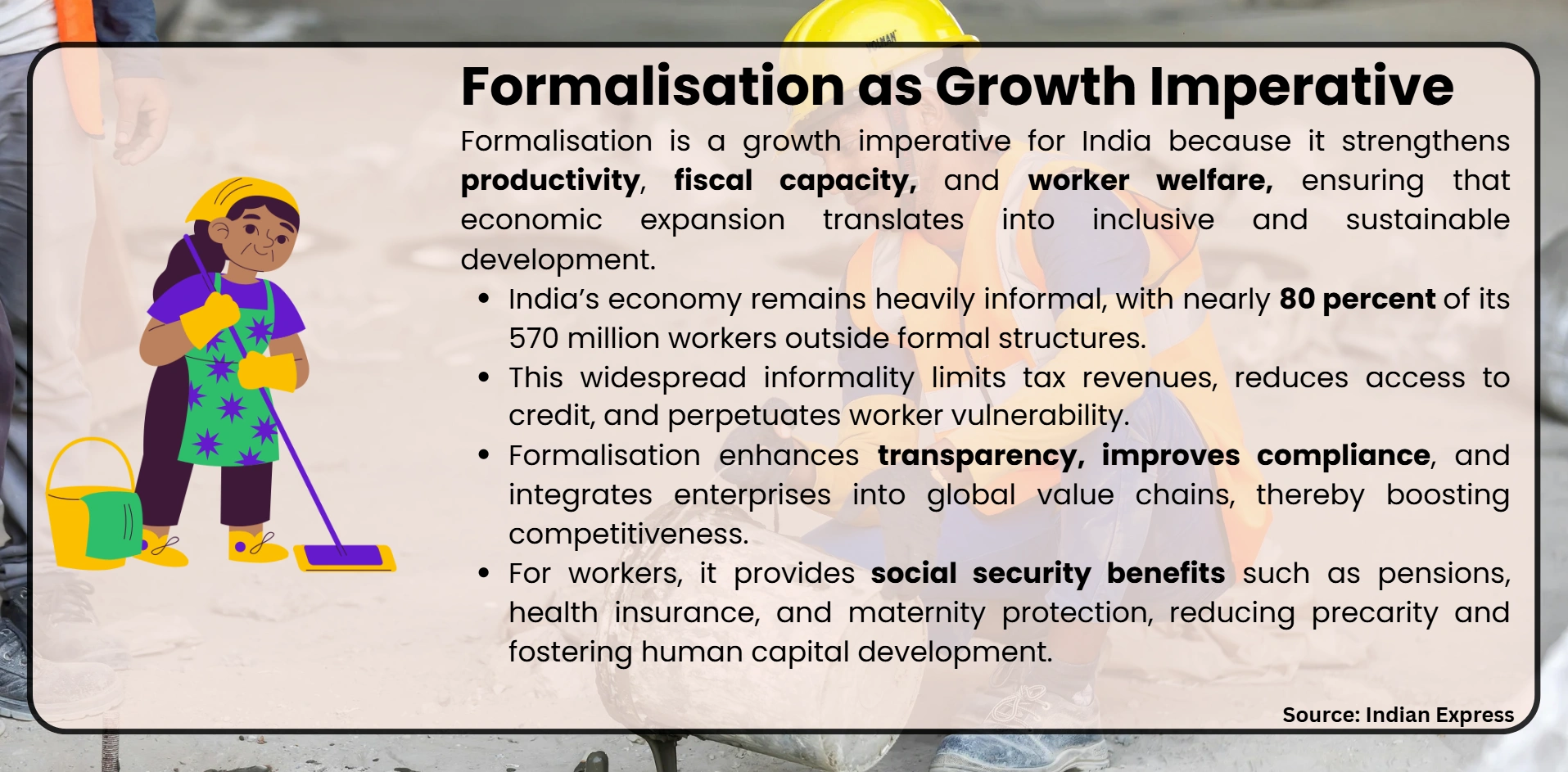
The sector of informal employment still prevails in the economy of India, with almost eighty percent of the 570 million workers running without structures of employment. This endemic casualness limits tax collection, reduces output and maintains a weakened position among the workers. Formal businesses are usually characterised by a lack of access to credit, technology and markets and thus limiting their ability to grow and to play significant roles in national development. In turn, the existence of informality reduces macroeconomic stability, as well as micro-level welfare.
Gains of formalisation
Formalisation has a relation with high productivity and efficiency. Companies in the formal sector enjoy regulatory controls, institutional capital and are integrated into the global value chains. They can use these advantages to embrace modern technologies, enhance working conditions and reach more markets. Formalisation to workers implies increased wages, better skills acquisition facets, and career stability in the long run. Formalisation is a source of sustained economic growth by decreasing transaction costs and increasing competitiveness.
Fiscal Capacity and State Capacity
A formalised economy also enhances the fiscal base of the state. Better compliance with taxation is achieved as formal structures are introduced into the culture of enterprises and workers to increase government revenues. The increased fiscal ability allows the state to invest better in infrastructure, education, and healthcare. This kind of investment forms a cycle where better public goods, in turn, bring about productivity and growth.
Recent Policy Intervention
The new labour codes, as well as the recent policy initiatives, are a big step towards formalisation. The codes are intended to harmonise the disjointed labour laws and offer safeguards to various classes of workers, including those in the gig economy. Although there are issues related to the process of effective application of such reforms, they are an indication of the desire to find a balance between employer flexibility and the security of employees. The outcome of such interventions will determine whether formalisation is capable of achieving inclusive growth and social justice.
Social Security and Aid for Workers
A stable economic system has to include such elements as social security and worker protection. They reduce susceptibility, enhance welfare and convert macroeconomic growth into distributive advantages, which is fair among different categories of workers. Social Security provides financial protection for workers and families through schemes like retirement, disability, and survivor benefits, while "Aid for Workers" often refers to broader social security systems.
The Centrality of Social Security
Social security is not a tool of welfare; it is an economic shift requirement. With most workers in India being well and truly out of the formal protection arrangements, precarity and inequality are further propagated by the absence of social security at all levels. The human capital is strengthened through the provision of pensions, health insurance, and maternity benefits, reducing poverty and creating sustainable and long-term productivity. Through these institutional measures, the state guarantees that employees are not exposed to market risks and economic crises.
Labour Codes and Legality Recognition
A significant policy shift is the introduction of the four new labour codes of India related to wages, industrial relations, social security and occupational safety. These codes rationalise 29 already existing labour laws, as well as including previously uncovered classes of workers, such as gig and platform workers. The fact that these workers have been given a legal status is a very good milestone that they are being recognised based on their economic input, albeit seeking to align them with institutional structures. However, the recognition is not enough; it has to be complemented by the mechanism that will allow getting the benefits.
Gig Workers and Implementation Problems
The gig workforce in India is estimated to grow at a very fast rate, extending from 10 million now, in 2024-25, to over 23 million in 2029-30. Even though the Social Security Code of 2020 serves as a theoretical framework under which they can be included, there are still practical difficulties in their implementation. Portability, funding, and the electronics infrastructure make it more difficult to deliver welfare entitlements. The e-Shram portal, which has enrolled more than 30 crore unorganised workers, indicates the progress, but converting registration into meaningful benefits is a daunting task. Devoid of effective policing, gig workers might be formally recognised and essentially unprotected in reality.
Inclusive Worker Protection
Protection of workers should be considered as one of the pillars of inclusive growth. In addition to legal systems, it requires coordination between the state, employers and digital platforms as a means of an efficient implementation process. The portability and sustainability of benefits may be guaranteed by a three-part system based on the three components: governmental controls, employer investment, and employee involvement. It is not just to minimise precarity but also to have a future-ready and resilient workforce, which is actually in tandem with global standards that social security is embedded within the growth architecture in India.
Labour Codes and Policy Push
The labour codes in India are a relevant policy action of the recent past that has attempted to optimise regulatory structures, give additional weight to worker welfare and align labour markets with existing economic conditions.
Unification of Fragmented Laws
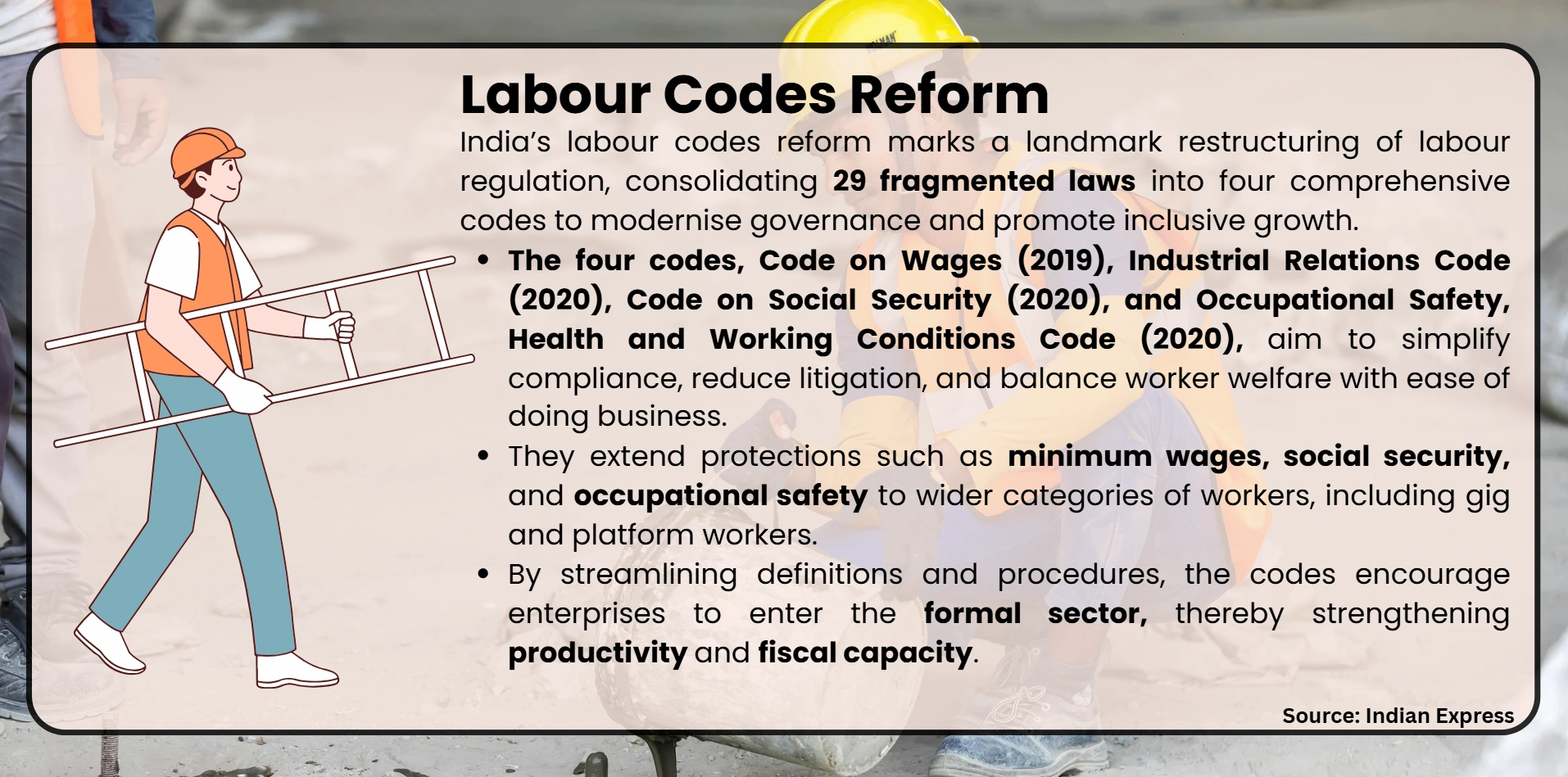
In India, historically, labour regulation was administered by 29 central statutes, many of which overlapped and had lapsed in relevance and were difficult to enforce. By introducing compliance burdens on the employers and making workers vulnerable to inconsistent protection against the differences, such fragmentation on the one hand resulted in an unequal alliance between both parties. The new labour codes, which are Wages (2019), Industrial Relations (2020), Social Security (2020) and Occupational Safety, Health and Working Conditions (2020), have consolidated these predecessor acts into four codifications, with each a unified codification, implying structural realignment to enhanced clarity, efficiency and uniformity in labour regulation.
Striking a Balance between Worker Welfare and Ease of Doing Business
The provisions attempt to balance the protection of workers and economic agility. The codes enhance labour rights by increasing the social security rights and raising the minimum wage, and also strengthen the occupational safety standards. On the part of an employer, they facilitate the process of compliance, reduce the rate of litigation, and create a more predictable regulatory environment. This balanced state becomes essential in an economy developing fast in a continuously changing environment, where welfare and competitiveness cannot be measured. The codes hope to reduce informal employment and bring about a form of engagement in the formal sector by refining definitions and procedures.
Gig and Platform Workers
Another significant change is the recognition of gig and platform workers in the Social Security Code (2020) on a statutory basis. The inclusion acknowledges the growing importance of digital labour markets and tries to apply protection regimes to people who have long since been displaced or stripped of formal organising. Still, current issues persist in the form of making benefits portable, financial contributions, and effective enforcement. Although this recognition is a critical step, its effective seizing requires strong institutional structures which operationalize the legal stipulations to tangible welfare results.
Policy Stretch and Internationalisation
The labour codes are not just domestic reform; they are one of the most critical aspects of the broad Indian initiative to integrate with the global economic systems. Unification of labour standards and international standards enhances the bargaining power of the country in the trade talks, draws foreign direct investments and incorporates it into international value chains. This prospective policy is an illustration of a future-fit workforce, which is secure, efficient, and competitive. The paramount dragging force, however, is the implementation, which requires symbiotic alignment between the central and sub-national authorities as well as between the private businesses and the working labour force.
Gig Economy and Inclusion
The gig economy of India is a large opportunity as well as a complicated challenge. Although it has brought more jobs and distributed the workload more widely, the problem of true inclusion and the creation of sufficient social protection systems on behalf of gig employees remains a complex challenge to be addressed at the policy level. The gig economy presents opportunities for economic inclusion through flexible work and low entry barriers, but it also deepens divides by often providing only precarious, low-wage jobs that lack traditional social and legal protections.
Rise of the Gig Workforce
The digital platforms, urbanization, and extensive smartphone penetration have contributed to the rapid growth of the gig workforce in India, creating an atmosphere of inclusive growth to occur over a relatively short period. It is estimated that as of 2024-25, there can be an increase in the number of ten million workers to about twenty-three million employees by 2029-30. This change indicates a change towards flexible and task-based employment, which offers opportunities to youth and women. However, a lack of a systematic form of protection leaves the employees susceptible to income instability, lack of health coverage and bargaining power.
Policymaking and Legislation
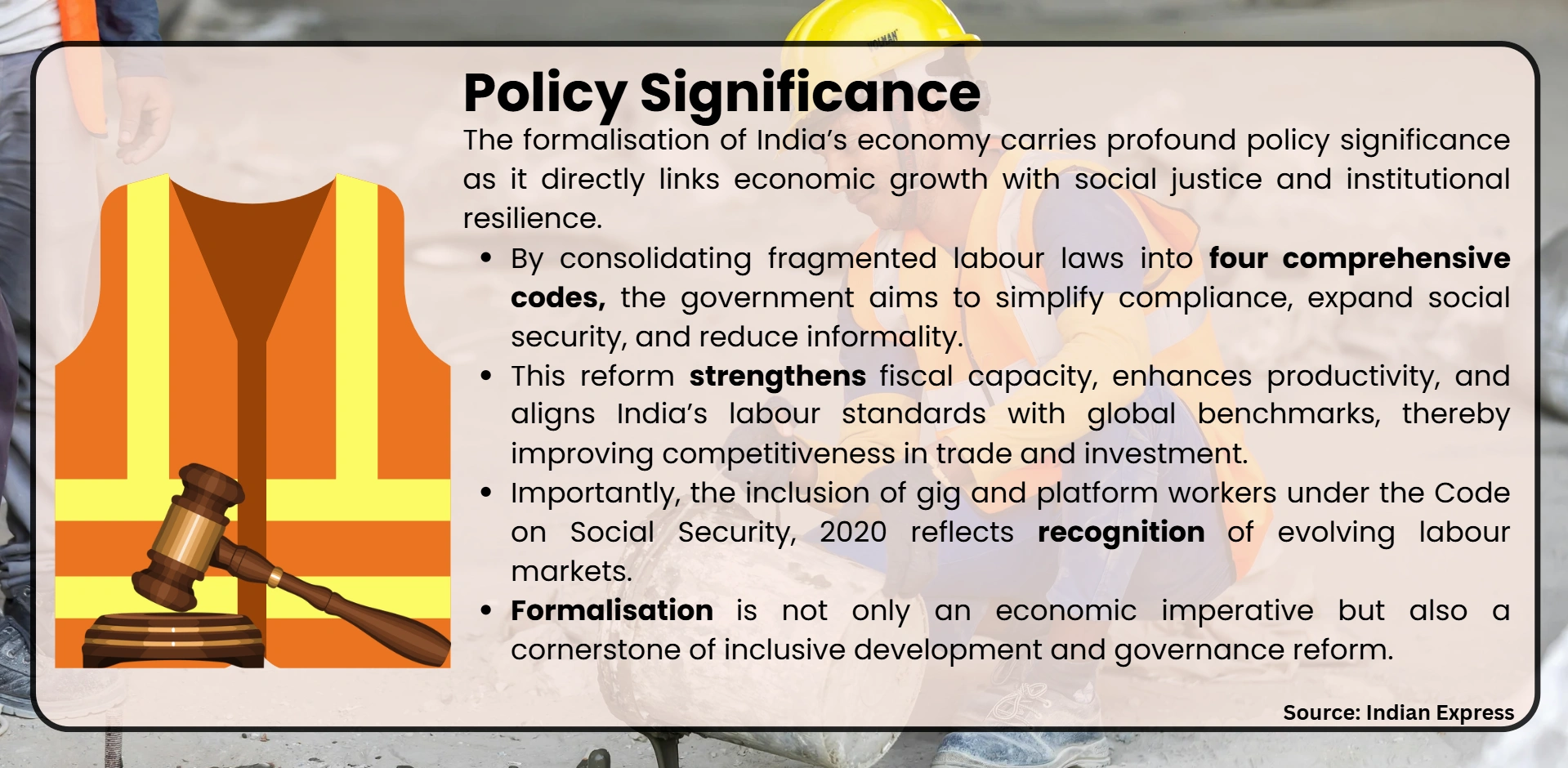
The Code on Social Security, 2020, is a milestone because it officially identifies the platform and gig workers as separate groups. This law status is massive, as it recognises their role in the Indian economy and tries to provide them with most benefits, including insurance and pensions. To do so, though, recognition is not a guarantee; it takes strong digital infrastructure, funding frameworks, and alignment between the government, employers, and platforms. It is in the absence of such that the message of inclusion will be mere symbolic language.
Problems of Portability and Enforcement
Gig work is fluid in nature, and workers are likely to migrate to new platforms or divide their jobs between several. This mobility makes it hard to be mobile with benefits like health insurance or provident funds. The funding sources, be it platform fees, state subsidies, or fees imposed on the employees, are controversial. Furthermore, it is hard to enforce in an industry where the management is decentralised and algorithmic in nature. These issues highlight the disparity between policy purpose and its actualised realities, and leave gig workers half-acknowledged.
Moving towards Inclusive Social Security
The tri-facet approach to realisation of inclusion requires government regulation, platform responsibility, and worker discipline. New tools like the e-Shram portal, which has registered more than 30 crore unorganised workers (including gig workers), are promising. However, the registration will have to convert into actual gains. There is a need to build a portable, contributory and enforceable social security system to curb precarity. This would not only secure the workers but also stabilise the labour market in India, which would be in line with the global standards of inclusive growth.
Conclusion
Formalisation of the economy of India is a critical precursor to the achievement of inclusive and sustainable development. The empowerment of fiscal capacity, an increase in productivity, and an expansion of social security alone bring about a reduction of precarity and resiliency in the labour market. The newly implemented labour codes are a timely policy intervention, to the extent that the multiplicity of fragmented laws gets centralized and the new categories, including gig workers, are considered. Still, the main challenge is the interpretation of legal recognition into the actual welfare delivery. To counteract this lacuna, effective implementation, institutional coordination, and the introduction of new mechanisms of the portability of benefits are required. Finally, formalisation is more than an economic necessity, as it is an outlet to social justice and fair development.