|
Key Highlights
- Community Driven MVR
- Participatory Climate Governance
- Empowerment of Communities
- Resilience Building
- Policy Integration and Technological Innovation
|
The article “From Grassroots to Governance: A Community-Driven MRV Framework in Tamil Nadu” outlines an innovative people-based climate intelligence process of Tamil Nadu, where communities undermine mainstream top-down strategies by taking a proactive role in creating a new Measurement, Reporting, and Verification (MRV) paradigm. Citizen engagement also enables a transparent and actionable governance of climate by collating real-time, village-level, and environmental data. This type of grassroots strategy strengthens resilience in agricultural, water systems, and disaster management, and at the same time, themes the local participatory activities with the state and federal-targeted climate commitments.
|
Tips for Aspirants
The article is important to the UPSC CSE and State PSC examinations since it clarifies the concept of participatory climate governance, grassroots MRV systems, and sustainable policy formulation, of major themes in the field of environmental, governance, and development studies.
|
|
Relevant Suggestions for UPSC and State PCS Exam
- Participatory Climate Governance: In Tamil Nadu, the people-led climate intelligence movement highlights the role of the people in policy-making and implementation of climate policy.
- Community-based MRV Structure: Measurement, Reporting, and Verification (MRV) are decentralised; the villagers reap real-time environmental results and, thus, increase the level of granularity and relevance of evidence.
- Transparency and Accountability: Local monitoring helps in reducing the asymmetry of information, distribution of resources in an equitable manner, as well as strengthening democracy in terms of governance structure.
- Community Empowerment: Farmers and villagers use real data transmitted through statistics on rainfall, soil quality, and biodiversity of farms to suit cropping systems and farm management.
- Technological Innovations: Low-cost sensors, mobile apps, and dashboards implementation include indigenous knowledge and scientific systems, establishing an inclusive body of knowledge.
- Resilience Building: The real-time intelligence helps in assisting disaster preparedness, water saving, and sustainable agriculture, and hence community resilience.
- Integration of Policies: Village-scale data will be globalized to the Climate Action Dashboard of Tamil Nadu, which will provide local efforts with the NDCs of India under the Paris Agreement.
- Replicability Model: The framework provides a systematic way in which the other states can integrate citizen-led intelligence into their governance systems.
|
The current state of climate governance has an increasing demand for frameworks,and at the same time,needs to address the scientific rigor as well as social inclusiveness. Traditional top-down models of climate surveillance, as useful as they are, often neglect the finer details of local communities, the most vulnerable to the change in the environment. In this regard, Tamil Nadu has become an innovative site of a people-oriented climate intelligence initiative where the citizens do the generating and administration of real-time environmental information on their own. At the primary level of this initiative, the community-based MRV framework, which aims to integrate village scaling observation into wider state-level climate governance, is considered. The framework increases transparency, accountability, and adaptive decision-making by enhancing the levels of decentralization in data collection and incorporating the methods of data collection into the everyday practices of farmers, villagers, and grassroots institutions.
Furthermore, the program provides communities with the ability to be more active in its influence on climate policy, and thus, transforms the process of knowledge production and governance democratization. This model can enhance resilience in the areas of agriculture, water management, and disaster preparedness, as well as harmonize local and national, and global climate commitments. The Tamil Nadu experiment, therefore, offers a promising way of reconsidering climate intelligence as a bottom-up, participatory approach, which can be relevant to other areas of the world that aim to incorporate data aggregated by citizens as part of the sustainable governance model."From Grassroots to Governance" describes the process of empowering ordinary citizens and local communities (the "grassroots") to influence and participate in broader policy-making and administration (governance), often through decentralization, participatory democracy, and strengthening local bodies like India's Panchayats, ensuring policies reflect real needs and fostering inclusive development from the bottom up.
Climate Governance and Local Participation
It is in the interest of climate governance that participatory modes develop integrative local knowledge in the form of institutional frameworks. The MRV initiative in Tamil Nadu is the best example of community involvement, transparency, and adaptive climate action. Climate governance involves multi-level decision-making for climate action, with local participation being crucial for effective, context-specific adaptation and mitigation, bridging national policies with on-the-ground realities through community engagement, knowledge sharing (like climate assemblies), and inclusive processes that empower local actors, though challenges like limited resources and fragmented mandates often hinder implementation.
Climate Governance as a Multilevel Process
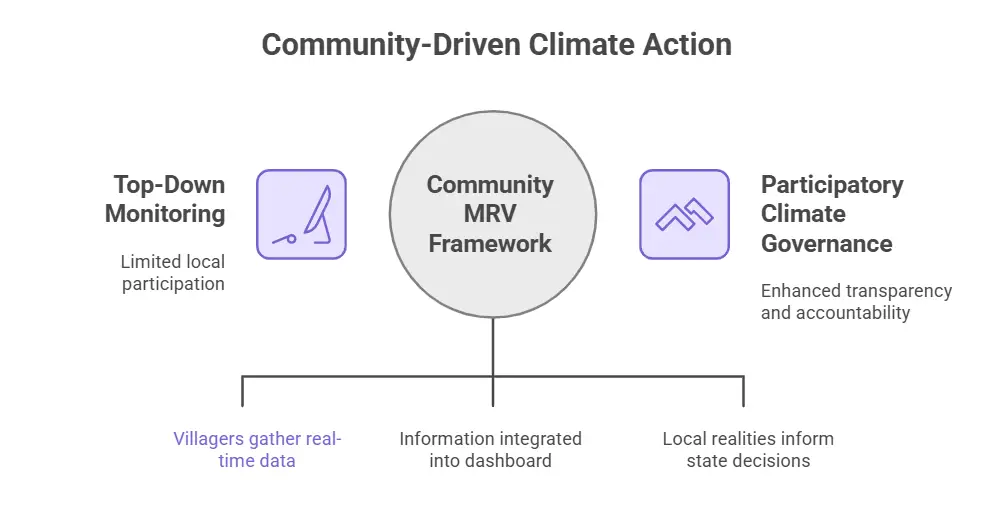
Climate governance is the institutional organization, policies, and monitoring mechanisms used to guide societies in their climate change responses. Historically, these structures were centralized, based on the national or state level of collection and reporting of data. Nevertheless, the top-down approaches usually do not reflect the micro-reality of the rural population, in which the effects of climate can be the most severe. The system of climate governance through the Climate Action Dashboard by Tamil Nadu explains how sub-state efforts can be used to supplement national efforts under the Paris Agreement.
The place of local involvement
The involvement of the locals is essential since the local communities have long-term expertise on ecosystems, farming, and water administration. Tamil Nadu arrayed by entrenching citizen-led monitoring through Measurement, Reporting, and Verification (MRV) systems, Tamil Nadu makes sure that climate insight is never far detached or hallucinatory. The villagers submit data on the rain, soil health, and biodiversity that are later merged into state-level platforms. The model of governance of the climate is democratised through this process of participation and increases accountability and transparency.
Community-based Framework
The new MRV structure in Tamil Nandi is unique in the sense that it involves data collection. Natural environments invoke real-time indicators of the environment provided by communities of ecologically diverse areas, including the Nilgiris and coastal districts. Such inputs are analyzed with the help of online tools and connected with the Tamil Nadu Climate Tracker, thus allowing policymakers to have access to the granular insights. This kind of integration will help in sealing the gap between scientific modelling and local realities so that there is responsiveness of climate policies to the needs of the local people.
Implications
This would increase the resilience of the system, making it possible to take decisive actions on localized data by individual communities because of the participatory governance model. Cropping patterns can be adjusted by the farmers, the management of the resources by the water users can be more effective, and the disaster preparedness can be more accurate. In addition, the connection of the village-scale intelligence with the district and state-based planning consolidates the contribution of Tamil Nadu to India’s nationally determined contributions (NDCs). This strategy reflects the way climate governance can transform into a multilevel system involving local participation that is central as opposed to peripheral.
MRV Model
Tamil Nadu’s shift towards climate governance is in the form of a paradigm shift, offering a community-oriented Measurement, Reporting, and Verification (MRV) framework. Local involvement in this model guarantees seamless real-time incorporation of village-based data on the state-level climate intelligence systems and the electronic village-based data into the policy objectives.The Monitoring, Reporting, and Verification (MRV) model in climate governance is a framework used to track greenhouse gas emissions, mitigation actions, and climate finance.
Foundation
Measurement, Reporting, and Verification systems are an essential part of climate governance, which provide the standardised mechanisms of monitoring emissions, resource use, and adaptation results. Traditionally, MRV has been a phenomenon of centralised institutions that are, in most cases, overlooked at the level of micro-realities. The Tamil Nadu project rethinks MRV and, therefore, incorporates it into community constructs, thus democratising data collection and strengthening accountability. This practice is in line with the international calls to engage in participatory climate governance in accordance with the Paris Agreement, in which transparency and inclusivity are considered key concepts.
Participation and Data Collection
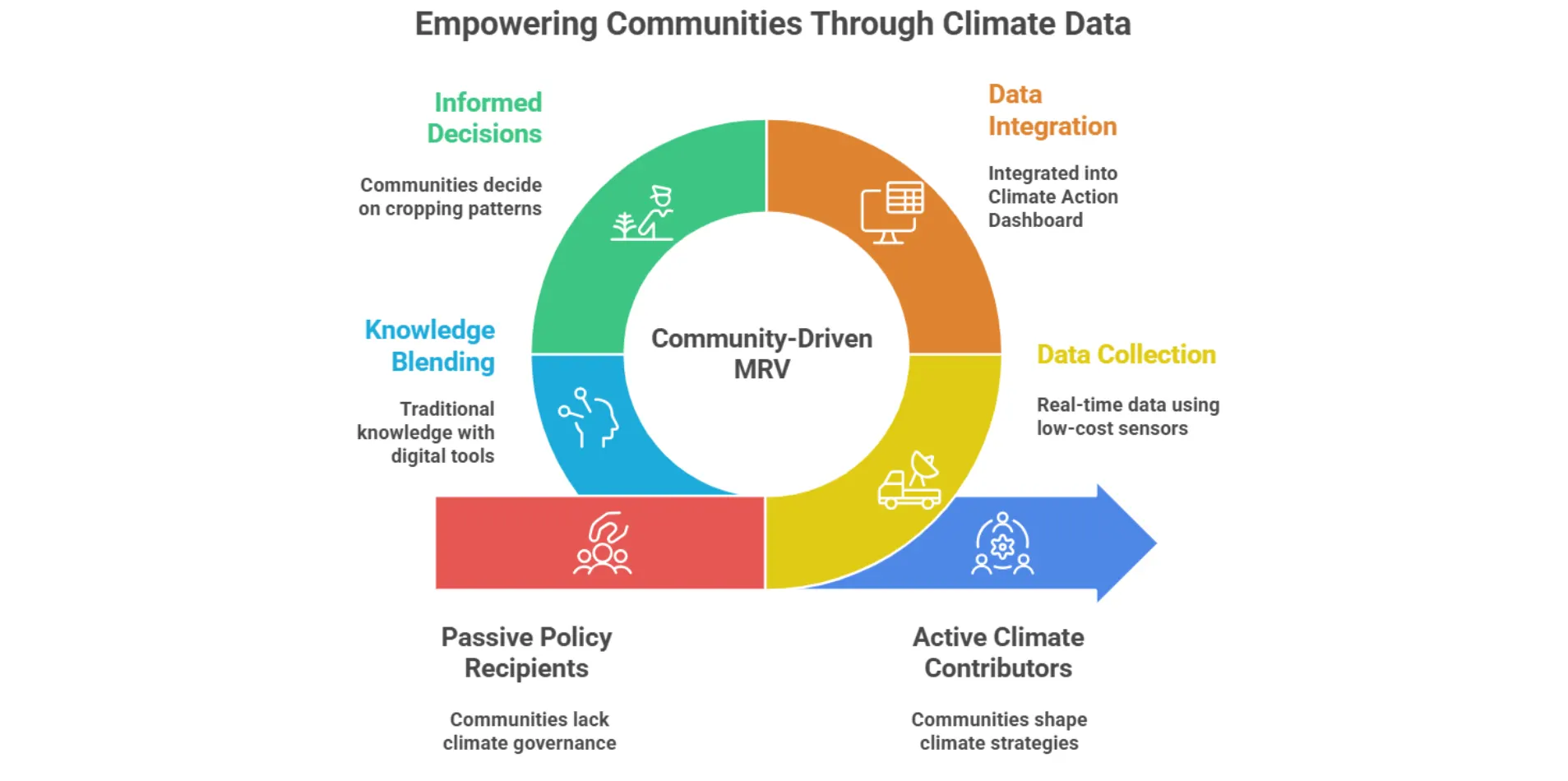
Since it is based on the notion of citizen-led monitoring, villagers, farmers, and grassroots organisations methodically document the environmental indicators (the levels of precipitation, soil moisture, and a change in biodiversity). These inputs are digitised by posting through mobile apps and sensors, both of which are accessible and scalable. Decentralising the data collection will enable the communities to become active participants, not just beneficiaries of climate policy. The participatory model, therefore, contributes to the development of a trusting relationship between institutions and citizens and, at the same time, produces small data that increase the accuracy of climate action planning.
The Inclusion into Governance Systems
The gathered data is fed into the Climate Action Dashboard of Tamil Nadu, where information on the village level is summed and analysed. This unification seals the gap between local realities and the state level of decision-making. The policy makers are provided with real-time information, and this facilitates responsive measures to droughts, floods, and other agricultural stressors. Most importantly, the structure facilitates the formal inclusion of the local voice into governance structures, which creates a feedback mechanism of having a policy impact on the community. This kind of integration is an example of multilevel governance in which local, state, and national systems have synergistic interactions.
Impacts and Innovations
A powerful example of how the involvement of the community can cultivate transformative change and introduce the element of innovativeness is the community-based MRV framework in Tamil Nadu, which has represented a redefinition of climate governance due to its incorporation of real-time and village-level data and participatory decision-making mechanisms.This article is part of a discussion meeting issue 'The growing ubiquity of algorithms in society: implications, impacts and innovations
Improving Transparency and Accountability
One of the key aftermaths of the community-led MRV framework is the enhancement of the levels of transparency in climate governance. The communities actively participate in the tracking of emissions, water use, and agricultural activities by decentralising the process of collecting the data. This mechanism of participation suppresses the lack of information between the citizens and the policymakers, thus making the process accountable in terms of resource distribution and performance of climate actions. Transparency also fosters a sense of trust, hence the greater involvement of the masses in climate actions and the strengthening of the democracies of states.
Empowering Local Communities
The framework empowers farmers and the village residents by providing operational intelligence based on real-time data of the environment. For example, rainfall indicators and soil moisture indicators can allow farmers to adjust the way they practice, and water resource users can work on the design of conservation measures more effectively. This empowerment shifts communities toward non-victim roles of policy to sturdy makers. This empowerment is more important in rural Tamil Nadu, where changes in climatic conditions have direct effects on livelihoods and food security.
Technological and Practice-based Innovations
Innovations form the main part of the success of the MRV framework. Communities can gather and send information with a high level of efficiency using low-cost sensors, mobile apps, and digital dashboards. These technological tools make climate intelligence democratic, meaning they can involve even villages with limited resources. Additionally, the connection between conventional ecological knowledge and the emerging digital systems is a unique innovation that will ensure that the scientific data is placed in the local realities. This two-world model augments the accuracy besides pertinence of the information created.
Enhancing Resiliency to Climate
The implications of these innovations are also spread out to the realm of resilience building. Instant data are used to provide an early warning of floods, droughts, and heat waves, which enhance disaster preparedness. Localised intelligence also supports conservation of biodiversity and sustainable agriculture, and is part of the overall commitment of Tamil Nadu to climate concerns. The structure also ensures an effective problem-solution relationship between local-level data and state and national data.
Policy and Future Pathways
The people-led climate intelligence movement in Tamil Naduneeds expansion into scalable and policy-bisected systems, which is a complex issue that involves proper adjustment of the local, state, national, and global governance levels.The book or publication titled Climate Governance and Local Participation: "Policy and Future Pathways" examines the critical role of local governments and stakeholders in addressing climate change through effective policy and future strategies.The people-led climate intelligence movement in Tamil Naduneeds expansion into scalable and policy-bisected systems, which is a complex issue that involves proper adjustment of the local, state, national, and global governance levels.The book or publication titled Climate Governance and Local Participation: "Policy and Future Pathways" examines the critical role of local governments and stakeholders in addressing climate change through effective policy and future strategies.
Scaling across Districts and States
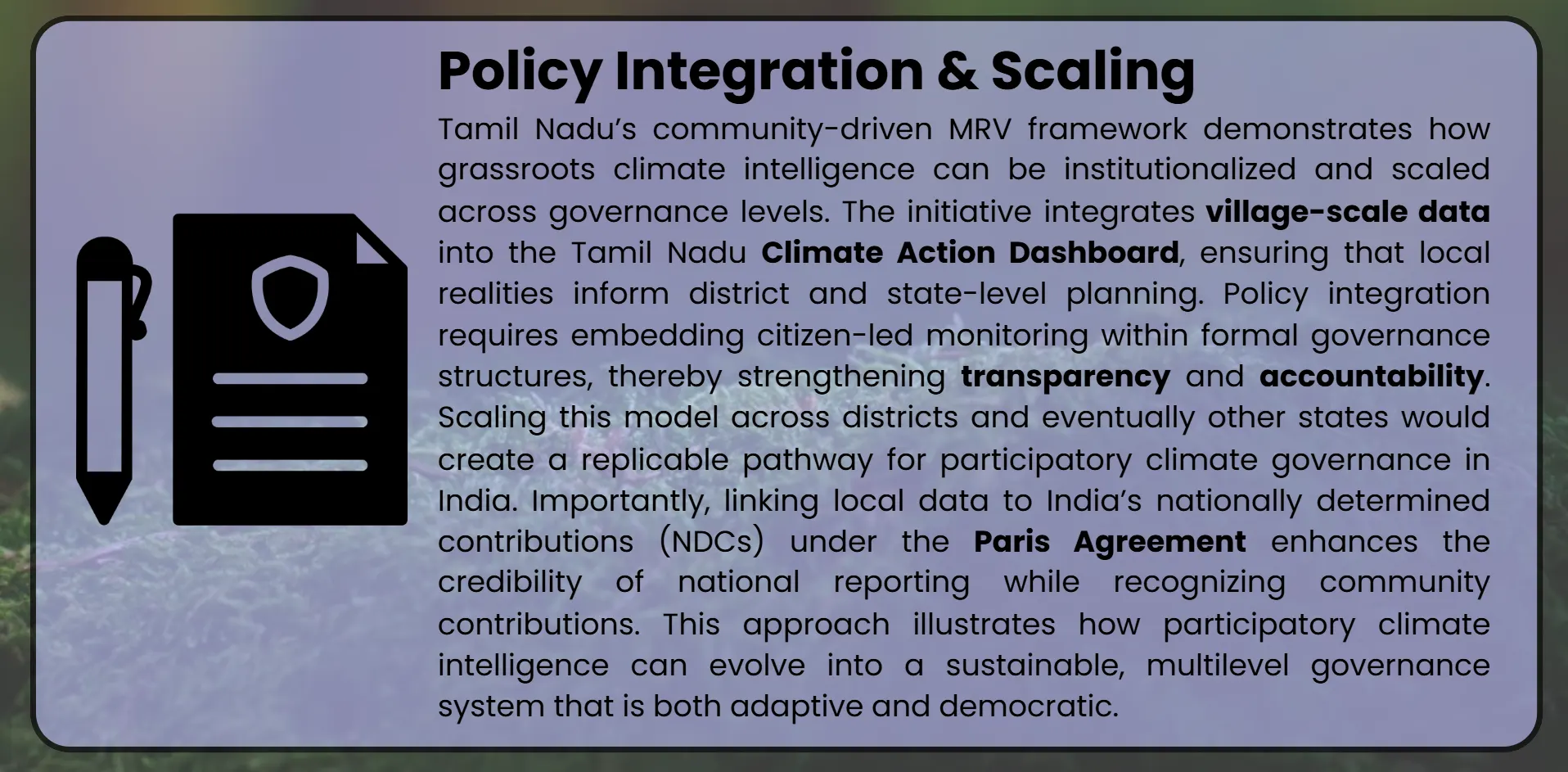
The future path of the Tamil Nadu MRV framework depends on its ability to expand to pilot villages, districts, and state levels. Massive scaling would require a strong institutional and systematic capacity-building effort and long-term investment in digital infrastructure. The implementation of citizen-separated monitoring in the household climate action schedule would provide another model to copy in the rest of the country; diffusion would be essential so that it can be utilized to shape regional adaptation plans, hence strengthening the collective climate vulnerability in India.
Connecting Local Data to National Pledges
The key route-way involves aligning the village-scale data on the national level (regarding the provisions made nationally under the Paris agreement) with the contributions of India (NDCs). MRV systems based on community involvement can provide evidence of the rate of emission reduction, resource preservation, and adaptive vision at the granular level. This kind of integration enhances the transparency of India, which ensures that the input of the grassroots is adequately reflected in the national reporting. Furthermore, this connection explains how the local engagement can strengthen the international climate promises, thus closing a gap between the international responsibility and the local situations.
The Participatory Governance
Sound policy incorporation requires institutionalization of participatory governance systems. The current Tamil Nadu Climate Action Dashboard is an example of how aggregated local information can be used to make state-level decisions. The future strategic directions must put in writing the involvement of the community in the governing structures so that the concept of citizen monitoring is seen as a substantive element, not a peripheral element of climate policy. The continuity will be safeguarded through institutionalization, which reduces dependence on short-lived projects or outside funding.
Building Trust and Adaptive Capacity
The dependability of this structure will be determined by the development of trust among communities and institutions. Adaptive capacity will be improved through the sharing of data, feedback, and deliberation that is inclusive. Besides, we should incorporate MRV into the preparation for disasters, water resource management, and agricultural planning so that climate intelligence can be put into practical use. By entrenching these practices in the design of sustained policy frameworks, Tamil Nadu can have a robust, yet flexible and democratic system of governance.
Conclusion
The climate intelligence movement that is people-led in Tamil Nadu is an example of how institutional systems can be changed through a community-based MRV framework due to the introduction of local knowledge into a system. The initiative can increase transparency, accountability, and adaptive capacity by reaching out to village-level information and merging it with state and national systems. However, it has a range of effects that go beyond just improving resiliency to democratization of climate policy, which means that citizens take an active part in the development of sustainable futures. This model, as it will scale, is a way to offer a repeatable route to other areas where participatory climate intelligence represents not only a governance innovation, but also potentially an essential mechanism to bridge action at the grassroots to global commitments.