|
Key highlights
- Supreme Court’s Verdict
- Conservation Paradigm
- Great Indian Bustard
- Development with Conservation
- Green Energy Corridor
|
On 19 December 2025, in its verdict, the Supreme Court held as obligatory the protection of the endangered Great Indian Bustard with the goal of extending the conservation areas in Rajasthan and Gujarat. It only requires underground cabling in priority areas and places limitations on overhead lines, wind and solar developments. The judgement transforms the Green Energy Corridor in India so that the planning of renewable transmission should not violate the irrevocable ecological boundaries, besides fulfilling the energy requirement. The ruling mandates undergrounding power lines in GIB habitats in Rajasthan & Gujarat, restricting large solar/wind projects (over 2MW), and creating strict conservation zones, fundamentally altering the Green Energy Corridor (GEC) plans by imposing ecological boundaries, signalling a shift towards integrating environmental duties with corporate responsibility.
|
Tips for Aspirants
The article is important for the UPSC CSE and the State PSC exams, because it compiles the themes of environmental law, the judiciary intervention, and energy policy, which are the major parts of governance, sustainable development, and ethics.
|
|
Relevant Suggestions for UPSC and State PCS Exam
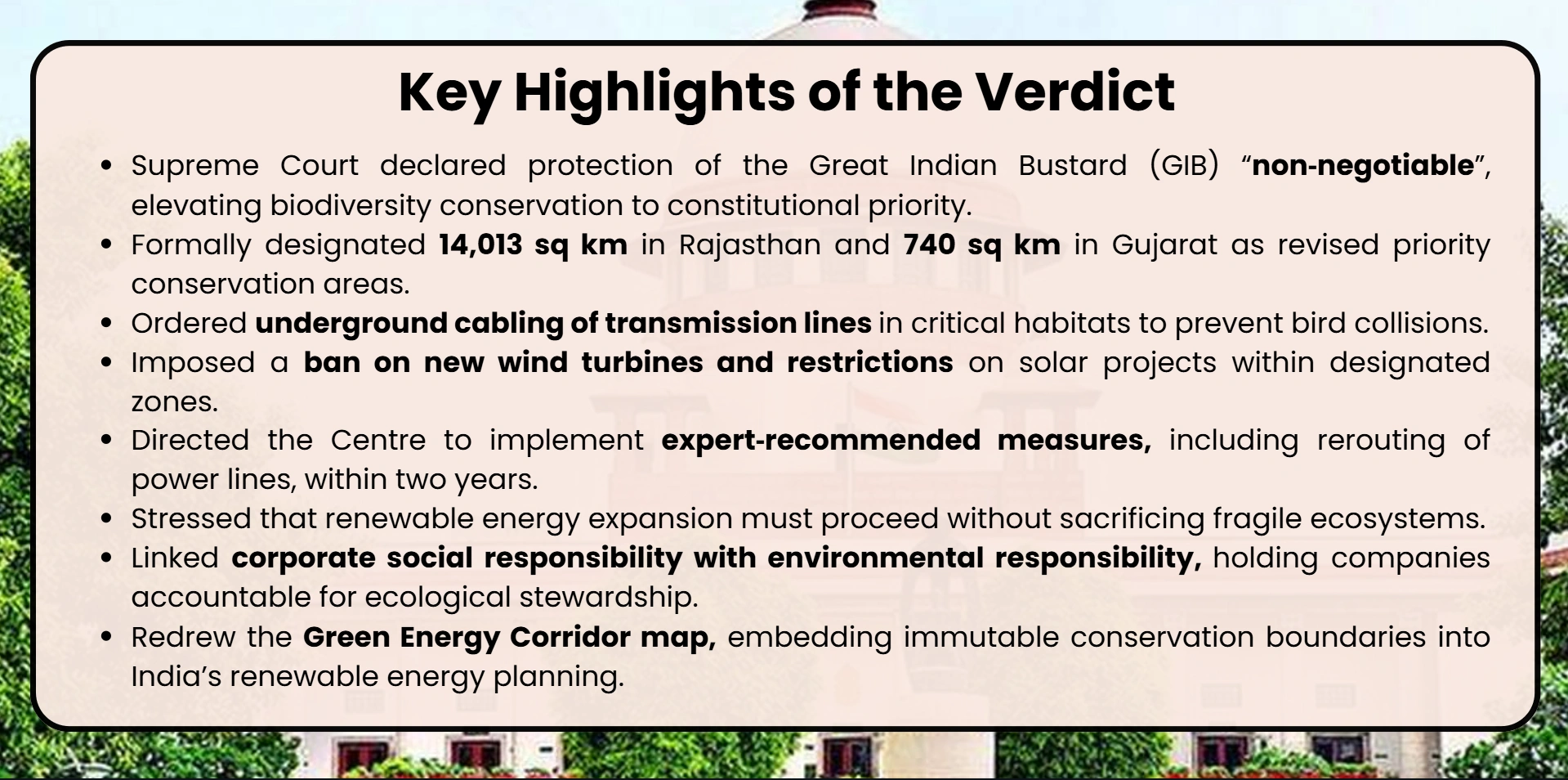
- The Supreme Court made the conservation of the Great Indian Bustard (GIB) non-negotiable to override biodiversity concerns at the constitutional level.
- Underground cabling in the priority habitat to reduce transmission line avian collision risks was mandated.
- Enforced limitations in the creation of the new wind and solar farms in the specified conservation areas in Rajasthan and Gujarat.
- Court ordered redrawing of the Green Energy Corridor (GEC) to avoid important GIB habitats and thus instilled ecological limits in energy planning.
- Changing the current energy policy from a resource-driven policy to an ecology-based integrated infrastructure policy.
- Highlighted corporate responsibility, which associates environmental management with wider social responsibility.
- Reaffirmed constitutional obligations in Article 21 (Right to life) and Article 51A(g) (Duty to protect the environment).
- It will make India an ideal case of sustainable development, in the harmonization of climate mitigation and biodiversity safety.
|
The recent verdict of the Supreme Court of India in the conservation of the Great Indian Bustard (GIB) is a landmark in the history of environmental jurisprudence and the energy governance that is practiced in this country. Once very common around the arid terrain of Rajasthan and Gujarat, the critically endangered species has gone through an appalling loss of population as a result of habitat fragmentation and collisions with overhead transmission lines. The Court has ordered extreme protection of this bird in reaction to petitions that pointed to the urgency of protection in view of the endangered status of the bird, including the placement of underground cabling in key habitats and the redesigning of renewable energy transmission paths. The ruling has a direct impact on the Green Energy Corridor, which is India's flagship transmission backbone intended to incorporate renewable energy in resource-endowed states into national demand centres.
Understanding the Supreme Court’s Green Mandate
Key aspects include mandating prior environmental clearance (EC) for projects and recognizing environmental protection as a constitutional obligation, not just a regulatory one. The Court implies a radical paradigm change in the development of infrastructure construction by obligating planners to see the unchanging ecological borders, which is a strategy to incorporate biodiversity conservation in the very fabric of the energy policy. The ruling casts emphasis on the importance of the fact that climate mitigation and ecological preservation cannot, and should not be mutually exclusive. It sets the background of a prospect of compromise between developmental demands and conservation ethics, thus making India one of the global models of sustainable energy shift based on environmental consciousness.
The case in which the Supreme Court ruled in December 2025 on the Great Indian Bustard (GIB) is a significant step toward Indian environmental policy. The Court has re-established a balance between the protection of biodiversity and the development of renewable energy resources by implementing conservation-driven requirements to energy planning and has created a new normative paradigm for governing practices of the country.
Great Indian Bustard
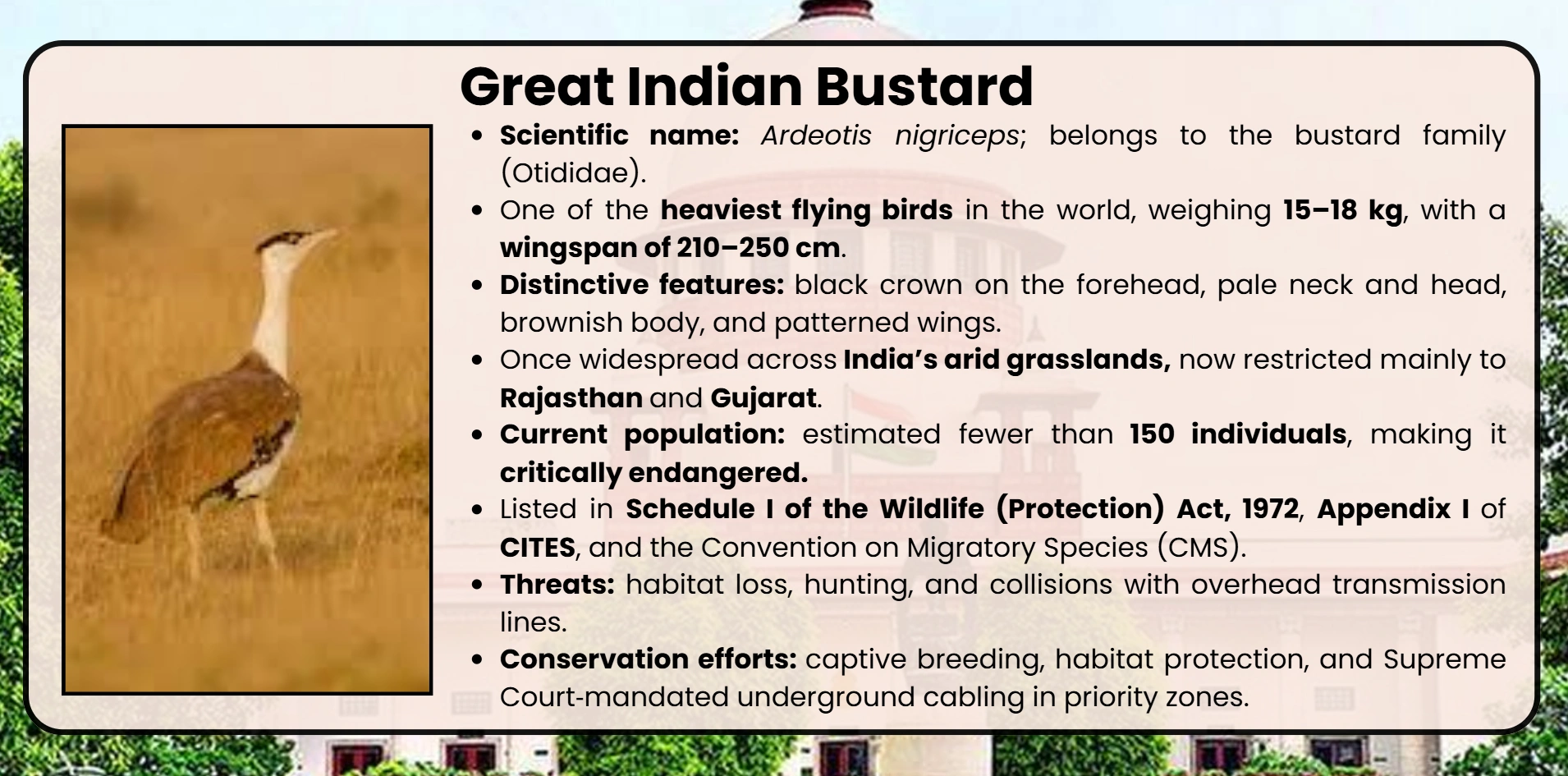
The Great Indian Bustard, or locally named Godawan, is a flagship species of the desert ecosystem. Its population has historically totalled across the arid landscapes down to fewer than 150 individuals, by the large majority an outcome of habitat destruction, deliberate hunting and fatal encounters with overhead transmission lines. Being one of the largest birds, its presence is inherently associated with the vitality of the grassland biomes; hence, it is an informative indicator of the ecological wholeness in general.
Intervention by Courts
The interest of the Court began with the petitions submitted in 2019 based on Article 32 of the Constitution that emphasised the urgent need to protect the GIB against the potential of a threat by infrastructural nature. In 2024, the expert advisory body was held to explain the measures that can reconcile the conservation priorities with the goals to be reached by India in the field of renewable energy. This report by the body brought out the inherent incompatibility of overhead power lines with wind turbine installations in vital habitats, hence leading to the decisive intervention of the Court.
Green Energy Corridor
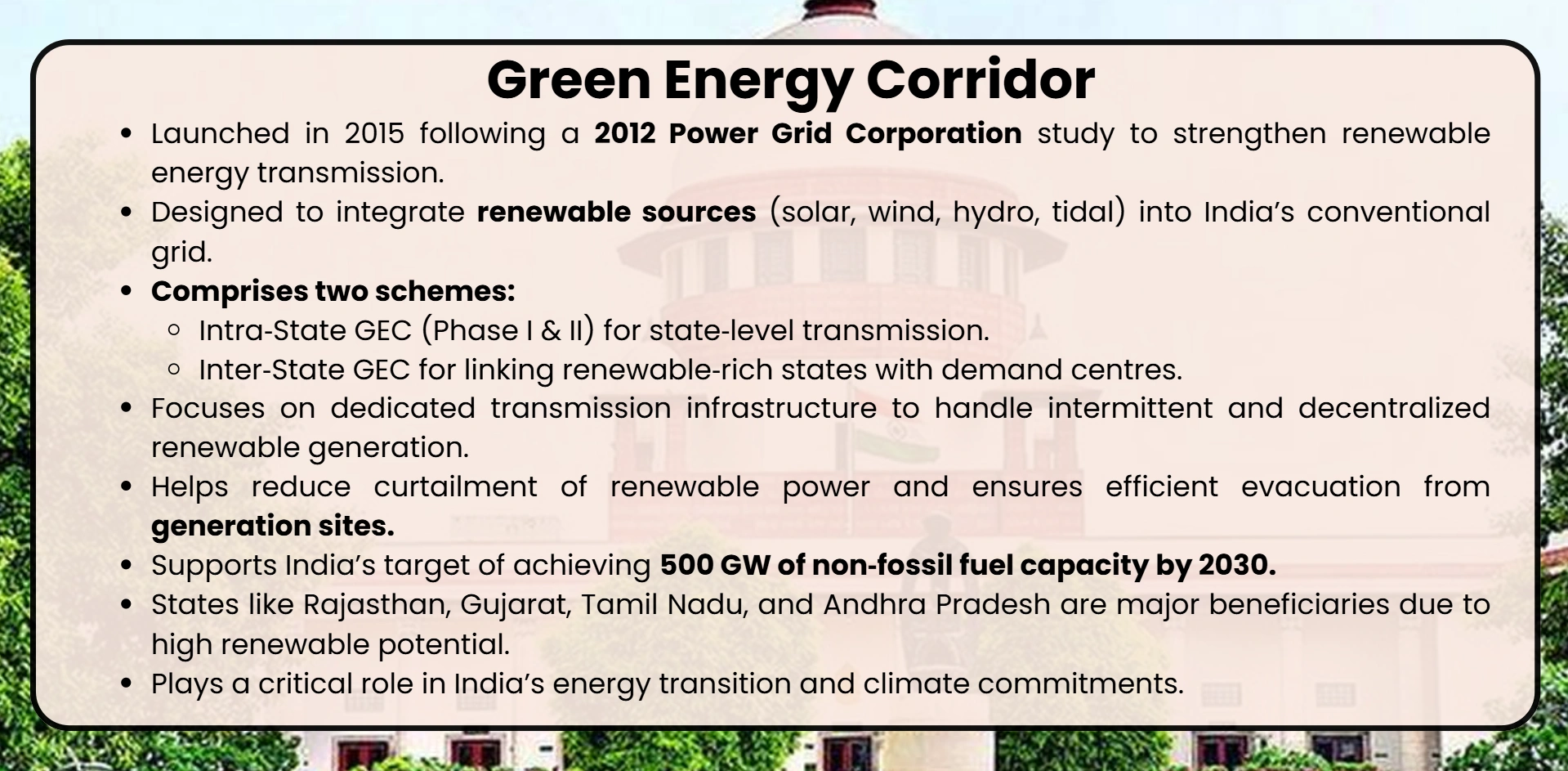
The Green Energy Corridor (GEC) initially came into being as a transmission spine which was intended to connect Rajasthan and Gujarat to the national markets. The court ruling by the Supreme Court, however, required underground cabling to be installed in environmentally friendly areas, and the transmission lines were re-aligned so as to avoid the conservation areas. This order is an effective redrawing of the GEC map as it makes ecological thresholds a part of the energy infrastructure planning. The case shows that resource availability and resource consumption centres are no longer sufficient to influence energy policy; conservation imperatives now form part of the invariable limits.
General Policy Implication
The ruling marks a new way of development in India. It confirms the fact that climate mitigation through renewable energy should be in harmony with the protection of biodiversity. The Court has already set precedence with making a statement that ecological ethics must be integrated into the design of infrastructure, as they have declared GIB safeguarding as non-negotiable. Besides safeguarding a species that is facing imminent extinction, this strategy will place India in the world as an example of a sustainable and eco-friendly transition towards energy.
Key Features of the Verdict
The ruling of the Supreme Court on conservation of the Great Indian Bustard (GIB) and green energy corridors restructuring is a historic change in Indian environmental jurisprudence. It makes the setting of conservation boundaries as non-revocable restrictions part of the national energy planning.
Requirement for Underground Cabling
It is one of the most prominent directives provided by the Court, which is the mandatory replacement of transmission lines in priority GIB habitats by underground cabling. This measure in itself alleviates high mortality rates that are a direct result of collisions with overhead conductors. Through the legislation of underground cabling, the Court provides that the renewable energy infrastructure does not threaten the viability of the taxa facing danger.
Limitations to Renewable Installations
The ruling also creates limitations on new wind and solar windmill installations in local areas of conservation zones. The Court argued that the development of renewable energy cannot override ecological requirements. The typology of renewable energy in Rajasthan and Gujarat, therefore need to be redefined in order to comply with the concept of biodiversity during site-selection and design.
Redrawing Green Energy Corridor
The Green Energy Corridor, which was initially planned to serve as a non-solar-network transmitting belt in India, has been redesigned to avoid important GIB habitats. This decision of the Court provides a change in the strategy: the transmission planning should be changed to include the availability of resources, demand centres, and ecological boundaries.
Non-Negotiable Principle
The most significant input of the verdict is that it states that safeguarding the GIB is a principle that cannot be compromised. The Court sets a precedent by making conservation a constitutional priority that has to be balanced with ecological stewardship development. The ideology provides a scalable case study on balancing biodiversity conservation and the increase in infrastructural development in the country.
Broader Implications
The decision shows that climate control and protection of biodiversity should go hand in hand. The implementation of underground cabling and reconfiguration will add expenses, but it will be used to contribute to the sustainability in the long term and increase the sense of global commitment in India in relation to the green transition. In this way, the decision places India at the forefront in terms of applying ecological ethics in the field of renewable energy regulation.
What will Change in Energy Planning?
The verdict by the Supreme Court on Great Indian Bustard (GIB) conservation is going to change the energy planning in India. The judgment redefines the notion of renewable energy projects by introducing conservation limits into infrastructural design and routing, as well as implementing them.
Ecology and Infrastructure
The decision obliges planners to consider ecological borders as immutable constraints. Transmission lines, wind farms, and solar parks can now only be constructed around priority habitats rather than through them. This is a clear break with a resource-focused paradigm to an integrated paradigm whereby the conservation of biodiversity is a structural determinant of energy infrastructure.
Expense and Technical Difficulties
The necessity of underground cabling and diversion of transmission lines is bound to happen, and this raises the cost of the project and poses a technical difficulty. However, the Court has pointed out that this kind of spending was justified in the prospect of sustainability. The enactment of undergrounding in highly sensitive areas is predetermined by the ruling so that the growth of renewable energy sources does not contribute to faster biodiversity degradation, and it sets an example of the necessity to keep ecological responsibility in the context of technically complex construction of infrastructure in the future.
Accountability to Corporations and Policies
Another thing that the Court associated corporate responsibility with environmental stewardship was the fact that companies cannot claim to be socially responsible and destroy delicate ecosystems at the same time. This makes accountability wider in the planning of energy sectors to compel both the government and independent participants in the role of infrastructure development to implement them to be in line with the constitution under Article 51A(g).
Sustainability
The ruling incorporates ecological integration in energy planning, making India one of the world leaders in terms of making the transition sustainable. It indicates that mitigation of climate and conservation of biodiversity should not be a mutually exclusive process, but should go hand-in-hand with each other. This will strengthen the credibility of India in the global climate talks and preserve its ecological heritage that is unique.
Broader significance of the Supreme Court of India
The Supreme Court of India holds immense significance as the apex judicial body, final interpreter, and guardian of the Constitution, making it one of the most powerful courts in the world. The decision of the Supreme Court on the Great Indian Bustard (GIB) and the reshaping of the Green Energy Corridor go beyond the conservation issues because it signifies a milestone in the developmental doctrine in India that incorporates ecological ethics in the decision-making process on energy planning.
Enhancing the Environmental Jurisprudence
The decision integrates the role of the judiciary as the protector of biodiversity. When the Court stated that conservation was priority number one in Article 21 (right to life) and in Article 51A (g) (Duty to protect the environment) of the Constitution, it labelled its conservation as non-negotiable. This increases environmental jurisprudence and makes sure that the ecological demands are not compromised by economic development.
Re-defining Developmental Paradigms
Traditionally, the infrastructure planning in India has been resources-based, with the emphasis on the demand centres and the energy availability. This paradigm is redone by the verdict and makes clear that conservation boundaries are supposed to be unchangeable, indicating a clear shift to sustainable development where conservation of biodiversity is integrated into the structure of renewable energy projects, not regarded as an externality.
Global Leadership
The ruling by India has a global appeal. It is in an age during which states consider the strain between mitigating climate and biodiversity depletion, the ruling shows that the two may be advanced simultaneously. By undertaking ecological protection in the growth of renewable energy, India will be a first mover in green transition, which will increase its climate negotiation reputation and biodiversity conventions in international dialogues.
Corporate and Policy Accountability
The ruling focuses on corporate responsibility and enlarges the horizon of accountability in energy planning. Companies that do renewable projects now have to align their operations with ecological ethics in such a manner that corporate social responsibility covers the aspects of environmental stewardship. This creates a paradigm through which the state policy and corporate business are aligned in a manner that conservation agendas are maintained.
Long-Term National Significance
The decision sets a precedent on development and ecosystem responsibility in all sectors besides the immediate conservation. It shows that infrastructure development should consider ecological constraints, hence preserving the Indian natural heritage for future generations. The ruling therefore reflects a comprehensive idea of development, combining the ecological, economic and ethical aspects.
Conclusion
The Supreme Court ruling on conservation of the Great Indian Bustard and revamping of the Green Energy Corridor is a conclusive incorporation of environmental concepts into the process of development in India. Through the system to ensure cables are underground, limiting the installation of renewable energy sources in the ecologically sensitive zones, and recalibration of the transmission routes, the Court has imposed biodiversity preservation as a constitutional imperative. This ruling highlights the need to ensure that climate mitigation and conservation should be developed together, thus setting precedence to have sustainable infrastructure planning. Thus, India presents a total picture where energy security and ecological responsibility meet each other, hence enhancing its position as a global environmental conscience master.