|
Key highlights
- Expansion of Ujjwala Yojana
- Basic Safety Check Campaign
- Fuel Retail Modernisation
- APNA GHAR Initiative
- Gas Pipeline Expansion
- One Nation-One Gas Grid
|
The Year-End Review released by the Ministry of Petroleum and Natural Gas in 2025 reports great improvement in the energy sector in India. The growth in the Ujjwala Yojana has led to more people having access to clean cooking fuels, whereas countrywide measures to safety checks have strengthened consumer protection. Digital payment system adoption, installation of electric vehicle charging systems and multi-fuel installations can only serve to show that the sector is gradually moving towards an energy ecosystem that is diversified. The APNA GHAR project has enhanced the facilities of truckers, and the further extension of a gas pipeline grid connecting 25400km is an example of the aim of the One Nation-One Gas grid to enhance the energy integration of the country. In 2025, India’s Ministry of Petroleum and Natural Gas prioritized speeding up the clean energy transition while strengthening national energy security through legislative reforms and expanded infrastructure.
|
Tips for Aspirants
The article is relevant to UPSC CSE and State PSC exams since it involves governance, energy policy, infrastructure, and reforms, which are critical areas in the General Studies, current affairs, and writing of the essay.
|
|
Relevant Suggestions for UPSC and State PCS Exam
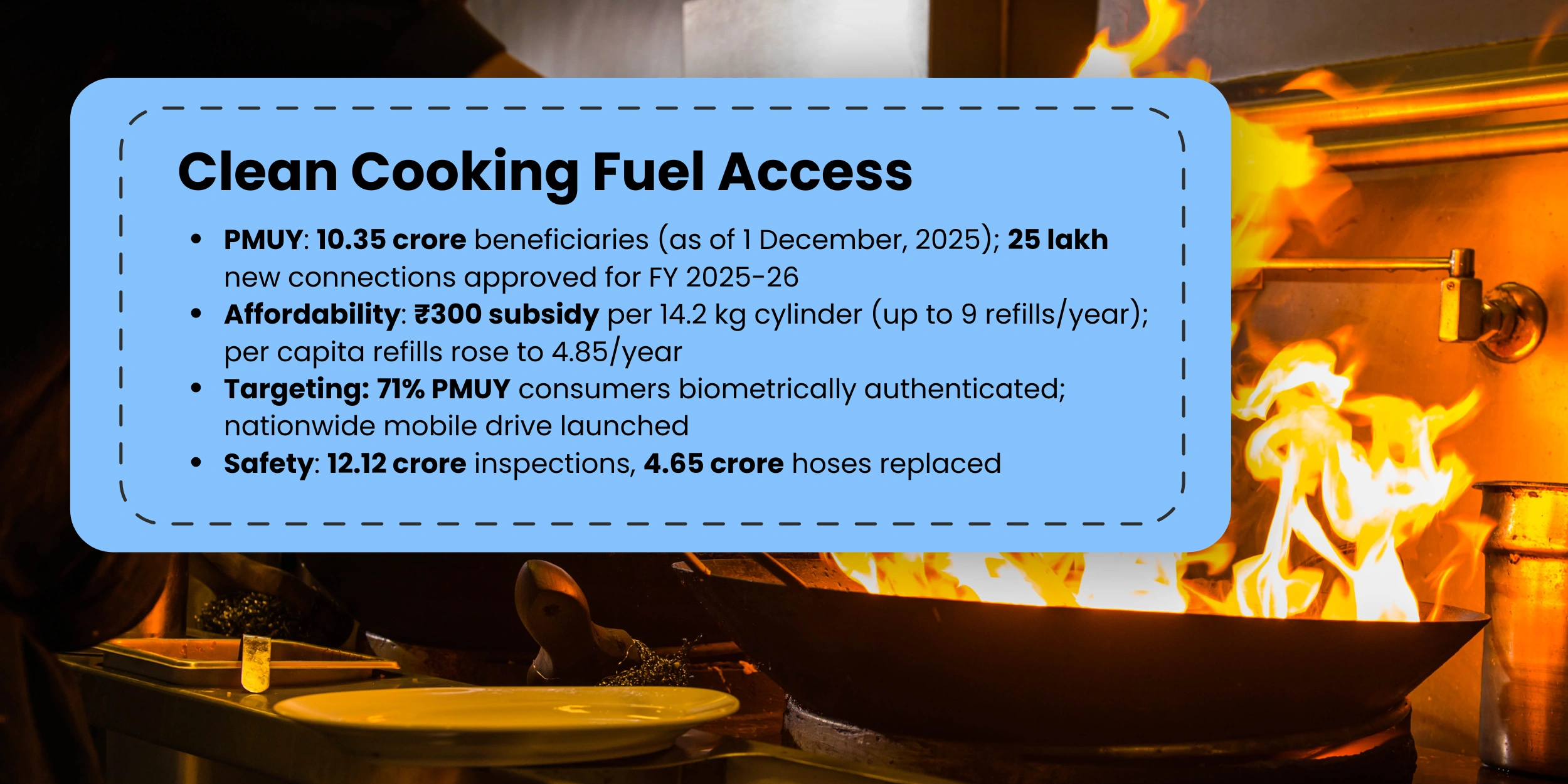
- Ujjwala Yojana Expansion: a total of 9.6 crore LPG connections have already been issued, and that is how clean cooking access, female health, and equity in rural energy are improved.
- The Basic Safety Check Campaign: So far, over 3.5 crore households have been encompassed via coverage of safe use of LPG, as well as to rejuvenate consumer confidence.
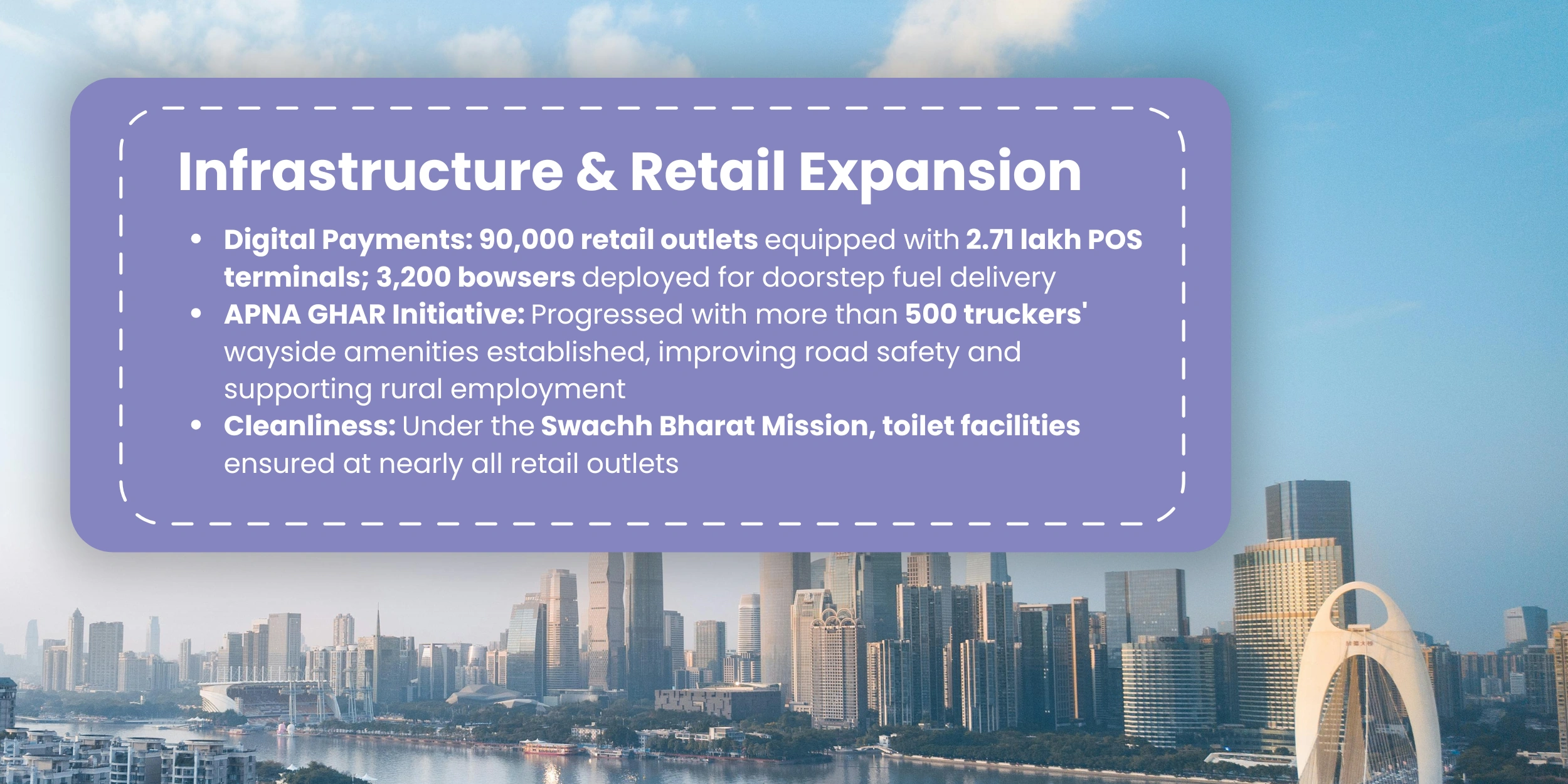
- Fuel Retail Modernisation: More than 82,000 of its outlets have been modernised to offer digital payments, EV charging, and multi-fuel energy stations, and this is helping India move to clean energy.
- APNA GHAR Initiative: Over 1,800 facilities are operating throughout the country, which contribute to the welfare of truckers, road safety, and roadside amenities.
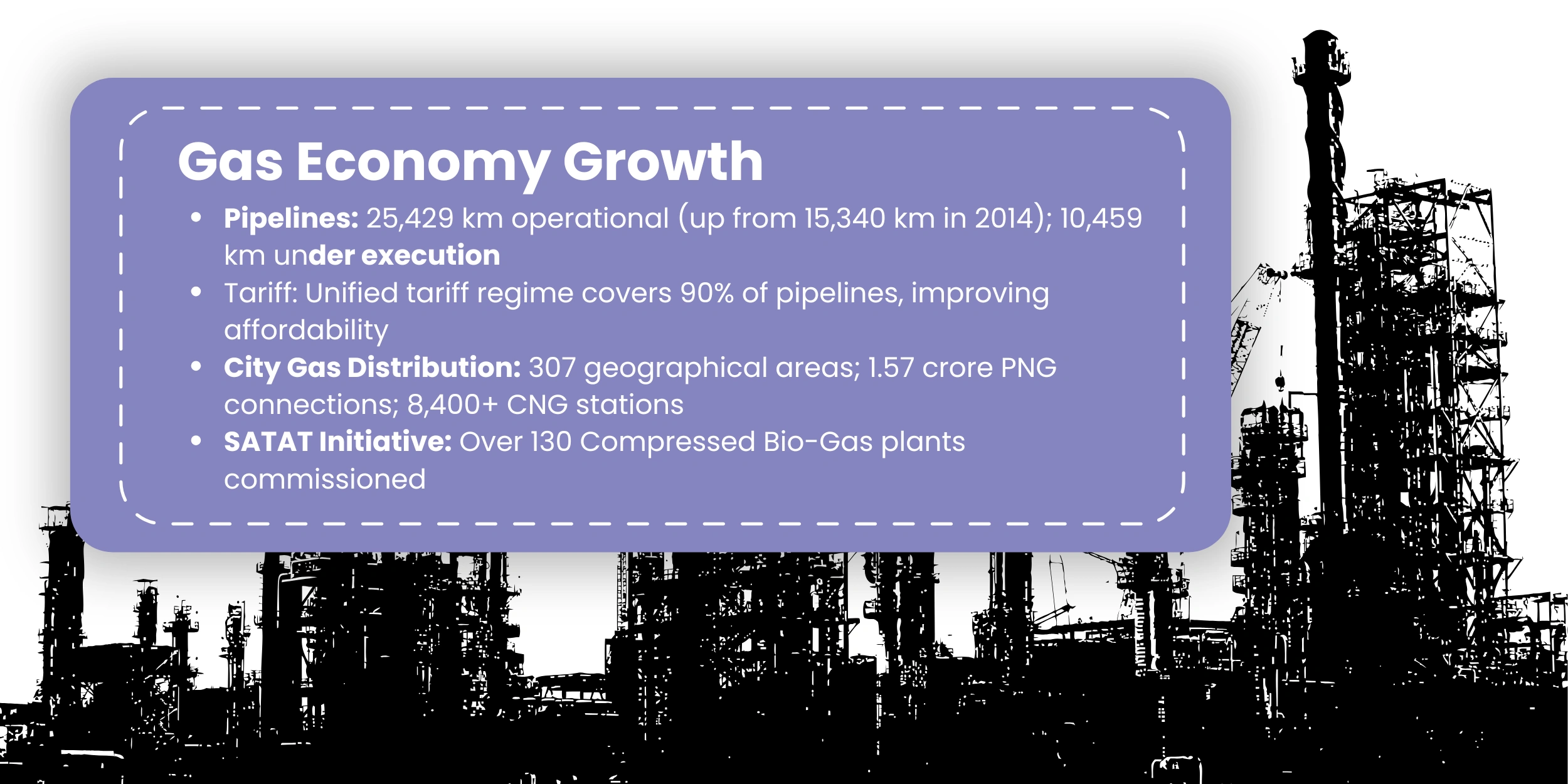
- Gas Pipeline Expansion: It has a 25,400 km system that is currently operational as a part of One Nation-One Gas Grid with supply and demand hubs built in.
- Upstream Sector Reforms: The Oilfields Amendment Act and petroleum and natural gas rules have been enacted that enhance transparency, investment, and efficiency.
- Strategic Vision: Focus on inclusiveness, sustainability, and resilience, which make energy a source of growth for the country.
|
Year-End Review of the Ministry of Petroleum and Natural Gas, 2025 illustrates that India is long-term determined in energy security, consumer improvement, and creation of sustainable and sustainable infrastructure. Considering that the energy sector has continued to be a priority in the national economy development, the Ministry has developed a multifaceted agenda that includes access to clean cooking technologies, the guarantee of safety, the upgrading of fuel retail, and structural changes in the upstream processes. The Pradhan Mantri Ujjwala Yojana growth is an important indication of the commitment of the government to making energy services accessible equally to the rural citizens, especially with a view to improving social inclusion and health policy implementation. On a complimentary note, the Basic Safety Check exercise that has been rolled out across the country has brought greater consumer confidence by institutionalising safety in the use of LPG. Similar to this, fuel retail infrastructure upgrading, such as the adoption of digital payments, electric vehicle charging stations, and multi-fuel energy stations are also indications that India is moving towards a diversified energy ecosystem. Programs like the APNA GHAR programme have enhanced roadside facilities for truckers towards road safety and well-being. On the macro-level, the development of a 25,400-kilometre gas pipeline network within the One Nation-One Gas Grid vision outlines the attempts to unite the market and provide a stable supply. Lastly, the reforms as enacted by the Oilfields Amendment Act and revised Petroleum and Natural Gas Rules are a paradigm shift in the upstream regulation, which will bring levels of transparency, investment, and effectiveness.
Bringing Clean Energy to More People
The Clean Energy Access expansion is one of the pillars of the Indian energy policy that demonstrates the interest of the government in equity, sustainability, and the common good as expressed by the Ministry of Petroleum and Natural Gas. India's Petroleum & Natural Gas Ministry's 2025 review highlights major strides in clean energy access via Ujjwala Yojana (10.35 cr beneficiaries), significant upstream reforms (Oilfields Act 2025), enhanced energy security via new exploration blocks, strategic reserves, and global investments, plus a push for biofuels (Ethanol Blending) and infrastructure, aligning with national goals for sustainable, affordable energy access for all citizens.
Ujjwala scheme and Universal Energy Access
The Pradhan Mantri Ujjwala Yojana (PMUY) has become one of the most radical interventions in social-energy in India. The scheme has significantly contributed to the economy by giving subsidised liquefied petroleum gas (LPG) to households with lower economic ability. The Year-End Review 2025 indicates that more than 9.6 crores of LPG connections have been released under PMUY, hence placing millions of women and children out of indoor air pollution threats. This growth highlights the concerns of the government in ensuring that there is a reduction of the rural-urban energy gap and the development of gender sensitive energy policies.
Health, Environment, and Social Impact
The shift to LPG has had a serious effect on people and their well-being, and on the sustainability of the environment. One of the major effects of air pollution that has caused respiratory diseases in rural women and children in the past has been significantly reduced by PMUY. Use of clean cooking fuels also leads to decreased carbon pollution and hence is also in line with the climate obligations of India as a whole. In addition, the policy fosters the agency of women since less time is spent collecting fuel, thus women can enjoy more time in education and economic endeavours.
Consumer Confidence and Safety
In addition to access, the Ministry has given priority to consumer safety by carrying out nationwide campaigns of Basic Safety Check. These measures will put safe measures in place so that the households that use LPG embrace safe practices, hence reducing the chances of accidents. The safety awareness, coupled with energy access integration, makes the consumer confident and resilient within rural communities. The inclusion of safety in the development of clean energy makes the government consider that inclusiveness does not affect reliability.
Infrastructure and Future Prospective
The growth of LPG availability is also encouraged by a vigorous infrastructure expansion, both in terms of distribution network reinforcement and digital surveillance. India is also establishing the foundation of a diversified energy ecosystem with more than 25,400km of gas pipeline to drive the One Nation-One Gas Grid vision. The interaction of the LPG growth and the connectivity of the pipelines is a joint strategy of energy security where the use of clean cooking is a component of a larger national energy transformation. In the future, the focus of the Ministry on multi-fuel energy plants and online systems will add to the achievements in accessibility, price, and sustainability.
Enhancing Consumer Safety and Infrastructure
Consumer safety and infrastructural placement has become a leading subject of the Ministry of Petroleum & Natural Gas in 2025, reflecting the energy change in India and its new paradigm of citizen-based governance broadly.
Basic Safety Check Campaign Nationwide
The ministry introduced a national campaign of Basic Safety Check (BSC) to ensure safe use of LPG connections across the household. The household covered by the initiative amounted to more than 3.5 crore households as per the Year-End Review 2025, with trained personnel undertaking the inspection of regulators, hoses, and appliances. Through this campaign, the risk of accidents was minimized, and it also built the confidence of the consumers in using LPG as a dependable cooking fuel. The government has instilled a precautionary culture and consciousness by instituting safety within the daily energy operations.
Fuel Retail Infrastructure Modernisation
The modernization in fuel retailing was very high in 2025 as part of the diversification process of energy in India. According to a report of the Ministry, over 82,000 retail stores are accepting digital payments, and this has made them both convenient and transparent to the consumer. In addition, charging stations and multi-fuel service points were opened at strategic points, and consumers can access petrol, diesel, CNG, LNG, and electricity under one roof. This combined technology is an example of how the state of India believes in a multi-energy future, where its reliance on traditional fuels would be decreased and encourage cleaner fuels.
Improving Consumers' Experience and Availability
The modernization program also focused on the consumer experience that was updated with the tools of digital interface and real-time oversight systems. Grievance-redressal systems and mobile applications were strengthened to provide a smooth service delivery. The activation of both cashless payments and smart metering systems gave consumers more freedom of choice and responsibility. The safeguarding of accessibility and safety by contradiction has helped the Ministry to make the infrastructural expansion inclusive and consumer-oriented.
Infrastructure as an Energy Transition Source
Enhancing consumer safety and infrastructure is more than a technical exercise and can be seen as an effective policy of facilitating the energy transition of India. The spread of multi-fuel hubs and online stores augments national climate aims as well as protecting the consumer centrality in the policy formulation. The synergies created based on the availability of safety campaigns and infrastructural modernization show a multi-faceted approach, in which access to energy, consumer protection, and sustainability meet to form the future energy-ready India.
Improving Roadside & Transport Facilities
Improving roadside and transport facilities involves a multifaceted approach focusing on safety, efficiency, sustainability, and user experience, encompassing infrastructure upgrades, technology integration, and policy changes. The further development of roadside and transport infrastructure was a major concern of the Ministry of Petroleum and Natural Gas in 2025, as it emphasized the importance of road safety, the welfare mindset, and the promotion of inclusive infrastructural growth.
APNA GHAR Welfare Program of Truckers
The APNA GHAR Welfare Program is an Indian government initiative by the Ministry of Petroleum & Natural Gas to provide safe, hygienic, and affordable rest facilities for truck drivers on highways. The APNA GHAR project was expanded to include all parts of the country in order to provide contemporary roadside services to truckers and transportation industry employees. There are over 1,800 APNA GHAR buildings set along highways, as the Year End Review 2025 has stated, that extend the service areas and assistance to rest, clean food, clean drinking water, clean sanitation, and digital services. The long-term issues of this initiative include the efforts to improve the welfare and productivity of truckers who are used to working in tough conditions throughout their lives.
Infrastructure Intertwining
The Ministry has increased the strength of the transport system in India by incorporating roadside amenities and safety. APNA GHAR facilities are closely located to fuel retail outlets to have smooth access to the emergency services and vehicle repairs. The medical assistance and rest zones reduce accidents caused by fatigue, hence making highways safer. This convergence of welfare and safety infrastructure is an example of a holistic approach to modernizing transport.
Digital and Multi-Utility Services
Digital payment platforms, Wi-Fi connectivity, and grievance-redressal platforms are also part of the APNA GHAR initiative and would allow truckers to receive services without any issues. The use of multi-utility kiosks deployment is likely to see drivers being in a position to replenish their mobile devices, receive navigation services, and make secure transactions. These online engagements and improvements are consistent with the need to move towards a cashless economy and a smart grid in India universally, thus making sure roadside facilities are always future-proofed.
Greater Change in Transport Efficiency
Enhancing the facilities on the road causes a direct impact on the transport efficiency and logistics. Better rest facilities help the truckers to adhere to regulated driving shifts in order to minimize delays and improve reliability in the supply chain. The welfare infrastructure that has been focused on by the Ministry is complementary to their efforts on energy generation that ensures there is synergy between fuel retail modernization and transport safety. The government promotes its vision of both inclusive growth and sustainable mobility by meeting the needs of humans and the infrastructure at the same time.
National Energy Security and Reforms
The focus on national energy security and the introduction of thorough reforms have formed one of the key priorities of the Ministry of Petroleum and Natural Gas throughout the year 2025 and, as such, ensured a reliable supply chain, a cohesive infrastructure network, and governance principles that can be described as transparent.
Gas Pipeline Expansion
Improvement of the national gas pipeline system is another core component of the energy security policy of India. The country currently has a vast pipeline capacity of over 25,400km, which is the main backbone of the One Nation-One Gas Grid, according to the Year End Review 2025. Such a coordinated mechanism can be used to offset the unequal allocation of natural gas in the regional sectors, to address the issue of supply shortages, and to enhance the competitiveness of industries. The pipeline system creates resilience against market shocks in international energy markets by connecting demand centres and production hubs.
Diversification and Energy Transition
Gas infrastructure development supports the rest of the efforts of the Indian energy transition. Natural gas, which serves as a cleaner fossil energy, serves as a middle stage between lessening the intensity of carbon use and assisting in the uptake of renewable assets. The focus of the Ministry on multi-fuel energy plants and LNG terminals would guarantee the supply diversification. This will not only enhance the strength of energy security; it will also help India to fulfil its commitments in the Paris Agreement, and thus, natural gas can be used as a transitional fuel on the way to the net emission level.
Reforms in legislation and regulations
The introduction of the Oilfields Amendment Act, 2025, and new rules on Petroleum and Natural Gas are a huge move in reforming the upstream sector. These actions simplify the process of licensing, promote greater transparency, and give incentives to investors in exploration and production. The reforms are expected to open up the hydrocarbon industry in India to global capital and technology through cutting down bureaucracy and enhancing laws. This change in law highlights the government's move towards balancing the development of resources and environmental protection.
Enhancing Governance and Investment Climate
The digital governance initiatives, such as e-auctions and real-time tracking of production data, are accompanied by the reforms in the upstream sphere. These interventions improve accountability and minimize inefficiencies, thus improving investor confidence. The emphasis of the Ministry on transparency has made the energy reforms more than growth-oriented, but also conscious of the citizens. India is establishing a sound energy security structure by integrating governance reforms in its infrastructure expansion.
Conclusion
The Annual 2025 Year-End Review of the Ministry of Petroleum and Natural Gas shows how India has been able to holistically pursue energy governance by incorporating social equity, consumer safety, modernisation of infrastructure, and upstream reforms. Programs like Ujjwala Yojana expansion, safety awareness campaigns across the country, modernisation of retail points, APNA GHAR centres, with the 25,400 km network of gas pipes in the country, all contribute to energy security in the country. The increase in transparency and in the investment is also enabled by the legislative amendments, which have been made in connection with the Oilfields Amendment Act. Taken together, all of these interventions are a demonstration of a strategic framework to synthesize welfare, sustainability, and resilience, thus making the Indian energy sector an agent of inclusive sustainable development.