Learn what the Frontier Nagaland Territorial Authority (FNTA) created through a tripartite agreement, provides semi-autonomous status to six underdeveloped eastern districts of Nagaland Kiphire, Longleng, Mon, Noklak, Shamator & Tuensang.
|
Key Highlights
- Eastern Nagaland Autonomy
- Frontier Nagaland Territorial Authority
- Historical Demand of Autonomy in Eastern Nagaland
- Structure and Powers of FNTA
- Developmental and Social Implications of FNTA
- Broader Political and Regional Importance in NE India
|
Eastern Nagaland is in the limelight after a tripartite agreement that was signed between the Centre, the Government of Nagaland, and the Eastern Nagaland People Organisation (ENPO), which crafted the establishment of the Frontier Nagaland Territorial Authority (FNTA). By granting self-government status to six historically underdeveloped districts long demanding statehood, the FNTA will facilitate long-term neglect of tribal peoples and provide an example of inclusive federalism to the Northeast of India. The Frontier Nagaland Territorial Authority (FNTA) is a result of a historically significant tri-partite agreement signed in February 2026 between the Government of India, the Nagaland Government, and Eastern Nagaland People’s Organisation (ENPO).
The FNTA, which is formed as a corrective action to overcome decades of socio-economic deprivation and long-standing demands to make Nagaland a state, gives six districts located in Eastern Nagaland self-rule. The creation of the FNTA is a strategic compromise that balances indigenous ambitions with the stipulations of the constitution that are outlined in Article 371 (A), thus creating a new example of participative federalism in the Indian federation.
Historical Demand of Autonomy in Eastern Nagaland
The Eastern Nagaland Peoples’ Organization (ENPO) has secured the creation of the “Frontier Nagaland Territorial Authority” (FNTA), granting legislative, executive, and financial autonomy to six underdeveloped districts. Stemming from decades of perceived economic and political marginalization since 1963, seven tribes had long demanded a separate “Frontier Nagaland” state, a movement that ultimately led to the 2026 agreement. The quest to establish self-determination of Eastern Nagaland through the Frontier Nagaland territorial authority (FNTA) is based on an extended history of socioeconomic shabbiness, instigating political organisation and deeper-seated tribal dreams of equitably organised governance.
Unequal Development in Eastern Nagaland
The six eastern districts, which include Tuensang, Mon, Longleng, Kiphire, Noklak, and Shamator, have continued to perform poorly as compared to the western counterparts in terms of literacy, healthcare delivery, and infrastructural development. Empirical data points to Mon and Tuensang having below-average literacy rates of 80 percent, but road connectivity and medical facilities are severely deficient. These inequalities have created a sense of marginalisation among the eight key tribal communities that live in this land.
Political Mobilization and Rise of ENPO
Having been formed in the early nineties, the Eastern Nagaland people organization, or the ENPO, became the primary civic vehicle that brought forth the redress demands. By 2010, ENPO had officially been seeking to establish a separate Frontier Nagaland State to redress the perceived neglect and underrepresentation of Nagaland in the political systems of Nagaland. Such an imperative grew momentum with a progression of popular demonstrations, written memoranda, and systematic state ceremonies boycotts, thus indicating a deep resentment of traditional conditions of governance.
Autonomy Compromise in Eastern Nagaland
Later, after a long series of negotiations, a trifold agreement between the Union Government, the Nagaland government, and ENPO was signed in February 2026. Instead of dedicating full statehood, the accord established the FNTA that devolves legislative, executive, and fiscal power over 46 subjects whilst retaining the safeguards under Article 371 (A). The compromise is a measured balance between the national sovereignty requirements and the desire of the native communities; hence, it forms a pivotal point in the development of Indian federal policy.
Structure and Powers of Frontier Nagaland Territorial Authority
The Frontier Nagaland Territorial Authority (FNTA) is a semi-autonomous institution created under a tripartite agreement signed on 5 February 2026 between the Government of India, the Government of Nagaland, and the Eastern Nagaland Peoples’ Organisation (ENPO) to address longstanding regional underdevelopment. Conceived as a “middle path” short of full statehood, it grants a measure of devolutionary autonomy to the region. The Frontier Nagaland Territorial Authority (FNTA) is an agreed national administrative system of autonomy, aimed to devolve powers in six eastern districts, although retaining the constitutional character of Nagaland.
Administrative Framework of FNTA
The FNTA is a tripartite agreement of the present-day bargain between the Central government, the Government of Nagaland, and the ENPO. It is a semi-autonomous entity in the districts of Tuensang, Mong, Kiphire, Longleng, Noklak, and Shamator. It has jurisdiction over 46 subjects, including local administration and infrastructure, education and health services, thereby reducing their dependence on the central administration of Kohima.
Legislative and Executive aspects of FNTA
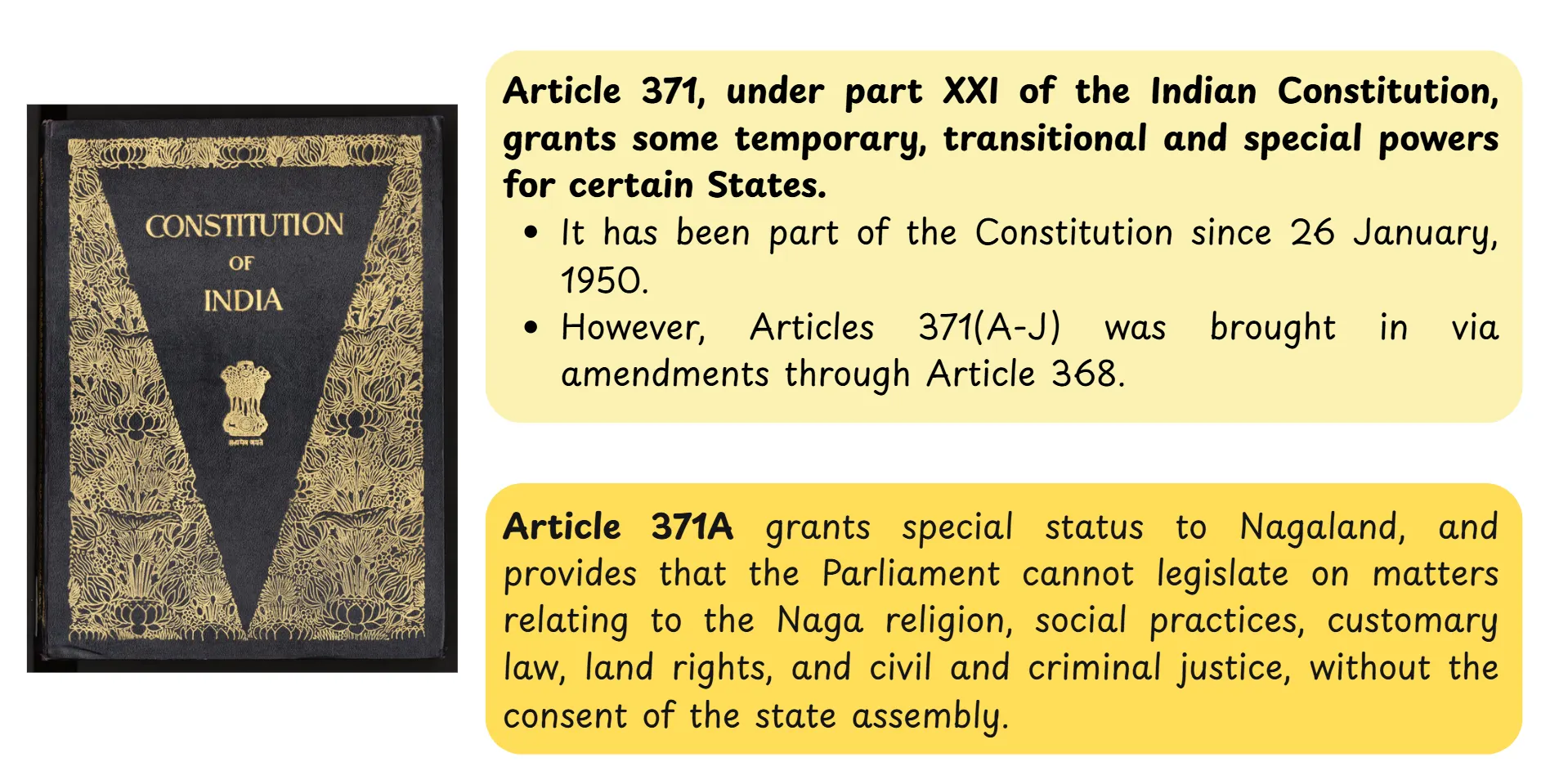
FNTA has a legislative and executive prerogative over devolved topics, thus facilitating decisions at the level of a district. This structure is also consequential because it allows tribal people to come up with their policies tailored to their socio-cultural and developmental needs. More importantly, Article 371 (A) protective provisions are still in place, so that the customary laws and practices of the tribal groups of Nagaland do not face disregard.
Financial Autonomy and Developmental Role of FNTA
The authority has the mandate of fiscal powers to plan and execute schemes independently.
This involves management of financial allocation towards roads, schools, and hospitals. Reports made by the FNTA present it as a kind of devolutionary autonomy model, with the projections claiming that the FNTA would help bridge the developmental gap within the districts whose literacy and infrastructure indicators were below the state averages.
Developmental and Social Implications of FNTA
The FNTA is not merely an administrative innovation; rather, it is designed to fill the long-term developmental void and to strengthen social unity in the six districts of eastern Nagaland.
Optimised Developmental Upliftment in Eastern Nagaland
The FNTA devolves authority on 46 subjects that run along the education, health, and infrastructure sectors. This is urgent since the literacy levels in Mon and Kiphire are below the state level of 80+%, and healthcare establishments are few compared to the western part of Nagaland. Through financial independence, the FNTA will allow locally specific plans to enhance the roads, schools, and hospitals, resulting in a reduction of structural differences.
Cultural Acknowledgment and Recognition of Eastern People
In addition to material development, the FNTA recognizes the cultural differences of the tribes in Tuensang, Noklak, and Shamator. Article 371 (A) safeguards the customary laws and practices from being altered, and those tribal institutions can attend to governance. Such appreciation boosts cultural pride and reduces alienation that was contributing to the desire to have a separate state.
Social Cohesion in Eastern Nagaland
The FNTA is more focused on the grassroots, and the roles of the civil society and tribal councils are to be involved in the planning and monitoring. This participative model can be important to the marginalised communities because it improves accountability, and the development process focuses on the local priorities. Analysts consider this to be the beginning of the realization of inclusive federalism in the Northeast of India.
Broader Political and Regional Importance in NE India
The Frontier Nagaland Territorial Authority (FNTA) is not only a localized reaction to grievances but also a way of development of the extensive politics and the region in the pattern of development of Nagaland, the Northeast, and the federal structure of the Indian nation as a whole.
Nagaland: Balancing Unity and Diversity
FNTA gives Nagaland freedom without breaching its territorial integrity. This is a compromise that fulfils the demand by the Eastern Nagaland People Organization (ENPO) to be granted statehood without compromising on the state cohesion. Analysts note that the transfer of power to forty-six subjects increases the faith of the people of Nagaland in their leadership and prevents the destruction of the Nagaland political map.
The Regional Implications of Northeast India
FNTA is seen in the North East as a kind of devolutionary autonomy paradigm. Through the legislative, executive, and fiscal powers it gave to the historically marginalised districts, the authority shows how such negotiated settlements can address the pressures of separatism. According to researchers, such an arrangement may set an example to the rest of the states struggling with ethnic or regional claims.
Federal Innovation and National Perspective
On a larger scale, the FNTA demonstrates the development of Indian federalism. It is what can be called an example of how constitutional protections of Article 371(A) can be transformed to suit a plurality of ambitions. According to policy analysts, this move affirms constitutional morality in that tribal rights are reconciled to national unity, thereby creating a precedent of inclusive governance in multi-ethnic societies.
Conclusion
The introduction of the Frontier Nagaland Territorial Authority is an interesting institutional innovation of the federal situation in India. The FNTA ensures that there is no developmental inequality in the 6 historically marginalised districts and protects tribal identity through Article 371 (A) by canning legislative, executive, and financial power to the six marginalised districts. Politically, it shows aspirations of independence versus filling in the national integrity, thus introducing a viable pattern of inclusive governance that enhances stability in the region and ascertains the constitutional obligation of diversity in India.
Frequently asked questionsFrequently asked questions
Historical Demand of Autonomy in Eastern Nagaland?
The Eastern Nagaland Peoples’ Organization (ENPO) has secured the creation of the “Frontier Nagaland Territorial Authority” (FNTA), granting legislative, executive, and financial autonomy to six underdeveloped districts. Stemming from decades of perceived economic and political marginalization since 1963, seven tribes had long demanded a separate “Frontier Nagaland” state, a movement that ultimately led to the 2026 agreement. The quest to establish self-determination of Eastern Nagaland through the Frontier Nagaland territorial authority (FNTA) is based on an extended history of socioeconomic shabbiness, instigating political organisation and deeper-seated tribal dreams of equitably organised governance.
Autonomy Compromise in Eastern Nagaland?
Later, after a long series of negotiations, a trifold agreement between the Union Government, the Nagaland government, and ENPO was signed in February 2026. Instead of dedicating full statehood, the accord established the FNTA that devolves legislative, executive, and fiscal power over 46 subjects whilst retaining the safeguards under Article 371 (A). The compromise is a measured balance between the national sovereignty requirements and the desire of the native communities; hence, it forms a pivotal point in the development of Indian federal policy.
Structure and Powers of Frontier Nagaland Territorial Authority?
The Frontier Nagaland Territorial Authority (FNTA) is a semi-autonomous institution created under a tripartite agreement signed on 5 February 2026 between the Government of India, the Government of Nagaland, and the Eastern Nagaland Peoples’ Organisation (ENPO) to address longstanding regional underdevelopment. Conceived as a “middle path” short of full statehood, it grants a measure of devolutionary autonomy to the region. The Frontier Nagaland Territorial Authority (FNTA) is an agreed national administrative system of autonomy, aimed to devolve powers in six eastern districts, although retaining the constitutional character of Nagaland.
Developmental and Social Implications of FNTA?
The FNTA is not merely an administrative innovation; rather, it is designed to fill the long-term developmental void and to strengthen social unity in the six districts of eastern Nagaland.
Broader Political and Regional Importance in NE India?
The Frontier Nagaland Territorial Authority (FNTA) is not only a localized reaction to grievances but also a way of development of the extensive politics and the region in the pattern of development of Nagaland, the Northeast, and the federal structure of the Indian nation as a whole.