|
Key Highlights
- A total of INR 58000 Crore loan
- Just 9 Offenders own a major part
- Still, INR 39,000 Crore is not recovered
- Weak Recovery Policies as a challenge
- Fugitive Economic Offenders Act, 2018
- Need for more Global Cooperation
|
The total debt of economic offenders who have escaped India is about INR 39,000 crores. Only nine such fugitives, with a good many of them high-profile individuals, have a principal and interest amount of about 58,000 crore rupees. The amount recovered amounts to INR 19,000 crore, which is about one-third of the total liability. With the issue of arrest warrants, these individuals are still in foreign countries, hence highlighting that there are big challenges to extraditing them, recovering assets, and security of the Indian financial network.
The recent news regarding India's banking system under siege refers to the ₹58,000 crore debt owed by nine major fugitive economic offenders (FEOs) who have fled the country to avoid prosecution.
|
Tips for Aspirants
The article is important to study governance, financial responsibility, legal principles, and policy change, which are the main areas of learning with respect to the study of economics, polity, and current affairs in the examination of the UPSC CSE and State PSC examinations.
|
|
Relevant Suggestions for UPSC and State PCS Exam
- Indian banks’39,000 crore rupeesare owed by fugitive economic offenders.
- Only nine criminals account for liabilities of INR 58,000 crore, out of which INR 19,000 crore have been recovered.
- High-profile examples are of Vijay Mallya (INR 9,000 crore), Nirav Modi (INR 13,000 crore), and Mehul Choksi, and demonstrate weak enforcement of the system.
- The Fugitive Economic Offenders Act, 2018, enables the government to seize the property of offenders who escape to foreign countries.
- The activities are performed by the Enforcement Directorate (ED), the CBI, and banks in connection with asset recovery and extradition.
- Problems: Protracted court procedures, inadequate international collaboration and the use of international jurisdictions by the perpetrators.
- Lessons on policy: stronger banking regulations, forensic audit, whistle-blower protection, and recovery transparency.
|
White-collar crimes committed by prominent people have become a pertinent challenge to the financial stability and the system of governance in India. The issue of fugitive economic offenders, i.e. the people who no longer reside in the jurisdiction to face the charges, has found a lot of interest in the mass media but also among the institutional actors of the past few years. According to the official statistics, the total figure of the debt provided to those who have fled India is about 39,000 crore rupees to the banking institutions, as an example of the losses incurred by the financial sector. More remarkably, only nine criminals also represent the liabilities worth approximately 58,000 crore rupees, out of which approximately 19,000 crore rupees have been recovered using the available legal and institutional structures. This event highlights the weak areas of the banking and regulatory systems of India, whereby loopholes in the system have been used to foster massive fraud.
Nine Offenders and ₹58,000 Crore Debt: How India’s Banking System Is Being Stretched to Its Limits
The introduction of the Fugitive Economic Offenders Act, 2018, is a type of legislative action that would help alleviate these difficulties by providing the authorities with the ability to confiscate assets and simplify the extradition process. However, the neutralities of international law, the diplomatic practices and lengthy court proceedings continue to hamper the speedy solving of such matters. The problem is not confined to financial aspects, but it has some ethical aspects in terms of responsibility, disclosure, and protecting the national finances.
Scale of the Problem
Such a phenomenon of fugitive economic offenders in India not only amounts to a financial crunch but also a huge governance dilemma, undermining the stability of the banking system, people's trust, and credibility of regulatory bodies.
Severity of Financial Damages
Total loss of credit to economic criminals who have defaulted in India is worth about 39,000 crore rupees, which is very attractive to highlight the vulnerability of the banking sector to massive fraudulent activities. More significantly, nine persons alone bear about 58,000 crore rupees in terms of liabilities, including both the principal and accrued interest. This great concentration of debt in a small group of criminals demonstrates the degree how which system loopholes can be utilised with catastrophic impact.
Effect on the Banking Institutions
These losses are far-reaching to the banking system of India. The banks in the public sector are already burdened with bad assets, and when the high-value loans go under default, the existing banks further strain. Varnishing of capital reserves deteriorates their ability to give credit, hence limiting economic growth. Additionally, reputation loss caused by such scandals destroys trust among investors within the country and abroad. Recognition of considerable amounts of money makes the recovery of large amounts of money difficult, which further generates views on inefficiency in financial governance.
Recovery Activities and Constraints
Though assistance has been returned to the tune of approximately 19,000 crore rupees, i.e. one third of all debt owed, and the recovery process is slow going but full of huddles. The Fugitive Economic Offenders Act, 2018, on seizure of assets has had a certain positive effect, but the process of extradition often takes a long time because of the complicated international legal systems. The ability of the offenders to take advantage of the jurisdiction and safeguards of foreign countries shows flaws in one-sided domestic responses. Although this is an achievement in itself, it demonstrates how hard it can be to recover the finances expended on the offender after he or she runs away.
Governance Issues
The issue of concern goes beyond economic measures to include some underlying issues of workability and responsibility. A small number of individuals being able to plan fraud of this scale are indicative of the weaknesses in terms of oversight and due diligence, as well as regulatory implementation. It also creates ethical issues about how public funds are misused and the decline of the relationship between the citizens and the institutions. Only more powerful law-making tools and systematic reform of the banking processes, risk judgment, and global collaboration may help address those issues.
Case Profiling and Recovery Operations
The model of the high-profile absconding economic criminals has taken centre stage in the battle of India, trying to protect the funds of its people. Their respective cases show the weaknesses in the system, and their respective recovery programs demonstrate the improvement and the long-term struggles in the financial governance structure of the country.
Kingfisher Airlines
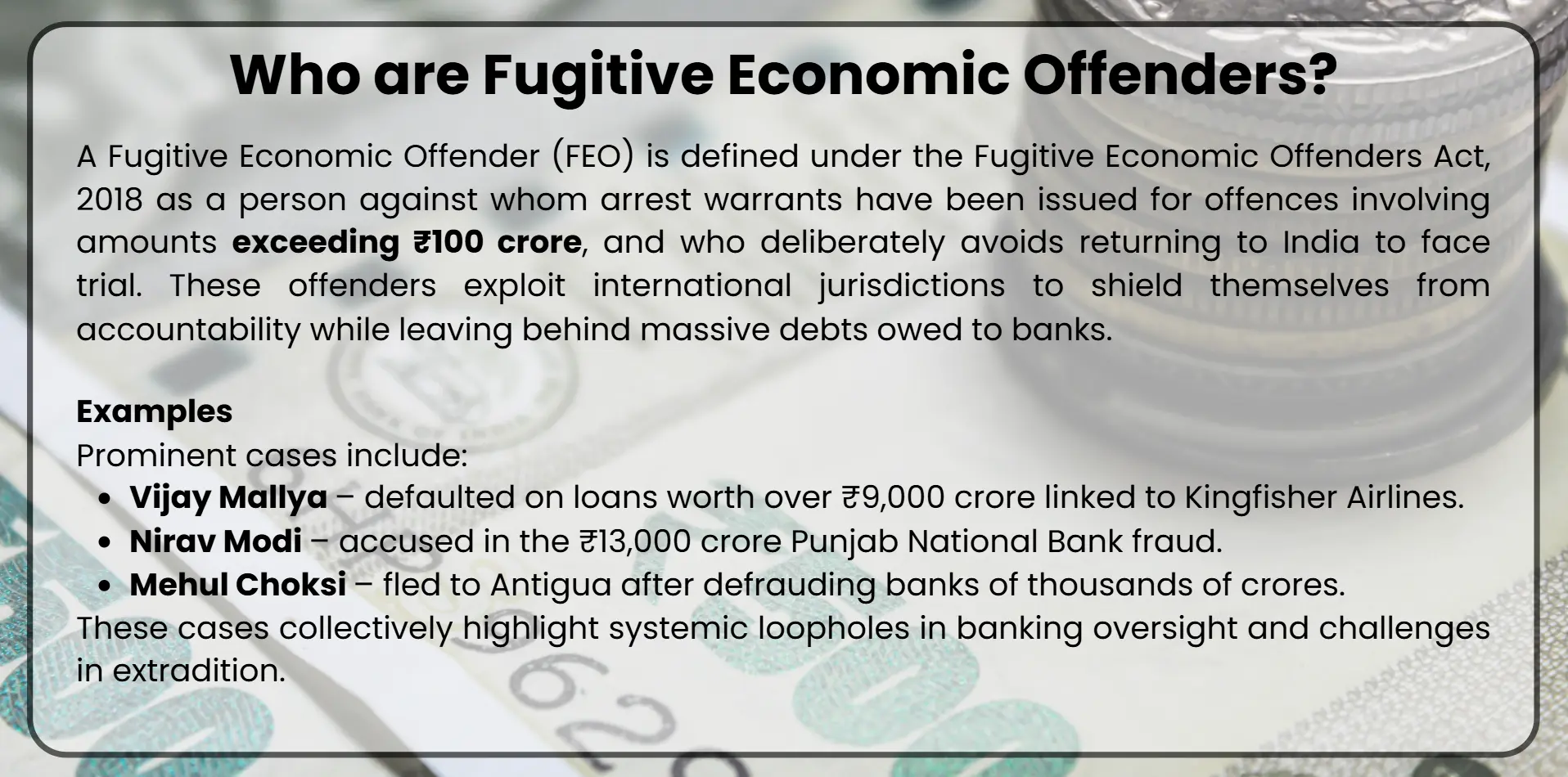
The case of Vijay Mallya is one of the brightest examples of economic fraud. Mallya failed to pay back loans worth more than 9000 crore rupeeslinked with Kingfisher Airlines. Though proclaimed as a fugitive economic offender under the Fugitive Economic Offender Act, 2018, he still remains resident in the United Kingdom and challenges the process of extradition. This case demonstrates the multidimensionality of imposing responsibility under cross-cultural jurisdiction in matters where the local laws assume the acquisition of property and the conviction of the criminals.
Nirav Modi
Another huge case is that of Nirav Modi, who was allegedly involved in arranging a fraud that was reported to be of over 13,000 crores rupees against Punjab National Bank. Fled to London in 2018, Nirav Modi is still fighting in the UK courts. The Enforcement Directorate has already confiscated properties worth thousands of crores; however, there are lengthy lawsuits which have not helped to retrieve them fully. The case of Nirav Modi highlighted the scale of financial malpractices that can be supported by conspiracy and a lack of supervisory controls.
Mehul Choksi and Offshore Evasion
Very closely associated with Nirav Modi, Mehul Choksi is claimed to have swindled Indian banks of a number of several thousand crores. Choksi fled to the country of Antigua and Barbuda, where he became a citizen, making extraditing him an uphill challenge. Although Indian government officials have confiscated some of the domestic property, recovery abroad has been limited. The case underlines the way that criminals use global mobility and citizenship gaps to avoid responsibility.
Recovery Accidents and Restrictions
Though these hiccups have been experienced, partial recovery success has been achieved in India. According to official statistics, INR 19,187crore has been recovered, mostly by means of asset seizures and other settlements, and this makes approximately a third of the total liability. The State Bank of India has led these recovery efforts by the banks in the public sector. Yet, this difference between the total liabilities, which are estimated as 58,000 crore rupees and the recovered amount indicates the weakness of existing mechanisms. The most common are the international cooperation dilemmas, lengthy court battles, and the fact that criminals can use their property overseas.
Legal and Institutional Framework
A dynamic approach towards dealing with fugitive economic offenders in India has been facilitated by a mixture of law-making creativity as well as institutionalised mechanisms, which are designed to protect the national treasury and improve the accountability of the financial system.
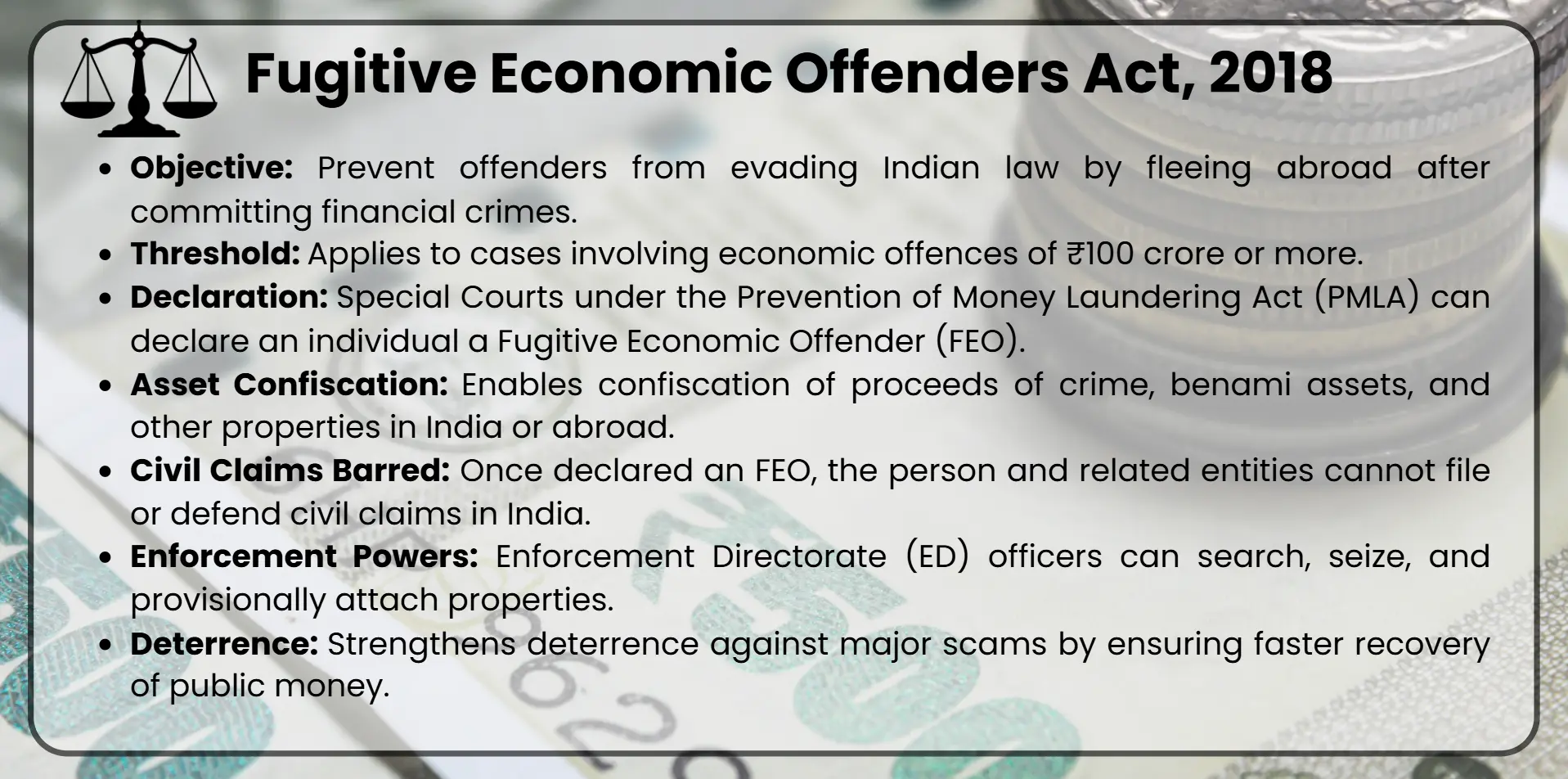
The Fugitive Economic Offenders Act, 2018
In 2018, the Fugitive Economic Offenders Act (FEOA) was adopted and is the foundation of the legislation on the topic of financial fraud in India on a large scale. According to the Act, authorities have the right to declare a person a fugitive economic offender in the instance of an offence committed of sums of more than 100 crores rupees and failure to show up to face prosecution. As soon as it has been announced, the properties of the offender located in India can be confiscated, and civil proceedings against such an individual can be suspended or terminated. The Act aims to prevent actions of transgression by targeting punitive acts on both the criminal and his/her financial resources.
Enforcement Directorate and Investigative Agencies
It is through the Enforcement Directorate (ED) that the provisions of the FEOA are enforced. It has the authority to apply to special courts to declare the criminals and seize their property. Together with the ED, such agencies as the Central Bureau of Investigation (CBI) and financial institutions of the ruler collaborate to track down assets, prosecute recovery actions, and seek extradition petitions. Such institutions are the support structure of the enforcement environment in India; however, their effectiveness is often hindered by the lengthy process of legal actions and global legal challenges.
Judicial Review and Foreign Collaboration
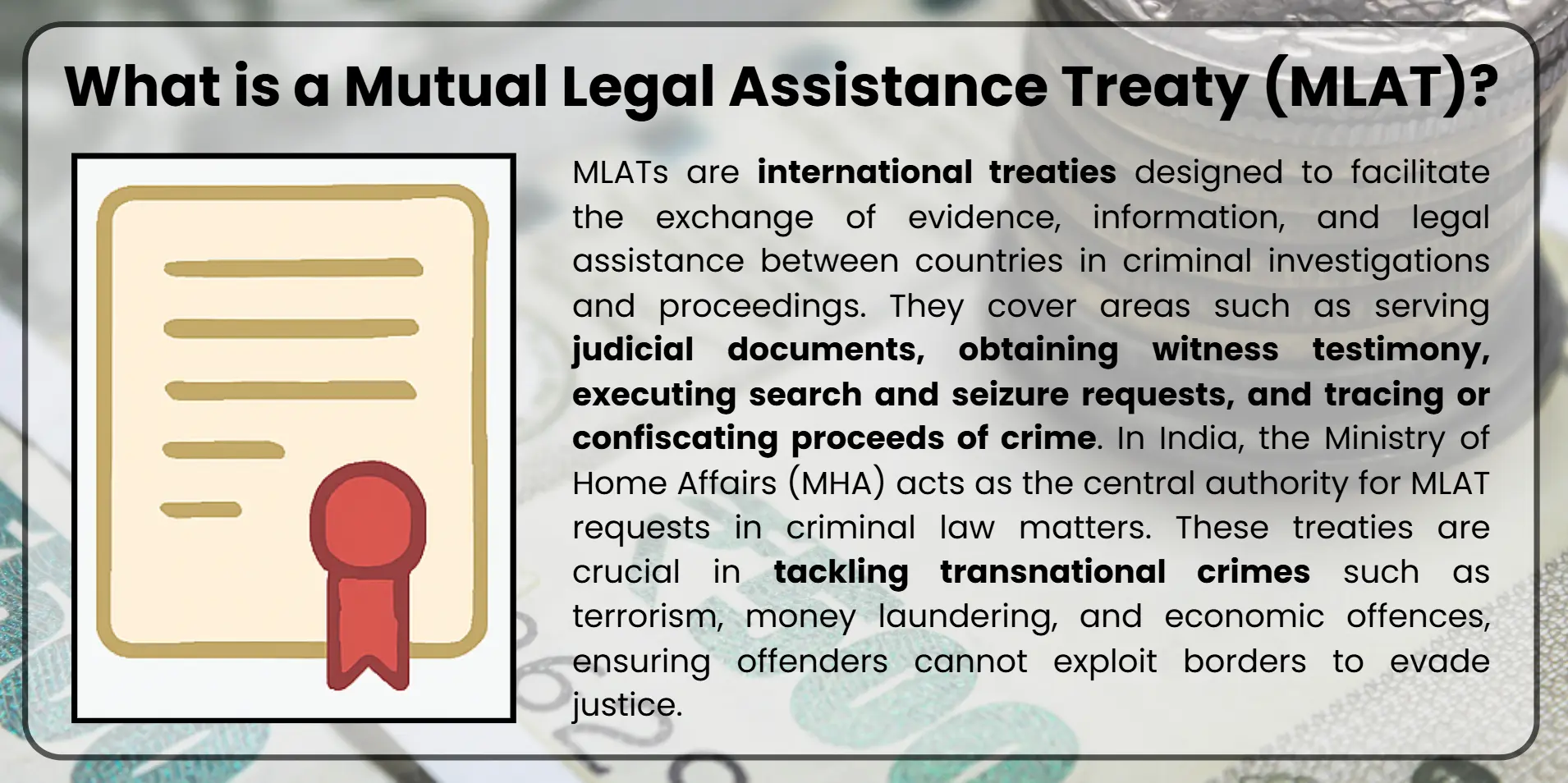
The Act has led to the creation of special courts that apply judicial checks on the declaration of offenders and the administration of assets in confiscation. However, extradition is not only a complicated procedure, but also requires bilateral treaties and diplomatic talks. Criminal activities such as those of Vijay Mallya and the Nirav Modi cases show how criminals can use their jurisdictions in other countries to evade courts. The dependence of mutual legal assistance treaties (MLATs) and the cooperation with other agencies like Interpol illustrate the importance of international cooperation in the process of the improvement of the enforcement abilities of India.
Reforms and Challenges by the institutions
Even though the legal framework exists, there are still issues. The slow rate of extradition, challenges in tracking assets abroad and delays in the procedures dilute deterrence. Moreover, collaboration between various agencies sometimes leads to overlaps of activities. Increasing the institutional capacity, enriching the forensic auditing, and simplifying international cooperation are the key reforms that should be made to ensure that the framework can achieve the desired goals.
Lessons and Way Forward
This fact is also indicated by the continued existence of financial crimes perpetrated by fugitive economic offenders operating in India. Lessons of the policy based on these cases are the key to strengthening oversight, improving recovery systems, and achieving international collaboration.
Enhancing the Supervision of Banks
There is one major lesson that emphasizes the need to have proper banking oversight. Many high-value frauds occurred due to due diligence, poor quality of internal controls, and lack of prompt identification of anomalies. Tightening of risk assessment structures, obligatory compliance audit, and increasing the responsibility of corporate officials in the banks are essential reforms. The shield of financial governance should be based on preventive vigilance and not reactive measures to safeguard the public money.
Improving Legal Necessities
The Fugitive Economic Offenders Act, 2018, has provided a legal basis for the seizure of the assets and the pursuit of the offenders even in foreign countries. However, its effectiveness is related to the timely judicial procedures and inter-agency collaboration. The procedures can be streamlined, and delays in declaring offenders can be minimized, and the extent of the asset attachment could be expanded in order to increase deterrence. Furthermore, forensic accounting and advanced financial intelligence systems will enable those in charge to better track complicated money trails.
International Cooperation and Extradition
One such problem is the extradition of criminals who use overseas jurisdictions. India should reinforce bilateral treaties, use the mutual legal assistance treaties (MLATs), and proactively use bodies like Interpol to hasten the process. Signing mutual agreements with those nations that act as safe havens will strengthen the ability of India to reclaim its assets as well as bring criminals to justice. To overcome barriers to cross-border enforcement, diplomatic interaction, as well as legal harmonisation, is essential.
Establishing Goodwill and Openness
In addition to financial gains, ethical issues of accountability and trust of the people are raised by the issue. Confidence in institutions can be fortified through transparent disclosure of recovery initiatives, systematic reporting of progress, as well as publication of awareness campaigns to the population. The reforms of the policy should also focus on corporate governance, the protection of whistle-blowers, and the introduction of heavier fines on collusion in the financial sector. Reformsare required to rebuild credibility, which will involve more than punitive actions and entail bringing about total reforms that focus on integrity and transparency.
Conclusion
The fugitive economic offenders in India point to the intersection of the fiscal vulnerability of people, lack of governance and moral responsibility. With INR 39,000 crore in aggregate liabilities and partial recoveries of INR 19,000 crore, the circumstance is both symptomatic of systemic weaknesses and also of some institutional response. High-profile cases of extradition and reclaiming assets contribute to the complex procedures of the extradition and reclaiming, and the Fugitive Economic Offenders Act, 2018, provides a legislative ground for deterrence. The key issues of the future are strengthening control of the banking sector, further internationalisation, and the need to enhance transparency as a standard practice. India can secure the public financing only with the help of holistic reform in order to restore these funds, to regain the trust in the financial institutions, and to support the integrity of its economic governance.