Key highlights
- Global Leader in Innovation
- Low funding in R&D
- Private participation is low
- Patent filings are still lacking
- Need for academia-industry partnerships
|
The article “India’s Innovation Dream vs. the R&D Reality” explains how India intends to be a global leader in the area of innovation, but still has poor research and development (R&D) funding. It clarifies the structural imbalance, the subsequent effects, including brain drainage, and dependency on external technologies, and stresses the urgency to increase investment and strengthen the cooperation between academia and industry divisions.
Tips for Aspirants
This article is relevant to the UPSC CSE and State PSC exams because it touches upon topics of governance, economic policy, innovation, and R&D investment, which are essentials of the GS Paper, essay writing, and interview. |
Relevant Suggestions for UPSC and State PCS Exam
- The current spending on R&D is 0.65 percent of the GDP, which is significantly low compared to the global average.
- Government Investment accounts for more than 70% of total investment.
- This imbalance has had impacts of low commercialisation of patents, dependence on imported technologies, loss of competitiveness in the industrial sector, and brain drain.
- There are still quality issues with the registered patients, despite an increase in patient numbers annually.
- Patient applications by women haveincreased.
- The ratio of investment in R&D should be boosted to 2 to 3 percent of the GDP, and the academia-industry partnerships should be improved.
|
The need to become a global leader in innovations is entrenched in the developmental vision and discourse of India. In the last ten years, there have been efforts, including Make in India, Startup India, and Digital India, to market the country as a hub of technological progress and entrepreneurial zeal. However, this aspiration is faced by a structural challenge of the current gap in R&D investment. The investment in R&D in India today amounts to below 1 percent of the gross domestic product (GDP), whereas 2-4 percent is allocated in developed countries and innovation-oriented states. This gap not only limits the possibility of achieving indigenous technological breakthroughs but also limits the use of external knowledge systems and imported technologies. There are several effects such as the amount of patents generated is lower, the research infrastructure is less developed, and talented workers are moving to the nations that have stronger innovation systems. It is important to address this weakness, not only to become more economically competitive but also to gain strategic autonomy in the biotechnology, artificial intelligence, and clean energy sectors.
The article explores the lines of the Indian shortfall in the field of R&D, what it means to the national ambition, and the avenues by which the gap between ambition and reality can be bridged by increasing the level of investment, institutional reform, and collaboration between the research and development community and the commercial sector.India's "innovation dream" is propelled by a massive talent pool, a growing startup ecosystem, and strong government initiatives, yet it is held back by the "R&D reality" of chronic underinvestment, a weak link between academia and industry, and a risk-averse corporate culture
Indian innovation ambition
The Indian innovation ambition captures the developmental dreams of India and strategic priority because of its quest to gain technological sovereignty in an ever-evolving world order. This aspiration is shaped by policy efforts, institutional capabilities and threats of under-investment in research and development (R&D).
Vision of Global Leadership
India is emerging as a world-class innovation centre with a view to using its demographic dividend, growing digital infrastructures, and entrepreneurial ecosystem. Startup India and Digital India are some of the initiatives designed to promote creativity, the application of technology, and knowledge-based growth. The success of the country in developing the COVID-19 vaccines within the shortest time in history and achieving a soft landing on the south pole of the moon shows its ability to break through innovation. These achievements align with the fact that India has the potential to pursue frontier technologies.
Investment Deficit in R&D
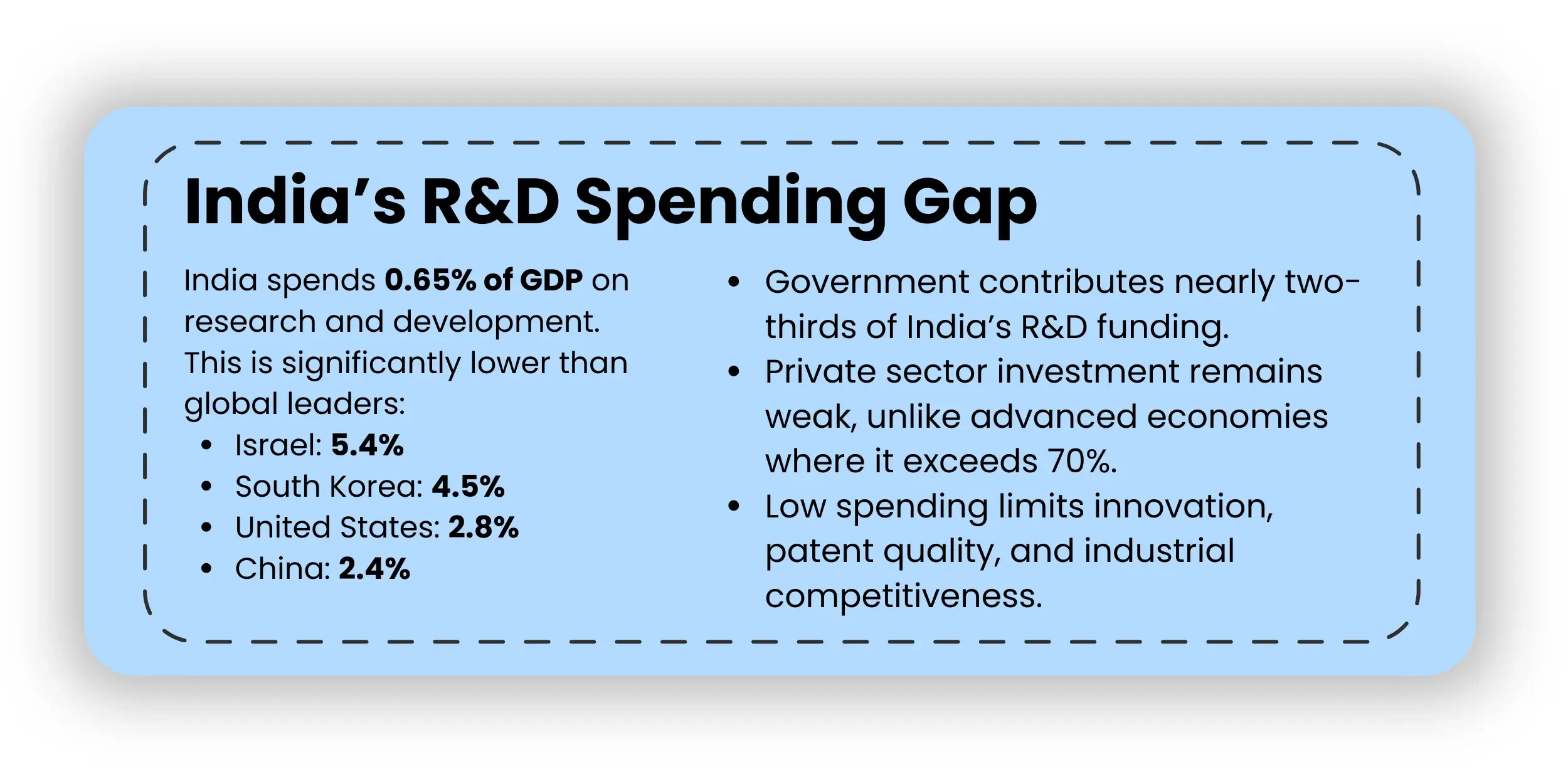
India invests less than 0.65 percent of its GDP in R&D, whereas South Korea has little more than 4.5 percent, Israel 5.4%, the United States 2.8%, and China 2.4%. Underinvestment like this limits the scaling of research in Indian Institutes of Technology (IITs), the Indian Institute of Science (IISc), and CSIR laboratories. Besides, the role of the private-sector is still minimal, with the government financing outlay of almost two-thirds of overall R&D spending. All these structural imbalances undermine the innovation system of India and hamper its ability to compete internationally in patent applications.
Consequences
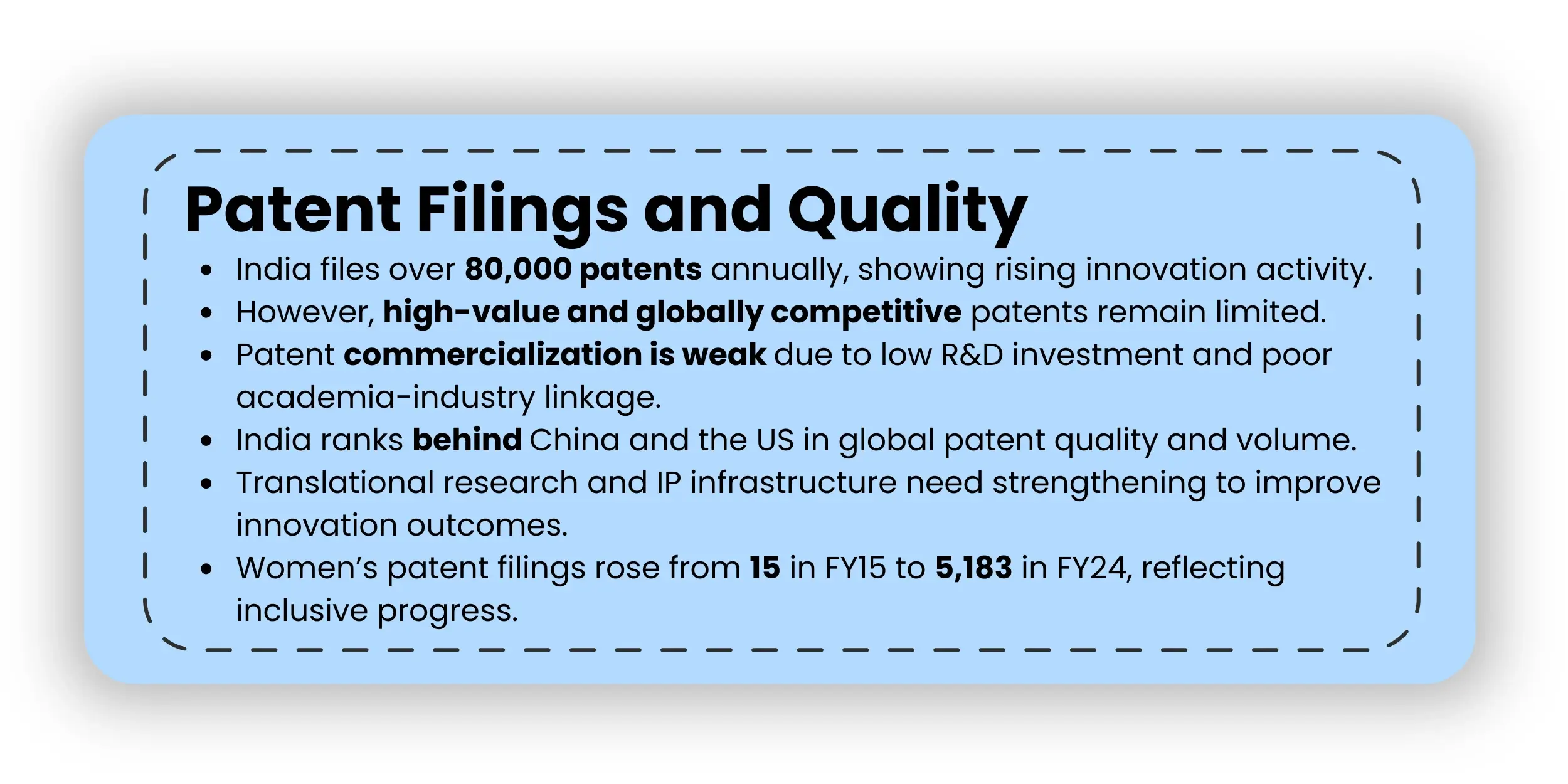
There are practical implications of the deficit in R&D spending. India still lags in international patent ranking, with the number of high value patents being less than those of the economies that are driven by innovation. The growth rate of patent applications has also increased by two times since 2014-15, with application counts going over 80,000 in a year; however, the quality and commercialisation of the patents are limited. Moreover, lack of finances triggers the brain drain, as young and bright researchers move to countries with better infrastructure and possibilities. This dependence on foreign technologies undermines India's strategic autonomy in such areas as biotechnology, artificial intelligence and clean energy.
Manual of Realising Ambition
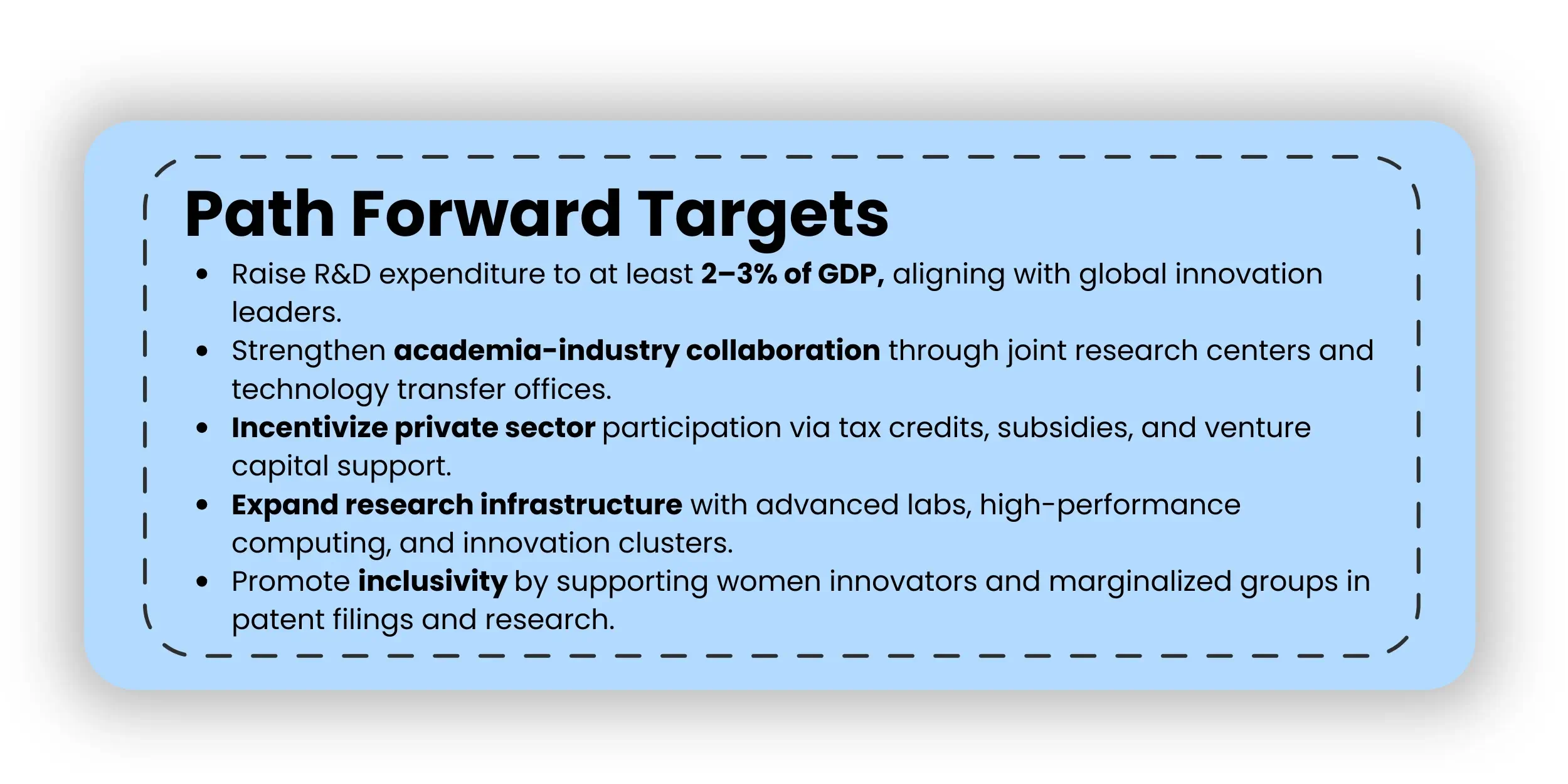
India should improve its R&D investment by at least 2-3% of GDP, encourage academia-industry partnership, and encourage involvement of the private sector. Intellectual property regime, building more research infrastructure, and enabling women innovators, who have increased their number of patents filed, from 15 in FY15 to 5,183 in FY24. India can narrow the research gap and make the country's innovation aspiration a lasting leadership to guarantee economic competitiveness and technological autonomy.
Current R&D Deficit
The desire to emerge as the world leader in innovation is holding India back, as there has been a long-standing research and development (R&D) gap. Though policy efforts have been made, the investment level has been poor relative to international levels.
Low R&D Expenditure
In recent years, India has experienced stagnation in the gross expenditure on R&D, which is about 0.65 percent of GDP. This percentage is considerably low compared to such countries as South Korea (4.5%), Israel (5.4%) and the United States (2.8%). This underfunding is a sign of inadequate government funding and the poor involvement of the business community. Although state agencies pay close to two-thirds of the total research and development expenditure, there is reluctance in the market to invest heavily in long term research by the private enterprises.
Structural Imbalances
Structural problems contribute to the deficit. Though there are many institutions of higher learning, the facilities lack developed labs and reliable research funds. Whereas high-quality research is being generated by the Indian Institutes of Technology (IITs) and the Indian Institute of Science (IISc), their outputs are not nationalised owing to resource scarcity. Besides, the research allocation efficiency is diminished by the incoherent funding systems and bureaucratic lag.
Effects
The consequences of the lack of investment can be observed at the global level of innovations and patent applications in India.
- Even though there are applications in the range of over 80,000 each year, despite those numbers, there are still only a small number of high-priced patents in comparison to China and the United States.
- Such a deficit impairs commercialization and industrial competitiveness.
- Moreover, insufficient financing is also a reason to believe in brain drain, as talented researchers will move to other countries that can provide better infrastructure and possibilities.
- The reliance on technologies brought into the country in areas like biotechnology, semiconductors, and clean energy reduces the strategic autonomy of India even more.
Examples
- India spends less than 8% of its revenues in R&D in the pharmaceutical sector, which is low compared with 15-20 percent in developed countries, though the Indian industry is actually a global generics provider.
- India is also poor in the innovativeness of its domestic solar technology in renewable energy, where it is dependent on imported technologies.
- India lags even in the emerging technologies like artificial intelligence from countries that possess stronger R&D ecosystems.
Underinvestment: The Consequences
The issue with innovation in India is that underinvestment in research and development (R&D) is undermining the country in achieving the goal of becoming a global innovation leader. This failure of structure produces ripple effects in the economic, technological, and strategic realms.
Weak Innovation Ecosystem
The level of R&D spending is low and does not facilitate breakthrough innovations in India; whereas India has a budget of about 0.65 imperative over GDP as compared to the 2-4 percent found in developed economies. The Economic Survey 2025 reveals that gross R&D spending has grown fromINR 60,196 Crin FY-11 to INR 1, 27,318 Crin FY 21-22, but is still very low compared to other developed countries. As a result, the creation of valuable industries like biotechnology, semiconductors, and artificial intelligence is discouraged.
Relying on Foreign Technologies
This under-investment continues the dependency on foreign technologies. As an example, the renewable-energy industry in India is still very reliant on imported solar modules, and high-tech manufacturing is still held back by outsourced automation platforms. This reliance leads to loss of strategic independence and creates vulnerability to the economy in the face of supply-chain risks.
Limited Patent and Commercialization
Though filings of patents in India have exceeded 80,000 patents per year, the quality and commercial use of these patents are weak compared to those of China and America. The loss of intellectual-property infrastructure and lack of funding for translational research is a pull-down of developing marketable innovation out of academic discoveries.
Brain Drain and Talent Mobility
Lack of sufficient research infrastructure and resources forces talented researchers to explore other possibilities in foreign countries. Countries with a strong innovation ecosystem draw Indian talent, hence a loss of necessary human capital in the home country in terms of innovation. The studies showthat the unwillingness of the private sector to invest leads to further aggravation of this problem, which means the necessity to leave the responsibility to academia with a disproportionate responsibility.
Industrial Competitiveness
The manufacturing industry is facing a threatening competitive disadvantage due to the chronic underinvestment in research and development. Without the element of innovation-led growth, the Indian companies will be limited to low-tech production, thus making it hard to compete with the global leaders in high-technology manufacturing.
Path Forward
India's desire to be a worldwide leader in the field of innovation requires a clear direction. To resolve the existing research and development (R&D) gap, there is a need to reform the system and spend more and more to strengthen the cooperation between the governmental institutions, the academic sector, and the industry.
Raising R&D Expenditure
At the current stage, India spends about 0.65 percent of gross domestic product (GDP) in R&D, which is significantly lower than the global average of 1.8 percent and much less than the figures of other successful economies such as South Korea (4.5 percent), a major number of which are representatives of the developing world. To ensure a sustained growth on the basis of innovation, the spending level must be increased to a minimum level of 2-3 percent of the GDP. This investment should be spread to key areas of strategy of the country, such as biotechnology, artificial intelligence, clean energy and defence technologies to provide for both economic competitiveness and national security.
Enhancing Academia-Industry Partnership
One of the strategies is strengthening the collaboration between industrial corporations and universities. Despite high-quality output of research by institutions like the Indian Institutes of Technology (IITs) and the Indian Institute of Science (IISc), commercialisation of the output has not been very successful. To address this gap, the introduction of joint research centres, incentives in industry-funded projects and increased technology-transfer offices can be efficient. The South Korean story can serve as a good example since it has reached high success partly due to strong academia-industry-governmental ties, a structure which India can follow.
Rewarding Private Sector Participation
The share of the overall R&D expenditure of the private companies in India does not go beyond 40 percent, compared to more than 70 percent shared by the advanced economies. This can be achieved by tax credits, innovation-related subsidies and venture-capital finance funding in order to encourage the long-term research projects by the private companies. Industries like Pharmaceuticals and renewable energy are some of the industries that India could facilitate more private commitments in research and development, so that it will not solely rely on imported technologies.
Building Research Capacity and Accessibility
India needs to strengthen investment in innovative laboratories, high-performance computing, and innovation clusters that will serve the apex research. The improvement of access to women and marginalised people is also essential. As an example, women in India took more patents during FY24, growing by 5,183 as compared to FY15. The capacity to innovate in the country will further be achieved by enforcing the intellectual property regimes and incubation centres where the start-ups can be supported.
Conclusion
The inability to produce enough research and development is another prominent setback towards turning India into a global player in the field of innovation. The article shows that small-scale R&D investment, restricted involvement among the business world, and the lack of connections among the academic and industrial sectors all blend together to undermine technological advancement, as well as strategic independence. To designate ambition into practical results, India should greatly increase the R&D expenditure, strengthen institutional structures, and foster forms of inclusive innovation environments. Without any strong-handed reforms, the country will continue to be reliant on foreign technologies and lose its competitiveness in the key industries. Bridging this research gap is thus necessary to align the grand vision of India and sustainable leadership in science, technology, and innovation.