|
Key Highlights
- GEO-7
- Highlighted Environment Crisis
- Suggested Transformative Pathways
- Economic and Social Dilemmas
- Challenges and Risk
- Opportunities and Path Ahead
|
The article “Global Environment Outlook 7 (GEO-7): A Roadmap for the Survival and Sustainability” highlights how climate change, the loss of biodiversity, and the pollution crisis are converging systematically, thus predicting how the environmental issues will be acute through their intersection. It compares the current devastating trends to alternative ones based on systemic changes, Indigenous knowledge, and equity thinking. Although GEO-7 maintains the danger of irreparable harm, it equally states that aggressive, coordinated effort can get trillions in advantages, improve civic health results, and guarantee a sustainable, inclusive future.
|
Tips for Aspirants
The article is relevant to the examinations of UPSC CSE and State PSC as it provides the important context of global environmental regulation, sustainability mechanisms, and equity, which are the main points of discussion of GS papers and essays.
|
|
Relevant Suggestions for UPSC and State PCS Exam
- UNEP investigates global environmental health and sustainability, which is represented in GEO-7.
- It points to all these crises converging, i.e., climate change, biodiversity loss, land degradation, and pollution.
- The evaluation cautions that the current trends will probably fail to meet the Paris agreement and the Sustainable Development Goals, thus placing the planet in irreparable harm.
- It promotes the radical courses of change that require systematic reforms in energy systems, food systems, and water systems, as well as urban systems.
- Renewable energy, the circular economy, and clean technologies are discussed as the priority solutions in the report.
- It combines the knowledge and practices of the Indigenous population and participatory government processes in developing inclusive sustainability.
- This analysis focuses on the economic dividends, which give projections of trillions of benefits, a reduction of a large portion of poverty, and civic health.
- Some of the risks noted are policy fragmentation, inequity, financial deficiencies, and governance disparities.
- The report puts urgency and opportunity simultaneously and states that cutting-edge action is a must now to be resilient and equitable tomorrow.
|
One of the most extensive surveys of the state of the planet and the future of sustainable development of the human race is the Global Environment Outlook 7 (GEO-7) by the United Nations Environment Programme (UNEP). It highlights the convergence of various environmental emergencies: climate change, biodiversity loss, land degradation, and pollution, as a collective of arcades threatened by the strength of environmental balance and human welfare. GEO7, therefore, builds on previous versions to emphasise those convergences between environmental issues, which discourage ecological stability and human welfare. The report warns that the ongoing trends are inadequate to achieve the goals as agreed at the global level, such as the Sustainable Development Goals and the Paris Agreement, putting the world at risk of irreparable damage. At the same time, GEO-7 formulates a revolutionary vision, which gives priority to systemic reforms in the energy, food, water, and urban systems. It showcases the economic and social returns of bold action, such as the possibility of trillions of dollars in gains, better health of the populace, and equity. More importantly, GEO-7 incorporates the Indigenous knowledge and participatory governance as vital elements of sustainable pathways. As a result, the report is a hard warning that should be heeded, and therefore it is treated more as a strategic roadmap, which governments, businesses, and citizens need to work towards in a concerted manner with urgency. This article reviews the key highlights of GEO-7, its diagnosis of environmental degradation, its course towards transformation, as well as its message to world politics and equity.
The environmental crisis of the 21st century
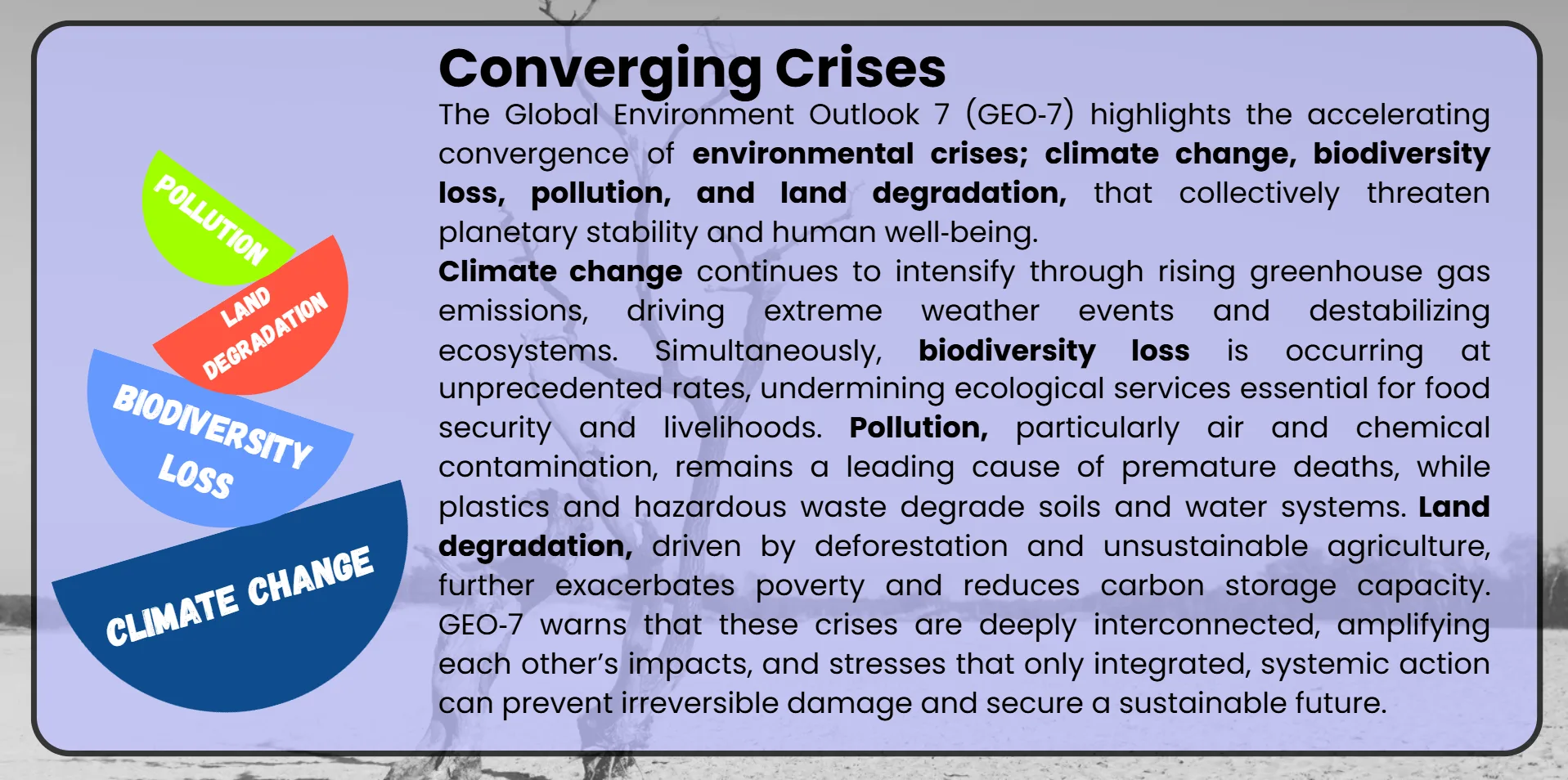
The Global Environment Outlook 7 (GEO-7) stresses the fact that the world faces a convergence of crises, i.e., the problem of climate change and the loss of biodiversity, the erosion of arid land areas and the pollution thereof, which threaten the ecological balance and the well-being of the population.
Global Warming and Growing Tensions
The issue of climate change is still the most pressing environmental problem because the world's temperatures keep increasing due to the inappropriate use of energy and the production of greenhouse gases. GEO-7 cautions that we are on the wrong track of trying to reach the goals of the Paris agreement, and thus are leading the world to a form of catastrophic warming. Strengthening heat waves, floods, and droughts are already interfering with livelihoods, food security, and infrastructure, especially in the vulnerable areas. The report highlights that, unless we undertake de-carbonization in a hurry and radical transitions in the energy systems, we will exceed manageable carbon effects.
Extinction and the Death of an Ecosystem
The report records a rampant decrease in biodiversity, with the rate of species extinction far beyond the natural baselines. Ecosystems are being pushed to collapse due to habitat destruction, overexploitation as well and pollution, which is crippling key services, including pollination, water purification, and carbon sequestration. GEO-7 emphasizes the fact that a decline in biodiversity is a socio-economic crisis in addition to an ecological tragedy since millions of individuals depend directly on healthy ecosystems to survive and express their culture.
Pollution and Human Health
One of the major causes of premature deaths in the world today is pollution as a major cause especially air and chemical pollution. GEO-7 defines pollution as a silent but deadly crisis to both cities and country folks. The increasing quantities of plastics, poisonous chemicals, and untreated wastes are polluting water bodies and soils, and thus threatening food chains and the health of the population. The report recommends the rapid implementation of principles and clean technologies of the circular economy to reduce waste and emissions.
Both Land Degradation and Resource Stress
Deforestation, unsustainable agricultural practices, and soil erosion contribute to land degradation, which is a very important aspect of the global ecological crisis. GEO-7 records that poor-quality land reduces the productivity of agricultural activities, enhances poor living conditions, and fosters desertification. This destruction is also coupled with climate change since the damaged ecosystems would not have the ability to store carbon anymore. One of the recommendations of the report is the adoption of integrated land management in which conservation, restoration, and sustainable farming efforts are merged.
Lost International Marks and Consequences
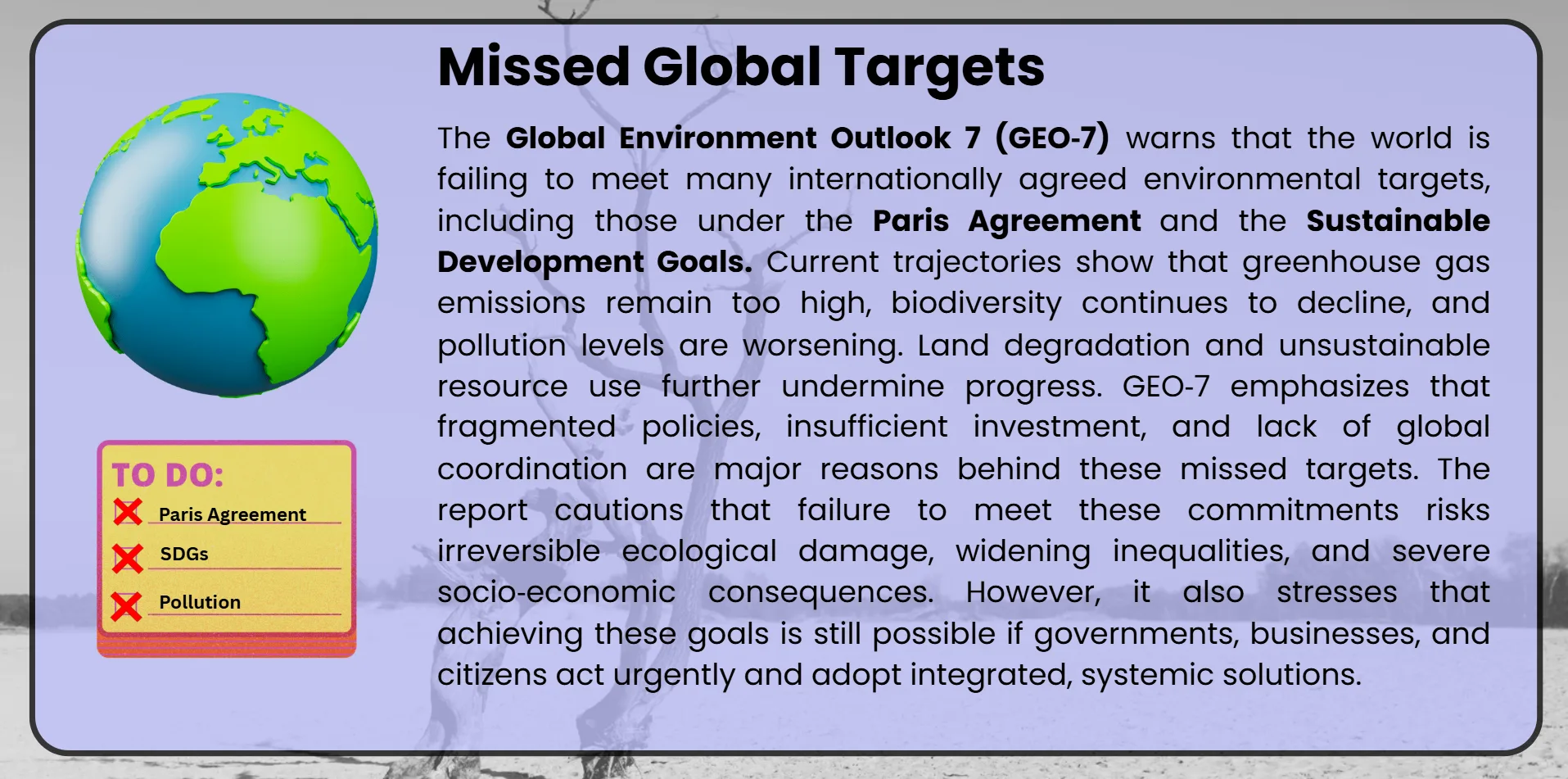
However, in addition to international agreements, GEO-7 comes to the conclusion that a large number of environmental targets, including those of the Sustainable Development Goals, will not be met by current policies. The result of such failure poses a significant danger to the social and economic destruction, amplifies disparities, and affects the stability of the world order. Nevertheless, the report asserts that the achievement of these objectives could be achieved provided governments, businesses, and citizens take decisive and concerted actions.
Transformative Pathways
Global Environment Outlook 7 (GEO-7) has argued that human beings need to take radical directions so as to turn around environmental degradation. These pathways include systemic reforms, equity, and mobilization of knowledge as antecedents to the sharing of sustainability.
Integration at a System level
GEO‑7 stresses that it is impossible to solve environmental problems in isolation. The systems of energy, food, water, and urban systems are incredibly interconnected, and disjointed policy regimes often can sabotage improvements. The transformative pathways, hence, require combined governance systems that have a combination of addressing the issues of emissions abatement, sustainable agricultural methods, water security, and resilient urban planners. These systemic approaches have the advantage that what happens in one area does not contradict what happens in another.
Clean Energy and Circular Economies
A key driver of change is the fast decarbonisation of the energy systems. The GEO-7 supports rapid renewable energy, an increase in energy efficiency, and the electrification of transportation. At the same time, the principles of circular economy, i.e., waste minimization, material reuse, and the development of clean technologies, are also predicted as the primary measures to reduce pollution and reduce resource consumption. These transitions reduce as well as create economic, recreational, and job opportunities.
Indigenous and Local Understanding
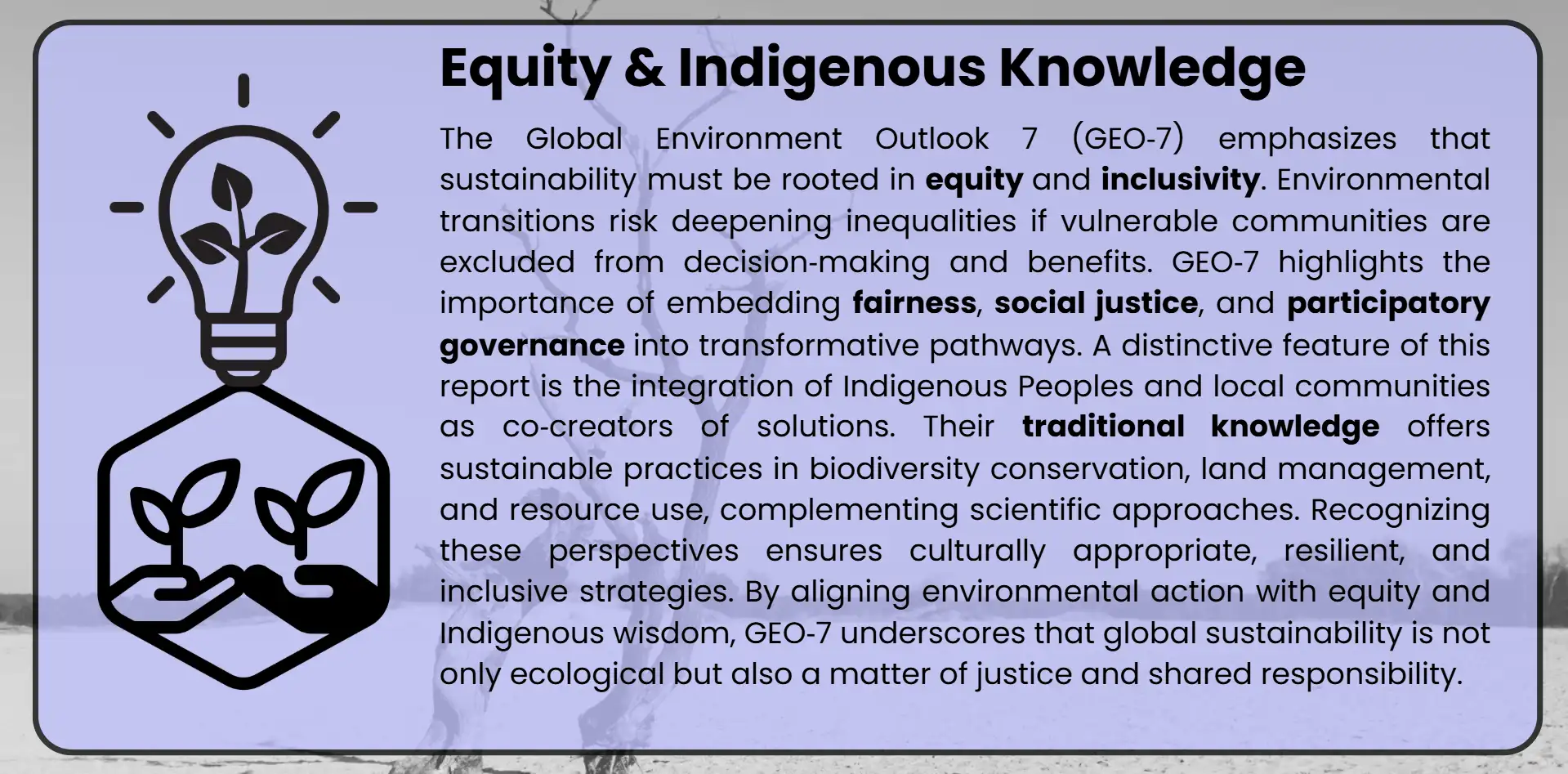
GEO-7 presents the first initiative to include Indigenous Peoples and local communities as solutions co-creators. Their indigenous knowledge offers ecologically sound land management principles, biodiversity protection, and exploitation of resources. By identifying and incorporating these views into the international policy structures, the project guarantees the creation of culturally better-fit, embracive, and sustainable paths. This sort of participatory style empowers governance and boosts the environmental action legitimacy.
Social Justice, Inclusion, and Equity
The pathways of transformation should be inclusive. GEO-7 cautions that it can increase inequalities in cases of transition when the vulnerable communities have been left out. Therefore, they should incorporate social justice in their policies and ensure that clean energy, sustainable food, and safe water are equally available. With environmental action and poverty reduction as well as health enhancements, it can be concluded that the transformative pathways are accompanied in such a way that they represent two tools of ecological and social resilience.
International Relations and Government
Lastly, GEO-7 has highlighted the importance of unity in governance on a local, national, and international level. Disjointed policies and short-term political expediency inhibit development. Transit systems require a vision that stretches over the long term, international collaboration, and strong accountability systems. It is possible to reach the Sustainable Development Goals only by means of collective efforts and prevent the irreversible destruction of environmental resources.
Economic & Social Dimensions
According to the Global Environment Outlook 7 (GEO-7), economic prosperity and social equity theorise on the fact that environmental sustainability is systemic. It clarifies the way in which decisive action has the potential to bring about a positive change in the various levels of human development.
Associated Economic Benefits
GEO-7 highlights that allocations to environmental safety have high economic rewards. Switching to output energy sources, eco-friendly agriculture, and the emerging and growing circular economies may unlock trillions of dollars in future merits. This kind of investment reduces dependency on exhaustible resources, creates new markets, and spurs innovation. The report highlights the fact that the price of inaction, the catastrophes of climate and health crises, as well as the breakdown of biodiversity, is much greater than the economic outlays necessary to transform the system.
The Equity and Poverty Reduction
Social justice also occurs due to environmental action. GEO-7 emphasizes that viable ways forward can empower the poor people through creating equitable access to clean water and energy, safe water, and food stock. Weak societies, the main victims of environmental degradation on many occasions, would enjoy the fruits of inclusion policies that value fairness and inclusion. The integration of equity in the governance of the environment makes transformative pathways tools of ecological and social resilience.
Public Health and Well‑Being
Direct benefits are pollution reduction and restoration of ecosystems as they lead to the improvement of human health. According to GEO-7, cleaner air, safer water, and healthier diets are also the results of the increased environmental policies. These gains reduce the burden of disease, increase productivity, and reduce the costs of healthcare. The report emphasizes the fact that environmental sustainability is not just environmental but also a necessity for the people and the planet, which integrates a healthy planet with a healthy human population.
Worldwide collaboration and Global responsibility
Lastly, GEO-7 argues that collective action is the key to economic and social prosperity. Disjointed policies and immediate concerns weaken efforts, but integrated governance is a sure way of maintaining stability and fairness. To align the environmental action with the sustainable development objectives, it is important to make environmental action international, share knowledge, and participate inclusively.
Risks & Challenges
Gap Global Environment Outlook 7 (GEO-7) presents multiple sets of risks and challenges that pose a danger to realizing global sustainability aspirations due to the urgency of an integrated and transformative action.
- Increasing Environmental hazards:GEO-7 emphasizes the fact that the problems of climate change, loss of biodiversity, land degradation, and pollution are increasing at the same rate, posing challenging and interconnected risks. These emergencies disrupt food security, water supply, and human health, as well as threaten ecosystems with irreparable damage.
- Fragmentation of Policies and Governing Challenges: Fragmented governance is one of the greatest impediments. There is a tendency to deal with isolated problems without considering the interconnections between the systems. GEO-7 emphasizes that the result of such fragmentation was not only ineffectiveness but also resource waste. The lack of international collaboration and short-term political needs also act as obstacles, and one cannot keep the national strategies and global commitments aligned.
- Equity and Inclusion Gaps: The report warns that a move towards sustainability might reinforce inequalities in the case of vulnerable communities being locked out. Without inclusive policies, marginalised populations will be left behind, and they are highly impacted by environmental degradation.
- Economic and Social Indicators: Lastly, GEO-7 points out that developing countries have financial constraints in technological shortages and insufficient capacity, which are major challenges. Most countries can fail to adopt transformative trajectories without proper investment and transfer of knowledge.
Urgency & Opportunity
The Global Environment Outlook 7 (GEO-7) emphasizes that the human species is now at a crossroads where the difference between the irreparable and the ecological degradation on the one hand is colliding with untapped and previously unseen avenues of sustainable growth on the other.
Closing Window of Action
- GEO-7 signifies that the time span is quickly going to close in attaining global environmental targets.
- Increasing greenhouse gas emissions, the growing degradation of biodiversity, and growing pollution are driving the planetary systems to tipping points.
- Late action is the danger of sealing a doomsday scenario, such as catabolism, and drastic socio-economic disruptions in the ecosystem.
- The report emphasizes the fact that the only way to stabilize the environment within safe limits is through systemic and coordinated interventions.
Possibilities of a Change
Although the crisis is quite severe, GEO-7 focuses on the fact that the solution is not too far away.
- Transformative change can be achieved through rapid decarbonisation and implementation of principles of the circular economy and integrated governance of the energy, food, and water systems.
- These paths not only reduce environmental risks but also create trillions of dollars in economic gains, enhance population health, and decrease inequality.
- When equity and inclusion are incorporated in the strategies aimed at the environment, societies can ensure that those vulnerable communities benefit from the fruits of sustainability.
Conclusion
The Global Environment Outlook 7 (GEO-7) can be viewed on the one hand as a drastic warning, and on the other as a practical roadmap into the human future. It explains why the issues of climate change, biodiversity decline, pollution, and land degradation are becoming increasingly convergent, but, at the same time, outlines the transformative paths that can be built on the principles of systemic reform, equity, and Indigenous knowledge. It is highlighted in the report that an active combined policy intervention can prevent the irreversible ecological degradation and lead to a wide range of economic and social benefits. Finally, GEO-7 presumes that sustainability goes beyond environmental responsibility and turns out to be a prerequisite of global justice, resilience, and prosperity, hence promoting shared responsibility to ensure a healthier and fairer world.