The recent announcement by the National Museum of Asian Art of the Smithsonian, registering the repatriation of three historically important South Indian bronze sculptures, i.e. Shiva Nataraja, Somaskanda, and Saint Sundarar with Paravai, is based on an extensive provenance research that proved their fine illegitimate acquisition from temples of Tamil Nadu. This move is not only an indication of a strict adherence to ethical museum practices but also an affirmation of the need to have cultural heritage reclaimed in the Indian context.
|
Key highlights
- Why is the Smithsonian Institution giving bronzes back to India?
- The Bronzes and Their Position in NMAA Collections
- Shiva Nataraja (Chola period, ca. 990)
- Somaskanda (Chola period, 12th century)
- Saint Sundarar and Paravai (Vijayanagara period, 16th century)
- Decision to Return Bronzes by NMAA
|
The Smithsonian's National Museum of Asian Art has announced the return of three historic South Indian bronze sculptures to India. This move by the Smithsonian Institution to give back to India these bronzes has garnered some academic and cultural interest in other parts of the world. India reclaims its cultural heritage as the Smithsonian returns three sacred bronzes following provenance research that confirmed their illegal removal from temples in Tamil Nadu. The artifacts, which were located in the National Museum of Asian Art (NMAA) in the past, were discovered as a result of a systematic provenance audit, which pointed to a discrepancy between the acquisition records. Such an act highlights a growing international thrust to restitution and moral custodianship in museum settings, especially where the gathered material was looted or stolen or taken out in colonial or shrouded conditions. Besides the act of giving back, it is a decision that pointed at the shift in the responsibility of the institution, the importance of transparent provenance research, and a general impact on cultural diplomacy and the maintenance of heritage.
Why is the Smithsonian Institution giving bronzes back to India?
This repatriation of cultural artifacts has become one of the most crucial international issues that has been driven by moral discussions and international lobbying. The MONDIACULT 2025 Global Report of UNESCO has restitution as one of the pillars of cultural justice, with a requirement of over eighty-five percent of African heritage objects outside the continent. The campaigns in Asia and Africa go hand in hand with awareness of the colonial past of robbery paintings and insist on reconciliation. The move of the Smithsonian fits the global trend, which demonstrates the stability and responsibility of institutions and is a part of the larger project of fair cultural heritage policymaking.
|
The Bronzes and Their Position in NMAA Collections
Three South Indian bronzes, Shiva Nataraja, Somaskanda, and Saint Sundarar with Paravai, have long been features of the collections of the National Museum of Asian Art and have recently been reassessed with the occurrence of provenance anomalies. In early 2026, the Smithsonian’s National Museum of Asian Art (NMAA) announced that it would return three sacred South Indian bronze sculptures to India: a 10th-century Shiva Nataraja, a 12th-century Somaskanda, and a 16th-century Saint Sundarar with Paravai. Subsequent investigations established that these artefacts had been illegally removed from temples in Tamil Nadu.
Change of Custodianship of bronze sculptures
The bronzes are perfect specimens of Chola and Vijayanagara metal work that are central to the academic ideas of the day, South Indian ritual and art activities. NMAA’s rigorous provenance research identified evidence of gaps and inconsistencies in acquisition documentation, which led to deaccession and repatriation activities that are in conformity with current ethical benchmarks.
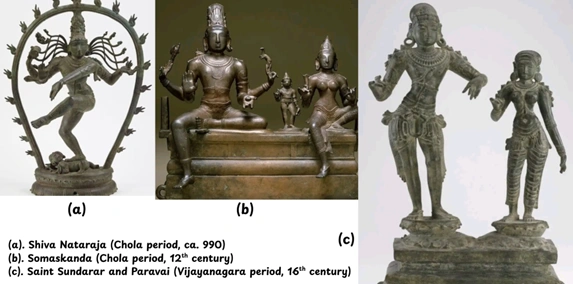
(a) Shiva Nataraja (Chola Period, ca. 990)
It is the most iconic representation of the metallurgical artistry and iconographic traditions of the Chola era. Shiva is depicted as the cosmic dancer surrounded by an aureole of fire, which is decorated with flames. Produced through the lost-wax casting technique, the bronze has well-refined proportions, a rhythmic stance, and other complicated features (the damaru, abhaya mudra, and the depiction of apasmara under the foot of Shiva), which all communicate a progressively ritual and theological meaning in South Indian Shaiva practice. As both a religious and aesthetic masterpiece, the sculpture has been of significance in academic research into Chola patronage, temple cults, and technical virtuosity, such as medieval South Indian foundries.
(b) Somaskanda (Chola Period, 12th Century)
The Somaskanda group, the group of Shiva, Parvati, and their son, Skanda, portray the sense of family and dynasty present in Chola temple art. Characterized by the balanced modelling and serene facial types, the bronze conveys the intimacy of the ritual and aristocratic support of the Shaiva school of thought. Also, the compositional clearness and the finishes on the surface provide irreplaceable testimony to workshop traditions and to establish the liturgical location in sanctum complexes and place the object in a fundamental role in the research of iconography continuity and local influence on style in later Chola metalwork.
(c) Saint Sundarar and Paravai (Vijayanagara Period, 16th Century)
The bronze echoes both the worship aesthetic of the Vijayanagara period and also its predilection for the Distribution of interests to the narrative of bhakti poets. It depicts Saint Sundarar, often shown with attendant, Paravai, in a manner of expressive realism and costume details characteristic of South Indian sculpture of the sixteenth century. Two aspects explicated by both the iconography and the pose of the work are the changing forms of saints' worship, of temple processions, and the relationship between literary hagiography and iconography. In turn, the statue can be viewed as an embodied medium that connects scholars with the modern networks of devotion, as well as artisans who were engaged in the practice of Vijayanagara polity.
|
Acquisition and Display of Bronzes
Previously, on display of the museum as one of the existing collections of these objects has been documented as removal from temple surroundings in Tamil Nadu, leading the museum to start negotiating their eventual return; one of the sculptures will remain on a long-term loan to enable public interpretation. The decision is consistent with the expected larger trends in repatriation hundreds of Indian artifacts have been handed back by the United States in recent years indicating that the institution has been changing to be much more open to restitution.
Decision to Return Bronzes by NMAA
The decision of the Smithsonian to repatriate the three South Indian bronzes is followed by provenance research, which demonstrated that there are inconsistent records on the acquisition of the three bronzes, promoting the re-evaluation of institutional ethics, legal requirements, and current international diplomacy.
Research Findings on Bronzes
When the systematic review of provenance carried out by the National Museum of Asian Art revealed discrepancies, disclosing that the bronzes were removed from the temple of Tamil Nadu, the museum began categorizing the objects as illicitly obtained and began negotiations to begin the process of their return. One Sculpture, the Shiva Nataraja of the Chola period, will be on long-term loan under a loan agreement with India, as paperwork and hand-over is in process.
Implications of NMAA’s decision
It specifies a tendency towards restitution around the world and institutional responsibility: within the past three years, in the United States alone, its repatriations to India are in the hundreds (297 items returned in 2024), demonstrating the accelerated movement of provenance and legal redress. This strengthens cultural diplomacy, hastens the process of provenance audits in museums, and heralds a new set of precedents in the matter of reconciling the interests of the populace and those of the rightful owners.
Conclusion
The big step in establishing Smithsonian will return three Indian bronzes after confirming their illicit removal. Here’s what the repatriation means for India’s cultural heritage provenance-based ethical standards and institutional responsibility since the repatriation of three South Indian bronze: Shiva Nataraja (Chola, ca. 990), Somaskanda (Chola, 12th century), and Saint Sundarar with Paravai (Vijayanagar, 16th century) sculptures by the Smithsonian has become a key confirmation. The admittance of documentary gaps and transfer of the objects into the cultural context enhances clear accounting of stewardship and, at the same time, enforces legal and moral precedents of any further collections.
The Smithsonian’s National Museum of Asian Art has announced that it will return three ancient bronze sculptures to India. The move comes after a multi-year provenance investigation confirmed that the artefacts had been illegally taken from temples in Tamil Nadu. This project highlights the necessity to conduct further provenance research, form joint alliances with the communities of origin, and to reformulate policies that properly balance between accessibility to the general public and ownership. The case progresses eventually to evolving standards in museum practice and bring to the broad efforts in the area of restorative cultural diplomacy.
Frequently Asked Questions (FAQ)
It is in the news because the Smithsonian’s National Museum of Asian Art has decided to return three sacred South Indian bronze sculptures that were illegally removed from temples in India.
The Smithsonian is repatriating three Indian bronzes after detailed provenance research confirmed that the sculptures were illegally removed from temples in Tamil Nadu and later entered museum collections.
The sculptures—Shiva Nataraja (Chola period, c. 990 CE), Somaskanda (Chola period, 12th century), and Saint Sundarar with Paravai (Vijayanagara period, 16th century)—reflect the exceptional craftsmanship of South Indian bronze casting. Originally, they were sacred icons, traditionally taken out in temple processions as objects of worship.
During the Chola period (9th–13th century CE), artisans created some of the finest bronze sculptures in Indian art history, primarily using the lost-wax (cire perdue) casting technique. These sculptures were mainly religious in nature and intended for temple worship and processions.
Test your understanding
Questions from this article
Prelims practiceWith reference to Three Indian Bronzes to be Returned by the Smithsonian, consider the following statements:
- The recent announcement by the National Museum of Asian Art of the Smithsonian, registering the repatriation of three historically important South Indian bronze sculptures, i.e.
- Shiva Nataraja, Somaskanda, and Saint Sundarar with Paravai, is based on an extensive provenance research that proved their fine illegitimate acquisition from temples of Tamil Nadu.
- This move is not only an indication of a strict adherence to ethical museum practices but also an affirmation of the need to have cultural heritage reclaimed in the Indian context.
View answer
Answer: 1, 2 and 3. The Smithsonian will return three Indian bronzes after confirming their illicit removal. Smithsonian National Museum of Asian Art NMAA has announced the return of three historic South Indian bronze figure to India. Here what the repatriation means for India cultural heritage.
Mains practiceExplain the key features of Three Indian Bronzes to be Returned by the Smithsonian and examine its significance, major issues and wider implications.
Answer in 250 words.
View answer approach
- Define and place Three Indian Bronzes to be Returned by the Smithsonian in context.
- Examine Why is the Smithsonian Institution giving bronzes back to India?.
- Examine The Bronzes and Their Position in NMAA Collections.
- Examine Change of Custodianship of bronze sculptures.
- Conclude with a balanced assessment and an appropriate way forward.
Frequently asked questionsFrequently asked questions
The Bronzes and Their Position in NMAA Collections?
Three South Indian bronzes, Shiva Nataraja, Somaskanda, and Saint Sundarar with Paravai, have long been features of the collections of the National Museum of Asian Art and have recently been reassessed with the occurrence of provenance anomalies. In early 2026, the Smithsonian’s National Museum of Asian Art (NMAA) announced that it would return three sacred South Indian bronze sculptures to India: a 10th-century Shiva Nataraja , a 12th-century Somaskanda , and a 16th-century Saint Sundarar with Paravai . Subsequent investigations established that these artefacts had been illegally removed from temples in Tamil Nadu.
Decision to Return Bronzes by NMAA?
The decision of the Smithsonian to repatriate the three South Indian bronzes is followed by provenance research, which demonstrated that there are inconsistent records on the acquisition of the three bronzes, promoting the re-evaluation of institutional ethics, legal requirements, and current international diplomacy.