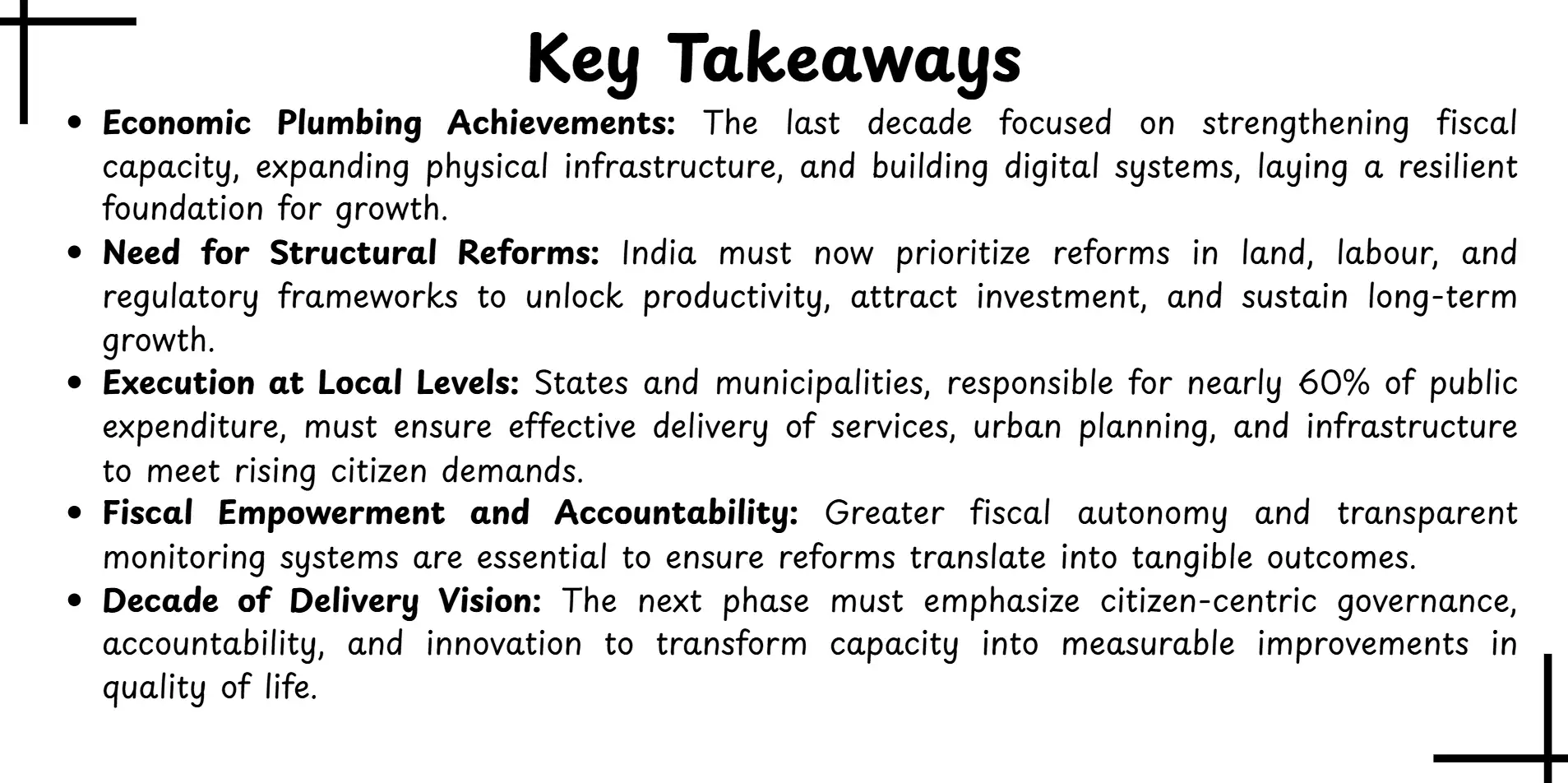
India in the last decade has focused on strengthening fiscal infrastructure, developing digital platforms, and increasing physical infrastructure, and now the need of the hour is to shift towards reforms and action. The importance of the given transition is connected with the fact that states and municipalities will easily provide results, making the institutional capacity turn into a more citizen-centred system of governance, responsibility, and development; thus, setting the next stage of the Indian development agenda.
|
Key highlights
- The Plumbing Decade of the Indian Economy
- Indian Digital Transformation
- India’s Economic Reforms Imperative
- Implementations at the Indian State & Municipal Levels
- Towards an Indian Decade of Delivery
- Citizen-Centric India
|
India experienced a positive development over the last ten years, characterised by the enhancement of capacity building factors, including, but not limited to, fiscal consolidation and online facilities, and the presence of massive physical projects in the country. All these measures are what can be described as the plumbing of the economy, which allows the economy to be resilient and efficient in governance. As the country is beginning a new stage of development, the priority should shift away from the creation of systems, but to the successful implementation of the initially created systems, marking the state and municipal levels in particular. This shift highlights the need to be accountable, institutionally innovative, and people-oriented in developing sustainable development.
The Plumbing Decade of the Indian Economy
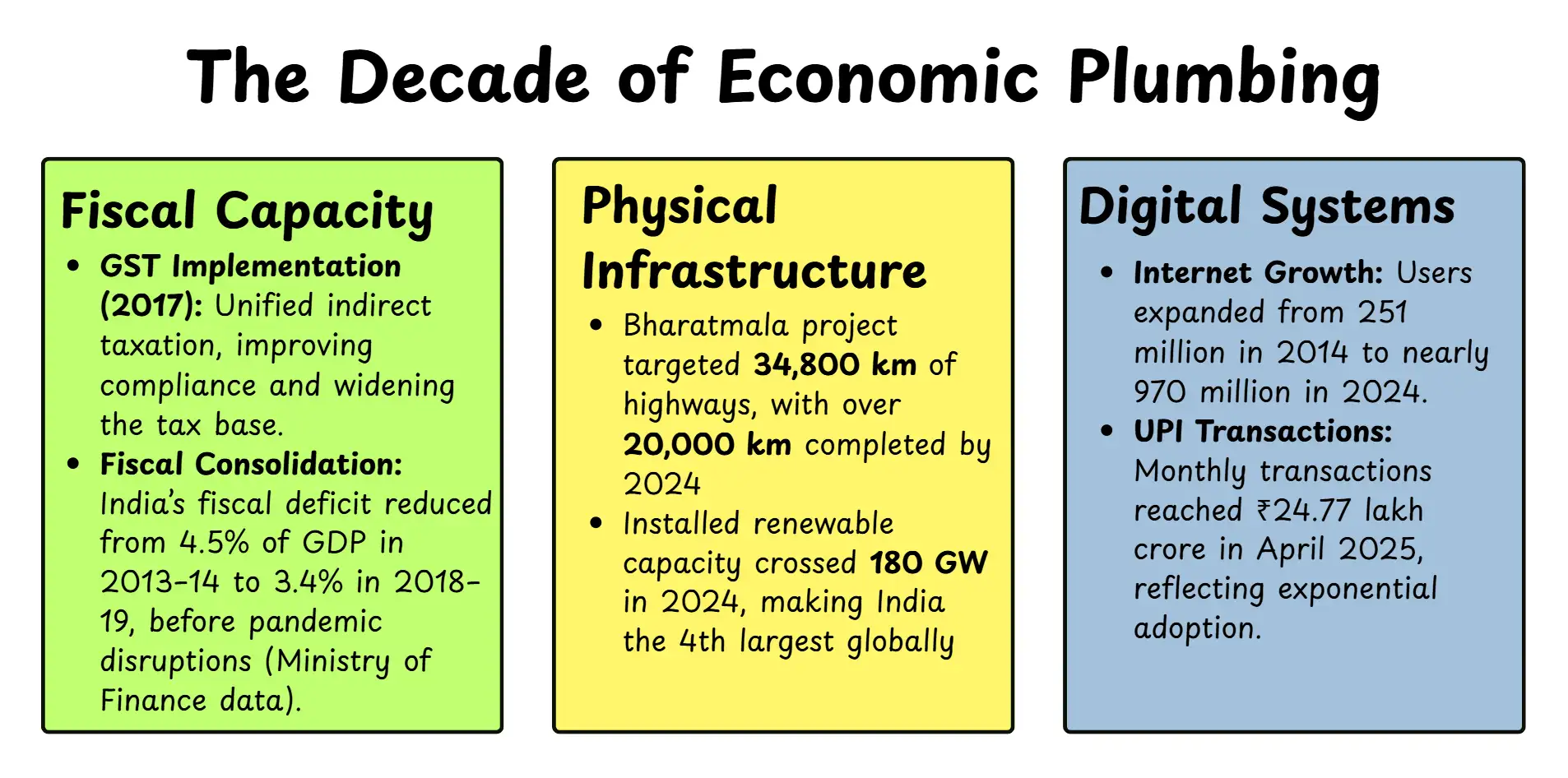
The previous 10 years of India were marked by reforms at the core level of the country: the increased fiscal potential, the development of infrastructure, and the implementation of digital processes, which created a basis of resilience and efficiency. This economic plumbing is what laid the foundation for the reforms which were to come.
Building Fiscal Capacity of the Indian Economy
Over the last ten years, India focused on the stabilisation of the fiscal structure. Indirect tax, like the Goods and Services tax (GST), was brought together, which enhanced compliance and collection of revenue. As a result of fiscal consolidation, the deficits were decreased, which allowed a large amount of state investment in infrastructure. These measures enhanced a more predictive business environment and increased the ability of the government to fund welfare and development programmes.
Expanding Physical Infrastructure in India
This was characterised by huge investment in roads, rail and energy systems. Barhatmala and Sagarmala initiatives increased the speed of connectivity, and the capacity of renewable energy reached over 180 GW by 2024, making India the energy powerhouse in the global arena. This type of expansion not only facilitates industrial growth but also enhances efficiency in logistics, thus leading to lower costs both to the businesses and the consumers.
Indian Digital Transformation
Indian Digital Initiative transformed governance and delivery of services. Internet subscriptions have increased from 251 million in 2014 to almost 970 million in 2024, and UPI transactions to 24.77 lakh Crore in April 2025. The availability of platforms like DigiLocker and UMANG increased accessibility to government services, which resulted in increased transparency and inclusion.
Last Decade of the Indian Economy
The ten-year foundation of economic plumbing resulted in resiliency, inclusion, and efficiency. India has developed the necessary base for the second step, such as structural reforms and steady activity, by combining fiscal discipline, infrastructure growth, and digital innovation.
India’s Economic Reforms Imperative
The further stage in the economic development of India requires a radical shift in the priorities of the capacity-building activities to the entire structure reformation process. The long-term growth and increased competition rely on the radical changes in land, labour regulations, and structures of governance.
Structural Reforms for the Indian Economy
The Economic Survey 2024-25 suggests that India has to achieve a more or less eight percent per annum growth rate in the next 20 years so as to become a developed-world country by 2047. This high-spur target will necessitate a radical change in the land procurement process, flexibility of labour and deregulations, thus opening up the production potential and inviting greater investments. Lacking these reforms, even the gains of infrastructure development and digital systems will stand still.
India Needs Labour and Enterprise Simplification
The deliberations on optimising labour laws and licensing processes have become critical issues of focus by policymakers in the recent past. The 2025 reform agenda focused on the rationalisation of regulations and the improvement of support systems of micro, small, and medium enterprises (MSMEs). These are meant to reduce red tape, enhance the growth of the formal sector and promote employment in different economic sectors.
Investment and Technologyare Imperative for India
The Economic Survey also emphasises that the levels of investment in India have to increase to 35 percent of gross domestic product, as compared to where it is at present, 31 percent of gross domestic product, to continue with the path of growth. This target requires reforms that motivate the accumulation of funds into the private sector and increase the scale of manufacturing capabilities, as well as introducing and implementing new technologies to the overall industrial policy arena, including artificial intelligence, robotics and biotechnology.
Indian Governance Reforms
Finally, it is necessary to introduce reforms that are more focused on outcome-based governance at the state and municipal levels. The rationalisation of institutions, easy accountability, and citizen-based delivery models will make sure that the policy changes are reflected in the concrete changes in the living standards, which will condition the direction of India's development throughout the decade.
Implementations at the Indian State & Municipal Levels
The course of development of India now needs an increased emphasis on implementation. Although the institution's capacity has been enhanced at the national level, the major challenge that remains is ensuring that the reforms are implemented at the state and municipal levels in order to ensure that the results are realised.
Decentralised Governance in Indian States
States and cities are the line arm of governance that has the responsibility of planning cities, sanitation, housing, and the provision of local infrastructure. This is highlighted in the Report on State Finances 2024 of the Reserve Bank of India, whereby it is noted that the subnational governments make about sixty percent of the total expenditure that is directed at the policy by the national government and this serves to illustrate the central position that the subnational governments play in converting national policy directives into service delivery that is centred to the people.
Indian Municipal Challenges
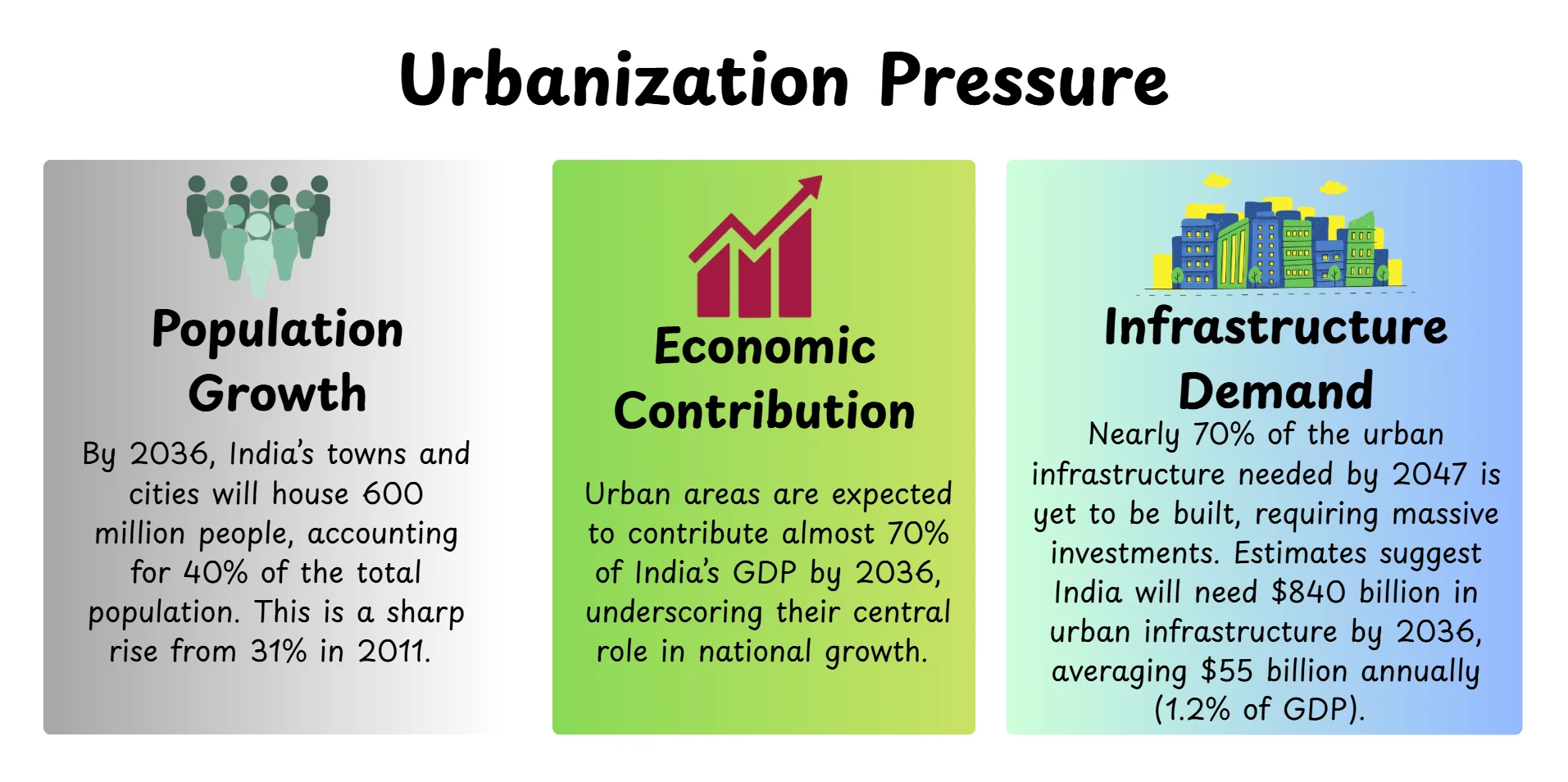
The urban population of India is expected to reach six hundred million by 2036 (UN World Urbanisation Prospects, 2024). This accelerated demographic growth exerts great strain on local governments to provide effective transportation and waste management systems and proper housing options. The next generation of challenges is an empowerment of municipal financial resources and administrative capacities in order to address these issues, since currently, various local authorities are experiencing challenges related to the lack of resources and the weakness of institutional structures.
Fiscal Empowerment of Indian Municipalities and States
The Fifteenth Finance Commission suggested a higher rate of fiscal transfer to the states and urban localities, with a great stress on expenditure accountability. Increased financial freedom, with open audit systems, would help to make sure that the funds allocated are spent wisely in infrastructural and welfare delivery.
Towards an Indian Decade of Delivery
The Indian economy has been at an economic crossroads. After consolidating financial strength, developing digital systems, and broadening physical infrastructures, the next decade needs to focus on delivering the visible results, which will ensure that the changes implemented will result in tangible gains to the people.
Moving India from Capacity to Outcomes
According to the Economic Survey 2024-25, the major issue faced by India is no longer capacity creation but how to optimise its use. The redirection of attention to ensuring that these funds are yielding visible returns in terms of employment, productivity and welfare is required by public investment that has risen to 11.8% of GDP in 2024-25.
India Needs to Focus on Governance
Accountability and Governance,the good governance delivery depends on the accountability of the institutions. The outcomes-based, cross-state monitoring, and urban infrastructures stand as the key areas of the 2024 State of Governance Report by NITI Aayog to seal gaps in the areas of education, healthcare, and urban environments. Clear appraisal systems that are supplemented with citizen feedback systems can be used as a guarantee that reforms are implemented with effectiveness other than just being promulgated.
Technology as Indian Growth Enabler
UPI, DigiLocker, and PM Gati Shakti can be considered as tools of implementation. As it was in April 2025, UPI transactions were higher than 24.77 lakh crore, which depicts the ability of technology to expand the scale of service delivery in curbing fiscal leakages.
Citizen-Centric India
The decade of delivery must be based on inclusive results, which would include city resilience, rural transformation, and fairly distributed access to essential services. On account of the ability to merge fiscal empowerment, institutional accountability, and technological innovation, India can benchmark reforms into verifiable quality of life improvements, and thus move on the path of sustainable development.
Conclusion
Finally, the deliberate emphasis on strengthening fiscal power, the development of the digital environment, and the modernisation of the physical infrastructure throughout the past decade has empowered India with a solid base. The next decade should be marked with wholesome reforms and strict adherence to their application, particularly at the subnational levels of governance. Effectiveness in service delivery, high levels of accountability, and results that focus on the citizens will be critical to transforming structural capacity to quantifiable development. India can ensure a sustained, inclusive, and strategy-oriented developmental thrust through the alignment of institutional reforms with technology and fiscal empowerment, which would sustainably drive the country to long-term national development.