In 2025, India saw a strong revival of the cooperative movement under the theme “Sahkar Se Samriddhi” (Prosperity through Cooperation). The Ministry of Cooperation led this effort to make cooperatives more modern, transparent, and effective so they could play a bigger role in economic development. Coinciding with the United Nations declaring 2025 as the International Year of Cooperatives (IYC), the government implemented major policy reforms, including the National Cooperative Policy 2025, to empower rural communities and align with the "Viksit Bharat 2047" vision.
|
Key highlights
- International Year of Cooperatives
- Indian Cooperative Movement
- Scale and Reach of Cooperatives
- Key Achievements of Cooperatives
- National Level Initiatives
- Financial and Policy Support
|
In 2025, the United Nations has proclaimed the “International Year of Cooperatives” with the theme“Cooperatives Build a Better World”. Special attention to the large system of cooperative infrastructure in India, recent reforms, and policy initiatives make this announcement significant in the context of modern policy discourse.
The recent move by the United Nations has marked 2025 as the International Year of Cooperatives with a theme of“Cooperatives Build a Better World” that affirms the global popularity of the collective economic model. At the vanguard of this movement is India, which has a robust system of cooperatives which includes more than 8.5 lakh societies and 32 crore members. Based on the philosophy of Sahkar Se Samriddhi, the cooperative sector has traditionally propelled rural development, monetary inclusion and female empowerment. New reforms, such as the digitalisation of Primary Agricultural Credit Societies and the creation of national-level cooperative institutions, demonstrate the interest that the Indian government has in making this sector a force to promote inclusive and sustainable growth.
History of Indian Cooperative Movement
The Indian cooperative movement has transformed into an introduction to the rural indebtedness and socio-economic problems, which have been slowly institutionalised in legislation and policy reform. Its path shows both indigenous practice and interventions by the colonialists.
Early Aboriginal practices of cooperatives
Collective management of resources (often done in the form of pooling) was practised in the Indian villages long before they were formally codified, like in the Devarai forests. These models that were community-based were practised to incorporate cooperation in farming and water distribution, which formed the foundations of later institutional frameworks.
Cooperative:Colonial Legislation
The first legal framework was the Cooperative Credit Societies Act of 1904, which was introduced following suggestions by a British officer called Fredric Nicholson. In 1904, the Tirur Cooperative Society in Tamil Nadu became the first cooperative to be registered in Asia.
Growth and Merger of Indian Cooperatives
Later legislations such as the Cooperative Societies Act of 1912, widened the scope even further to include production and marketing. By independence, cooperatives had become critical in overcoming the credit shortages in the rural areas, and in promoting collective resilience.
Scale and Reach of India Cooperatives
The cooperative sector of India is very extensive and inclusive, being one of the biggest shared economic systems in the world. The size of it determines continuity of the past and its current changes with the purpose to enhance the involvement of the grassroots.
Indian cooperatives & its Expansion
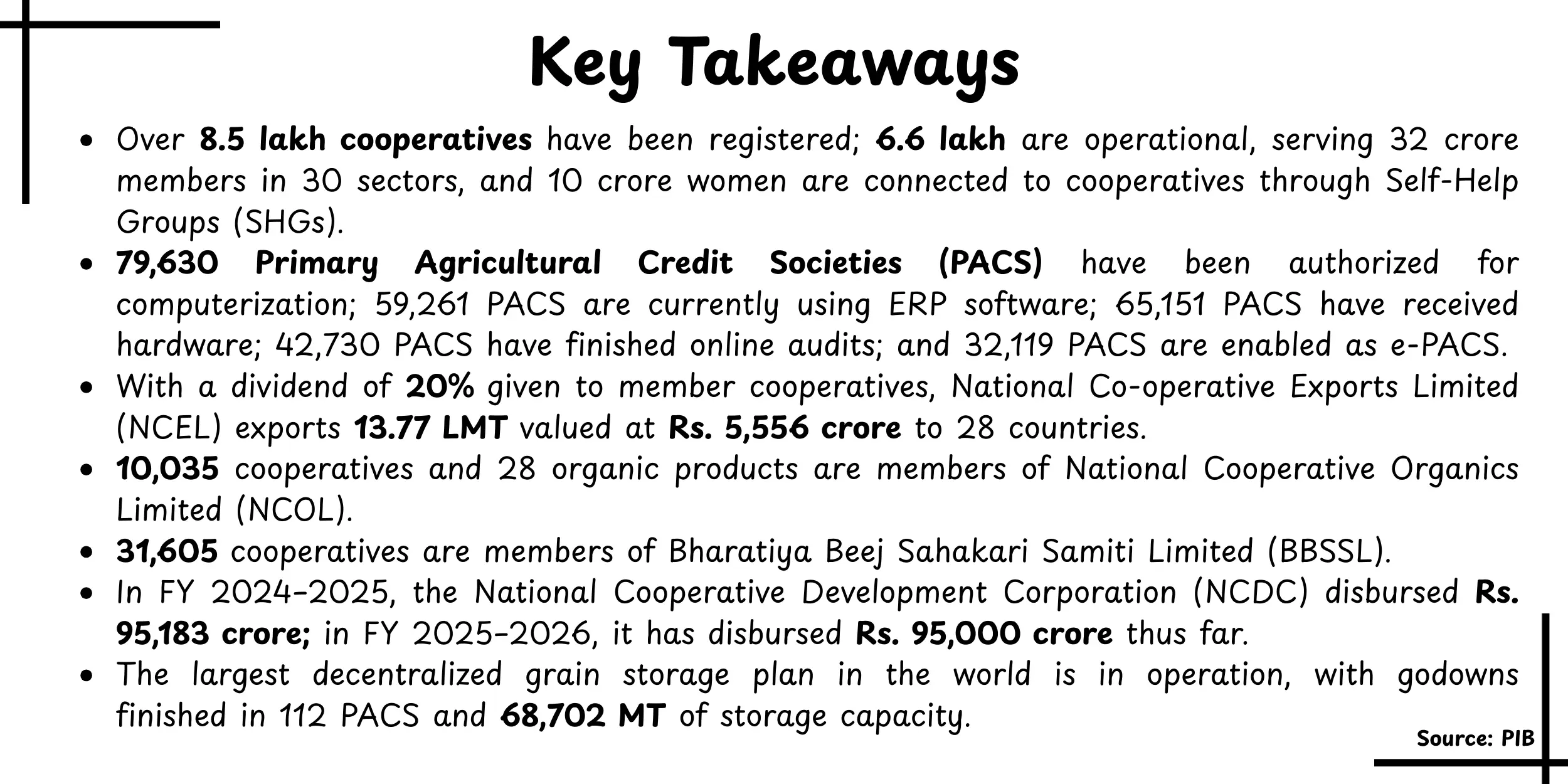
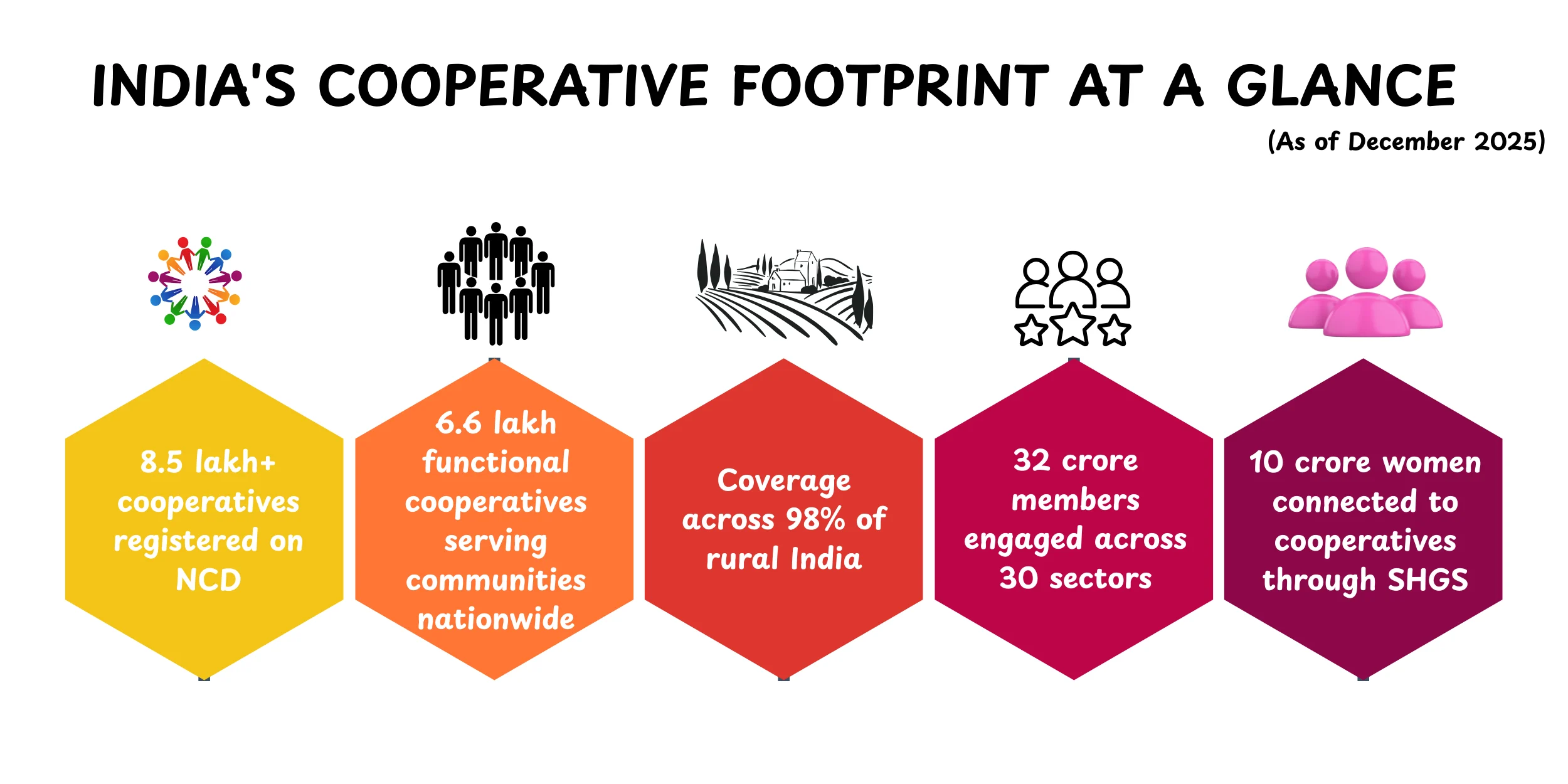
India has more than 8.5 lakh registered cooperatives, out of which 6.6 lakh cooperatives are operational and cater to 32 crores members in various industries, including agriculture, dairy, fisheries, housing, and consumer services. This large membership base delineates the capacity of the model of the cooperative to induce the rural and urban people into organised economic participation.
Women Participation in Cooperatives
One such dimension of this reach is gender inclusiveness. As many as 10 crore women are associated with cooperatives by way of Self-Help Groups (SHGs), resulting in greater financial literacy and social empowerment. This involvement emphasises cooperatives as a tool of equity, which has the level of sealing inequality and helping the community to become more resilient.
Integration of the Tech in Cooperatives
The digitalisation of the cooperative network is also going on very fast. There are 79,630 Primary Agricultural Credit Societies (PACS) with approved computerisation, and 59,261 already using ERP systems. Also, 32,119 PACS have shifted to e-PACS, which makes rural credit delivery transparent and efficiency-based.
Key Achievements of the Indian Cooperative Sector
The cooperative sector in India has reported much success in the past years, which influences how the given sector is witnessing a transition into a modern, inclusive, and technology-driven system. These achievements show their contribution to the rural development, financial empowerment and development of the national economy.
1. Digitalisation of PACS
One of the great accomplishments is the computerisation of Primary Agriculture Credit Societies (PACS). Among 79,630 PACS licensed, 59,261 of these have implemented ERP systems, and 32,119 are already shifted to e-PACS, which ensure that transparency, efficiencies, and accountability in delivering rural credit have been attained.
2. Expansion of Cooperatives in Multiple Sectors
Cooperatives have now grown to include dairy, fisheries, housing and consumer services in addition to credit. Examples of hugely successful cooperatives in the farm and other industries include Amul, IFFCO, and KRIBHCO, which have tremendously helped in food security and provided jobs in rural areas.
3. Women Empowerment in Cooperatives
This is achieved by more than ten crore women through stronger financial structures and social equity in Self-Help Groups (SHGs). This achievement highlights why cooperatives have the capability to overcome some of the gender proxemics to enhance community resilience.
4. National-Level Cooperative Institutions
New ventures such as the introduction of National Cooperative Exports Limited (NCEL), National Cooperative Organics Limited (NCOL), Bharat Bhandaran and Storage Seed Ltd (BBSSL) are new combinations. The goals of these institutions are to increase exports and to increase organic farming and seed security.
5. Policy and Financial Support for Cooperatives
The National Cooperation Policy 2025 focuses on strengthening the profit-oriented changes in law, digital, and inclusivity, that is, cooperatives can be the engines of Viksit Bharat 2047. Their achievements are further amalgamated by financial support, such as the NCDC and tax incentives.
National‑Level Initiatives in the Cooperative Sector
The cooperative movement in India has improved with a number of activities on the national level aimed at modernising the operations, increasing market penetration and enhancing institutional capacity. Such steps mirror the intention of the government towards inclusive and sustainable development.
Market and Export Integration under Cooperatives
National Cooperative Exports Limited (NCEL) has allowed cooperatives to enter the international market directly. NCEL is increasing the competitiveness of small producers by combining their products and making sure that they get decent returns. This project is in line with the vision of India that cooperatives would be used as drivers of rural development.
National Cooperative Organic Limited
The establishment of National Cooperative Organic Limited (NCOL) fosters the use of organic farming methods, thus certifying and creating market connections to farmers. Equally, seed storage and distribution are enhanced by Bharat Bhandaran and Storage Seed Limited (BBSSL), which protects agricultural resilience. These organisations fill important gaps in sustainable food and agriculture.
Research and Education in Cooperatives
A proposed National Cooperative University is intended to train and study cooperative management on a specialised basis. Moreover, the emerging and new initiatives like Sahakar Taxi Cooperative give an emphasis to diversification in the service sector, which increases employment and cooperative presence in the urban settings.

Financial & Policy Support in the Cooperative Sector
The issue of finance and policy support has played a key role in developing the sphere of cooperation in India, making it sustainable, inclusive, and resilient. The measures reveal how the government is interested in empowering the grassroots institutions.
Financial Assistance for Cooperatives
The National Cooperative Development Corporation (NCDC) has been critical through the provision of concessional loans and grants to cooperatives in the areas of agriculture, dairy, fisheries, and housing. This modifies its official data to state that in 2024-25, NCDC has disbursed a total of INR 65,183 crore to fortify cooperative infrastructure, which will be capable of facilitating the modernisation and growth of services.
Cooperative Policy Framework
The National Cooperative Policy 2025 focuses on the need to be digital, transparent, and inclusive. It incorporates cooperatives into the national programmes like Atmanirbhar Bharat and PM -Kisan Samriddhi Kendras. Fiscal relief packages, such as lowered surcharge rates on cooperative communities, contribute to the financial sustainability.
Strengthening Institutional Cooperatives
Implementation of a Cooperative Ranking Framework helps to provide accountability and competitiveness between societies. Together with digital transformations on the basis of ERP-based PACS, these policies enhance efficiency, inclusivity, and alignment with the vision of Viksit Bharat 2047 of India.
Conclusion
To summarise, the cooperative movement in India is a case of salient case study where we find the efficacy of joint action in achieving the goals of inclusive development, rural resilience, and sustainable development.It covers a total of 8.5 lakh societies with 32 crore members, which testifies to its ongoing historical presence as well as current innovation. New reforms recently implemented include digitalisation of PACS, building institutions on the national level, and policy frameworks that support cooperatives, which make them indispensable instruments of the realisation of Viksit Bharat 2047. Since 2025 is proclaimed the International Year of Cooperatives, the model of India provides an internationally applicable way to fair prosperity.