The India Middle East–Europe Economic Corridor (IMEC) is a proposed, transformative multinational infrastructure project launched on September 9, 2023, aimed at enhancing trade, digital connectivity, and clean energy integration across Asia, the Middle East, and Europe.
The India Middle East Europe Economic Corridor is a pioneer initiative that aims to change how trade and connectivity work across three major regions of the world. It is designed as a modern economic bridge which connects India to Europe through the Middle East using a network of ports, railways, energy pipelines and digital infrastructure. Instead of relying only on long and congested sea routes, this corridor offers a faster and more efficient way to move goods, data and resources across continents. The IMEC corridor brings together countries with shared economic interests to strengthen supply chains, reduce transportation costs and encourage sustainable development. The corridor can boost trade, attract investment and create jobs, especially through cleaner routes.
IMEC also highlights a shift in global thinking. In a world shaped by geopolitical tensions and supply chain disruptions, countries are looking for reliable and resilient connectivity alternatives. This corridor builds trust, long term economic partnerships and shared growth. If implemented successfully, the IMEC Corridor can transform global trade routes and play a very important role in enhancing India’s foreign trade ventures.
What is the India Middle East Europe Economic Corridor?
The India-Middle East-Europe Economic Corridor is a massive infrastructure project launched at the 2023 G20 Summit. It aims to create an uninterrupted trade route linking India, the Arabian Peninsula and Europe via sea and rail. It also includes energy and digital networks, promising faster and cheaper trade while countering other initiatives like China's Belt and Road. The IMEC involves ports, high speed railways, electricity cables and hydrogen pipelines which connect India to the UAE, Saudi Arabia, Jordan, Israel, Greece, and Europe. This reduces transit times and costs to a large extent.
Key Components and Structure
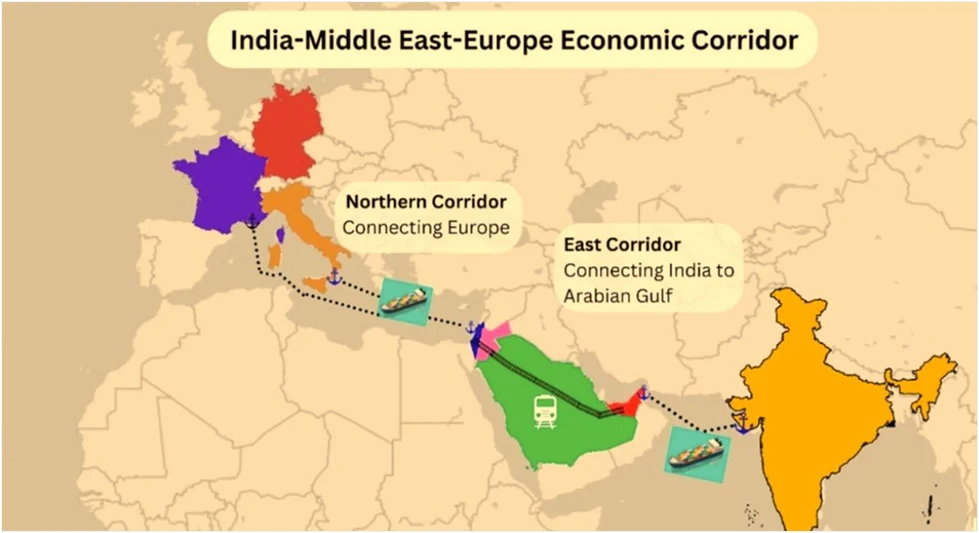
The IMEC project is structured around two distinct corridors linking eight major economic stakeholders.
Eastern Corridor: Connects India through key ports such as Mundra and Mumbai to the Arabian Gulf via the UAE, with onward connectivity to Saudi Arabia and Jordan.
Northern Corridor: Northern Corridor: Connects to the Arabian Gulf region, particularly Saudi Arabia and Jordan, to Europe through Israel via rail, extending to the port of Haifa and subsequently connecting by sea to major European ports such as Piraeus in Greece.
Significance of IMEC Corridor
The IMEC corridor is a connectivity project launched at the 2023 G20 Summit to link India, the Arabian Peninsula and Europe through railways, ship networks and pipelines. It plays a very important role in cutting trade transit times by up to 40%, saving costs and resources. It offers a strategic alternative to China's BRI.
Economic and Logistics Efficiency
The IMEC corridor is expected to reduce logistics costs by 30% and transportation time by 40% which will enhance supply chain resilience. This will automatically increase the economic and logistic efficiency by transporting commodities faster and in a more easy manner.
Strategic Geopolitics
The IMEC corridor serves as a counter to China's Belt and Road initiative and offers a faster, more safe trade route, reducing reliance on the vulnerable Suez Canal, particularly during geopolitical crises and war.
Infrastructure and Digital Connectivity
The initiative focuses on building railways, ports, energy pipelines for green hydrogen, and high speed data cables. This will enhance speedy connectivity and ensure faster transfer of committees and data between India, Middle East and Europe.
Energy and Digital Integratio
It strengthens ties with the Middle East for energy security, facilitating the transition to low carbon economies through green hydrogen and integrated electricity grids. The corridor aims to create a high-speed digital network between India, the Middle East and Europe enhancing data flow and financial connectivity between the regions.
Regional Stability
By connecting India with UAE, Saudi Arabia, Jordan and Israel, it aims to foster economic cooperation, normalizing relations in the region which often get disrupted due to geopolitical instabilities. The IMEC corridor is a good way to strengthen diplomatic ties and is also known as the ‘corridor of peace’.
Significance of IMEC Corridor for India
The IMEC corridor helps India reduce its heavy dependence on the Suez Canal by creating an alternative trade route to Europe via the Middle East. This became especially important during the Red Sea crisis of 2023-24, when Houthi attacks disrupted commercial shipping and caused delays. By offering a more secure and safe route, IMEC is expected to cut travel time by up to 40% and reduce logistics costs by about 30%, which will directly benefit Indian exporters.
The corridor will also improve the efficiency of India's west coast ports, such as Mumbai and Mundra, by linking them more closely with Gulf and Mediterranean trade routes. In fact, better connectivity with Europe through IMEC can help India move beyond low value work and play a bigger role in high value manufacturing and services within the global value chain system.
What are the Obstacles in the Progress of the IMEC Corridor?
The IMEC corridor faces several obstacles such as the intense geopolitical instability in West Asia along with the Gaza conflict. The corridor also faces challenges in terms of immense infrastructure funding needs, logistical gaps in rail networks and competition from existing maritime routes like the Suez Canal. Let’s take a look at the obstacles in the progress of the IMEC corridor.
Geopolitical Instability
The ongoing Israel Gaza war conflict has stalled diplomatic progress, particularly in Saudi-Israel normalization and Jordan-Israel relations. Increased hostilities in Yemen, Lebanon and risks to maritime security in the Red Sea pose significant safety risks.
Infrastructure and Technical Gaps
Significant investments are needed to bridge missing rail links between Jordan, Saudi Arabia and Israel along with upgrading the port infrastructure to improve the efficiency of connectivity between the regions. To solve all the technical gaps, a lot of investments are required.
Exclusion of Regional Powers
Major regional powers like Turkey, Egypt and Iran are excluded from the initiative, creating potential for opposition or the development of rival corridors. This can create a situation where the rival corridor can end up interrupting the functioning of the IMEC corridor.
Logistical Competition and Coordination
The established Suez Canal route remains more cost-effective, whereas, IMEC seeks to provide a more efficient, secure, and sustainable alternative to current trade routes. Exclusion of regional powers such as Egypt and Turkey might create competition and IMEC may need to prove its superior value proposition.
Which Ports are Part of IMEC?
The IMEC route connects major ports across India, the Middle East and Europe. In India, important ports include Mundra and Kandla in Gujarat and Jawaharlal Nehru Port Trust near Mumbai. In the Middle East, the IMEC corridor uses ports such as Fujairah, Jebel Ali and Abu Dhabi in the UAE. In Saudi Arabia, the corridor uses ports such as Dammam and Ras Al Khair in Saudi Arabia. Israel’s Haifa port is also an important link in the route. On the European side, major ports include Piraeus in Greece, Messina in southern Italy and Marseille in France. In the IMEC corridor, a dedicated railway line will connect Fujairah port in the UAE to Haifa port in Israel,enabling faster and smoother movement of goods.
Importance of IMEC for India in Reducing Choke Point Risks
The IMEC corridor is very important for India in reducing chokepoint risks, specifically the Suez Canal and Red Sea bottlenecks by providing a faster, 40% shorter, and 20-30% more cost effective alternative route for trade activities. It also enhances strategic energy security and boosts logistics efficiency via combined sea and rail infrastructure. Let’s understand the importance of IMEC for India in reducing chokepoint risks.
Suez Canal Blockage (2021)
India-Middle East-Europe Economic Corridor (IMEC), unveiled at the 2023 G20 Summit, is of paramount importance to India as a strategic, multi-modal connectivity initiative designed to diversify trade routes and reduce reliance on vulnerable maritime chokepoints, particularly the Suez Canal. The Suez Canal was blocked by a massive container ship, leaving hundreds of vessels stranded and disrupting nearly 12 percent of global trade until a major operation was conducted to clear the route. This created a lot of difficulty in Indian foreign trade activities at that time.
Red Sea Crisis (2023–24)
Attacks by the Houthis on commercial shipping highlighted the risks of relying heavily on a single trade route. Nearly one fourth of India’s cargo passing through the Red Sea faced delays due to the attack. Many ships had to reroute which added over a week of extra travel time.
Impact on India-European Trade
As most Indian-European trade depends on the Red Sea and Suez Canal corridor, many Indian exporters held back shipments in the last quarter of 2023-24, leading to a decline in India’s foreign trade. This created a need to think about more efficient ways of connectivity.
India’s Foreign Trade Vulnerability
The EU accounts for over 12 percent of India’s total merchandise trade, making disruptions in this route a serious concern for Indian foreign trade activities. The IMEC corridor directly addresses this structural risk by diversifying trade routes. It is designed to provide a more efficient alternative to existing corridors like the Suez Canal and the North-South Corridor.
India’s Perspective
For India, the IMEC corridor is a practical strategy for economic risk management through trade route diversification. It also strengthens ties with the countries in the middle east such as UAE and Saudi Arabia. The IMEC corridor is expected to boost India’s export by 8%.
Conclusion
The IMEC corridor is an initiative to connect India, Middle East and Europe using a network of ports, railways, energy pipelines and digital infrastructure. All the three regions have shared economic interests to strengthen supply chains, reduce transportation costs and encourage sustainable development. The corridor can boost foreign trade, attract investment and create jobs, especially through cleaner routes. The IMEC corridor aims to create more efficient connectivity routes and not replace the existing routes such as Suez Canal aorth-South Corridor. However, significant investment is required to fulfil the IMEC corridor project and challenges like rival corridors also exist.
Frequently Asked Questions (FAQs)
The India–Middle East–Europe Economic Corridor (IMEC), also known as IMEEC, is a proposed economic corridor intended to boost economic development by enhancing connectivity and economic integration across Asia, the Persian Gulf, and Europe.
IMEC aims to build an integrated network of ports, railways, roads, sea routes, and pipelines to facilitate smoother and more efficient trade linking India, the Arabian Peninsula, the Mediterranean region, and Europe.
The corridor is proposed as a trade route connecting India to Europe via the United Arab Emirates, Saudi Arabia, Israel, and Greece, drawing inspiration from what is now referred to as the ancient Golden Road.
The India–Middle East–Europe Economic Corridor (IMEC), also known as IMEEC, is a proposed economic corridor designed to promote economic growth by strengthening connectivity and integration across Asia, the Persian Gulf, and Europe.
The India–Middle East–Europe Economic Corridor (IMEC) was launched at the G20 Leaders’ Summit in New Delhi on 9 September 2023, with a Memorandum of Understanding (MoU) signed by the leaders of India, the United States, Saudi Arabia, the United Arab Emirates, France, Germany, Italy, and the European Union.
Frequently asked questionsFrequently asked questions
What is the India Middle East Europe Economic Corridor?
The India-Middle East-Europe Economic Corridor is a massive infrastructure project launched at the 2023 G20 Summit. It aims to create an uninterrupted trade route linking India, the Arabian Peninsula and Europe via sea and rail. It also includes energy and digital networks, promising faster and cheaper trade while countering other initiatives like China's Belt and Road. The IMEC involves ports, high speed railways, electricity cables and hydrogen pipelines which connect India to the UAE, Saudi Arabia, Jordan, Israel, Greece, and Europe. This reduces transit times and costs to a large extent.
Significance of IMEC Corridor?
The IMEC corridor is a connectivity project launched at the 2023 G20 Summit to link India, the Arabian Peninsula and Europe through railways, ship networks and pipelines. It plays a very important role in cutting trade transit times by up to 40%, saving costs and resources. It offers a strategic alternative to China's BRI.
Significance of IMEC Corridor for India?
The IMEC corridor helps India reduce its heavy dependence on the Suez Canal by creating an alternative trade route to Europe via the Middle East. This became especially important during the Red Sea crisis of 2023-24, when Houthi attacks disrupted commercial shipping and caused delays. By offering a more secure and safe route, IMEC is expected to cut travel time by up to 40% and reduce logistics costs by about 30%, which will directly benefit Indian exporters.
What are the Obstacles in the Progress of the IMEC Corridor?
The IMEC corridor faces several obstacles such as the intense geopolitical instability in West Asia along with the Gaza conflict. The corridor also faces challenges in terms of immense infrastructure funding needs, logistical gaps in rail networks and competition from existing maritime routes like the Suez Canal. Let’s take a look at the obstacles in the progress of the IMEC corridor.
Which Ports are Part of IMEC?
The IMEC route connects major ports across India, the Middle East and Europe. In India, important ports include Mundra and Kandla in Gujarat and Jawaharlal Nehru Port Trust near Mumbai. In the Middle East, the IMEC corridor uses ports such as Fujairah, Jebel Ali and Abu Dhabi in the UAE. In Saudi Arabia, the corridor uses ports such as Dammam and Ras Al Khair in Saudi Arabia. Israel’s Haifa port is also an important link in the route. On the European side, major ports include Piraeus in Greece, Messina in southern Italy and Marseille in France. In the IMEC corridor, a dedicated railway line will connect Fujairah port in the UAE to Haifa port in Israel,enabling faster and smoother movement of goods.