Established in 2023, Sarvam AI is an Indian artificial intelligence company headquartered in Bengaluru, Karnataka. Sarvam AI is leading India's Sovereign AI movement by developing a full-stack, indigenous artificial intelligence ecosystem. Selected as a key partner under the India AI Mission.
|
Key Highlights
- Sarvam AI
- Building Indian Indigenous AI
- Foundational Capabilities of Sarvam AI
- Full-Stack Sovereign AI Ecosystem
- Strategic Alliances in the Delivery of Public Services
- UIDAI Collaboration with Sarvam AI
|
Sarvam AI is build up India’s self-reliance with local multilingual AI models built for Bharat diverse languages. Sarvam AI has come into the limelight as one of the selected projects in the India AI Mission to generate localised foundational models, with a budget of ₹246.72 crore. Its critical multilingual sovereign AI ecosystem enables India to be self-reliant in digital usage, cutting-edge reliance on external systems, and enhancing its citizen-centric applications by broader inclusion and prioritising the national priorities. The decision in favour of the autonomy of technology in India has placed Sarvam AI at the centre of national discussion concerning artificial intelligence. As a spin-off of the IndiaAI Mission, Sarvam AI is a model of an attempted strategic project to build resident indigenous multilingual and citizen-focused AI schemes that reduce dependencies on foreign systems. The customisation of foundational models to the Indian languages and governance environments makes it stronger on digital self-reliance, accessibility and matches technology innovation with adjacent national interests.
Sarvam AI is an Indian artificial intelligence company headquartered in Bengaluru, Karnataka established in 2023. Sarvam AI is leading India's Sovereign AI movement by developing a full-stack, indigenous artificial intelligence ecosystem. Selected as a key partner under the India AI Mission. Sarvam AI is build up India’s self-reliance with local multilingual AI models built for Bharat diverse languages.
Indigenous Building Techniques across Regions of South Asia
Building indigenous Indian systems whether in architecture or technology—requires embracing sustainable, locally rooted practices that honor traditional knowledge and environmental context. This includes the use of natural materials such as mud, bamboo, lime, and stone, often informed by the principles of Vastu Shastra, to design environmentally responsible and climate-sensitive structures. The process of digital transformation in India is becoming more and more dependent on artificial intelligence systems that are locally created to capture its linguistic diversity and socioeconomic realities and priorities in governance.
Digital Control and Self-Resilience through Sarvam AI
Creating native AI is not an ordinary piece of technology, but it is an objective. Training models on local worlds and Indian languages, India preserves its freedom in the most essential areas like the government, healthcare and citizenship. This will limit reliance on the international platforms and make innovation nationally focused. Studies have shown that sovereign AI models are essential in ensuring fair access, distinctiveness, and robustness in emerging markets.
Basic Models for Indian
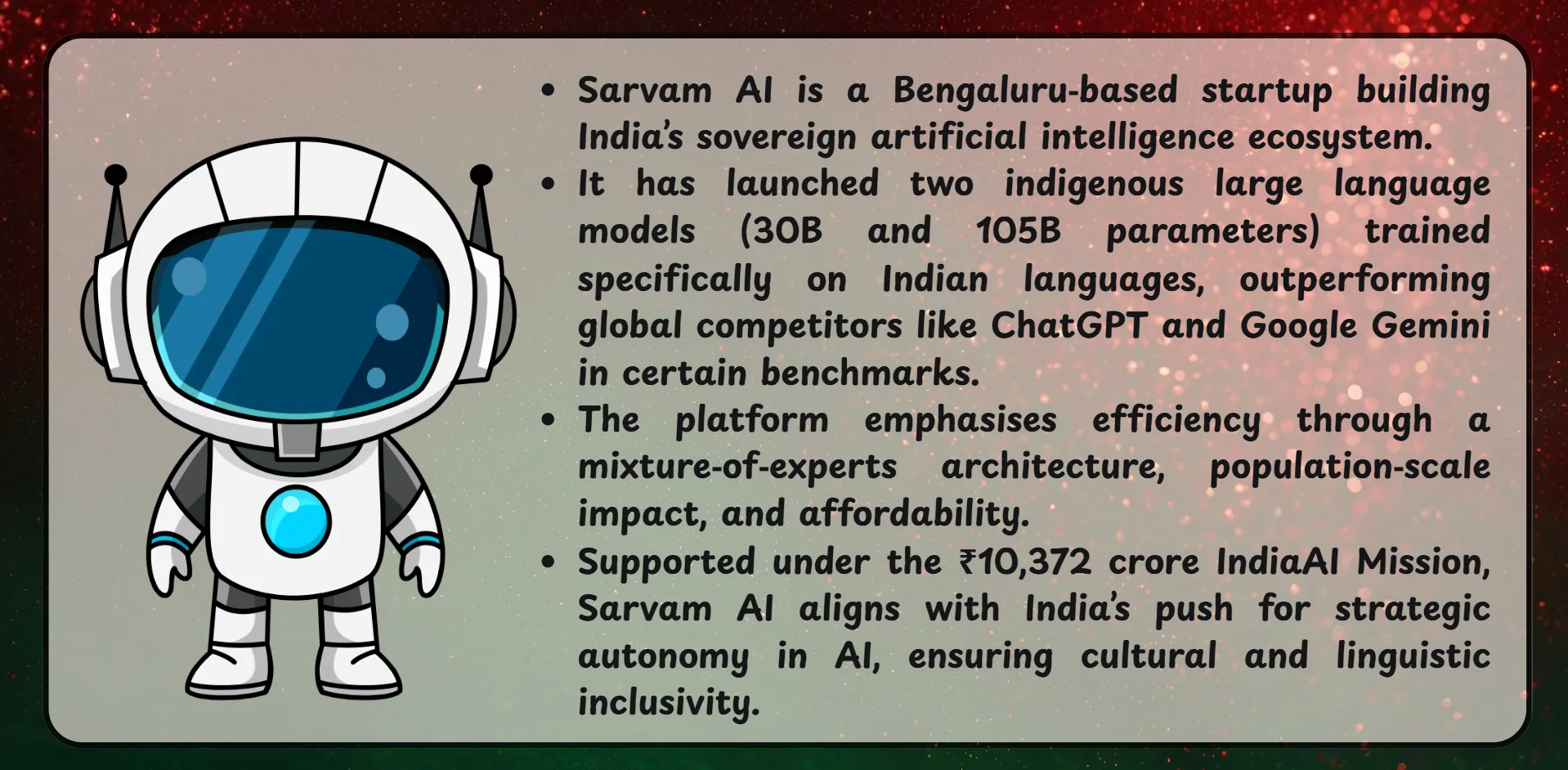
Sarvam AI has launched large-language systems like Sarvam 30B and Sarvam 105B, which have been designed to be deployed in a multilingual mode in government and enterprise applications. These models facilitate 22 scheduled languages and deal with such complications as mixed syntax and handwriting recognition. Their implementation of inclusivity in architecture results in increased accessibility for various people and augments the goals of the vision of India as a digital, self-reliant, inclusive, and growing nation.
Foundational Capabilities of Sarvam AI
The artificial intelligence path of India is stretched more by local foundational models that would deal with the language diversity and accessibility issues. The Sarvam AI, which is funded through the India AI Mission with INR 246.72 crore of compute infrastructures, is an up-and-coming language and speech technologies with an Indian context oriented technologies.
Bulbul: Text-to-Speech Innovation
Bulbul is a multilingual text-to-speech system that can work in eleven Indian languages and has forty-nine separate voices of the speakers. It enables natural and culturally competent communication in the provision of citizen services, thus being inclusive of the heterogeneous populations. These systems are required to bridge each digital divide in multilingual societies.
Saaras: Speech-to-Text for the Indian Realities
Saaras also adapted all twenty-two scheduled languages, including 8 kHz telephony audio and speech mix. This is an important feature of any governance or enterprise application where citizens often have mixed scripts and dialects. It has been shown that speech-to-text models fed with local data can improve the accuracy in a multilingual setup by deciphering the system significantly.
Vision: for Document Understanding
Vision can process twenty-two or more Indian languages, mixed scripts, and handwritten text. This model improves the processing of documents in the areas of governance, education, and enterprise to provide the accessibility of the model to millions of citizens. Vision makes India empower itself digitally by integrating inclusivity in its design.
Full-Stack Sovereign AI Ecosystem
The AI aspirations of India are based on the development of a sovereign ecosystem that incorporates both infrastructure and foundational models in addition to real-world applications. In the example of Sarvam AI, an end-to-end stack is developed in India and, therefore, guarantees technological self-sufficiency and national interests.
Sarvam for Conversations
This is an enterprise-level conversational AI providing human-like, culture-fluent voice in eleven Indian languages. It can handle more than a hundred million interactions with less than five hundred milliseconds of latency, which means that it is both scalable and efficient with citizen services and enterprise applications.
Sarvam for Work
Sarvam for Work is a single platform enterprise AI used to speed up productivity by an AI-assisted build-debug-optimize-cycle. Its modular architecture allows it to be integrated smoothly with various models, data sources, and infrastructures, which in turn enables organizations to innovate without foreign systems.
Sarvam AI for Content
The ability facilitates multilingual video dubbing, cloning of voice, and translation of documents without loss of layout and tone. Inbuilt quality review tools make it accurate and hence educational, governing, and localizing the media.
Sarvam AI for Edge intelligence
This system uses cloud and edge inference together, which enables real-time assistants, on-device natural language processing, and speedy translation. This small, low-latency deployment is very important in rural and remote settings, hence reinforcing inclusiveness in India.
Strategic Alliances in the Delivery of Public Services
Institutional partnerships to entrench an artificial intelligence (AI) in India, with indigenous innovation in governance and citizen services, support the AI renaissance. The Sarvam AI partnerships with national and state governments represent the idea of how sovereign AI can reflect the constructive change of the measurable public value in scale.
UIDAI Collaboration with Sarvam AI
The Unique Identification Authority of India (UIDAI) has developed collaboration with Sarvam AI to improve Aadhaar services by means of AI-based voice interaction, real-time fraud detection, or multilingual support. A customized Generative Artificial Intelligence stack will exist on a secure platform at the UIDAI, capable of supporting ten languages used in India, and can give real-time enrolment information. This project indicates that AI could be used to increase aspects of trust and effectiveness in the systems of national identities, thus strengthening the accountability of the government.
Odisha Sovereign AI Hub
The Government of Odisha, in partnership with Sarvam AI, is developing a 50 MW AI-optimized sovereign capacity hub. The facility is planned as a national computational backbone, which can be used in mining, industrial safety, and Odia-language proficiency development. The infrastructure helps in fortifying national digital sovereignty by providing resilience and accessibility of a wide range of sectors, and by making use of it to contribute to the sovereign compute grid of India.
Tamil Nadu & IIT Madras Digital Sangam
Sarvam AI is also partnering with the government of Tamil Nadu and IIT Madras on the design of Digital Sangam, which is to be the first Sovereign AI Research Park in India. Incorporating a 20MW AI data centre, the park will combine innovative compute, research, and start-up incubation, therefore enabling mass-scale innovation in a sovereign environment.
Conclusion
Sarvam AI is an illustration of how India has been keen on developing a sovereign, multi-lingual, and inclusive AI. It reduces reliance on external systems through local foundation model development and strategic alliances, as well as improves access to governance, enterprise, and citizen services. Each of its programs is based on the India AI Mission and reflects the vision of Viksit Bhart 2047, according to which technology becomes the driver of fair development, digital self-sufficiency, and competitiveness in the world.
Frequently asked questionsFrequently asked questions
Indigenous Building Techniques across Regions of South Asia?
Building indigenous Indian systems whether in architecture or technology—requires embracing sustainable, locally rooted practices that honor traditional knowledge and environmental context. This includes the use of natural materials such as mud, bamboo, lime, and stone, often informed by the principles of Vastu Shastra, to design environmentally responsible and climate-sensitive structures. The process of digital transformation in India is becoming more and more dependent on artificial intelligence systems that are locally created to capture its linguistic diversity and socioeconomic realities and priorities in governance.
Foundational Capabilities of Sarvam AI?
The artificial intelligence path of India is stretched more by local foundational models that would deal with the language diversity and accessibility issues. The Sarvam AI, which is funded through the India AI Mission with INR 246.72 crore of compute infrastructures, is an up-and-coming language and speech technologies with an Indian context oriented technologies.
Full-Stack Sovereign AI Ecosystem?
The AI aspirations of India are based on the development of a sovereign ecosystem that incorporates both infrastructure and foundational models in addition to real-world applications. In the example of Sarvam AI, an end-to-end stack is developed in India and, therefore, guarantees technological self-sufficiency and national interests.
Strategic Alliances in the Delivery of Public Services?
Institutional partnerships to entrench an artificial intelligence (AI) in India, with indigenous innovation in governance and citizen services, support the AI renaissance. The Sarvam AI partnerships with national and state governments represent the idea of how sovereign AI can reflect the constructive change of the measurable public value in scale.
Odisha Sovereign AI Hub?
The Government of Odisha, in partnership with Sarvam AI, is developing a 50 MW AI-optimized sovereign capacity hub. The facility is planned as a national computational backbone, which can be used in mining, industrial safety, and Odia-language proficiency development. The infrastructure helps in fortifying national digital sovereignty by providing resilience and accessibility of a wide range of sectors, and by making use of it to contribute to the sovereign compute grid of India.