An AI stack is the full set of tools and systems that work together to create and run AI applications. The India AI Stack is a comprehensive, five-layer digital public infrastructure (DPI) designed to democratise artificial intelligence and ensure its benefits reach all 1.4 billion citizens. India is building its own sovereign and inclusive AI ecosystem, called India AI, by developing homegrown foundational models, expanding computing capacity, and creating large, diverse datasets..
|
Key highlights
- India AI Stack
- India's Vision and Democratisation of AI
- Layers of the India AI Stack
- Sectoral Adoption and Real-Life Impact of India AI Stack
- Strategic Investments and Future Outlook for India
|
India AI Stack is a pioneering project that is supposed to democratize artificial intelligence and place it within the national strategy of development. It is important for developing sovereign models to offer affordable access to computing resources, create a strong infrastructure, and provide clean energy. Being a multi-layered architecture that includes applications, models, compute, infrastructure, and energy, it aims to bring population-scale effects in eight important fields, including healthcare, agriculture, education, justice, and disaster management. Through fostering the growth of sovereign models, broadening low-cost access to computing, and solidifying digital and energy infrastructure, the initiative will make India focused on technological self-reliance and inclusive expansion. The AI Stack, in the vision of the AI for Humanity, shows how the harnessing of innovation can help to promote welfare, equity, and sustainability. The India AI Stack has been in the news recently because the government officially commenced the launch of its intertwined framework, which is meant to democratize artificial intelligence and, as a result, guarantee population-level accessibility in all its numerous sectors.
Democratising Artificial Intelligence in India
Democratizing Artificial Intelligence in India aims to make AI a public good, providing equitable access to technology for startups, researchers, and citizens—not just large corporations. Under the India AI Mission, with an outlay of over ₹10,300 crore, India is expanding high-performance computing, developing indigenous AI models like Bharat Gen, and creating national datasets such as AIKosh to drive innovation in healthcare, education, and agriculture. Indian AI trends are deeply premised on the premise of democratization, which means artificial intelligence is a broad service rather than being limited to a few corporations or countries.
India’s Vision of AI for Humanity
The Government of India sees AI as an inclusive growth driver, as the government plans to integrate it in healthcare, agriculture, education, justice, and disaster management. This vision highlights welfare and equity, citizen-centric innovation, access, and transparency.
Democratizing AI in India through Infrastructure and Access
Following the India AI Mission, INR 10,300 crore has been allocated to increase computing and model development. India AI Compute Portal offers 38,000 GPUs at subsidized prices of 100 rupees per hour, which is lower than high prices in the world, where they cost more than 200 rupees. It reduces the barriers to entry of startups and researchers, hence making these programs inclusive.
Sovereign AI Models
India is also creating indigenous models in AI, like Bharat Gen and Bhashini, which include over 350 language models in order to reinforce multilingualism. India AI Kosh currently has 5,722 datasets and 251 models contributed by 54 organizations in 20 industries. These attempts make sure that AI is based on the linguistic, cultural, and governance priorities in India.
Significance to Inclusive Growth
India positions AI as a public good by incorporating low-cost computing, sovereign models, and strong infrastructure. This democratization enhances technological self-dependence, embraces scale usage among the citizens, and promotes the vision of AI to Humanity.
Key Layers of the India AI Stack
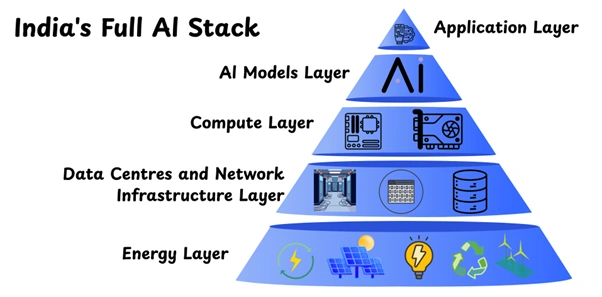
The India AI Stack is a five-layer architecture aimed at democratizing artificial intelligence for population-scale impact in sectors like healthcare, education, and agriculture. Its layers include Applications, AI Models, Compute (GPUs and data centres), Digital Infrastructure (data and networks), and Energy. The stack leverages indigenous AI models, cost-effective infrastructure, and sustainable energy solutions. Assuming a pyramid of national priorities, the Indian artificial intelligence (AI) ecosystem is designed in five overlapping layers that are logically designed to make sure that AI systems are designed to operate in a reliable, inclusive, and scalable manner.
Application Layer of India AI Stack
The Application Layer will be tasked with converting the work of complex AI to the services that citizens are offered, the examples of which include health diagnostics, agricultural advisory systems, and e-courts. There has been a proven rise in crop productivity in Andhra Pradesh and Maharashtra by 30-50%, using AI tools.
AI Model Layer of India AI Stack
The AI Model Layer is the brain of AI systems. IndiaAI Mission has contributed to the creation of a dozen native models. The IndiaAIKosh alone has nearly 5,722 datasets and 251 models across twenty sectors. Such initiatives as BharatGen and Bhasini also support access to multilingualism and sovereign innovation.
Compute Layer of India AI Stack
The Compute Layer provides the computational muscle to train and deploy a model, and it is supported by the IndiaAI Compute Portal, which provides access to 38,000 GPUs and 1,050 TPUs at subsidized prices of about ₹100/hour compared to the international price of ₹ 200.
Infrastructure layer of India AI Stack
Data centres and networking facilities form the basis of the infrastructure layer. The current installed capacity of India is 960 MW, and it is expected to reach 9.2 GW by 2030, which is supported by a nationwide 5G rollout and high inflows of foreign capital invested by various corporate giants like Microsoft, Amazon, and Google (Ministry of Communications, 2025).
Energy Layer of India AI Stack
The energy layer should be able to provide reliable power to meet artificial-intelligence workloads. Installed capacity in India is over 509.7GW, with over 51 percent of the same coming from non-fossil fuels. SHANTI Act also supports the deployment of nuclear energy via Small Modular Reactors and thereby provides a stable and sustainable grid condition.
Sectoral Adoption and Real-Life Impact of India AI Stack
The adoption of advanced technologies especially AI, Industry 4.0 tools like IoT, robotics, and big data, as well as digital platforms—is creating significant real-world impacts across the global economy. The India AI Stack is a multi-layered ecosystem covering applications, models, compute, digital infrastructure, and energy—designed to democratize AI at a population scale. By February 2026, it has evolved from experimental pilots into a nationwide force, enhancing efficiency across key sectors. The AI implementation in India is rapidly spreading throughout the field of priority sectors, hence providing real benefits to the citizens and contributing to governance, productivity, and delivering their services on a large scale.
AI in Agriculture and Rural Development
AI-powered advisory applications are revolutionizing agrarian activities. Intelligent plant machines used in Andhra Pradesh and Maharashtra have provided a 30 percent and 50 percent growth in productivity with increased crop harvest and resource use efficiency. These technologies help in precision agriculture and help to boost rural livelihood.
AI in Preventive Care and Healthcare
AI in healthcare enhances diagnostics, treatment planning, patient monitoring, and drug discovery, improving efficiency, accuracy, and overall patient outcomes globally. Medical imaging AI is used to detect tuberculosis, lung cancer, and neurological diseases at an early stage. Integration of AI-related diagnostics in district hospitals leads to enhanced preventive treatment and a reduction in the incidence of illnesses. These innovations make the services more accessible and of high quality.
AI in Skill Development and Education
AI learning has been implemented in the National Education Policy 2020, using curricula, DIKSHA, and YUVAi. The programmes will empower grade 8-12 students with the relevant AI skills, therefore advocating digital literacy inclusively and equipping the young demographic against future employment prospects.
AI in Disaster Management and Judiciary
The adoption of e-Court Phase III AI helps to boost translation, case management, and vernacular judgment production and, therefore, increase transparency. At the same time, the India Meteorological Department uses AI to anticipate cyclones and rainfall as well as lightning, and applications like Musam GPT can help farmers and disaster preparedness organizations.
Strategic Investments and Future Outlook for India
The artificial intelligence practices within India are being shaped by the enormous financial investments and long-term plans that mutually support technological self-sufficiency, sustainability, and international competitiveness as far as artificial intelligence is concerned.
Computer and Semiconductor Investments in AI by India
India Semiconductor Mission has completed 10 projects worth IUR 76,000 crore, and these projects include fabrication and packing facilities. At the same time, the IndiaAI Mission has invested INR 10,300+ crores in compute access, offering 38000 GPUs and 1050 TPUs at subsidised prices of 100 per hour.
Investments in Digital Infrastructure and Data Centres in India
The current data centre of India of 960 MW is expected to grow in 2030 to 9.2 GW with the help of AI and cloud workloads. Microsoft has made its 1.5 lakh crore, Amazon 2.9 lakh crore, and Google 1.25 lakh crore commitment to building AI centres and cloud services that show how much the world is trusting India to form its digital landscape.
India’s Sustainability and Energy Outlook
As the largest user of AI with a total installed power capacity of above 509.7 GW, with the majority (more than 51 percent) of these sources being non-fossil, India guarantees clean and reliable energy availability to power the AI workloads (Ministry of Power, 2025). SHANTI Act also supports the deployment of nuclear energy via Small Modular Reactors and thereby provides a stable and sustainable grid condition.
Future Prospects for India
The strategic investments make India a place of inclusive AI innovation. And by combining sovereign models, affordable computing, resilient infrastructures, and clean energy, India is getting ready to exist in a world where AI will support equitable growth and worldwide hegemony.
Conclusion
To sum up, India AI Stack comprises a holistic framework where applications, models, compute, infrastructure and energy are integrated to democratise artificial intelligence at the level of the population. Focusing on the sovereign model building, affordable access to computing, reliable digital infrastructure, and sustainable energy, India can become technologically independent and, at the same time, maintain inclusivity and equity. This approach both empowers the country with innovation and makes AI a national good, in line with technological advancement in terms of the good of society, sustainability, and the vision statement of AI to Humanity.