|
Key highlights
- Ecological Myopia
- Root Causes
- Political Geo-Ecology
- Long-term policies
- Towards Sustainable Climate Governance
|
Ecological myopia is a short-sighted, disjointed climate action that does not take into consideration the systemic sources of disturbance. The ecological myopia is based on the national interests and reactionary policies that hamper the governance capacities to acknowledge the interdependence of the planet. Analytical clarity is achieved with a political geo-ecology lens, which can incorporate ecological science with world politics in such a way that it will bring out the root causes and work towards designing sustainable regimes beyond borders, promote cooperation, and combat climate unravel in a holistic way.
|
Tips for Aspirants
The article is relevant to UPSC CSE and State PSC exams since it helps to deepen the understanding of the issue of climate regulation, environmental justice, and global politics, which are most popular in the areas of environment, polity, and international relations.
|
|
Relevant Suggestions for UPSC and State PCS Exam
- Ecological Myopia: Parochial, short-term, and fragmented climate policies that overlook the adoption of system-level aspects of disruption.
- Beneath the Disruptive action of climate:
- Industrialisation and reliance on fossil fuels (IPCC AR6 suggests that 75% percent of the greenhouse gas emissions are related to the burning of fossil fuels).
- Unsustainable consumption and deforestation (World Bank data reflect that agriculture has contributed 23% to total emissions).
- Malfunction in governance and geopolitical rivalry (existing policy directions can result in 2.7˚C warming by 2100).
- The economic models are more focused on GDP growth than sustainability (estimated that it can push 132 million people below the poverty line by 2030).
- Political Geo‑Ecology: Focusing on transboundary collaboration with political geography, it focuses on ecological diplomatic efforts (UNEP GEO 7 reports that integrated governance can lower the loss of 30 percent by 2050).
- Towards Sustainable Governance: Planetary, Equity, Justice, participatory, and inclusion of scientific evidence in policymaking.
|
The growing rate of climate change has revealed a terrible intellectual and policy blindness: ecological myopia. Being a short-term, fragmented, and nationally confined orientation to environmental governance, the condition weakens the ability of societies to address the systemic causes of environmental instability on the planet. Traditional climate response has the propensity to favour short-term mitigation aims or technological fixes, thus overlooking the structural reasons that lie deep-rooted in economic theories, geopolitical tussles, and unsustainable consumption styles. This limited vision sustains reactive approaches in which ecological crisis is not responded to in the inherently integrated manner of ecological crisis. To solve this shortcoming, a planetary lens is needed, that is, a solution which incorporates ecological science and political geography, i.e., political geo-ecology. This view places climatic disturbance into the greater context of world interdependence, the undeniable bond between the ecology, states, and systems of governance. Through the application of this lens in repositioning climate action, policymakers and researchers can recognize underlying factors through which to implement transboundary collaboration and destabilize the governance system to emphasize ecological fairness and resilience.
Climate Disruption Hidden Root The Politics of Ecological Myopia is likely the title or a key theme of an academic article or discussion point, rather than a specific book. It refers to the concept of ecological myopia, which is the tendency to treat climate change as an isolated environmental issue rather than a systemic problem rooted in the intertwined dynamics of politics, economics, and society. The issue then is not just technical but more to the point, political: to overcome ecological short-sightedness and develop a form of sustainable government that is able to protect planetary futures.
Defining Ecological Myopia
Ecological myopia is an eco-centric epistemic and normative gap in the modern climate-governance systems. It comes in the form of short-termism and close-mindedness, which hides the systemic risks, related to the planet and silences the effectiveness of policy in reaction to climate interference. Ecological myopia (or environmental myopia) is a decision-making bias where immediate economic returns and short-term operational goals are disproportionately prioritized over long-term environmental consequences.
Conceptual Definition
The ecological myopia is conceptualized as a reductionist approach to climate change, in which it is portrayed as an ordinary environmental issue as opposed to a marker of more general disruption of the Earth-system. Scientists argue that this kind of attitude limits risk cognition so that political, economic, and daily activities can continue under the fallacy of a stable planet. Ecological myopia ignores the complexity of the relationships between the ecological system, political system, and economic system by focusing on discrete technical outcomes such as emission targets or renewable-energy commitments.
Features of the Ecological Myopia
The attributes of ecological myopia are short-term thinking, fragmentation, and national self-interest. Short-termism favours immediate gain (in place of long-term sustainability); fragmentation is manifested in policies that focus on symptomatic views (as opposed to structural ones); and national self-interest becomes the main barrier to ecological myopia by emphasizing domestic interests over international collaboration. These pretty combined attributes support the reactive approaches that do not appeal to the systemic premises of climate degradation.
Consequences
There are strong implications of ecological myopia on climate governance. It brings shallow answers that focus more on technological solutions than on questioning unsustainable behaviours of consumption and geopolitical competition. The limitation creates a lack of prompt action, adaptation, and a false illusion of progress. The international summits, like the one dominated by Brazil, have a tendency to herald minor progress and neglect the building instability around the ecosystems like the Amazon rainforest, hence demonstrating how ecological short-sightedness undermines scientific integrity and governmental responsibility.
Towards a Planetary Lens
Ecological myopia has been identified and highlights the need to have an alternative framework. The planetary lens, that incorporates political geo-ecology, places climate change in the broader grid of the global interdependence. This worldview focuses on the inseparability of ecosystems, states, and governance systems. The transcendence of ecological myopia allows policymakers to identify underlying factors, build transboundary partnerships, and come up with governance frameworks that allocate ecological justice and resilience over time. Accordingly, the meaning of ecological myopia is not just descriptive, but rather prescriptive, giving a way to reform the systems.
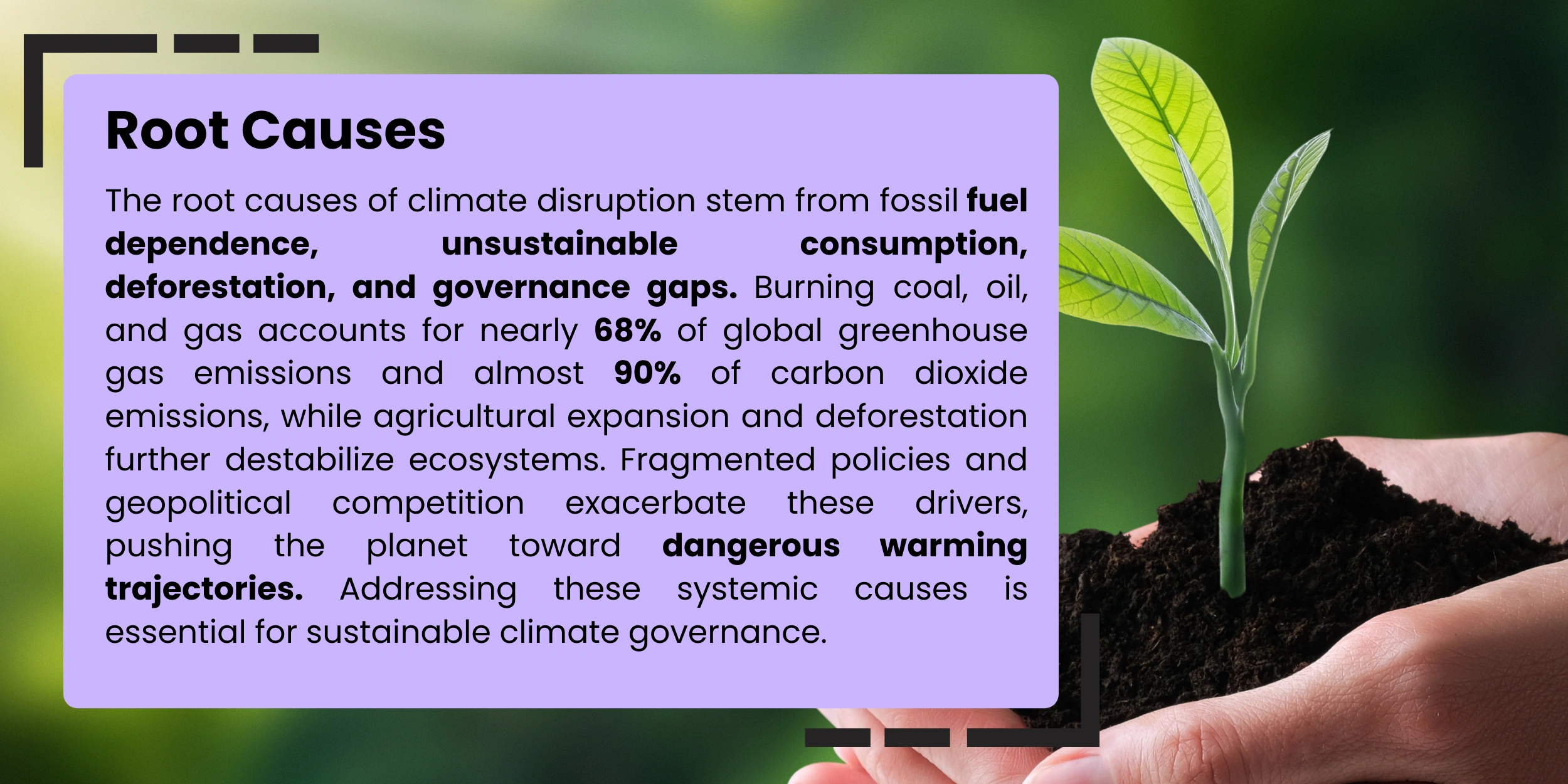
The Disruption or climate change and its causes
Climate disruption will not be a mere factor of the growing greenhouse gas levels; it is the aggregate of systematic forces ingrained within economic, political, and social systems, of destabilizing planet systems.
Industrialization and reliance on Fossil fuels
The major driving force of climatic disruption is in the prehistoric course of industrialization and reliance on fossil fuels. As of the IPCC Sixth Assessment Report of 2023, the impacts of anthropogenic activities have contributed about 1.1˚C to global warming since the pre-industrial era, of which about 75 percent of greenhouse gas emissions have been associated with the combustion of fossil fuels. This has made the economies dependent on coal, oil, and gas, binding their economies, and thus, de-carbonization has become an urgent and politically complicated affair.
Unsustainable Consumption and Resource Extraction
Another key factor that has contributed to the apocalypse is the unsustainable consumption and extraction of resources. According to the Country Climate and Development Reports (CCDRs) by the World Bank, the unregulated consumption of energy, food, and raw materials is increasing at a rapid rate, in the process of deforestation, loss of biodiversity, and water shortage. Indicatively, more than 23 percent of global emissions are because of agricultural expansion, which is destroying tropical forests that serve as major carbon repositories. The practices are a product of ecological short-sightedness, in which short-term economic developments are given precedence over long-term sustainability on the planet.
Geopolitical Competition
The geopolitical rivalry and the loopholes in governance are also contributing to climate disruption. The international collaboration is often fragmented and does not support the responsibility of a planet, but rather the national interests. IPCC observes that, unless the current policies are altered, warming will approach 2.7˚C by the year 2100, which is way above the target of 1.5˚C in the Paris Agreement. Poor governance frameworks coupled with unequal financial promises cross with failure to adapt and mitigate properly, hence the continuity of ecological injustice and an unfair disproportionate effect on the vulnerable Global South populace.
Inequality
Beneath these reasons is a structural economic model that nurtures growth and not sustainability. Ecological costs are usually pushed out in the pursuit of GDP growth, which strengthens inequality and susceptibility. The World Bank also notes that failure to initiate systemic reforms would lead 132 million people into poverty by 2030 because of climate effects. Climate disruption is therefore inescapable with socio-economic injustice, making it essential to have a planetary perspective that incorporates ecological science with political economy.
Political Geo-Ecology A Planetary Lens
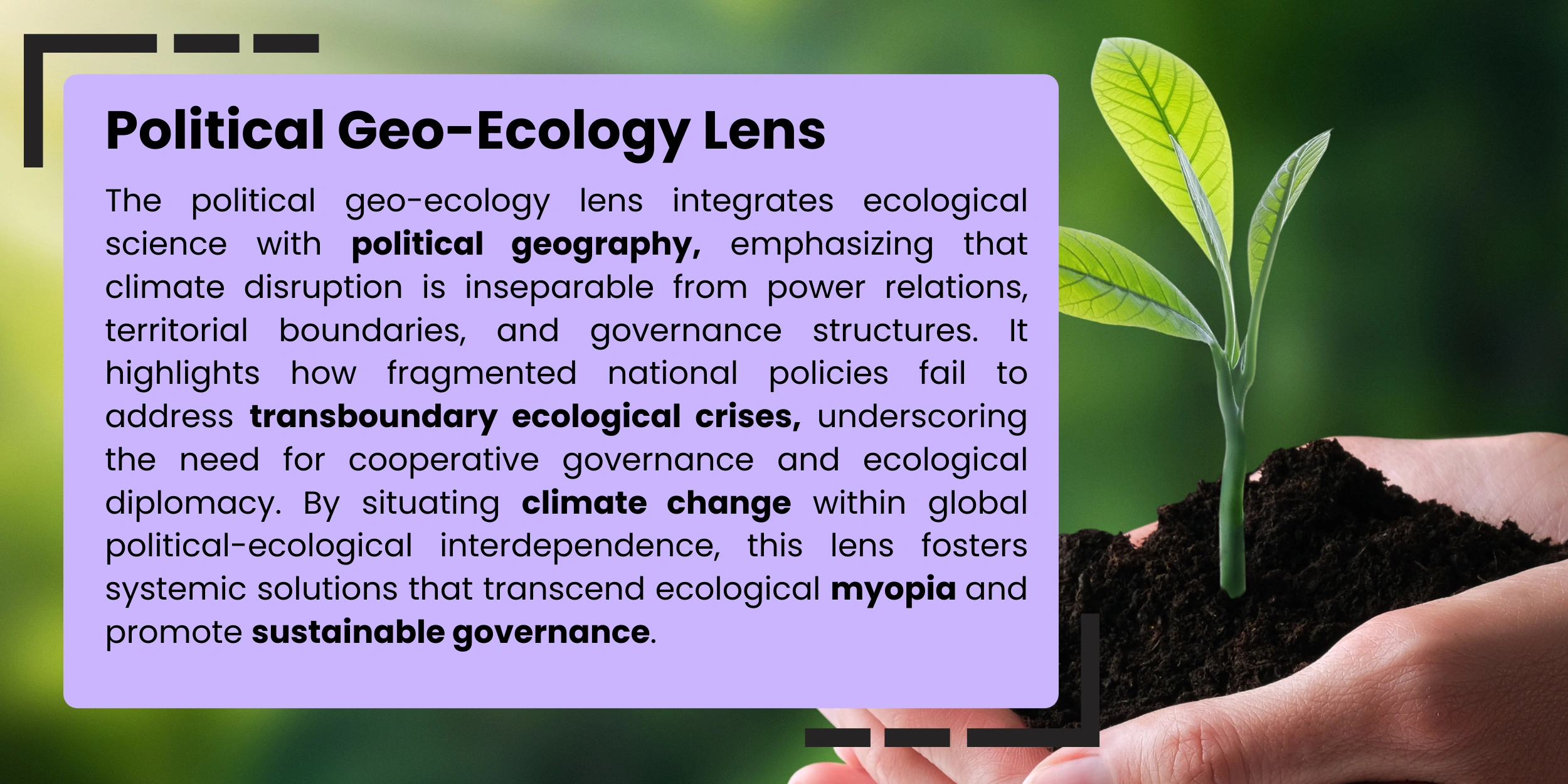
Political geo-ecology is the planetary lens blending the science of ecology and political geography. It stresses the interdependence among ecosystems, states, and systems of governance, and hence facilitates the responsiveness of systems to climate disruption.
Conceptual Foundations
Political geo-ecology is one way that places climate change in a wider context of political and ecological interrelations worldwide. In contrast to the traditional forms of environmental governance that usually buffer the ecological problems against geopolitics, this strand of thinking highlights that climatic derailment cannot be discussed outside of power relations, territorializing activity, and resource struggle. Through the integration of ecology and political geography, it emphasizes the manner in which governments need to transform themselves to indicate interdependence on the planet.
Ecosystems and States
The planetary lens shows the fact that ecosystems and states are so closely related. Indicatively, the
Global Environment Outlook (GEO-7, 2024) of the UN Environment Programme highlights that transboundary ecosystems (e.g., river basins, forests) should be managed through a system of cooperation to avoid ecological systems breakdown. Similarly, IPCC AR6 Synthesis Report (2023) cautions that the effects of climate, such as droughts and floods, are beyond national boundaries, and they require collective actions. Political geo-ecology, therefore, replicates the shift of climate action initiatives to a shared planetary issue, as opposed to a fragmented nationalist goal.
Governance and Cooperation
Political geo ecology emphasizes the need to have governance structures that are ecological myopia. The World Bank states that improper collaboration and unity may continue to push millions of people into poverty by the year 2030 due to the lack of sufficient cooperation and divided policies that cannot succeed in uniting the processes and address the issue (World Bank Climate and Development Reports, 2023). Planetary lens advocates for ecological diplomacy, common responsibility, and inclusive institutions that combine scientific knowledge and politics together. This strategy guarantees that the climate policy takes the issue of ecological justice as well as the reality of geopolitics into account.
Towards a sustainable governance
Political geo-ecology adoption contributes to the realization of sustainable governance because the ecological considerations are incorporated into political systems. It demands structural changes like accountability systems on the planet, allocation of resources fairly, and citizens taking part in the climate policy. The findings of the UNEP GEO-7 suggest that integrated governance can limit biodiversity loss by up to
30% by 2050, provided that it is practiced on an international basis. Political geo-ecology is thus not only a theory, but provides viable solutions of resilience and equity.
Moving towards Sustainable Governance
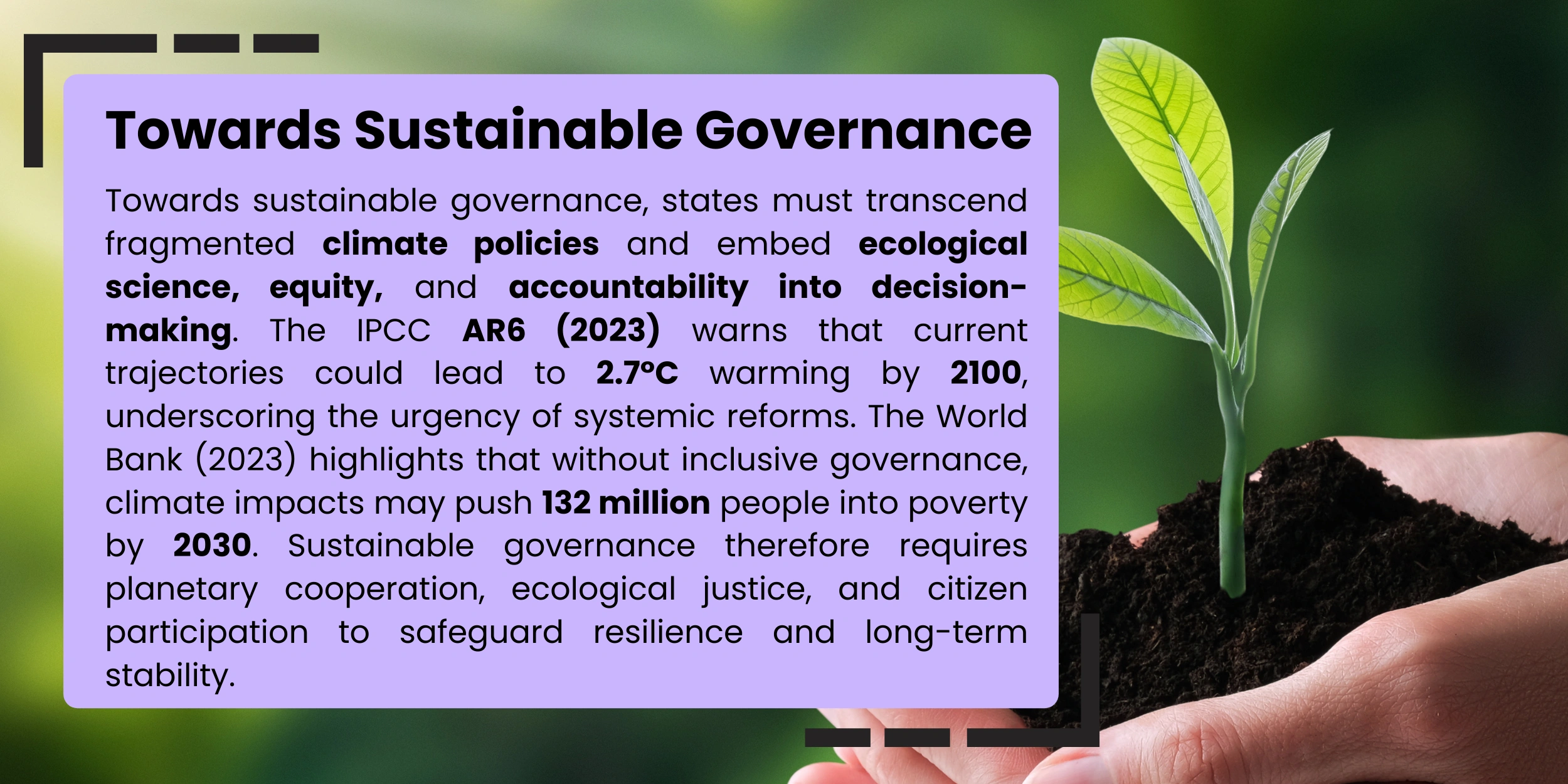
Sustainable governance requires systemic changes that connect ecological science, political accountability, and social equity, and go beyond the piecemeal climate policies to create coherent structures to help create resilient frameworks that promote planetary stability and justice. Moving towards sustainable governance means integrating social, environmental, and economic goals into core decision-making, shifting from short-term gains to long-term well-being for future generations.
Restructuring Governance
Institutions need to reform systems of proactive and systemic mechanisms in place of reactive and short-term systems in the quest to achieve sustainable governance. According to the United Nations Environment Programme (UNEP, GEO-7, 2024), governance should emphasize the implementation of ecological aspects in the political and economic decision-making practice. This shift implies a change where the GDP-based models of growth are replaced by the sustainability approach (to evaluate the resilience, the biodiversity, and the social well-being) to guarantee that the governance structure does not exceed the planetary limits. 8
Science and Policy
Proper governance implies the organization of scientific knowledge into political procedures. According to the Intergovernmental Panel on Climate Change (IPCC AR6, 2023), the climate impacts have been escalating faster, and across the planet, the global average temperature is expected to rise by 2.7°C by 2100 under current policy scenarios. Integrating science in the governance structures ensures the presence of evidence-based decision-making and the authority of the states to develop adaptive strategies beneficial in reducing risks and improving resiliency. The approach makes integration more effective and less ecological myopia.
Fairness and Equity
Environmental justice and equity should be of primary concern in the implementation of sustainable governance. The World Bank has stated in Climate and Development Reports (2023) that the climate disruption has the potential to place 132million people in poverty by the period 2030 without systemic reforms. To resolve the issue of inequality, there is a need to have inclusive institutions to empower the marginalized communities, to address unfair distribution of resources, and participative decision-making. Just governance will limit susceptibility in addition to causing strategic resistance to climate shocks.
Global Collaboration
Sustainable governance is concerned with global cooperation. The reason is that transboundary issues like deforestation, water shortage, and biodiversity loss require a unified solution. According to the GEO-7 estimates prepared by UNEP, integrated governance has the capacity to ensure a 30 percent reduction in biodiversity loss by 2050 if it is applied worldwide. The systems employed, such as ecological diplomacy, collective responsibility, and planetary surveillance systems, promote collaboration between states so that the governance becomes planetary-minded instead of myopic in ecological thinking.
Conclusion
Ecological myopia is one of the major limitations in the modern forms of climate governance that results in systemic crises being moved to the short term, with fragmented answers. This wind-tunnel view keeps the inappropriate response going since it clouds the structural sources of disruption deployed, namely the industrial dependency, a destabilizing consumption, and geopolitical struggle. The ecological science and the global governance framework can be unionized into a planetary structure based on the political geo-ecology approach to provide a remedy solution that fosters collaboration, equality, and strength. Sustainable governance should not be limited to national self-interest but should extend to include scientific evidence in the policy and focus on equity. It is only through a successful, ecological breakthrough that humanity can be able to come up with holistic models that can guarantee planetary stability and a fair, comprehensible, and sustainable future for everyone.