|
Key highlights
- IndiaAI Mission
- 10,300 crore Investment,
- 38,000 GPU Installations
- Focused on Inclusion
- Integrate Rural Development
- Public-Private-led Initiatives
- Skill Enhancement
|
The article “From Vision to Reality: India’s ₹10,300 Crore Leap into Artificial Intelligence” explains why direct investment of 10,300 crore rupees by India, combined with implementing 38,000 graphics processing units (GPUs), is transforming the artificial-intelligence (AI) in the country. It outlines strategic infrastructural projects and inclusive innovation across industries, including healthcare and agriculture, and therefore increases global competitiveness and economic growth. Furthermore, the article determines such issues as ethical regulation, information protection, and competence development as salient ones and offers a roadmap that would enable sustainable and fair AI-driven development.
|
Tips for Aspirants
This article will be significant to upcoming UPSC CSE and State PSC exams because it connects AI investment to governance, inclusive growth, ethics, and policy, which are important in the economy, technologies, and society.
|
|
Relevant Suggestions for UPSC and State PCS Exam
- India is making investments under the IndiaAI Mission of 10,300 crore, putting together 38,000 GPUs to support AI infrastructure in the country.
- Healthcare, agricultural, educational, and governance applications of AI intend to close social-economic disparities and build rural communities, start-ups, and MSMEs.
- It is estimated that by 2035, AI will contribute USD 1.7 trillion to the Indian economy by increasing productivity and automation, and making the country more competitive.
- India is also one of the leading countries in terms of AI readiness that encourages foreign partnerships and public-private-led initiatives to develop a strong ecosystem.
- Social concerns, privacy of data, and skills gaps are among the crucial topics that demand good governance and regulatory standards.
- It will concentrate on the skills of one million specialists, ensuring energy-saving AI, and ensuring resources that are used fairly to achieve sustainable development.
|
The twenty-first century has witnessed the mechanical impact of artificial intelligence (AI), which has transformed the dynamics in the economic, governance, and sociocultural spheres. The most recent developments in India, in particular the installation of 38,000 GPUs of its AI infrastructure, are viewed as a massive financial investment to the tune of more than 10,300 crores rupees, thus making it an enormous technological breakthrough. This is not just a fiscal expenditure policy but an excellently planned project to put India on the platform of inclusive innovation all over the world. Productive in enhancing the capacity to compute and making advanced AI-technologies more affordably accessible, the effort will counter-balance systemic barriers in the most fundamental areas of life, such as healthcare, agriculture, education, and state operations. As defined, the pursuit of inclusivity aims to use AI in order to empower the marginalised groups, enhance productivity, and nurture entrepreneurial environments. Moreover, the investment is an indication of India's willingness to strengthen its competitive position in the world market, appeal to foreign investors, and trigger local research and development. At the same time, it is a burning question about ethical governing, privacy of information, development of the necessary skills, all of which should be taken care of when long-term development is the goal.
India's ₹10,300 Crore leap into AI is driven by the India AI Mission, launched in 2024, to establish India as a global AI leader by building computing infrastructure (targeting 38,000 GPUs), supporting startups, developing indigenous AI, and ensuring responsible use for inclusive growth, with projections of adding $1.7 trillion to the economy by 2035 through applications in healthcare, agriculture, and governance, making AI accessible via subsidized GPU access and Indian language models.
AI Infrastructure Strategic Investment
The India-New Zealand Free Trade Agreement (FTA) stands as a watershed in the history of India's trade diplomacy because it reflects both the economic expediency and strategy when it comes to the globalisation efforts of integrating the supply chain. India will receive zero-duty market access for all its exports to New Zealand. In return, India will relax tariffs on 95% of imports from New Zealand, with 57% of these products becoming duty-free from day one.
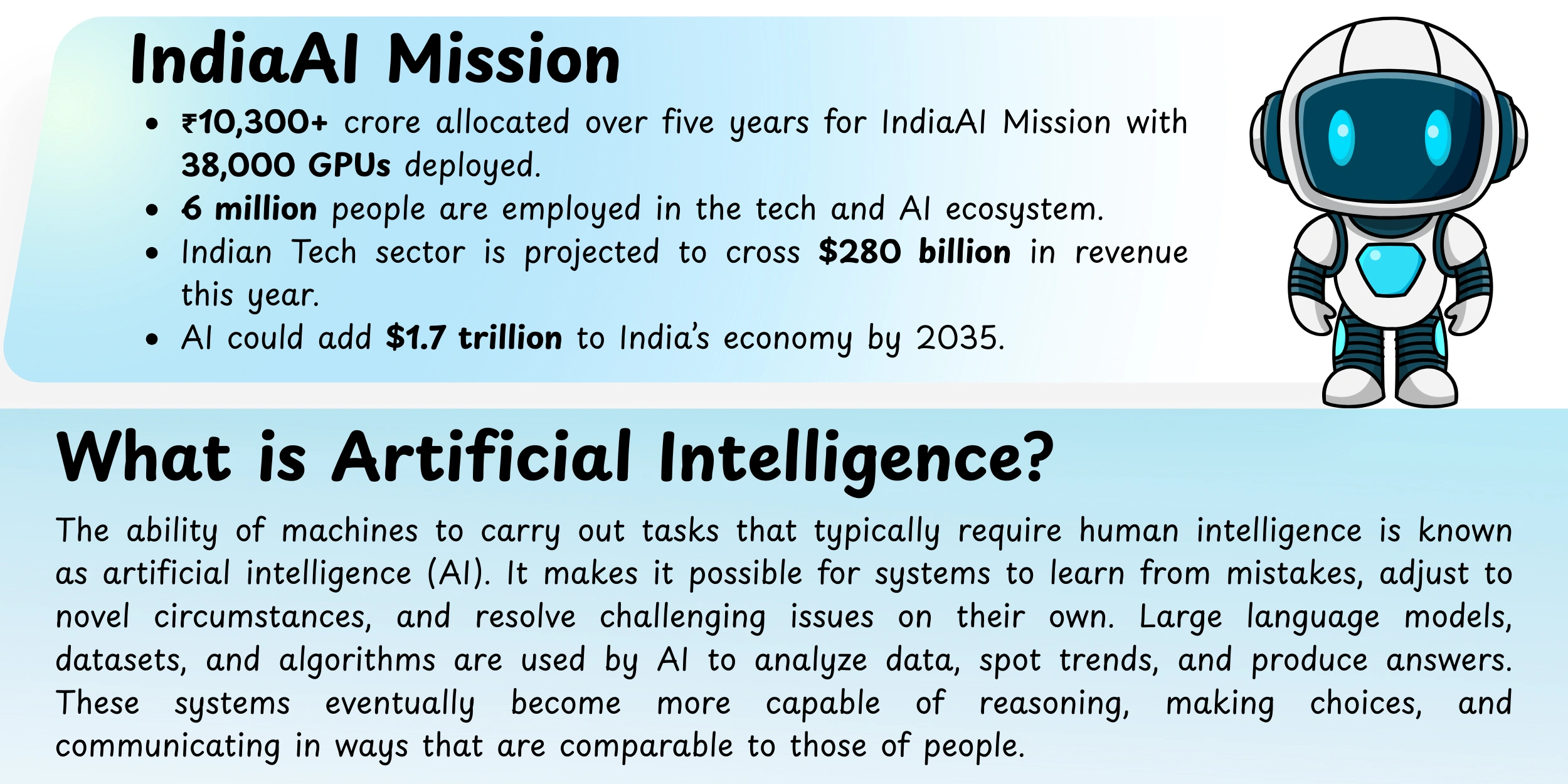
Under the India AI Mission, a commitment of a total of 10,300 crore rupees, along with 38,000 GPUs, has been done by the government for inclusive digital infrastructure and technological transformation. Strategic investment in AI infrastructure is a global priority, involving massive capital expenditure by tech giants, significant funding from governments, and the emergence of specialized investment partnerships.
Increasing Computational Capacity
The supply of 38,000 Graphics Processing Units (GPUs) is one of the pillars of the AI agenda in India. Due to the national coverage of this infrastructure, startups, researchers, and public institutions are able to have access to state-of-the-art computing facilities at reduced prices in India. This participatory computing power democratisation counterbalanced the international system relying on those sites and has strengthened home capacity.
Developing National AI Ecosystem
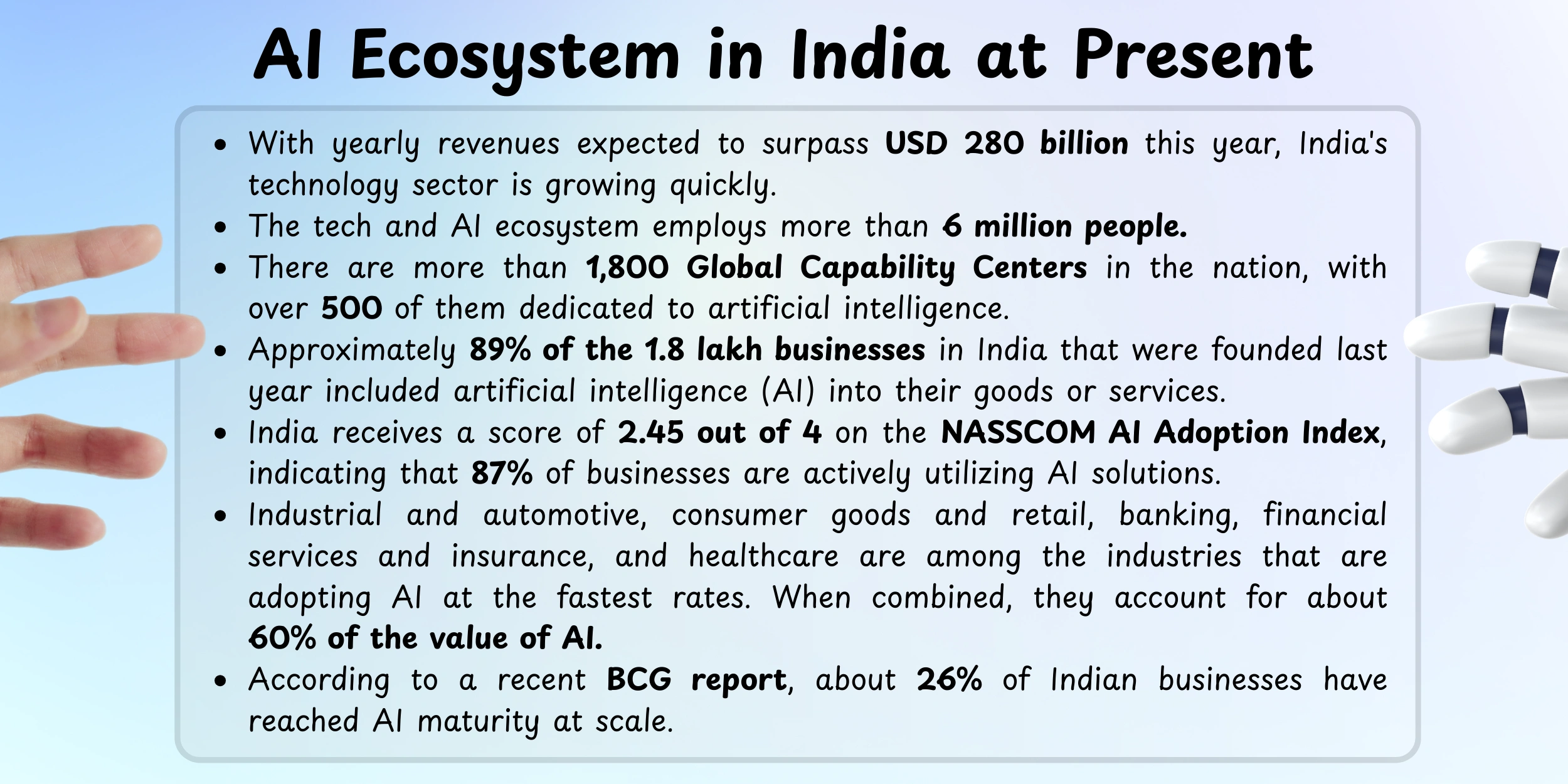
In March 2024, the IndiaAI Mission was established with the focus on the creation of digital infrastructure on a global level and innovation centres. The project assists in start-ups, the development of local AI models, and the incorporation of skilling programmes within the industry. It is estimated by the government that India has more than six million people working in the technology sector, and the revenues of the sector are expected to exceed USD 280 billion in the year 2025. Careful investment in AI infrastructure, in turn, would augment already present assets, making India a hub of research, entrepreneurship, and policy-based innovation.
Economic Potential
Studies have shown that AI may be used to contribute about USD 1.7 trillion to the economy of India by the year 2035. Such a projection highlights the potential of AI to become transformative when it comes to increasing productivity, automation, and the invention of new types of jobs. India can also speed up activities, and by investing in infrastructure, the country can boost its competitiveness on a global scale. High-scale compute capabilities will also be enticing foreign partnerships and public-industry partnerships, and additional means of bringing India into the global AI value system.
Meeting the Challenges
As much as infrastructure development is a prerequisite, issues still arise in ensuring fair access, ethical governance and efficient utilisation. Issues related to the privacy of the data, the bias of working algorithms, and unequal distribution of skillsets should be resolved by means of introducing extensive regulations, as well as specific educational programs. In reaction, the IndiaAI Mission implements its skill development programmes to generate a pool of AI-focused talent that allows the spread of AI-infrastructure advantages in domains beyond metropolitan centres across rural and underserved populations.
Moving towards Inclusive Innovation
The Indian AI mission is optimistic with regard to inclusivity in such a way that technological advancements are made advantageous to the various communities. The initiative would close socio-economic gaps by allowing access to new state-of-the-art computing to promote equitable innovation. Moving towards Inclusive Innovation involves a deliberate shift in the innovation process, moving from traditional models focused solely on economic growth to a holistic approach that prioritizes social, environmental, and equitable outcomes.
AI in Healthcare Access
AI is already being implemented to enhance healthcare provision, especially in low-service areas. Artificial intelligence-based diagnostic and predictive analytics allow for detecting the disease sooner and treating it better. The foundation of AI Centres of Excellence in the healthcare sector, including the partnerships with AIIMS Delhi and IIT institutes, will help to increase the national health programmes and decrease the gap in access to medical services.
Facilitating Rural Community Empowerment
The uses of AI in agriculture are changing crop management, soil examination and weather forecasting. AI-powered advisory systems can help farmers to get information on optimising yields, controlling pests and irrigation in real-time. The government has invested in AI Centres of Excellence in the agricultural sectors that help in implementing sustainable practices and improving productivity, which directly affect the rural livelihoods.
Skilling and Education
Inclusive innovation can be applied to education as well, wherein AI-powered platforms can enable education to close learning gaps. The adaptive learning systems individualise the content to students, whereas AI-based language tools broaden access to quality education regardless of linguistic phobias. The IndiaAI Mission incorporates skilling programs to equip young people towards AI-oriented industries to overcome the talent gap and make them equal participants in the digital economy.
Start-up and MSMEs Support
Access to high-end computing resources can be a problem for startups, micro, small, and medium enterprises (MSMEs). Using 38,000 GPUs in the IndiaAI mission, the government has guaranteed affordable access to high-degree infrastructure. This type of democratisation encourages innovation among smaller businesses that would be able to compete on the global level and make economic growth inclusive.
International Positioning and Economic Development
The decision by India to invest about 10,300 crore in artificial intelligence (AI) infrastructure and 38,000 graphic processing units (GPUs) is not only an innovation strategy aimed at the domestic market, but also a national positioning behaviour aimed at supporting expansion of the national economy. International positioning refers to a country's strategic role, influence, and integration within the global economic and geopolitical landscape. This positioning directly impacts economic development by influencing access to trade, investment, technology, and global supply chains.
Enhancing the Global AI position of India
The agenda of AI in India is aimed at the country taking a higher position in the global digital economy. The Oxford Insights AI Readiness Index of 2024 ranks India among the 15 countries based on its preparedness to use AI, which is a sign of its thriving role in forming the global AI standards. It expands the computational capacity, and this way, the nation can become an epicentre of AI study and co-operation, and it will invite international co-operation and foreign direct investment.
Economic Growth Potential
According to the India Brand Equity Foundation estimates, AI will add close to USD 1.7 trillion to the gross domestic product of India by 2035. This expansion is likely to be caused by productivity gains, automation, and the development of new business models in various sectors. Such areas as manufacturing, logistics, and financial services are the spheres that will get significant advantages, thus introducing new jobs and providing better effectiveness. The investment in the GPU is going to make sure that the Indian enterprise can compete on a global basis, as it will be able to use the latest computational resources.
Public-Private Partnership
IndiaAI Mission lays emphasis on the collaboration between government, academia, and industry. Multinational technology companies are now actively collaborating with Indian organizations to work on AI solutions together. An example is NVIDIA, which has already declared partnerships with Indian start-ups and research institutes in efforts to ensure that they maximize the usage of GPUs in terms of AI innovation. These alliances would increase the credibility of India as a global hub of AI and bring its economy into global supply chains.
Global Competitiveness
In spite of these developments, India is faced with issues that concern the shortage of talent, ethical leadership, and regulatory systems. As infrastructure development continues to make headway, global competitiveness needs to be sustained on a long-term basis, thus focusing on a qualified workforce and well-established intellectual property regimes. The IndiaAI Mission has government skilling efforts that will train more than one million professionals in AI-related areas, thus assuring long-term economic sustainability.
|
Artificial Intelligence to Support an Inclusive Society
The report by NITI Aayog entitled “AI for Inclusive Societal Development explains an elaborate approach that focuses on enabling the masses in the informal sector of Indian society by implementing sophisticated technology. The discussion provides an outline of the use of Artificial Intelligence, the Internet of Things, and blockchain technologies in enabling the incorporation of more than 490 million informal workers, inherently overcoming the methane effects in the systems. It suggests the implementation of voice-first AI solutions to reduce the linguistic barrier, automated smart contracts to ensure prompt compensation, and an on-demand digital learning platform to be used to support the acquisition of skills.
The key component of the initiative is the Digital ShramSetu Mission that aims to increase the level of technology adoption and encourage collaboration between governmental and private sectors, as well as civil society. Interoperability, data governance, and capacity building are the focus areas in the framework of the Mission as enabling factors for the general technological uptake.
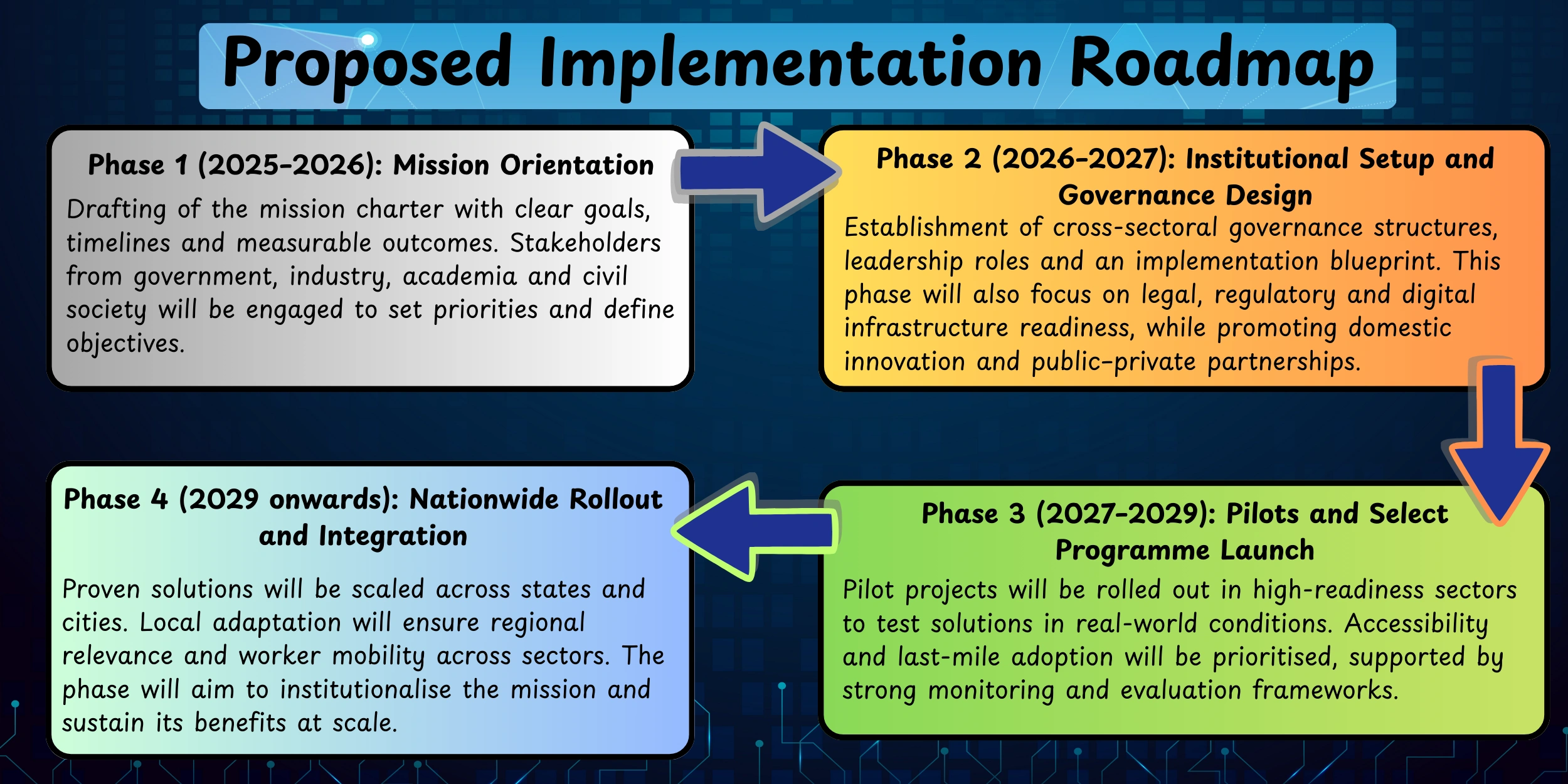
The report drives the urgency of pursuing long-term investment in research and development, strategic vocational education, and the development of a robust innovation DNA to protect the inclusive gains in technological adoption. It contends that such an investment will support the establishment of a sound knowledge base, venture enterprises, and eventually ensure that there is equal access to the emerging digital opportunities.
|
Challenges & Roadmap Ahead
The high-pitched AI program of India, which is enriched with the investment amount of 10,300 crore rupees and the use of 38,000 GPUs, is faced with severe challenges that should be addressed in terms of a systematically detailed road map. This framework is necessary so as to make the technology socially and sustainably relevant. "Challenges and Roadmap Ahead" refers to identifying obstacles (like job creation, infrastructure, inequality, technology gaps) and outlining strategies (policy changes, innovation, investment, skill development, stakeholder collaboration) for future growth and improvement.
Ethical and Governance Issues
The increased rate of AI implementation impels acute, ethical issues revolving around the algorithmic prejudice, visibility, and responsibility. Fields like healthcare and financial services are considered areas that may discriminate against certain users without strict regulatory checks by the authorities on AI systems, which have been confirmed by empirical studies by NITI Aayog. The establishment of effective governance frameworks, such as a full set of ethical codes and external regulators, is an unavoidable requirement for the protection of citizens' rights and responsible innovation.
Data Privacy and Security
The ecosystem of AI in India is highly dependent on massive amounts of data gathering, but the issue of privacy and the inappropriate use of personal data are still significant. The Digital Personal Data Protection Act of 2023 creates a set of legal laws, yet its effectiveness lies in its implementation in terms of proper enforcement systems and campaigns on socialisation. According to a study, without a system of appropriate cybersecurity measures, the adoption of AI might put major industries in a risky situation.
Talent and Skill Development
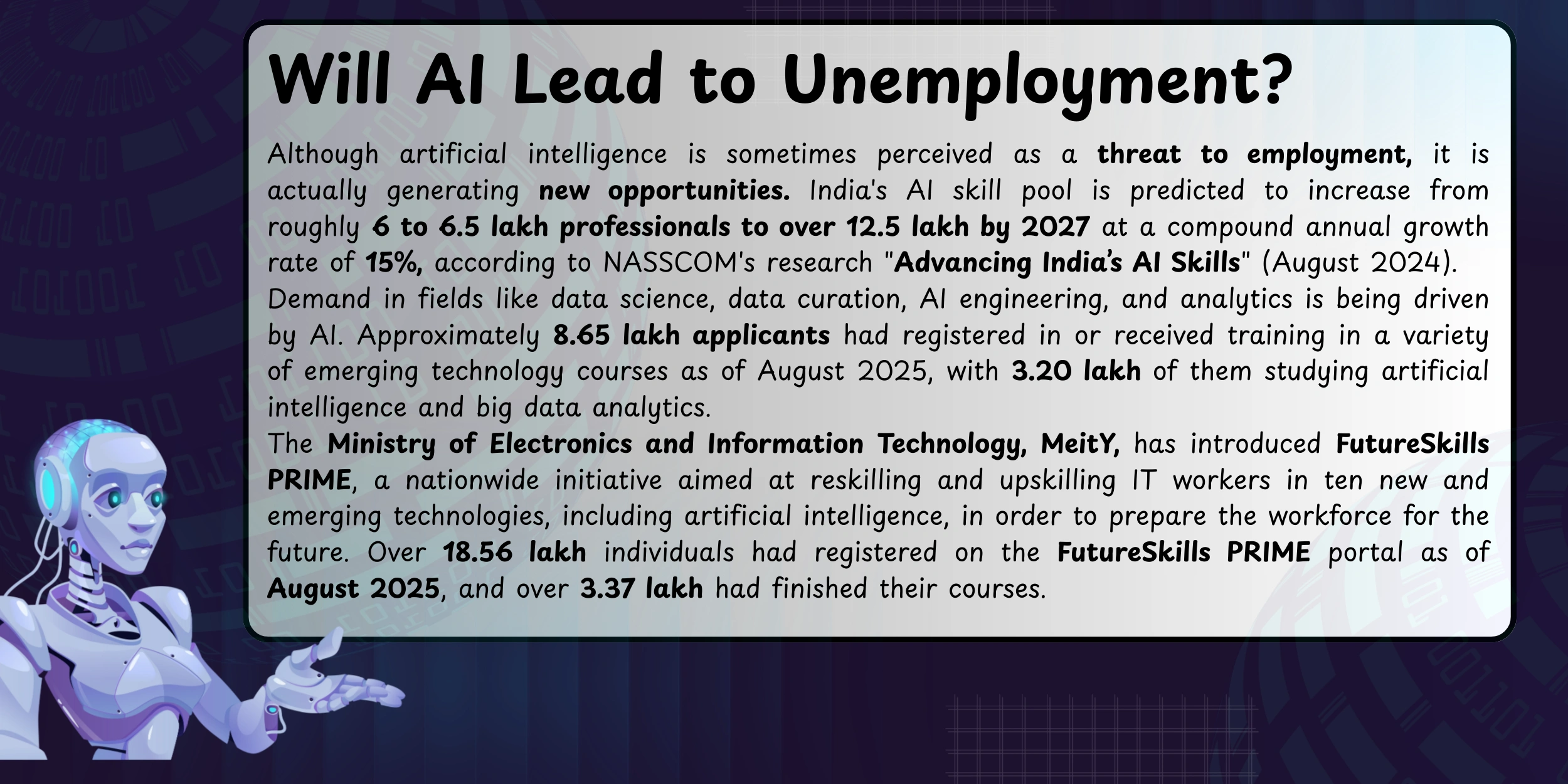
The major challenge is to close the current gap in skills. Nasscom explains that in 2030, the number of AI professionals needed in India will be about a million, but the existing training resources will be enough only to employ one-fifth of them. Skilling is also a part of the IndiaAI Mission, but scaling the programmes to rural and semi-urban areas is still the priority. It is essential to create AI-related programs both in universities and vocational education institutions to develop a robust workforce.
Sustainability in Growth Strategy
The developed roadmap is based on a multi-pronged approach:
- Increasing the infrastructure: Investment in AI-based cloud and GPUs.
- Inclusive Access: Making sure that the rural communities, startups and MSMEs will benefit from the AI resources.
- International Cooperation: Building ties with global companies and research teams.
- Regulatory Evolution: Revision of regulation frameworks to deal with the risks of AI and ethical concerns.
Conclusion
The 10,300 crore strategic investments and the 38,000 GPUs deployed by the India AI Mission indicate the revolutionary change in the direction of inclusive technological development. Expanding computational capacity, making it accessible and supportive to people, and embedding it in various industries and systems in healthcare, agriculture, education, and entrepreneurship, the initiative would make India a world leader in responsible adoption of AI. However, issues of morality, information security, and proficiency advancement require a defined road map to achieve sustainability. Finally, such a mission can be seen as the Indian vision of utilizing artificial intelligence as one of the means of economic development, but as a means of fair development and demand in the digital age as well.