|
Key Highlights
- Indian Maritime Industry
- Issues in Sustainability
- Technological Advancements
- Initiatives by India
- Funding Mechanism
- International Cooperation
|
The National Mission on Edible Oils-Oil Palm (NMEO-OP) is aimed at reducing the extreme dependence on foreign edible oil by enhancing its production in the country, especially palm oil. It provides options of financial incentives, promotes sustainable cultivation, and strengthens value chains based on the Strategic use of public-private options. The vision is to have a secure income for the farmers, environmental protection, and sustained resilience, which will generate a self-sufficient, sustainable edible oil system within India.
|
Tips for Aspirants
This article is of immense relevance to the UPSC Civil Services Examination and the State Public Service Commission examinations, as it deals with governance, agricultural policy, self-reliance, sustainability and rural development, which are fundamental subjects in the curricula of economics, environmental studies, and contemporary affairs.
|
|
Relevant Suggestions for UPSC and State PCS Exam
- In India, presently about 56 percent of the edible oil intake is based on imports, with palm, soybean and sunflower oils being the most common imported oils.
- This reliance creates imbalances in trade and an increase in the price sensitivity to changes in the global market.
- Maritime India Vision 2030, the Sagarmala Programme, and the Amrit Kaal vision 2047 are the main policy frameworks, which focus on modernisation, green shipping, and restoration of the ecosystem.
- Goals
- Planting 6.5 lakh hectares of land with oil palm plants.
- Boosting crude palm oil production by the end of 2030.
- Stabilising the domestic prices of palm oil and guaranteeing income to farmers.
- To support environmental sustainability and Economic growth.
- Implementation Strategies: The mission includes financial aid, infrastructure enabling, a partnership between the government and the private sector, academic research, expansionary services, and strict monitoring systems.
- Impact: the programme will enhance self-dependency, rural livelihoods, food security and the spread of the concept of sustainability.
- Way Ahead: The value to add to the future in this regard should include research and development, increasing the awareness of the farmers, improving organisational coordination, and balancing between economic growth and environmental responsibility.
|
The edible oil industry has a central niche in the greater framework of food security, agricultural sustainability, and economic resilience. Given the rapidly growing population and changed dietary patterns, the demand for edible oils has always surpassed the supply in the country, with the country developing a strong reliance on imports, especially palm, soybean, and sunflower oils. This dependency not only burdens the national balance of trade, but it also puts the nation at the mercy of international prices and breaks in the supply chain. The Government of India responded to these organizational challenges by opening the National Mission on Edible Oils, shared between Edible Oils and Oil palm(NMEO-OP), as the policy tool to boost the ecosystem of edible oils. Its mission is to promote self-reliance by increasing oil-palm farming in agro-climatic regions with climatic conditions viable to harvest oil-palm, serving the farmers through a guaranteed price, and encouraging technological advancement of the value chain.
India's National Mission on Edible Oils (NMEO), particularly the NMEO-Oilseeds component, is a government initiative (2024-2030) to achieve self-reliance (Atmanirbhar Bharat) in edible oils by boosting domestic production of oilseeds like groundnut, mustard, soybean, and palm oil, reducing huge import dependency (around 56-57%) through improved seeds, technology, farmer support (MSP, training), better processing, and expanding cultivation into fallow lands, aiming to increase production significantly by 2030-31. It is also important with its focus on environmental protection so that when expanded, ecological integrity is not affected. With the financial, public-private collaboration, and research-based strategies, NMEO-OP aims to shift the institutional edible oil environment in India from being not reliant on importing but rather having the potential to develop self-sufficient capacity in India to produce edible oils.This endeavour is, therefore, a conclusive step towards nutritional security, a strengthening livelihood of the rural region, and a long-term economic stability.
Background and Need for the National Mission on Edible Oils
The edible oil industry of India comprises one of the most vital parts of the food economy of the country, which has a bearing on nutritional security, sustainable agriculture, and trade relations. The prolonged increase in the domestic demand, together with the limitation of the local production resources, has created structural issues which should be addressed by specific response strategies. In this respect, the National Mission on Edible Oils-Oil Palm (NMEO-OP) was initiated to tackle such challenges and strengthen the edible oil ecosystem in the country. India's National Mission on Edible Oils (NMEO) was born from a critical need for self-sufficiency, with the nation importing ~60% of its edible oils (around $10 billion annually), especially palm oil, creating huge import bills and economic vulnerability.
Increasing Demand and Import Dependence
India is one of the largest oil consumers in the world, where consumption behaviour is dictated by an increase in population, urbanisation and changing diets. However, the local production has not been able to keep up with the increased demand, and this has led to imports, which constitute close to 56 percent of the demand for edible oil in the country, which mainly includes palm, soybean and sunflower oils. Such a dependency on imports is subjecting the economy to volatility of prices on the world stage and supply-chain shocks, with an enormous financial cost on the exchequer.
Policy Genesis of NMEO-OP
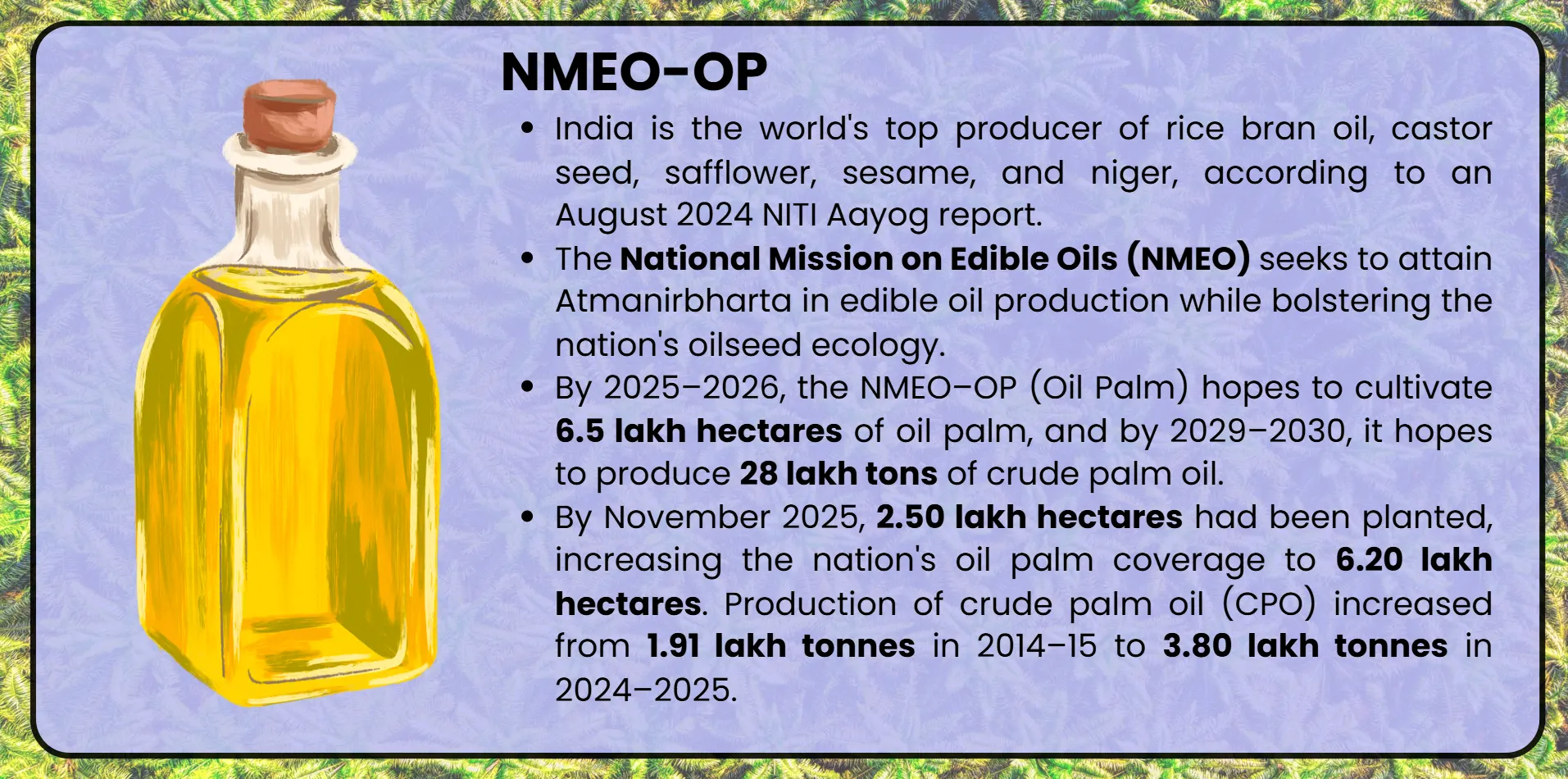
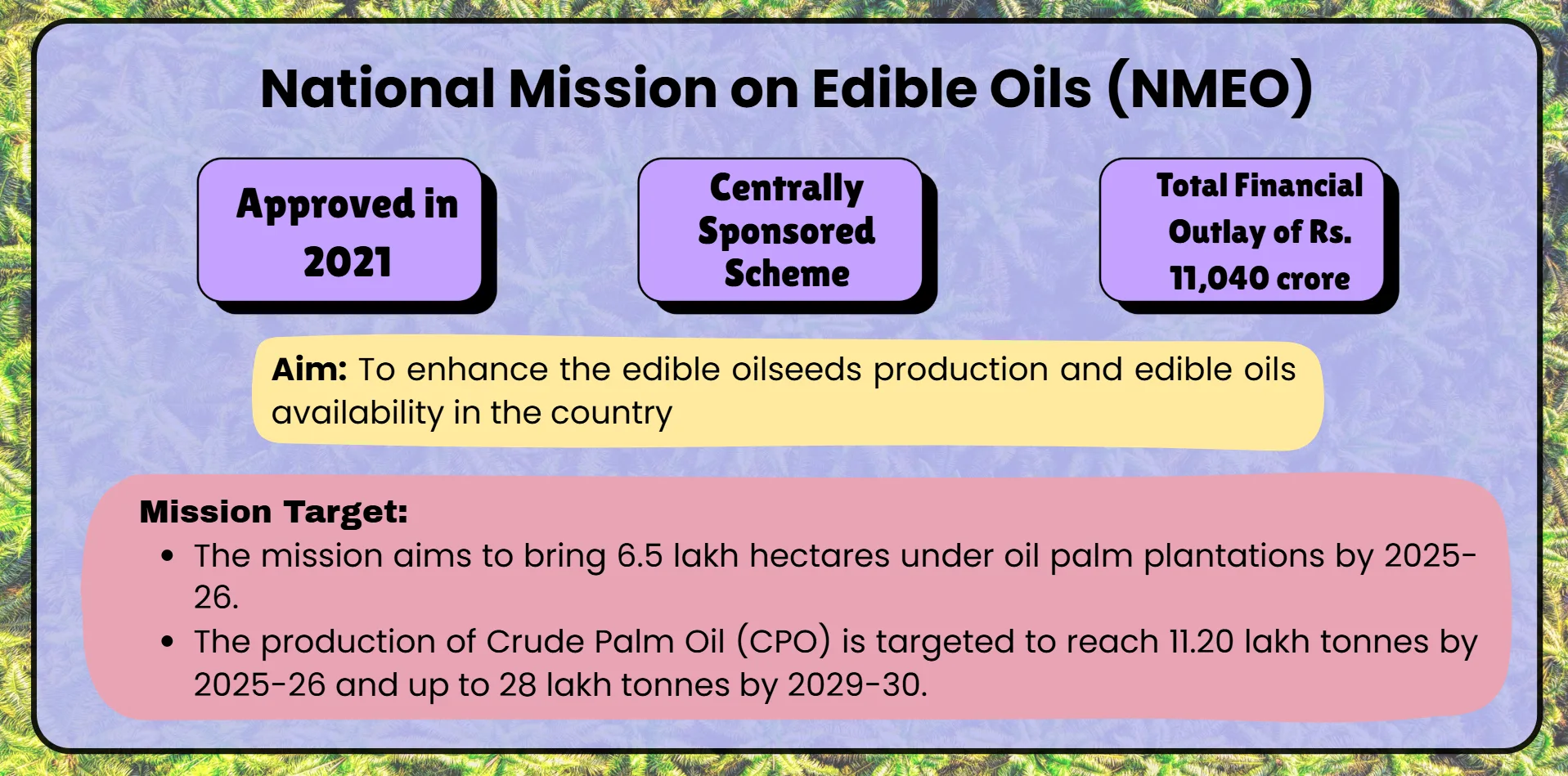
Having realised the urgency of decreasing the reliance on imports, the Government of India presented the NMEO-OP in 2021. The mission aims at increasing oil-palm plantation to 6.5 lakh hectares by 2025-26 and growing crude palm oil to 28 lakh tonnes by 2029-30. Further, it also deals with oil-bean growth as part of the National Mission on Edible Oils – Oil Seeds (NMEO-OS), which aims to ensure that the oil-bean production rises to almost 70 million tonnes by 2030-31 (an increase of 39 million tonnes). These are in line with the larger vision of achieving Atmanirbharta in edible oils, which is self-reliance.
Strategic Importance
The project is not just an agricultural project but an economic venture. NMEO-OP aims at boosting the incomes of farmers, eliminating the foreign-exchange payments and stabilising the domestic markets by promoting the growth of oil-palm production on appropriate agro-climatic locations. The mission emphasises the research, agriculture, refined breeding systems and cluster-based interventions to strengthen the value chain and incorporates into the mission the environmental conservation measures to maintain biodiversity and ecological integrity.
Context
With the opening of NMEO-OP, there is an extensive point to the agricultural and trade policy in India. The mission also aims to resiliently and sustainably transform rural communities through a restoration of structural imbalances in the production of edible oils, as a way of protecting nutritional security and empowering rural communities. Its final success will depend on proper implementation, the involvement of farmers and whether it will be possible to reconcile the economic development process and environmental sustainability.
Objectives of the Mission
The National Mission on Edible Oils-Oil Palm (NMEOOP) was set up in an attempt to curb continuous dependence on imported oils by India. Its goals are multidimensional as they involve economic self-sufficiency, welfare of the farmers and environmental sustainability.
Domestic Production
One of the primary goals of the NMEO-OP is to increase the production of edible oil in the country by encouraging the cultivation of oil palm in agro-climatic areas. The mission targets to plant 6.5 lakh hectares of oil palm by the year 2025 to 2026 and increase the production of crude palm oil by an amount of 28 lakhstonnes by the year 2029 to 30. This growth is meant to reduce the level of imports, stabilise supply and strengthen the food and security structure in India.
Farmer Income Security
One of the secondary, but key, objectives is to protect the welfare of farmers and stabilise their income. The mission offers financial support for the planting, irrigation, and processing units in addition to a price-assurance mechanism. Through the assurance of a fair and compensatory payment, NMEO-OP will work towards motivating farmers to participate and remove risks related to market volatilities.
Value Chain Development
The mission is to focus on strengthening the edible oil value chain through the partnership between the government and the private sector, research and technology transfer. Among these goals are building up modern processing facilities, improving the quality of the seeds and developing novel cultivation methods. NMEO-OP aims to create a robust ecosystem by engaging stakeholders in production, processing, and marketing to the advantage of producers and consumers.
Environmental and Sustainability
A key mission is to facilitate a balance between growth and environmentalprotection. The mission supports sustainable agricultural activities, discourages deforestation, and embraces water-efficient technologies. With this in mind, NMEO-OP seeks to make sure that biodiversity or ecological health, in the long run, and will not be negatively influenced by the increase in edible oil production.
Implementation Strategies
The effectiveness of the National Mission on Edible Oils-Oil Palm (NMEO-OP) will be dependent on well-planned implementation plans. These measures combine financial aid, institutional processes and greenbelt missions, thus strengthening the edible oil sector in India.
Farmer Support and Financial Support
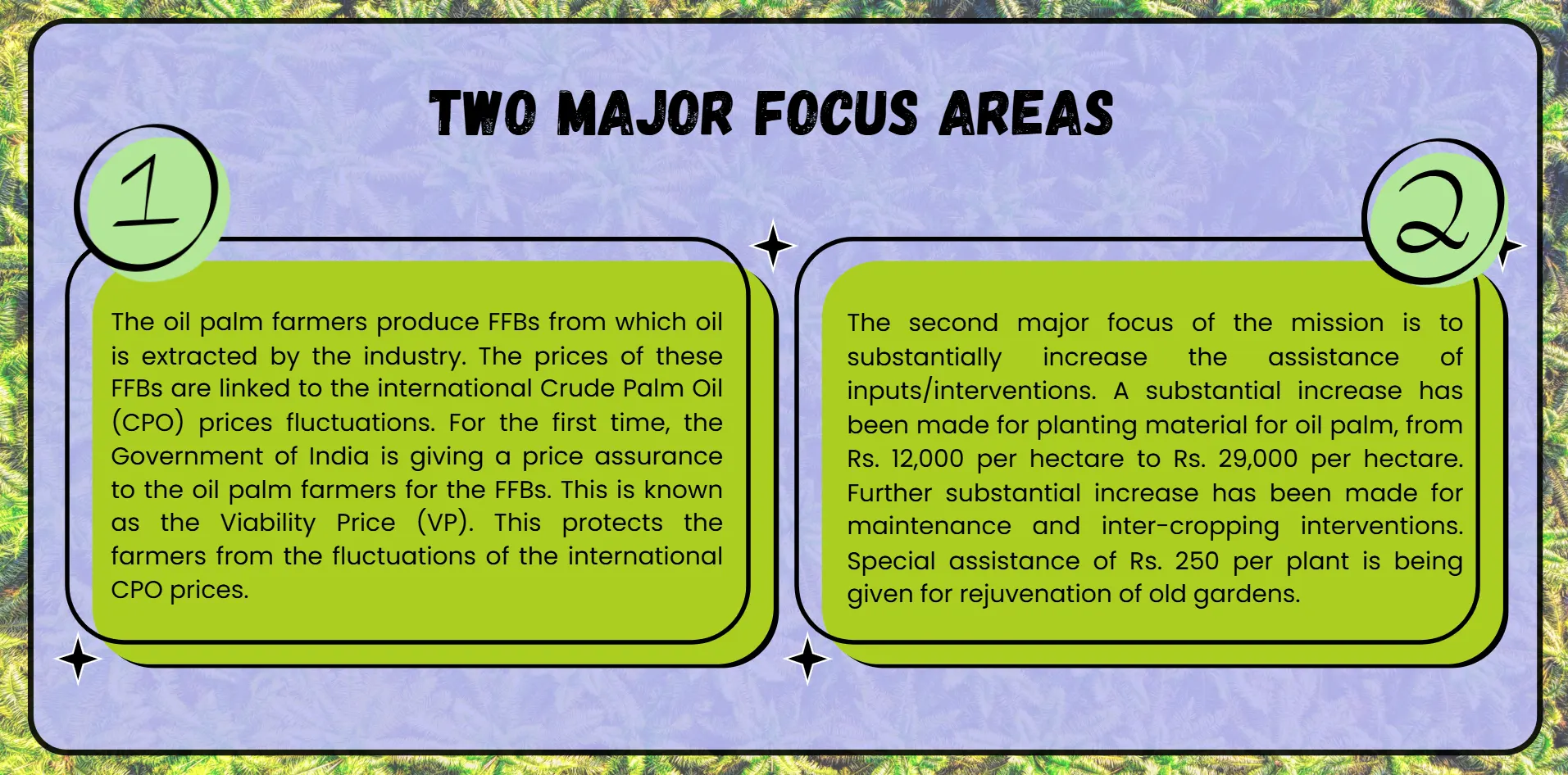
One of the major plans includes the direct financial aid offered to the farmers to plant material, irrigation and other ancillary inputs. The mission provides benefits such as nursery setting, drippy irrigation systems and inter-cropping aid. There is also an assurance of price that will ensure farmers get a good and compensatory price, hence reducing the risks that accompany the volatility of the market and encouraging farmers to adopt the production of the oil palm.
Infrastructure and Development of the Value Chain
NMEO-OP focuses on the development of all value chain infrastructures, including facilities that support seed gardens, processing mills and storage facilities. Collaboration between the government and Non-Governmental Organisations (NGOs) is encouraged to introduce modern processing facilities, and they would guarantee the timely acquisition and control of post-harvest losses. Through strengthening backward and forward relationships, the mission tries to produce a robust ecosystem, which brings about benefits to the producers and consumers.
Research, Extension and Capacity Building
One more strategic move that is critical is the investment in the research and extension services. The mission promotes high-yielding and resistant varieties of crops and the transfer of technology to farmers. Capacity building involves training programmes, demonstration plots and farmer field schools as some of the necessary elements. These programs aim at improving the production, increasing knowledge sharing and promoting innovation in agricultural methods.
Sustainability and Environmental Protection
Ecological sustainability is also a priority in the implementation strategies. The spread of oil palm is limited to the agro-climate zones, and thus, the ecologically sensitive areas are avoided. It encourages the use of water-efficient technology, intercropping concepts and soil conservation strategies to reduce environmental impact. Through integration of the sustainability measures, NMEO-OP aims at balancing economic development and protection of biodiversity and long-term ecological health.
Impact & Way Forward
The National Mission on Edible Oils-Oil Palm (NMEO-OP) is a strategic intervention to ensure that India does not depend on imported edible Oils. Its effectiveness is evident in economic, social, and environmental levels, but the future course of its development and the continuation of policy innovation and technologies aimed at farmers-centric long-term policies.India's National Mission on Edible Oils (NMEO) (specifically NMEO-Oil Palm, NMEO-OP) was needed due to massive import dependency (over 57%), high foreign exchange cost, and to boost farmer income, aiming for Atmanirbharta (self-reliance) in edible oils by boosting oilseed/oil palm production.
Economic and Trade Impact
The major impact of NMEO-OP is that it may lead to the reduction of importation dependency. Currently, India imports about 56%of its domestic consumption, which costs about INR 80,000 crores annually. The mission hopes to stabilize the supply chains, reduce outflows in foreign exchange and improve domestic food security by cultivating more oil-palms and enhancing the production of food by existing oilseeds. This economic reorientation is a direct way towards a self-reliant India as envisioned in the Atmanirbhar Bharat.
Rural Development
The rural communities have a significant socio-economic impact by mission. Financial aid, price guarantee systems, and infrastructural aid contribute to the streamlined incomes of the farmers. Oil-palm cultivation is an agronomy that boasts of high yield potential, which offers long-term livelihood security. In addition, the initiative develops rural jobs by establishing nurseries, processing plants, and value-chain connections, thus centralising rural economies and empowering the smallholders.
Environmental Considerations
Even though NMEO-OP promotes growth, it imposes environmental protection. Growing is restricted to agro-climatic areas that are considered conducive, especially the North-east and Andaman and Nicobar Islands. To reduce environmental hazards, sustainable practices are encouraged through intercropping, water-saving technologies, and soil conservation. The influence of the mission, therefore, goes beyond raw production, and sustainability is entrenched in agricultural development.
Way Forward
The new direction requires integrative strategies. To begin with, long-term funding of research and development is essential for the quality improvement of the seed and yield of the crop. Second, mass awareness and extension services should be strengthened to ensure farmers take them. Third, institutional alignment between central and state organizations is to be enhanced to make it easier to monitor. Lastly, balancing between economic development and environmental management will be essential for long-term sustainability.
Conclusion
The National Mission on Edible Oils-Oil Palm (NMEO-OP) is a policy program aiming to reduce the importation dependency of India, but at the same time ensure agricultural self-sufficiency and improve the condition of farmers. The mission aims at developing a sustainable edible-oil ecosystem through the incorporation of financial support, the development of infrastructure, research programmes and ecological protection. Its success in the long term, though, will depend on proper implementation, active involvement of farmers and the balance between the economic progress and environmental management. With the evolution of self-reliance of India in edible oils, the NMEO-OP is likely to become a pillar of food security, empowerment of rural communities and eco-friendly growth in the wider context of Atmanirbhar Bharat.