|
Key Highlights
- Increasing Threats of Bio-weapons
- India’s Vulnerabilities
- Biological Weapons Convention
- Non-State Actors
- Strengthening Human Capital
- Global Roadmap for India
|
India faces the increasing biosecurity threats, laboratory-gone-wrong, and bioterrorism. Biological Weapons Convention (1972) outlaws the development and use of biological weapons, but the structures in place to enforce the treaty are characteristically ineffective, leaving huge gaps in the international system. The presence of non-state actors who take advantage of synthetic biology and dual-use technology has raised the severity of the threat landscape. To this end, India should enhance epidemiological surveillance, biosafety laboratories, rapid diagnosis capacity, inter-agency resonance, and further international collaboration in order to protect the health, safety, and national strength of the population.
|
Tips for Aspirants
In reference to the UPSC CSE and State PSC exams, which involve governance, security, international treaties, and new biosecurity threats as some of the topics in the General Studies and essay writing, this article is especially relevant.
|
|
Relevant Suggestions for UPSC and State PCS Exam
- Biosecurity in India: Weakness in surveillance, skewed healthcare systems, insufficient biosafety testing facilities, and fragmented governance.
- Biological Weapons Convention (BWC): The first multilateral convention, which outlawsbiological weapons (1972); it does not provide strong check methods; India is also a signatory.
- Non-State Actor Threats: Terrorist organizations take advantage of synthetic biology, gene editing, and open-source data; the cyber-biological nexus makes it more dangerous.
- Way Forward for India: Instil a national biosecurity organization, increase the BSL-3/4 scientific laboratories, enhance surveillance systems, and make investments in rapid diagnostics.
- Human capital and awareness: Educating scientists and other security agencies, and integrating biosecurity education and public awareness to counter the misinformation.
- Global roadmap for India: Taking a proactive involvement in BWC conferences, promoting greater polarization, and strengthening international cooperation and capacity building.
|
Biosecurity has become an important aspect of national security in the twenty-first century, and this can be influenced by the two forces that are converging, which are global pandemics and the blistering growth of biotechnology. These are of utmost concern in a country like India, which is ecologically diverse and is a populous country. COVID‑19 revealed public health system vulnerabilities in any country, at the same time highlighting the risk of biological weaponry abuse by both the state and non-state actors. In this regard, the Biological Weapons Convention, which was implemented in 1972, is a milestone international treaty that prohibits the manufacture and use of biological weapons, but its mechanisms of control are still not yet adequate, leaving loopholes in the worldwide regulations. Further, the processes of biological agent Weaponisation by extremist groups and non-state players have become more efforts since the democratization of biotechnology via synthetic biology, genome editing, and open source research has reduced the barrier to entry, allowing non-state actors and extremist groups to potentially use biological agents in combating governments through preemptive strike.
It is along this backdrop that the biosecurity preparedness of India needs to be looked into, especially regarding laboratory safety and surveillance, but also in respect to the inter-agency coordination, international collaboration, and the awareness of the masses. It is thus important to strengthen biosecurity in order to ensure national resilience, safeguard the population's health, and increase the participation of India in international security systems.India's biosecurity imperative stems from its significant vulnerabilities to biological threats, which necessitate the establishment of a unified and modern national framework.The Biological Weapons Convention (BWC) effectively prohibits the development, production, acquisition, transfer, stockpiling and use of biological and toxin weapons. It was the first multilateral disarmament treaty banning an entire category of weapons of mass destruction (WMD).
Bio-Security Gaps and Challenges in India
The biosecurity system has been stretched in India according to rapid developments in biotechnology, experience in pandemics, and the increasing danger of bioterrorism. These obstacles will only be met by institutional reforms and coordinated governance.India faces significant biosecurity gaps, including fragmented laws, poor inter-agency coordination, weak surveillance, and vulnerability in agriculture/health sectors, requiring a unified national framework, modern tech adoption (AI, genomics), upgraded labs, updated laws for biotech, and better international collaboration.In 2025, India face critical biosecurity gaps and challenges driven by rapid biotechnological advances and a fragmented regulatory landscape.
Public Health Vulnerabilities
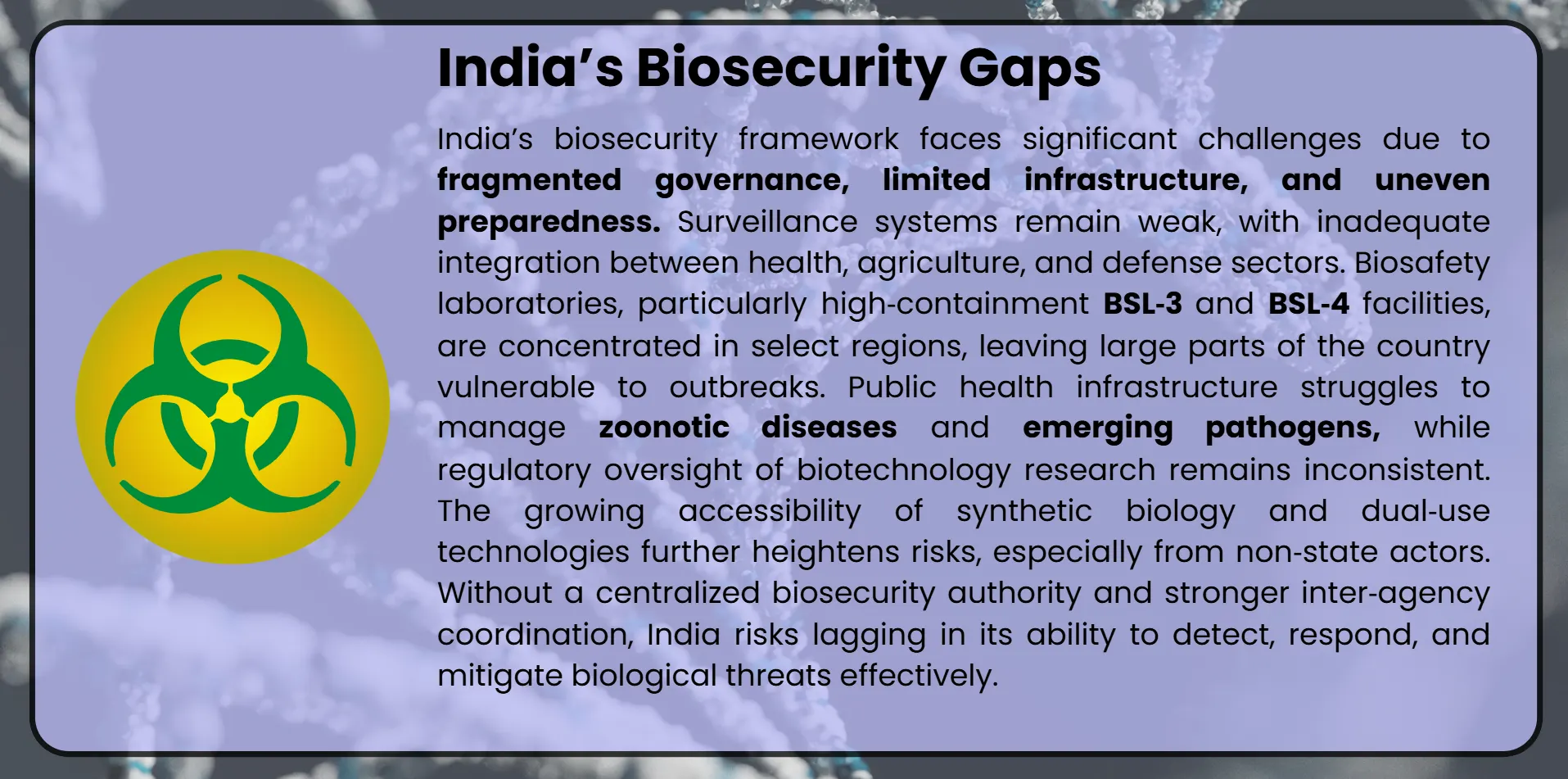
The large population and the imbalance in the healthcare facilities make India quite vulnerable to sensational dangers. COVID-19 demonstrated lapses in disease surveillance, testing capacity, as well as emergency response mechanisms. Zoonotic and infectious diseases are particularly prone to outbreaks in rural zones, which lack adequate healthcare facilities, and are one of the most vulnerable spheres. Lack of a singular national policy of biosecurity also makes it difficult to ensure coordination of health, agriculture, and defense in the face of preparedness and response gaps.
Laboratory Safety and Infrastructure Fortunes
India has some of the biosafety laboratories, such as BSL-3 and BSL-4 that are not distributed evenly but are found within limited areas. Most of the laboratories that deal with pathogens do not have standard safety measures, proper training, and external control. It increases the possibility of poor management or unintentional leakages of biological materials. Additionally, disjointed regulatory initiatives regulating biotechnology research do not support effective checking of the dual-use technologies, in which they can be used to fulfil both beneficial and harmful outcomes.
The Non-State Actors:Emerging Threats
Non-state entry has been reduced by the democratization of biotechnology by synthetic biology, as well as through gene editing and open-source systems. Pathogens or toxins could be used by extremist groups and terrorist organizations with the aim of exploiting this vulnerability in the enforcement of Indian biosecurity. It is also compounded by the fact that the cyber-biological nexus is an area where digital information regarding genetic sequences can be misapplied. The current legal and institutional practices in India are not adequately ready to address these new threats.
Deficits of Governance and Policy
India is a signatory to several international conventions, like the Biological Weapons Convention (BWC); however, the implementation is still very weak because strong mechanisms of verification are not in place. Locally, biosecurity has been distributed among various ministries, and this has resulted in duplication and ineffectiveness. It is suggested by experts that a dedicated national biosecurity agency be established in order to centralize supervision, intensify inter-agency movements, and mitigate biological harm in the wider national security planning. The future of India without such reforms is that the country will be way behind in overcoming the bio threats of the future.
Biological Weapons Convention (BWC)
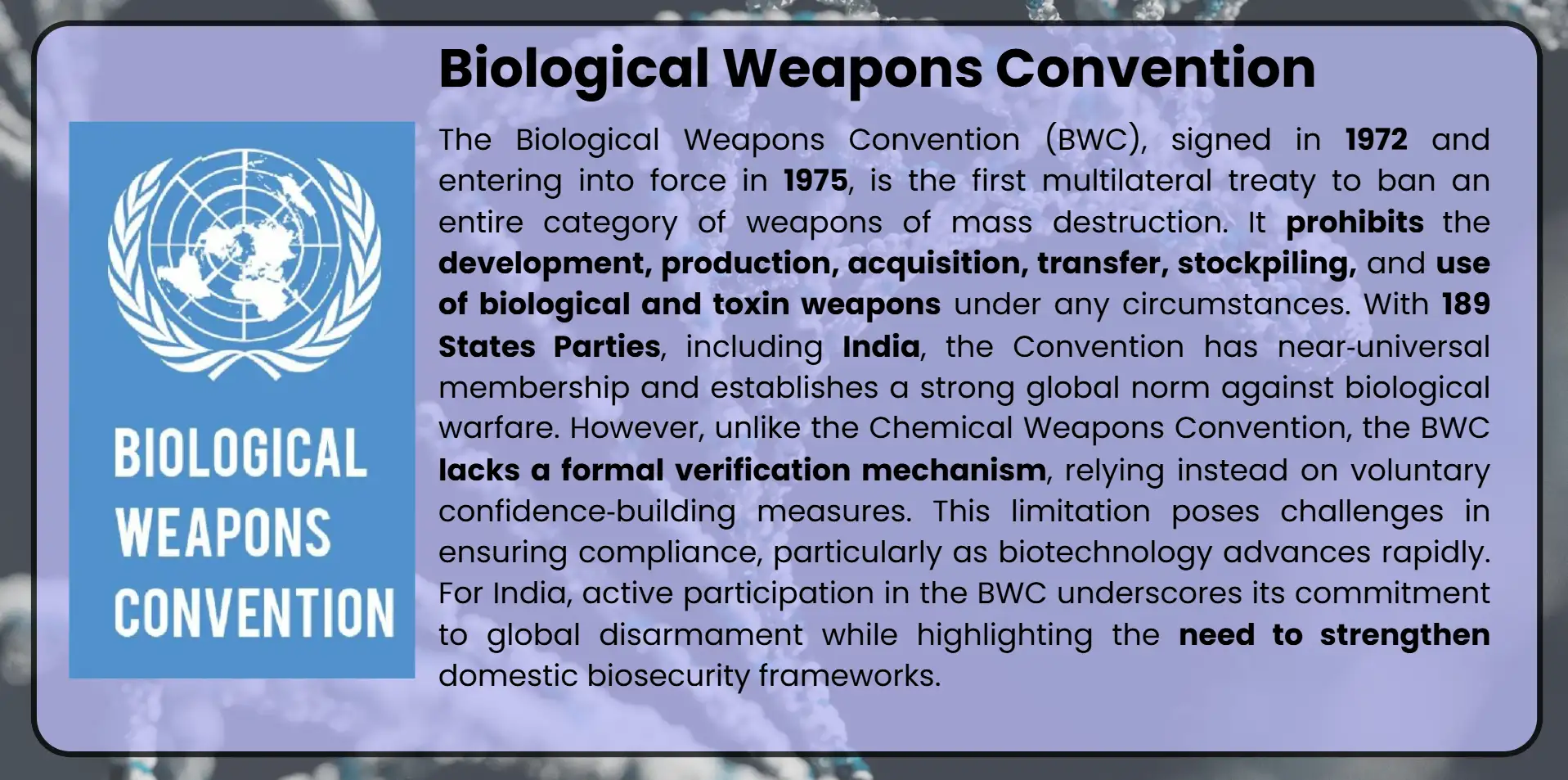
The Biological Weapons Convention (BWC) is one of the landmark conventions, containing direct prohibitions of the development, production, and use of biological weapons to reflect an international agreement against destructive power.The Biological Weapons Convention (BWC) is a global, legally binding treaty that bans the development, production, acquisition, stockpiling, and use of biological and toxin weapon.
Historical Background and Foundations
The BWC was signed in 1972 and came into effect in 1975, becoming therefore the first multilateral disarmament instrument to outlaw a complete type of mass destruction weapons. Its history goes further to the precedent of international efforts, especially the Geneva protocol of 1925, which prohibited the use of chemical and biological weapons, but not their development and acquisition. The pressure of heightened anxieties in the Cold War led to a call to have a more comprehensive framework in order to prevent proliferation, and as such, led to the incentive to negotiate the BWC by the states.
The main Levels of the Convention
The Convention establishes a total ban on the development, production, procurement, selling, inventories, and use of biological and toxin weapons regardless of the circumstances. It compels State Parties not only to destroy their remaining arsenals but also not to help other participants of the game to acquire those weapons. Most importantly, the BWC does not deny the dual-use character of biotechnology, but it does allow peaceful uses of biotechnology in medicine, agriculture, and industry, and prohibits aggressive applications. The treaty now has 189 State Parties, which is close to a universal membership.
The difficulties in Implementation and Verification
Although the BWC is powerful normatively, the lack of a formal mechanism of verification provides the BWC with serious challenges. Unlike the Chemical Weapons Convention, which is managed by the Organisation for the Prohibition of Chemical Weapons (OPCW),the BWC relies on the voluntary confidence-building mechanisms and self-reporting of states. This methodology has flaws that create gaps in enforceability, especially with the rise in the dynamism of biotechnology matters. Any efforts to come up with a verification protocol in the 1990s proved futile due to the differences in the stance of the member states, thus making the treaty prone to non-compliance.
Modern Relativism and the Indian Position
The BWC is still highly relevant in the twenty-first century, when synthetic biology, genetic engineering, and bioinformatics expand the range of positive and negative usage. Emerging threats are posed by non-state actors, such as terrorist groups, which might use the biotechnological developments to conduct bioterrorism. India, being a signatory, has continuously supported the goals of the Convention and has emphasized the need to increase international cooperation, capacity building, and equal access to the peaceful uses of biotechnology. The enhancement of the biosecurity structures in India, as well as the participation in the global governance, is crucial to the advancement of the strategic and humanitarian component of Indian interests.
Threat from Non-State Actors
The menace introduced by non-state actors in the context of biological security has become more significant than ever before, as new technological developments and international interconnections pose few obstacles to obtaining and misuse of biological means.Non-state actors (NSAs) pose significant threats by destabilizing governments, engaging in terrorism, cybercrime, and economic disruption, using asymmetric tactics like proxy warfare, drones, and illicit finance to challenge state authority and international security.
Increasing the Non-State Actor Capabilities
Terrorist organisations and other extremist actors that make up non-state actors are increasingly able to use biotechnology as an instrument of ill intent. The availability of synthetic biology, gene editing, and open-source genetic information has reduced the technical skills needed to handle pathogens. This is a positive trend of democratizing science, which facilitates innovation, but at the same time, opens opportunities. These actors may cause disastrous consequences due to the possible abuse of pathogens or toxins and may lead to an outbreak at local or even international levels.
Bioterrorism as a Strategic Tool
Biological weapons are attractive to non-state actors as they can cause a lot of disruption at a comparatively reasonable cost. In comparison with traditional arms, biological agents have the ability to spread unseen, crush health care facilities, and instil terror among the masses. The External Affairs Minister S.Jaishankar recently pointed out that the threats of non-state actors using bio-weapons are no longer as far-fetched, and the significance of enhancing biosecurity institutions and mechanisms around the world is desperately important. Biological attacks are covert and hence attribution is difficult, which in turn complicates deterrence and response planning.
Cyber‑Biological Nexus
This is brought by the merging of cyber and biological to add another layer to the threat. Non-state actors can use digital systems to gain access to genetic codes, spread Weaponisation methods, or strain bioinformatics systems. The rise of online sources and open databases increases the danger of a dual-use misuse whereby the lawful scientific information can be reused for malicious purposes. This cyber-biological nexus increases the vulnerability since attacks can take place in the realm of the virtual, but with a physical crisis in health.
Challenges in Policy and Governance
Bio-weapons conventions (Biological Weapons Convention) have weak verification processes to ensure adherence and to detect non-adherence in world policies. These gaps are exploited by non-state actors who do not have the obligations of a treaty. In the case of India, organized inter-agency coordination and investment in surveillance systems can help to identify abnormal epidemics, and hence, it enhances the domestic biosecurity structures. The international collaboration, sharing of intelligence and capacity building has continued to play a crucial role in ensuring that the developing threat situation is addressed.
Way Forward for India
The preparedness of India to biosecurity requires a proactive approach involving the combination of innovative use in science and reform of governance with global partnerships to deal with the changing threats of biology and protection of national resilience. India's way forward against non-state actor threats involves a multi-pronged strategy: strengthening cyber defenses (DCyA), enhancing financial intelligence, proactive diplomacy, border security, and community engagement, while also upgrading biosecurity with national frameworks, tech like AI/microbial forensics, and international cooperation.
Empowerment of Institutional Structures
India needs to put in place a centralized biosecurity authority and have responsibilities that are currently split among several ministries consolidated. It would establish a coordinated policy, a unified response, and a quick response in case of biological emergencies. This kind of agency may be able to combine health, agriculture, defense, and environmental sectors, thus cutting down duplication and boosting accountability. Such a structural reform is necessary to fix the broken governance that currently affects the biosecurity preparedness of India.
Enhancing Laboratory and Surveillance Capacity
Development of biosafety labs, especially the BSL-3 and the BSL-4, is essential in identifying and isolating dangerous pathogens. India must focus on equal allocation of such laboratories or allocation across geographical areas so as not to have them concentrated in the metro centres. Besides the physical infrastructure, the enhancement of disease surveillance systems and the simultaneous inclusion of real-time data analytics would facilitate prompt identification of an unusual epidemiological situation. Improved levels of diagnostic and genomic sequencing facilities have the potential to give quicker details about the impending threats, which would enhance preparedness.
Developing Human Capital and Social Enlightenment
Biosecurity is more of a human rather than a technological problem. India needs to invest in creating training for scientists, health care professionals, and security agencies on the biosafety measures and dual-use risk management. During the biological crisis, evangelism among the populations can decrease misinformation and increase community resilience. By promoting responsible research and by integrating biosecurity education into academic programs, ethical research practice will be promoted as well, and future generations of scientists will be won over to the idea of accountability.
Improving International Cooperation
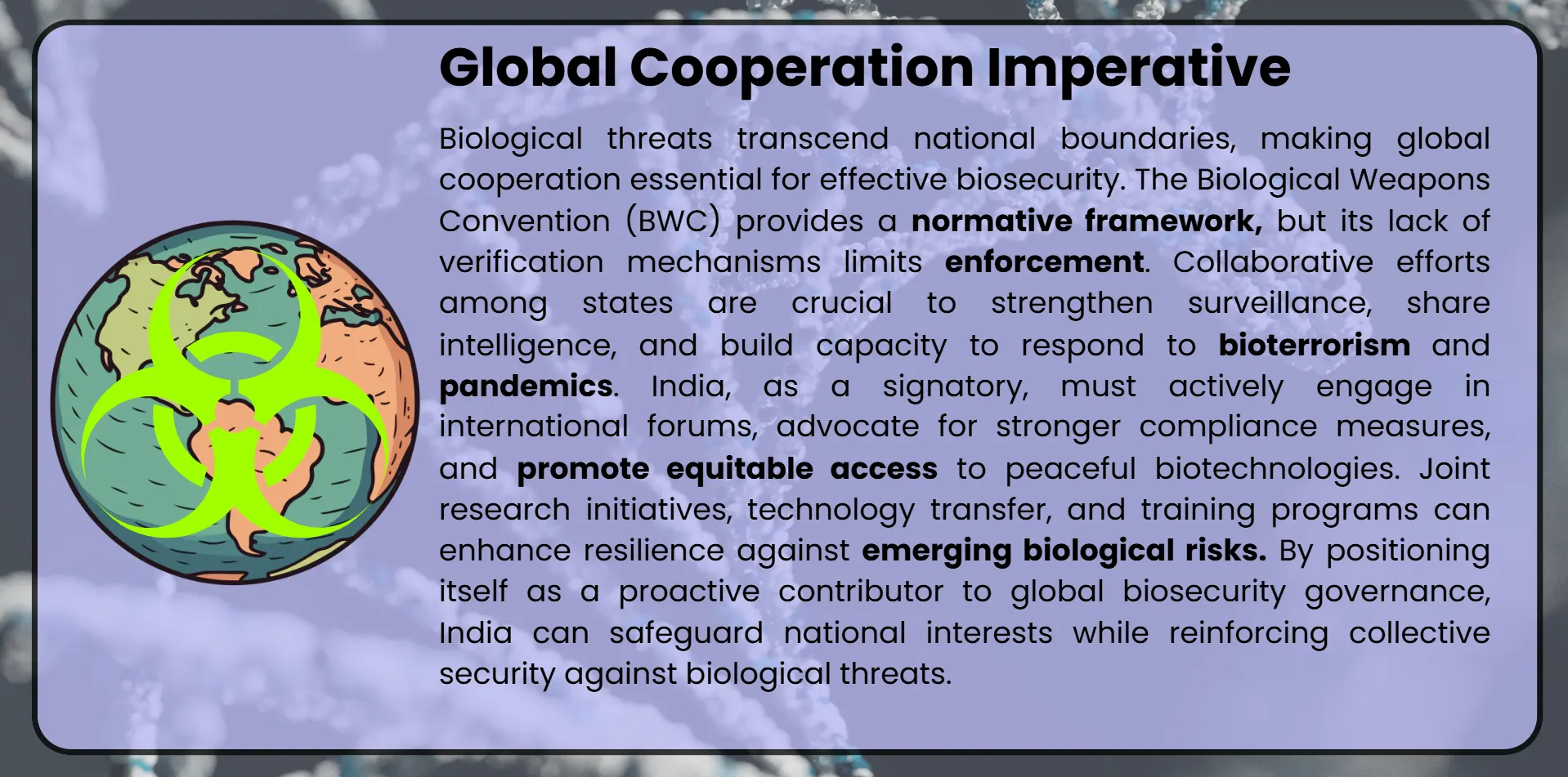
The interest of India in global biosecurity governance should be reinforced by participation in the Biological Weapons Convention (BWC) and other meetings. Cooperation with foreign partners in the field of capacity building, the exchange of technologies, and joint drills can be more effective in terms of preparing against transnational biological threats. India also ought to support the idea of instituting stricter verification provisions in the BWC so as to bridge the loopholes in enforcement. Having established itself as a biosecurity diplomat in the region, India is able to reconcile national interests with international humanitarianism.
Conclusion
The preparedness of India to biosecurity is at a critical predicament influenced by the twin forces of health crisis in the world and the changing biotechnological risks. Although the Biological Weapons Convention is a significant normative framework whose limitations are apparent in its enforcement, more powerful national efforts are required. Risks continue to increase due to the growing aspects of non-state actors and require vigilance and resilience. In the case of India, the way ahead would be to improve institutional structure, increase lab and surveillance capacity, strengthen public awareness, and further intensify international collaboration. A holistic approach to biosecurity will protect national well-being and stability, and implement India’s responsibility as a stakeholder in world governance.