Chemical parks play a crucial role in boosting independency by offering shared infrastructure, cutting costs for businesses, and promoting local supply chains. In India, this push is being further strengthened by the Union Budget 2026–27. The chemical parks have been anticipated in the Union Budget 2026-27, which proposes three chemical parks with an amount of 600 crore rupees. The phenomenon itself is noteworthy since it is the first specific financial year push by India for the infrastructure of chemical parks.
|
Key highlights
- Chemical Parks and Their Significance
- Chemical Sector of India
- Strategic Role of Chemical Parks for India
- India’s Environmental and Safety Imperative
- Future Outlook of Chemical Parks for India
|
The Union Budget 2026-27 is a sharp policy intervention in the chemical industry of India by the announcement of three chemical parks, which are supported by an annual allocation of 600 crore rupees. These parks, in line with the general objective of cluster-based industrialisation, are planned to be integrated by offering plug-and-play infrastructure, combined utilities, and balanced administrative processes. The program would consolidate the manufacturing power in the country, and curb dependence on imports, as well as improve global competitiveness, and match the sustainability requirements with the supplementary investments of Carbon Capture, Utilisation and Storage (CCUS). Taken together, these actions highlight the strategic goals of India as regards industrial resiliency and responsible growth as far as the environment is concerned. It is important because it strengthens national production, reduces reliance on imported goods, incorporates MSMEs, and helps achieve sustainable macroeconomic development through common production facilities and carbon-saving technologies.
Union Budget FY 2026-2027: Chemical Parks and their Significance
Chemical parks are carefully planned industrial areas created specifically for chemical manufacturing. They bring companies, suppliers, logistics services, and research facilities together in one secure location to make production and distribution more efficient. The declaration of specific chemical parks in the Union budget 2026-27 of the Union budget is a historic change in the Indian industrial policy. It embodies the economic interests as well as the sustainability needs.
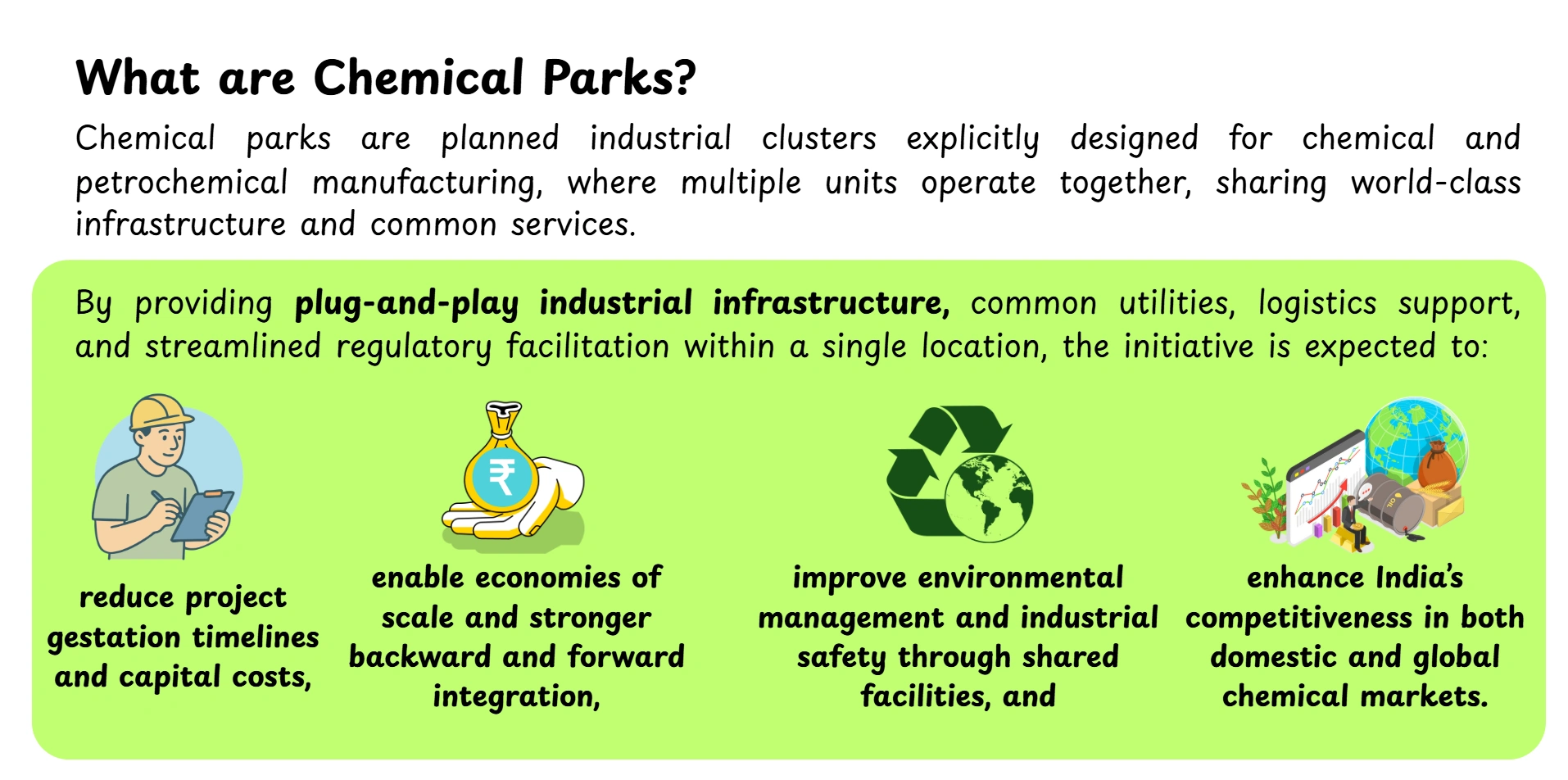
Chemical parks are purpose-built industrial hubs for chemical and petrochemical manufacturing, offering shared facilities such as pipelines, waste treatment systems, and logistics services to make operations more efficient and cost-effective.
Chemical Sector of India
India stands as the 6th largest chemical producer in the world, and 3rd in Asia, as it adds about seven percent to the national GDP. The Economic Survey 2025-26 points out that the sector contributed to 8.1 percent of the manufacturing gross value added in FY24, and production increased by 58,617 thousand metric tonnes in FY25, compared with 45,638 thousand metric tonnes in FY16, which represents a compound annual growth rate of 2.8 percent. These numbers highlight the structural significance and trend of development of the sector.
The Indian chemical industry is a significant and diverse sector, ranking as the world's sixth-largest producer and third in Asia, contributing around 7% to India's GDP, with major hubs in Gujarat and Maharashtra and covering over 80,000 products like bulk chemicals, specialty chemicals, agrochemicals, and petrochemicals
Policy Significance of Chemical Parks
The 600 Crore allocation to spend on the 3 chemical parks is the first attempt at providing budgetary support to the chemical cluster. A plug-and-play model is adopted by the initiative that will minimize the project gestation timelines, enhance the integration of supply chains, and introduce local and international investment. Chemical Parks are strategic, policy-driven industrial clusters designed to boost India's chemical sector through "plug-and-play" infrastructure, shared utilities, and improved environmental compliance.
Increasing Indian Self-Reliance
In addition to economic benefits, the initiative will combat reliance on imports in essential chemical segments. It incorporates MSMEs into structured value chains, thus making them competitive and employment-generating.
Sustainability Imperatives for India
In accordance with the 20,000 crore rupee investment in Carbon Capture, Utilisation and Storage (CCUS), chemical parks offer collective environmental facilities, which support the economic viability of the implementation of clean technologies and strengthen the governmental efforts to develop industrial processing as a sustainable development practice.
Strategic Role of Chemical Parks for India
Chemical parks are an important part of India’s industrial strategy, serving as ready-to-use hubs that help companies start operations faster, cut capital costs, and strengthen linkages across the supply chain. The establishment of Chemical Parks, as approved in the Union Budget 2026-27, is a calculated move towards cluster industrialization. This move incorporates infrastructure growth, green operations, and competitiveness to strengthen the chemical industry in India.
Increasing India’s Domestic Manufacturing
The chemical parks are designed to provide plug-and-play infrastructures, thus reducing the gestation period of a project and limiting capital investments. According to the Economic Survey 2025-26, the chemical production in India has grown from 45,638 thousand metric tonnes of chemical production in FY16 to 58,617 thousand metric tonnes in FY25, an expression of 2.8 percent compound annual growth rate. Such a growth curve confirms the additional need for integrated facilities to continue the movement.
Integration of the Supply Chain and Indian MSMEs
Unit concentration in Chemical Parks helps enhance economies of scale, as well as forward and backward integration, and improves logistics. This setup assists MSMEs in being integrated into organized value chains, thus enhancing competitiveness and creating jobs.
Investment and Global Competitiveness
Sharing of infrastructure and regulatory facilitation reduces the cost, thus making India more attractive to local and foreign investors. The parks are expected to solidify the position of India in the market of specialty chemicals, which is a setting or industry where demands prioritize innovation and cost effectiveness.
India’s Sustainability and Safety Imperative
Chemical Parks equally provide generic environmental infrastructure, which promotes programs like the Carbon Capture, Utilisation and Storage (CCUS). This integration will ensure that the global levels of safety and standards are followed, and also that the low-carbon industrial transition in India is driven.
India’s Environmental and Safety Imperative
The rapid growth of the Indian chemical industry needs strict environmental protection and full systems of industrial safety. These imperatives are met through the Union Budget 2026-27 through investments that are of a targeted nature and the core infrastructure planning.
India’s Low-Carbon Transition Mission
A five-year outlay of INR 20,000 crore for developing Carbon Capture, Utilisation, and Storage (CCUS) technologies is highlighted in the budget 2026. CCUS also has a critical part to play in ensuring that the emissions released by energy-intensive industries, such as chemicals, are stopped through the trapping and re-use of the carbon dioxide that is released before being discharged into the atmosphere. This project aligns with the general climate commitment undertaken by India in the Paris Agreement.
Shared Environmental Infrastructure in Chemical Parks
Chemical Parks will be set up to provide the common treatment plants of effluents, waste management, and the energy saving utilities. Such common facilities decrease the cost of compliance yet remain in line with the international environmental standards. The empirical observations prove that the management of waste, to some substantial degree, reduced the unit cost of treatment, which supports positive sustainability outcomes.
Improving Indian Industrial Risk Management
Cluster-based development promotes coordinated safety audits, emergency response teams, and hazard management apparatus. Such practice reduces the risk associated with the hazardous work and strengthens resiliency. According to the 2025 report of NITI Aayog, the compliance rates are promoted with the use of incorporated safety infrastructure over those of individual units, which are above thirty percent.
Strategic Importance for India
Through the incorporation of environmental and safety concerns as essential within the Chemical Parks, India is ensuring its industrialization is competitive and sustainable, therefore ensuring that India consolidates its rise as a reliable international source of chemical production.
Future Outlook of Chemical Parks for India
The Chain of Chemical Parks program declared in the Union Budget 2026-27 is an indication of a revolutionary route to the Indian chemical sector that will integrate infrastructure, sustainability, and competitiveness as the foundation of long-term industrial development.
Expanding Indian Chemical Manufacturing and Value Chains
The country has also achieved a consistent growth in the value of its chemical production, whereby the production stood at 45,638 thousand metric tonnes in FY16 and 58,617 thousand metric tonnes in FY25, hence a CAGR of 2.8 percent (Economic Survey 2025-26). Chemical Parks are argued to push this trend by cutting down on the project timelines, economies of scale, and adoption of MSMEs into organised supply systems.
Strengthening India on Global Market
The plug-and-play model, which will be facilitated by a 600 crore allocation, will help in attracting domestic and foreign investors. The segment of specialty chemicals is still a high-growth market (IBEF, 2025), and the parks will enable India to be stronger in this market by improving efficiency and innovation.
Enhances India’s Sustainability and Climate pledges
The 20,000 crore investment in Carbon Capture, Utilisation and Storage (CCUS) adds up to the parks by entrenching the low-carbon technologies in industrial clusters. The shared environmental infrastructure will provide cost-efficient adherence to the global sustainability standards.
A Long-term Industrial Resilience in India
All these measures are likely to create job opportunities, facilitate import substitution, and strengthen the development of India as a trusted chemical production centre that balances the industrial development with the local environmental concerns and international competitiveness.
Conclusion
The main achievement that is pushing the industrial policy of India is the declaration of special Chemical Parks in the Union Budget 2026-27. It will address and resolve structural problems by integrating cluster-based infrastructural, environmental protection, and carbon capture systems, in turn promoting competitiveness and building sustainability. It is intended to boost investment, domestic production, and reduce reliance on imports. Chemical parks in India create a hub of both efficiency and environmental management in the global chemical value chain as a component of the global climate commitments.