|
Key Highlights
- Evolution of Indian Voters
- Dual Role of Citizens
- Democratic Maturity
- End of Identity Politics
- Sustainability as Political Credibility
|
The history of Indian elections over five decades shows the metamorphosis of the Indian electorate into an identity-seeking voter, to the understanding citizen-auditor. The modern electorate does not just require economic prosperity but social justice and the sustainability of the environment. The governments are hence rewarded in terms of credible delivery and transparency, and sustainability, making resilience a new gauge of political legitimacy in the growing democracy of India.This study examines the link between electoral credibility and political competition by leveraging evidence from India’s technology-driven voting reform, the introduction of VVPAT.
|
Tips for Aspirants
The article is invaluable in the study of the UPSC CSE examination as well as the State PSC examination because it describes the issue of voter evolution, accountability in governance, and sustainability, which remains the focus in the analysis of polity, governance, and social political issues.
|
|
Relevant Suggestions for UPSC and State PCS Exam
- The Indian voter has evolved: no longer has to vote based on identity (caste, religion, and region) but instead based on performance.
- Citizen-auditor role: This role of voter is a participant (citizen) and evaluator (auditor), which requires accountability and transparency.
- Governance and delivery: Reforms in the post-1990s resulted in voters rewarding governments with infrastructure, welfare, and inclusive growth.
- Sustainability surge: Environmental resilience, climate readiness, and social equity now impact the election results.
- Democratic maturity: Voters want governments to strike between growth and long-term sustainability, which is an indication of greater democratic accountability.
- Political credibility: Sustainability and resilience have been brought to be a new measure of legitimacy with regard to governing.
- Relevance to exams: Shows the significance of the themes in policies, administration, development, and environment, as the topics in the spectrum of the General Studies papers and the writing of the essay.
|
Indian history of the last five decades highlights the radical change in the character of the election turnout and the relation of political responsibility. During the initial years of independence, the voting patterns were mainly shaped by identity markers like caste, religion, and region; since that time, the electorate has continued to become an increasingly critical and evaluating power. This development indicates the strengthening of democratic institutions as well as the increase in socio-economic ambitions of citizens. The present-day voter is no longer a spectator in the electoral performance, but is gaining more and more the capacity to be a citizen and an auditor of those in control to perform, be transparent, and credible.In the 1990s, with economic liberalization, the emphasis shifted to growth and development, but over time, the focus of the 1990s has proved to have a wider range of expectations. Modern citizens are also appreciating the reward given to governments that provide material prosperity, but also social equity and environmental sustainability.
The calculated elements of political legitimacy now include climate change, disaster preparedness, and inclusive welfare. Sustainability has, in this regard, become a novel standard of plausibility, a new definition of the tie between the state and society. The Indian voter, thus, represents a growing democracy in which accountability is set against development as well as stability."Half a Century of Mandates" is the title of a specific book chapter and phrase used in various contexts, primarily referring to long-standing government requirements or policies.
The Indian Voter and Development
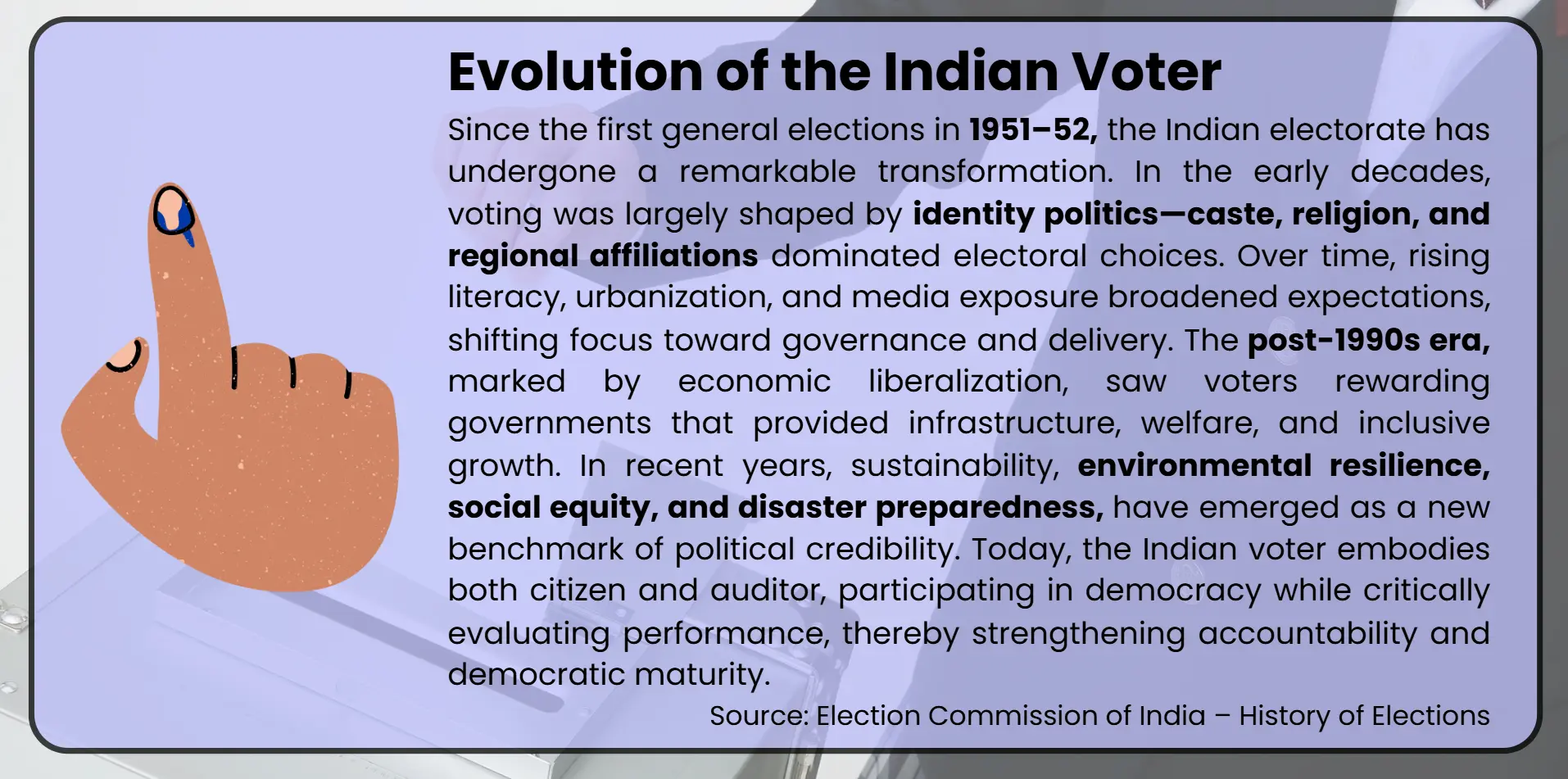
The history of the Indian electorate during the last 70 years is a historic democratic metamorphosis that has reverberated around the world. Starting with the first general elections of 1951-52 and stretching up to the present electoral battles, the voters have experienced a steady maturation process evolving more as an evaluative position within which governance performance, delivery of infrastructure and sustainability are placed ahead of the symbolic and identity-oriented engagements.
The Principles of Universal Suffrage
After gaining independence, India put into the constitution universal adult suffrage, which is a drastic change from the limited franchise of the colonial period. Egalitarian voting rights were embodied in the Constitution, and thus all citizens, regardless of caste, class, or gender, became enfranchised. The moving principle solidified the centrality of the voter to the democratic right to legitimacy as well as accentuated the normative adherence to participation inclusiveness.
Early Decades
Unlike in the past thirty years since independence, in these years, identity politics dominated the election behaviour, which was caste politics, religion politics, and regional politics. These constituencies were actively mobilised by political parties that engaged symbolic representation to mobilise them, and the electoral results often reflected the existing sociocultural partitions towards government, but not their performance.
|
In India, Identity Politics prior to the 1990s
|
|
In the several decades after independence, Indian politics took a factual turn due to identity mobilization. The politics of caste, religion, language, and regional affiliations, which had first manifested themselves in the early electoral arena, turned out to be the center of political competition. In an attempt to present itself as a wide alliance standing across diverse origins, the Congress Party initially tried to market itself as a very wide coalition, but it has been gradually obstructed by regional and community-based movements, which have defied it.
Caste acted as a central axis, particularly because it required social justice and representation. Burgeoning desires to achieve political empowerment were reflected in the rise of backward caste politics in those states, including Uttar Pradesh and Bihar. Similarly, religion also played a role in electoral affiliations and communal tensions that occasionally determined party politics. The linguistic identity also achieved political relevance, and the restructuring of states along linguistic lines occurred in the 1950s and reinforced the regional parties.
In the 1970s and 1980s, identity politics grew even more aggressive and aligned with the strong regional movements. Examples of parties negotiating political power using regional and cultural identities writable of them included the Dravida Munnetra Kazhagam (DMK) in Tamil Nadu and the Akali Dal in Punjab. Even though identity politics provided the representatives of the marginalized groups with the means of representation, it also disrupted the national political space, thus creating the conditions of coalition politics that were to gain significance since the 1990s.
Therefore, before the economic liberalization, Indian politics was a largely identity-oriented constituency, and the ruling as well as the performance was relegated to a second position.
|
After the 1990s
The curve was severely tilted with the liberalisation wave of the 1990s. The electorate was giving higher accolades to governments that managed to undertake infrastructural projects efficiently, increase welfare and promote equality in economic development. This led, in turn, to election decisions that increasingly reflected an increasing demand for efficiency, transparency, and accountability of government and therefore reduced the electorate to an ex post facto role of citizen-auditor, which was now charged to measure the policy commitments against the real performance.
Modern Times
Over time, in the recent past, the electorate has increased its appraisal to include environmental and social resilience. Such vexing issues as mitigation of climate change, disaster preparedness, and fair welfare provisioning have become a critical determinant of voter choice. The rise of sustainability as a standard of political integrity is evidence of the maturation process of the democratic ethos in India.
Move towards Governance and Delivery
This is a conspicuous change in voter behaviour in the democratic scene in India in the last three decades. Previous electoral campaigns were majorly affected by interest politics, but current results are increasingly becoming more reflective of the desire to have good governance, good delivery, and greater responsibility.
Developmental Politics
The liberalization efforts of the 1990s had created new dreams among the citizens. The electorate started to be interested in governments that could provide infrastructure, create jobs, and offer welfare programs. Therefore, development politics replaced the symbolic appeals, and electoral mandates gained more and more rewards for leaders who proved their qualifications in service provision.
Governance Accountability and Transparency
This means that the electorate grew to be more data cautious and critical as democratic institutions evolved. Governments were not just evaluated based on the promises they made during campaigns, but their actual performances, i.e., alleviation of poverty, access to healthcare, and quality of education. This paradigm shift held the voter as an auditor and held the leader to task for failures in governance.
Welfare Programs
The growth of welfare programmes, including those one to do with rural employment to those one to do with food security, continued to strengthen the call towards the concrete delivery. People rewarded governments that promoted inclusive development and thus reduced the social and economic inequalities. The credibility of welfare implementation was more and more reflected in the electoral verdicts instead of rhetorical flourish.
New Metrics
During recent years, there has been an evaluation of governance based on environmental and social resilience. Citizens are today demanding that governments tackle climate issues, disaster preparedness, and equitable welfare. The concept of sustainability has become a value of new quality political legitimacy, which is a testimony to the fact that the Indian democratic system has reached maturity.
Emerging Dynamics of Sustainability as Political Credibility
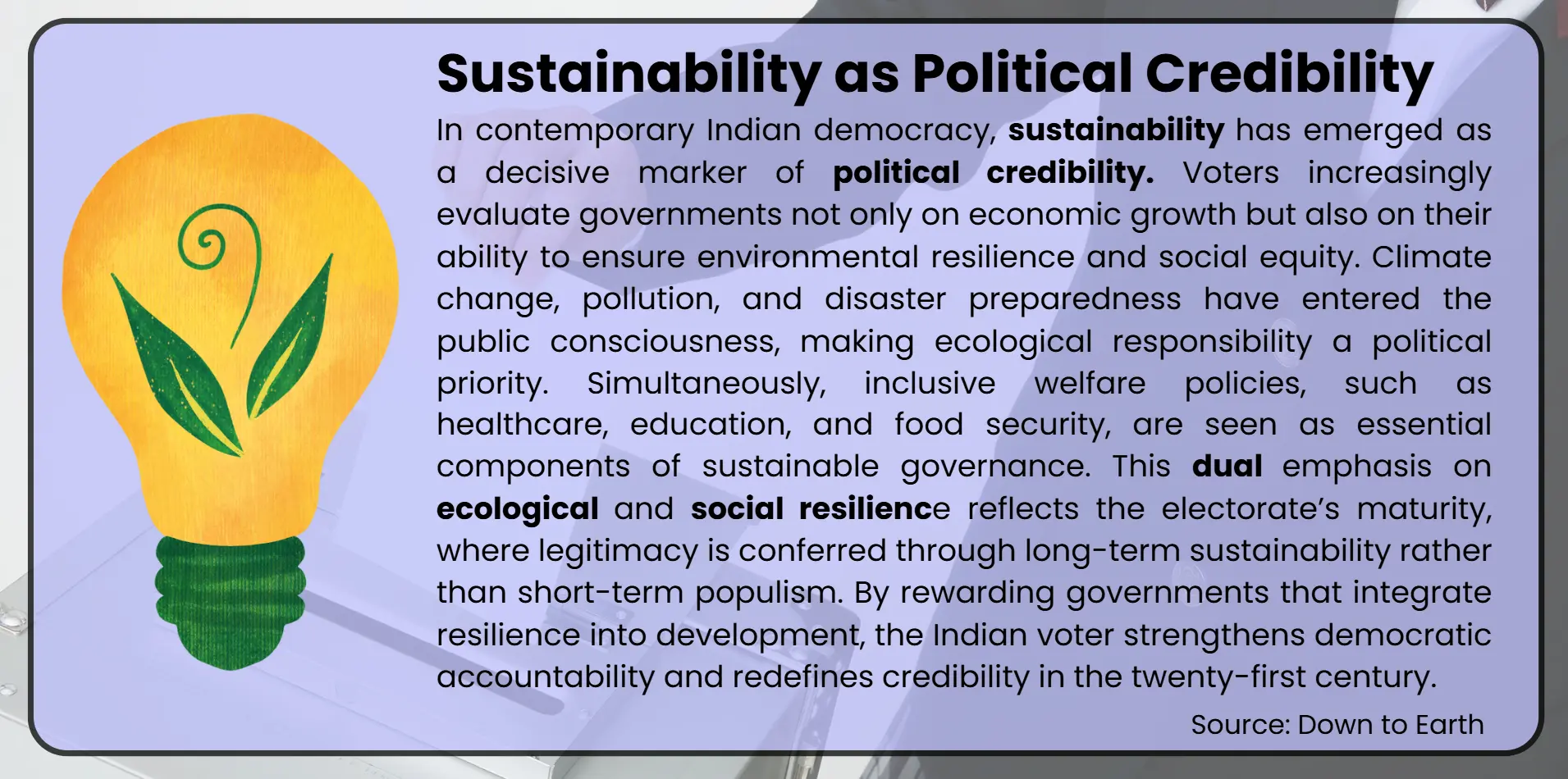
Indian democracy has undergone a massive change in the judgmental scales that its voters use in the past decades. In addition to the age-old focus on economic development and the provision of social welfare, sustainability, including both environmental and social aspects, has come into play as one of the crucial factors of political credibility.Sustainability is emerging as a crucial marker of political credibility, as voters increasingly value long-term environmental while environmental stewardship and sound governance over conventional short-term growth models.
Green Consciousness
The increasing awareness of the population about climate change, pollution, and environmental degradation has reformed the expectations of the voters. Citizens are growing more in favour of policies that emphasize clean energy, water conservation, and disaster preparedness. Those governments that can be proven to be ecologically resilient are rewarded at the polls, hence depicting how sustainability has been integrated into the system of democratic accountability.
Social Equity and Inclusion Development
The question of sustainability is not restricted to the issue of the environment only, and it also entails social resilience. The electorate today has come to judge governments in terms of their ability to guarantee fair means of access to medical care, as well as education and welfare. The inclusion as a development has especially among the marginalized groups been a credibility bar, thus strengthening the idea that sustainability cannot exist without social justice.
Credibility
Innovative governance, balancing between growth and resilience, is more and more associated with political credibility. Sustainable policies like renewable-energy development, programs to guarantee rural jobs, and climate-adaptation initiatives, among others, are examples of how legitimacy is enhanced through policies. The voters as auditors are rewarding those administrations that are incorporating resilience in the short-run delivery.
Democratic Maturity
The rise of sustainability as a political indicator is an indicator of how mature the Indian democracy is. The citizens are no longer satisfied with the symbolic representation or growth, but they need the strength that protects the next generations. It is this dual role and commitment, growth and sustainability, which redefine the relationship between state and society, introducing ecological and social responsibility in the democratic practice.
Citizen-Auditor Dual Role
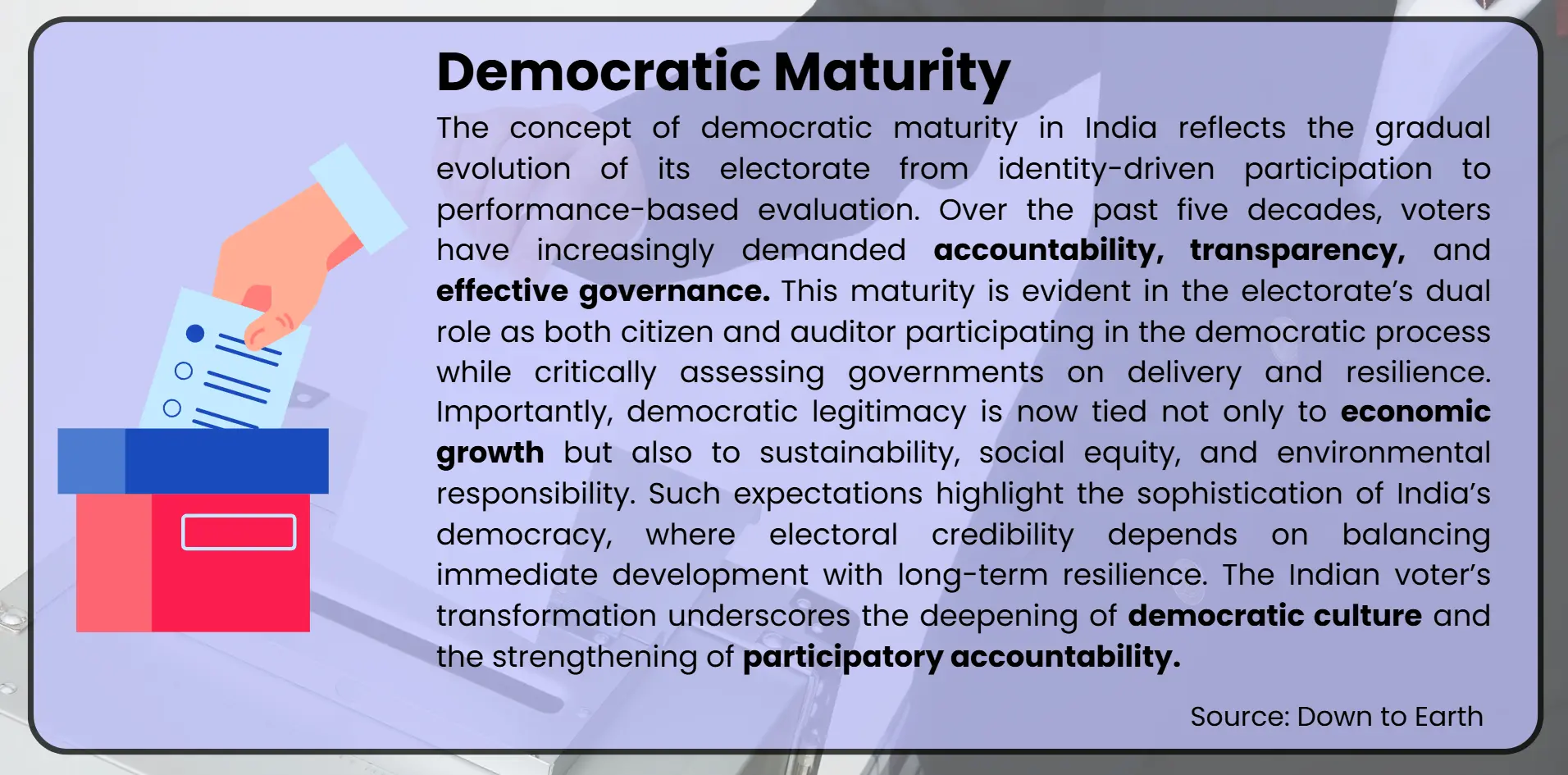
During the past 50 years, there has been a massive change in the Indian electorate. Citizens no longer act in the identity-created voting grounds as they have become the auditors of governance, and they expect transparency, efficiency in delivery, and strength of the political leadership.The “Citizen-Auditor Dual Role” is not a formally recognized professional title; rather, it is a conceptual idea that highlights the public’s ability to monitor and evaluate government actions, often through tools such as social audits.
Citizen Role
Voters use their constitutional right of universal suffrage as citizens and thus strengthen democratic legitimacy. This is a participatory role that is characterized by representation and assertion of rights. Voting is a sign of being a member of the democratic polity, and this is a way of ensuring that other voices are represented in governance.
Auditor Role
The voter has become not only active, but a critic or an analyst of election pledges in execution. Measurable outcomes that governments are rated on are the delivery of welfare, the development of infrastructure, and equity in society. The evaluative role is a product of an increasing demand for accountability, in which rhetoric is no longer a sufficient condition to guarantee electoral legitimacy.
Credibility and Sustainability
The role of an auditor applies to sustainability. People check on governments using their ability to provide environmental resilience, climate preparedness, and inclusive welfare. The maturation of India's democracy is pointing in the direction of political credibility, which is pegged on the integration of sustainability in the governance of the country.
Democratic Maturity
Active democracy is fortified by having a dual role of being a citizen and an auditor. It makes governments accountable not only for how to grow but also for how to be resilient. This change highlights the level of sophistication among the electorate, in which voting plays out as a belongingness move and an evaluation tool.
Conclusion
The transformation of the Indian voter in the last five decades brings out a better way of understanding the intricacy of the democratic maturity in the largest democracy globally. Since the identity-based engagement to the performance-based appraisal, citizens have become part performers and auditors, who require transparency, good services, and institutional sustainability. The current electoral behaviour has shown increased lean toward sustainability, both environmental and social, as a compelling ingredient of political fidelity. Such a change highlights the enlightenment of the electorate, where the legitimacy is given not just by growth promises but real-world governance, which ensures secured equity and sustainability in the long term. Within this paradigm, the Indian voter constantly strengthens the democratic accountability and credibility.