The One District One Product (ODOP) program is of importance because of its country-wide spread to 770 districts, a high percentage of export enhancements in Uttar Pradesh, and the introduction of the PM Ekta Malls, which shows the artisan heritage of India on the global front, thus improving livelihood and recognition.
|
Key highlights
- One District One Product
- History and Development of ODOP
- Economic and Social Impact of ODOP
- Market and Institutional Framework of ODOP
- Cultural Significance of ODOP
- PM Ekta Malls
|
The ODOP project is indeed a historic policy intervention in the developmental paradigm of India, and it was designed to make local craftsmanship merge with the national economic agenda. It started in Uttar Pradesh in 2018 as a method involving upkeep of over 770 districts, which are delineated by a specific product that reflects regional heritage and economic opportunities. The programme has enabled the artisans, enhanced exports, and conservation of cultural traditions through institutional governance, digital platforms, and global outreach mechanisms. ODOP, being a form of inclusive growth, the paradigm displays the way in which localised competencies may be transformed as catalysts to self-reliance, national pride, and global recognition.
History and Development of ODOP
One District One Product is a ground-breaking policy experience in India, aimed at developing social crafts and reinvigorating the workforce to be part of international value chains, empowering artisans, and ensuring their quality livelihoods.
Beginning of ODOP
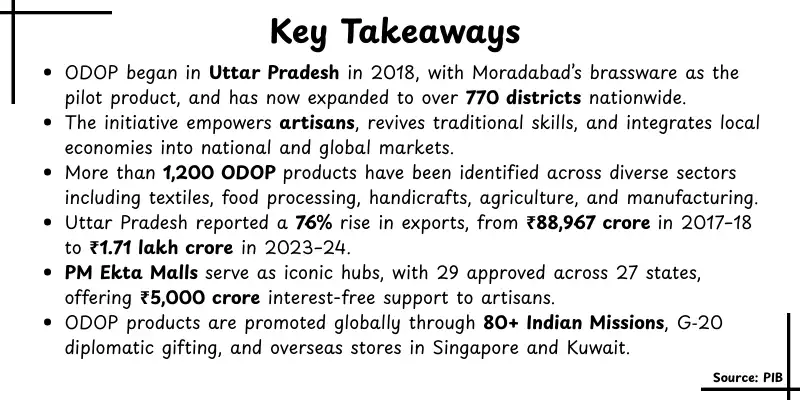
ODOP was started in 2018 when Moradabad was chosen by Uttar Pradesh as the pilot product of brassware. This branding approach at the district level was aimed at enhancing local skills and enabling artisans through institutions. This effort was quickly gaining momentum, and visibility was achieved by expos and trades shows, at the same time helping the community feel better about itself and its ability to withstand economic crises.
National Expansion of ODOP
As of December 2025, ODOP has gone countrywide and includes over 770 districts and registered more than 1,200 products in various industries like textiles, food processing, handicrafts, and agriculture. The scope of participation is exemplified by 235 ODOP listings of handicrafts and 412 products of agriculture, as stated bythe Ministry of Commerce and Industry.
ODOP’s Global Outreach
The programme extended to other domestic markets with ODOP products being exhibited at global exhibitions and diplomatic events. ODOP crafts were popularized via Indian Missions that reached out to more than 80 countries, and the overseas presence was strengthened with the help of dedicated outlets in Singapore and Kuwait. This extraterritoriality is an indication that ODOP is no longer a state experiment, but a symbol of cultural heritage and economic empowerment in the nation.
Economic and Social Impact of ODOP
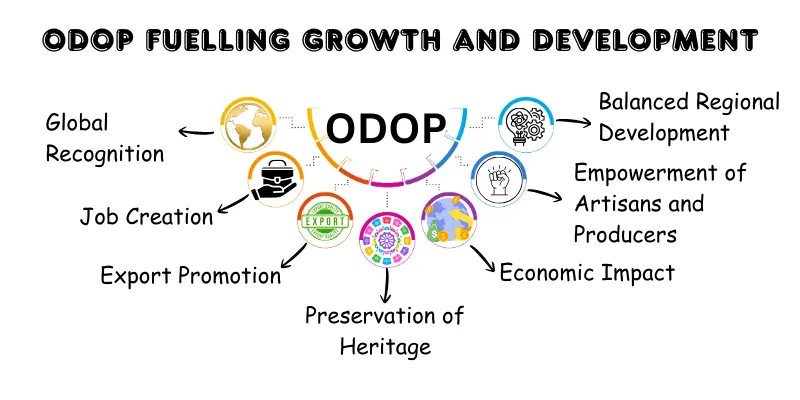
One District One Product (ODOP) program has become one of the developmental pillars in the Indian policy whose vision was to equalise regional development, empower artisans and reinforce rural entrepreneurship.
ODOP Empowering Regional Economies
ODOP counterbalances the disparities of regions by opening the doors to the district's strengths. By December 2025, the programme has been extended to more than 770 districts, and this has resulted in the establishment of localised growth engines that bring the traditional skills up to date with the current economic models.
ODOP Creating Jobs
The program has provided livelihood opportunities on a very large scale. More than 1.25 crore artisans had been trained and equipped in modern toolkits under the ODOP Skill Development Scheme in Uttar Pradesh itself. Besides, projects of about 6000 crore have been approved in accordance with the Margin Money scheme, which directly aids in supporting rural entrepreneurship.
Export Expansion through ODOP
The ODOP program has increased the export volume of India. Export volume grew by 76 percent in the fiscal year 2023,recovering 1.71 lakh crore, compared to 88,967 crore in the year 2017-18 in Uttar Pradesh. This approach improves the competitiveness on the international part by alignment in terms of the national programmes such as Make in India and the Districts as Export Hubs.
Social Empowerment with ODOP
On top of its economic aspect, ODOP helps to maintain the traditional handicrafts and empowers the other marginal groups, namely the women's self-help groups. The programme promotes social justice by combining cultural preservation and modern access to the market, and helps instil a feeling of national pride.
Market and Institutional Framework of ODOP
ODOP initiative is founded on a highly designed and yet flexible system of governance integrating central control with state-level autonomy to have effective selection of products, branding, and integration of the market across India.
Governing Structure of ODOP
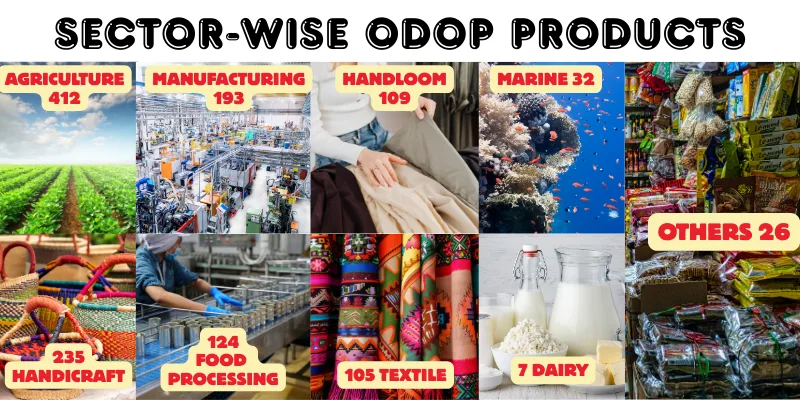
ODOP is implemented by the Department of Promotion of Industry and Internal Trade (DPIIT), together with state governments and district administrations. Selection of products is done on the basis of local ecosystems, and final lists are sent to DPIIT. By 2025, more than 1,200 ODOP products have been registered, including textiles (105), food processing (124), handicrafts (235), agriculture (412) and others. This devolved system is inclusive and, at the same time, holds national coherence.
Online Dynamics of ODOP
The e-commerce programs like the Government e-Marketplace (GeM)-ODOP Bazaar enable access to the market by offering a dedicated storefront to the artisans and producers. These platforms increase the outreach, cut intermediaries and increase transparency. State portals supplement GeM so that local sales channels are achieved.
World Wide Reach of ODOP
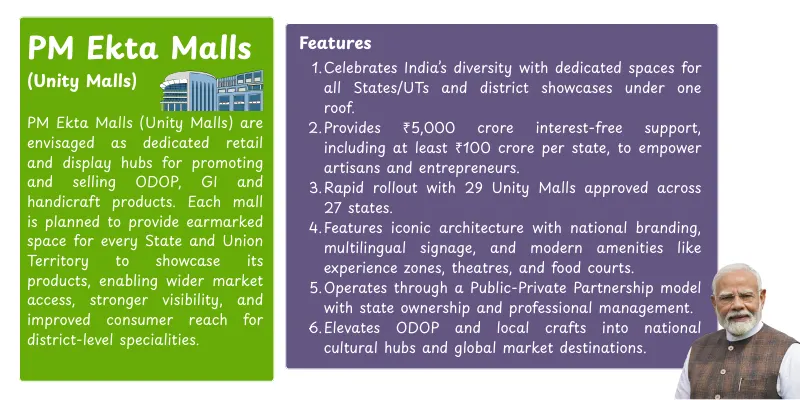
PM Ekta Malls are the symbolic retail centres with dedicated places in every state and union territory. Having approved 29 Unity Malls in 27 states, they offer about 5,000 crores of interest-free loans to artisans. Digital and physical infrastructures combined put ODOP products into national and global markets, strengthening the cultural identity and economic resilience of India.
Cultural Significance of ODOP
The ODOP initiative has even overcome domestic barriers where district-specific Indian products have been a cultural ambassador and economic resource in the world. Its expansion concurrently speaks of heritage conservation and business growth.
International Promotion through ODOP
ODOP products have been marketed by over eighty Indian Missions across the world with exhibitions, curated presentations, and diplomatic gifts. At the G20 gatherings, ODOP artisans were included in the official gift hampers, thus representing the Indian artistic prowess in the global arena of diplomatic relations.
ODOP’s Overseas Market Presence
In order to assemble a long-lasting international presence, ODOP products are currently being sold in three foreign stores: two in Singapore (Mustafa Centre and Kashmir Heritage) and one in Kuwait (Hakimi Centre). The premises will give the artisans access to the foreign consumer direct leadership, which guarantees the sustenance of demand and awareness in the foreign markets.
ODOP Preserving Heritage
In addition to its business agendas, ODOP is a representation of cultural identity, which transforms the usual crafts into national pride. The exhibitions, like ODOP Wall of SARAS Aajeevika Stores, anticipate native products; this is the same foreground that empowers the women and the self-help groups that are in rural areas. This and the dual focus on both heritage and livelihood highlight ODOP as both an economic and a cultural movement.
Conclusion
One of the examples of how India is combining its cultural heritage with economic development is the One District One Product (ODOP) program. ODOP has made local crafts technological drivers of national wealth by empowering artisans, broadening exports, and promoting even growth across the regions. Its institutional structure, online infrastructure, and reach around the world all make the districts of India regulators of international trade and cultural diplomacy. Finally, ODOP portrays the image of self-dependence and inclusivity, where culture and technology meet to strengthen the socio-economic fabric of India.
Frequently asked questionsFrequently asked questions
History and Development of ODOP?
One District One Product is a ground-breaking policy experience in India, aimed at developing social crafts and reinvigorating the workforce to be part of international value chains, empowering artisans, and ensuring their quality livelihoods.
Economic and Social Impact of ODOP?
One District One Product (ODOP) program has become one of the developmental pillars in the Indian policy whose vision was to equalise regional development, empower artisans and reinforce rural entrepreneurship.
Market and Institutional Framework of ODOP?
ODOP initiative is founded on a highly designed and yet flexible system of governance integrating central control with state-level autonomy to have effective selection of products, branding, and integration of the market across India.
Cultural Significance of ODOP?
The ODOP initiative has even overcome domestic barriers where district-specific Indian products have been a cultural ambassador and economic resource in the world. Its expansion concurrently speaks of heritage conservation and business growth.