|
Key Highlights
- Climate Finance
- India’s priorities
- Commitments related to Climate
- Equity and CBDR
- Domestic Preparedness
- Policy Innovation
|
India should take a realistic approach to climate finance, because the current trend of donor weary and cynical attitudes on the subject is therefore indicative of the larger trend being traced in traditional development aid. The increasing indebtedness of developed economies, to unprecedented levels, puts in question the dependability of the mass concessional flow of capital. Therefore, India should aim to balance its fast economic growth and its climate pledges, promote predictable and transparent financing, strengthen domestic tools, including green bonds and sector-wide public-private partnerships, to ensure resiliency and ensure its credibility.
|
Tips for Aspirants
The article is important for the UPSC CSE and State PSC level examinations, as the article connects climate finance with more perceptions of governance, equity, and development, and provides thought-provoking material in answer to essay questions, GS paper, and policy debate.
|
|
Relevant Suggestions for UPSC and State PCS Exam
- Global Context of Climate Finance: an increase in flows with uneven distribution; the lack of concessional support due to the fatigue of donors and the debt in the developed economies.
- Developmental priorities of India: Growth, poverty reduction, and energy security will continue to be a priority; climate preferences should be kept in balance with the realities back home.
- Climate Ambitions: Net-zero-2070, 50% reduction in the intensity of emissions by 2030; the successes in renewable energy build credibility.
- Equity and CBDR: India focuses on the common but differentiated responsibility, making calls to burden developed countries with historical responsibilities.
- Strategic Endearment: Coalition-building through BASIC, G20, BRICS, and creative finance and innovative systems.
- Home Preparedness: Green bonds, carbon markets, climatically sensitive budget, and community preparedness.
- Policy Innovation: Adoption of technology, early warning systems, and public-private collaborations to facilitate the reduction of dependency on unpredictable flows in donor resources.
- Climate Change Pragmatics: climate change as a shared responsibility, not charity. Need a way to make our ways sustainable.
|
Climate finance is now a major pillar of the worldwide climate change response, which is still debated over its effectiveness and validity. Just like conventional development aid, the development donors and recipients are gradually losing confidence in climate finance, questioning themselves on the availability of resources that are promised to become tangible. The scenario is further worsened by the immeasurable levels of public debt in developed economies, hence restricting the financial ability of the states to deliver on high-altitude promises. It is against this context that India is faced with the challenge of not only maintaining a high rate of economic development but also fulfilling its climate commitments at the same time. Pragmatism thus plays a vital role: playing with the global climate-finance structure, India needs to be fully cognizant of its limitations, and yet strengthen its own domestic systems to marshal resources. Such an undertaking needs to strike a balance between equity behaviours (doctrine of common but differentiated responsibilities) and innovative approaches that will utilise blended finance, transfer of technology, and partnerships between the government and the nongovernmental sectors. India can do this by taking a realistic but proactive position on climate negotiations and having climate finance become an instrument of resilience and sustainable development, as opposed to the instrument of aid dependency.
India's climate finance imperative is balancing massive green investment needs (hundreds of billions annually) with development goals, requiring a mix of domestic policy, international support, and private capital, focusing on equity for vulnerable populations and efficient, transparent use of funds for renewables, EVs, green hydrogen, and adaptation.
International Approach of Climate Financing
Climate finance has become a pillar of international climate action; however, it has witnessed massive growth and is also known to be faced with long-term structural hurdles. Evidence-based policy development requires an appreciation of the global environment.International climate financing balances equity (fair burden-sharing, supporting vulnerable nations) and efficiency (maximizing climate impact) through frameworks like UNFCCC's "Common But Differentiated Responsibilities" (CBDR), but faces challenges like governance gaps, inconsistent funding, and slow adaptation finance, requiring better coordination, local empowerment.
International climate financing balances equity (fair burden-sharing, historical responsibility) with efficiency (maximizing climate impact), guided by principles like Common But Differentiated Responsibilities (CBDR) under the Paris Agreement.
Global Flaws
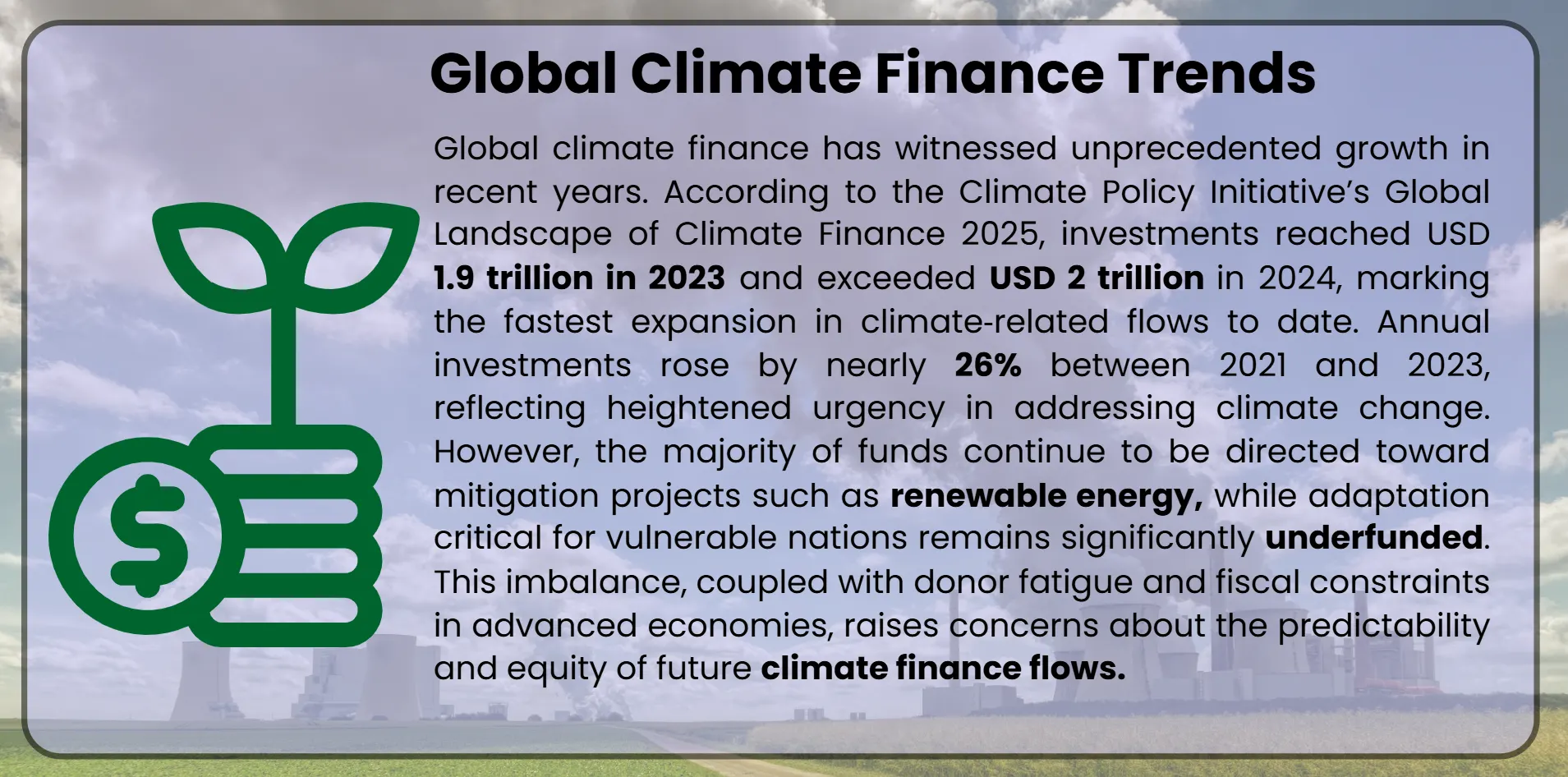
According to recent evaluations, global climate financing in 2023 has reached USD 1.9 trillion and in 2024 reached USD 2 trillion, which is an unmatched growth in the amount of investments specifically allocated to mitigation and adaptation. This growth indicates the increase in the urgency of governments and private investors, as well as multilateral institutions. However, even bearing these headline numbers, the spread of funds is still uneven, with a disproportionate part used on renewable-energy and mitigation actions, whereas adaptation, which is important to vulnerable countries, still gets underfunded.
Skepticism and Donor Fatigue
The climate finance context in the world is similar to the traditional aid pattern, where the diminished confidence stems from fatigue of the former and distrust on the part of the latter. It is argued by many developing states that the promises given under some systems as the Paris Agreement, have not manifested along predictive or concessional lines. At the same time, the donors raise issues about governance, absorptive capacity, and quantifiable outcomes. The result of this mutual fatigue has been the emergence of a credibility gap, since there is uncertainty as to whether climate finance can actually be a transformative tool instead of a continuation of aid dependency.
global-climate-finance
Debt Pressure
The other characteristic of the international environment is the high borrowing rates within the developed world economies that limit fiscal room in making commitments to the climate. Concessional flows to developing countries are facing more and more criticism, as governments struggle to maintain domestic recovery, social expenditure, and geopolitical priorities. This debt overhang would be a challenge to the negotiation process because developed nations could be struggling to change climate-leadership rhetoric with constrained fiscal resources. In turn, an increased disparity between aspiration and fulfilment increases the demand to find creative funding solutions.
Institutional Responses
The international institutions and climate negotiations have reacted by encouraging blended finance, mobilisation of the privately-owned fields, and cooperation between the South-South. Instruments such as green bonds, carbon markets, and risk-sharing facilities are becoming popular, pointing to the fact that people are not so dependent on public aid anymore, but rather on diversified financial ecosystems.
Climate vs. Development in India
India is at a meeting point where its levels of development should meet the desperate demands of the climate. The need to balance economic growth and sustainability through a practical approach of balancing equity, resilience, and innovation is necessary.India's climate-development challenge balances urgent poverty reduction (equity) with decarbonization (efficiency), viewing climate action not as a trade-off but as integral to resilient, competitive growth, focusing on green tech, adaptation (LiFE initiative), and demanding global climate finance to support its "Just Transition," ensuring low-carbon pathways don't halt essential development for its massive population.
Development and Growth
The dominance of the developmental desires and growth objectives can be traced in the fact that India remains committed to the idea of a fast-growing economy and reduction of poverty, which is considered central to achieving the Viksit Bharat-2047 vision. The trajectory is also supported by industrial growth, the development of infrastructure, and energy security. Having a population of more than 1.4 billion people, the urge to be employed, to have a place to live in, and the services of the contemporary world are growing exponentially. In turn, these developmental needs require significant investments in more traditional industries, which often rely on fossil energy, and they complicate the process of switching to low-carbon roads.
Commitments and Responsibilities
Climate commitments coupled with the global responsibilities include the fact that India has made ambitious climate capture goals, including net-zero emissions by 2070 and a 50 percent cut in the intensity of emissions by 2030. These undertakings are an indication of the realization by India that it has global responsibilities under the Paris Agreement. However, such a problem lies in aligning these aims with national realities. In India, despite tremendous performances like 50 percent non-fossil installed capacity already, with postponement, the structural emissions gap persists, and demands for larger-scale reforms in energy, transport, and agriculture are rising.
Need for Balance
The principles of equity and pragmatism are also always at the center of the Indian climate negotiations, where equity and Common but Differentiated Responsibilities (CBDR) are put forth. Having been a developing country, India argues that the advanced economies with a history of high emissions should have a higher financial and technological responsibility. However, the concessional flows are limited by donor fatigue and high levels of debt in the developed economies. The pragmatism of India therefore makes the financing mechanisms be diversified, which means having green bonds, blended finance, and public-private partnerships, but not external finance.
Innovation and Policy Integration
India requires domestic innovation and integration of policies to enable the implementation of development towards the imperatives of climate. India is investing in renewable energy and electric mobility, as well as in circular economy models, and has also been prepared to strengthen against climate risks in the face of resistance. In its budget provisions of 2025, climate resilience has been represented as an economic agenda where risks posed by climate are predicted to increase to about 25 percent of GDP by 2070. The development of a workforce that is climate-aware, the democratization of clean technology benefits, and the improvement of the monitoring frameworks are irreplaceable in terms of making sure that the climate action is in line with the developmental concerns, and vice versa.
Global Negotiation Strategic Engagement
The trading in the global climate negotiations, particularly in India, is a clear case of a careful balance between developmental needs and climate stewardship. Pragmatism guides its diplomatic behaviours, hence guaranteeing fairness, trustworthiness, and stability in the international climate finance discourse.Equity and Efficiency: Global Negotiation Strategic Engagement" refers to the inherent tension and trade-offs between fairness (equity) and maximizing aggregate welfare (efficiency) in international negotiations, particularly in asymmetric power dynamics.
Reaffirming Equity and CBDR
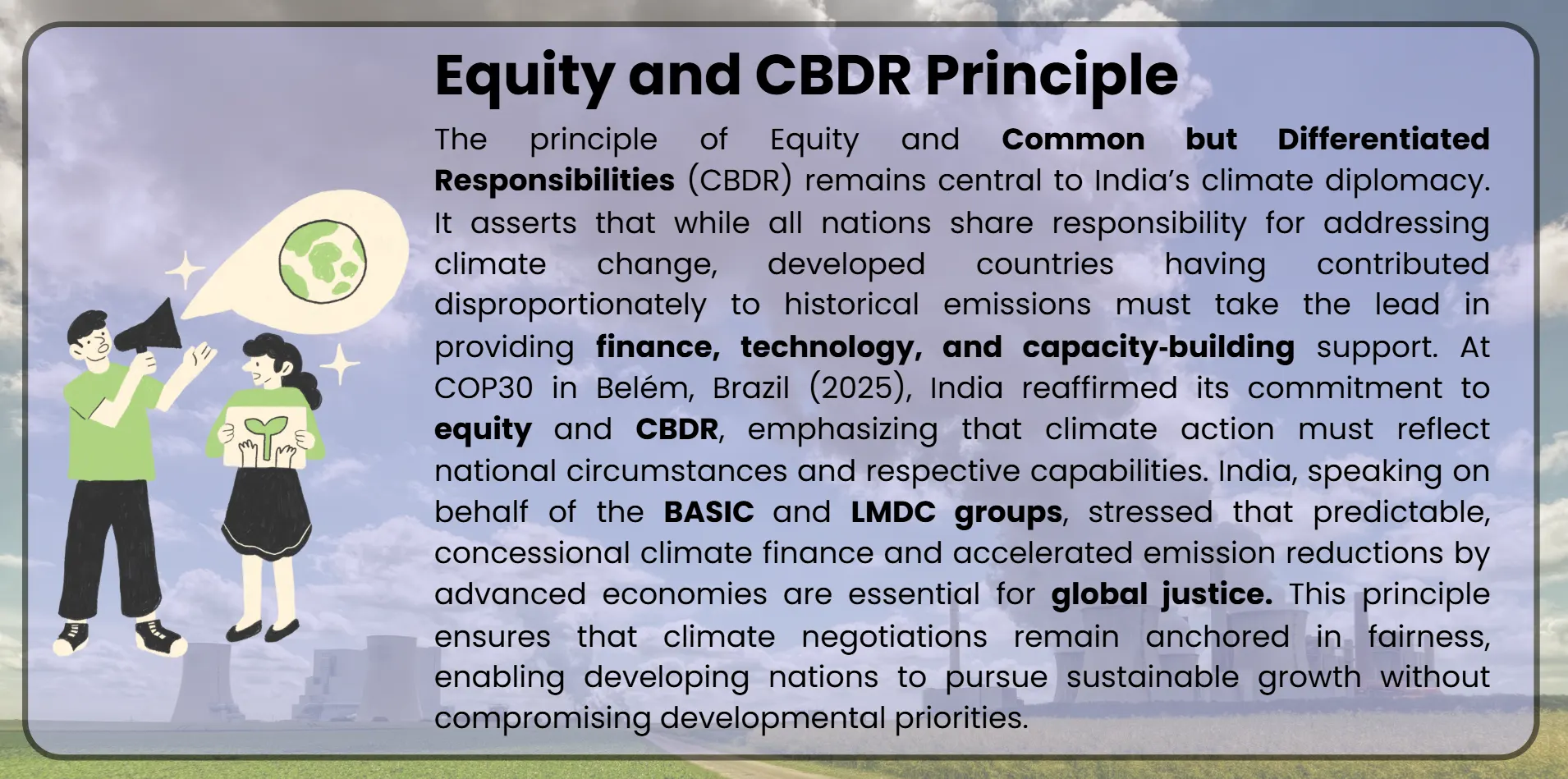
India has continued to scamper on the principle of common but differentiated responsibilities (CBDR) in talks about climate, in the process, giving factorial weighting on advanced economies on past emission records and sharing the responsibility. During COP-29 and COP-30, the country reiterated its policies that mandate that climate finance must be predictable, adequate, and concessional instead of voluntary or symbolic. Through cultural justice as part of sustainable development, India gathers its moral and political authority in the international arena.
Taking advantage of Multilateral Platforms
India is making efforts to engage in the multilateral institutions, such as UNFCCC, G20, and BRICS, to request clear and responsible climate finance systems. Its foreign policy is focused on coalition-building with the rest of the developing countries, especially via the BASIC alliance (Brazil, South Africa, India, China), which enhances the bargaining power of India. This collective bargain will see to it that climate finance discussions are never side-lined as a development agenda, but proceed with it as a development agenda.
Promoting Novel Finance Devices
India urges emerging economies to adopt novel financing approaches, such as blended finance, green bonds, and risk-sharing facilities, due to fiscal limitations that are endured by developed economies. The country has also supported the concept of operationalization of the Loss and Damage Fund and cautions against inappropriate contributions. The aim of this pragmatic strategy is to diversify the sources of finance, leverage on the private capital, and integrate technology transfer in the financing mechanisms, which reduces dependency on unreliable donor commitments and enhances stability to international financial volatility.
Positioning of aCredible Leader
The strategic involvement of India does not just involve defensive diplomacy; it is also inclusive of proactive leadership. India demonstrates credibility in the international negotiations by making strong commitments in domestic targets, e.g., 500 GW of non-fossil fuel capacity by 2030. This two-fold approach of domestic intervention and external lobbying makes India a middleman between the developed and the developing states, thus consolidating its role as a pragmatic and constructive actor in the balance of climate finance governance.
Home Preparedness and Policy Innovation
The policies and efforts of resilience in Indian governance should be considered because India is still,at some point, underprepared to address climate change at the domestic level. This two-fold approach guarantees longevity besides protecting the interests of development against climatic dangers. The pursuit of equity and efficiency in home preparedness involves a critical balance in public policy. Efficiency seeks to maximize overall societal welfare and resource allocation (e.g., minimizing costs or maximizing service levels system-wide), while equity focuses on the fair distribution of resources, opportunities, and outcomes among different population groups.
Increasing Ecosystem Resilience
India has established a number of programs to improve climate resilience and preparedness. The Ministry of Earth Sciences also developed initiatives, including the Mission Mausam and extended climate services within the India Meteorological Department, in order to develop a nation that is weather-ready and climate-smart. Such measures are to minimize the effect of an extreme weather event, enhance forecasting, and enhance communal resilience. This preparedness is critical considering that there have been rising instances of floods, droughts, and erratic monsoon conditions, which directly impact livelihoods and food security.
Financial and Governance Policy Innovation
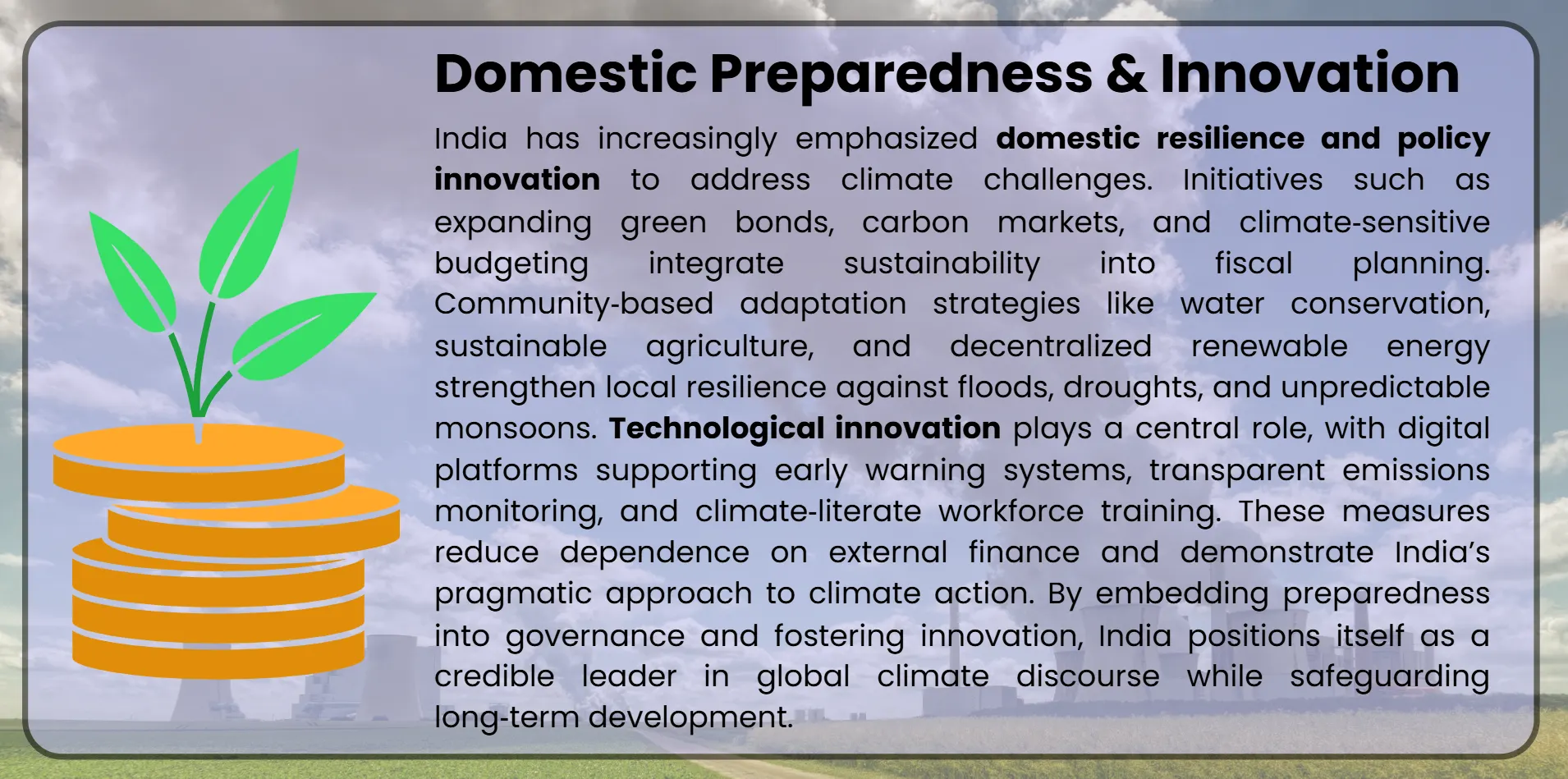
Domestic policy creation has focused on marshalling money and incorporating climatic objectives within a government. India has increased the issuance of green bonds, facilitated the carbon markets, and encouraged investments in renewable energy. This is accompanied by climatic prudent budgeting, where the issues of climate resilience are integrated into the national planning. A rather pragmatic view on climate finance is being adopted as public-private partnerships and blended-finance models are being used to decrease the reliance on uncertain international flows.
Localized Solutions and Technological Resilience
The readiness of India also incorporates decentralized innovation and community-based resilience approaches. It is becoming increasingly popular to incorporate climate adjustment into local economies, including water constraints, sustainable agriculture, and decentralized solar energy and bio-energy programs. A central part is taken up by technology in terms of providing the early warning mechanism, training the workforce on climate literacy, and open monitoring of emissions. The innovations make climate action not only top-down but also participatory to improve credibility and inclusiveness.
Implementation and Legal Processes
The success experienced in Beijing was also based on strict implementation. There were fines imposed on industries and local governments in case of non-compliance with the emission standard, and the performance of the officials was evaluated, taking into account environmental indicators. This was enhanced by legal requirements, making it a non-negotiable requirement. Such a framework discouraged regression, ensured the uniformity of measures to control pollution. In the case of Delhi, imitating these types of enforcement would require them to give power to an integrated authority whose jurisdiction is state-wide.
Lessons for Delhi
The disjointed watchdog infrastructure, as well as the weak enforcement of vulnerable monitoring in Delhi, is in contrast with the integrated system in Beijing. Setting up a centralised monitoring body, ensuring transparency of data to the populace, and integrating environmental performance indicators with governance reviews would significantly boost the air-quality management in Delhi. In addition, encouraging the involvement of citizens in the form of awareness tactics and online platforms would go in line with the policy goals, establishing a more sustainable system of governance.
Conclusion
The strategies of climate finance in India have to be founded on pragmatism, and the developmental concerns should be balanced with the global sustainability duties. The cynicism between donors and recipients is more than ever, and the amount of debt in developed economies is at a historic high, highlighting the formation of external flows. Through increasing internal preparedness, developing new policy frameworks, and effectively negotiating throughout the world, India will be resilient and facilitate fair climate action. After all, climate finance must be perceived as not a charity but a collective responsibility, and through it India might advance towards sustainable growth, as well as being a recognized and respected leader of the new climate discussion all over the globe.