|
Key highlights
- accelerating growth and low inflation
- GDP growth rate of 6-7%
- inflation below 4%
- cumulative inflows of more than USD 1 trillion
- 65 percent of the population is aged below 35
- new jobs in the technology sector
- strategic trade diversification
|
The article “2025 – India’s Defining Year of Stability and Strength” explains that the year 2025 is the golden moment of India because it represents the period in which economic growth is in synergy and inflation is low. It reinforces macroeconomic stability, structural reforms, and demographic benefits, and increases the global presence of the country. A combination of expansionary and price stability measures creates a picture of a strong economy, making India attractive to investment, encouraging innovations, and also bolstering its position as a reliable global trading and governance ally.
|
Tips for Aspirants
The article is significant in both the UPSC CSE and State PSC exams since it integrates the India 2025 track of economic development by associating growth, reforms, demographics, and global placement to governance, policy and developmental analysis.
|
|
Relevant Suggestions for UPSC and State PCS Exam
- India has been successful in having a GDP growth rate of 6-7% in 2025 and an inflation rate of less than 4%, hence showing proper management of monetary and fiscal policies.
- Institutional capacity became entrenched through tax rationalisation, modernisation of the labour code and development of digital governance to enhance competitiveness.
- Liberal norms made cumulative inflows of more than USD 1 trillion, and new trade relations broadened the Indian presence on the planet.
- Having 65 percent of the population aged below 35, skilling programs and innovation ecosystems used the potential of youth in boosting productivity.
- The introduction of artificial intelligence and the blistering start-up career opened millions of new jobs in the technology sector, which strengthened the reputation of India as an innovation centre.
- The presence of strategic trade diversification, strengthening energy security, and active climate diplomacy gave India a better bargaining position in the international system.
|
The year 2025 is a highly tense zero-point in the economic history of India that is often referred to as its Goldilocks moment, a rare combination of accelerating growth and low inflation. This tendency takes on a special value in the context of global economic instability, when many states are facing stagflationary demands, supply chain system shocks, and geopolitical uncertainties. The fact that India maintains strong GDP growth and price level is an indicator of the sustainability of its macroeconomic framework and the effectiveness of the new policy measures implemented. This foundation is based on a set of structural reforms, financial provisions, and narrow investments in infrastructure and digital governance. However, at the same time, productivity and competitiveness have been increased due to demographic benefits and the spread of clusters of innovation. The fact that India is a trusted international partner both in trade and climate talks only increases its strategic power. The balance achieved in terms of expansionary impulses and inflationary containment not only strengthens domestic confidence but also puts India in a better position in the world economic order. This article examines the outlines of the defining year of India and examines the interaction between the macroeconomic stability, institutional reforms, demographic cheap labor force, and global positioning. It argues that the year 2025 is not just a marker in a statistical profile but a revolution that might be carving out the long-term development progress within India.
India’s Strategic and Geopolitical Position in 2025 - Macroeconomic Stability and Growth
The India-New Zealand Free Trade Agreement (FTA) stands as a watershed in the history of India's trade diplomacy because it reflects both the economic expediency and strategy when it comes to the globalisation efforts of integrating the supply chain. India will receive zero-duty market access for all its exports to New Zealand. In return, India will relax tariffs on 95% of imports from New Zealand, with 57% of these products becoming duty-free from day one.
The economic path in India by the year 2025 indicates a very rare balance, with booming growth at the same time with low inflation. This effect highlights the strength of macroeconomic management during the situation of world uncertainties and reforms at home. 2025 was indeed a "defining year" for India,marked by a rare economic "Goldilocks moment" of high growth and low inflation, coupled with significant advancements in defence self-reliance and structural reforms.
Sustained GDP Expansion
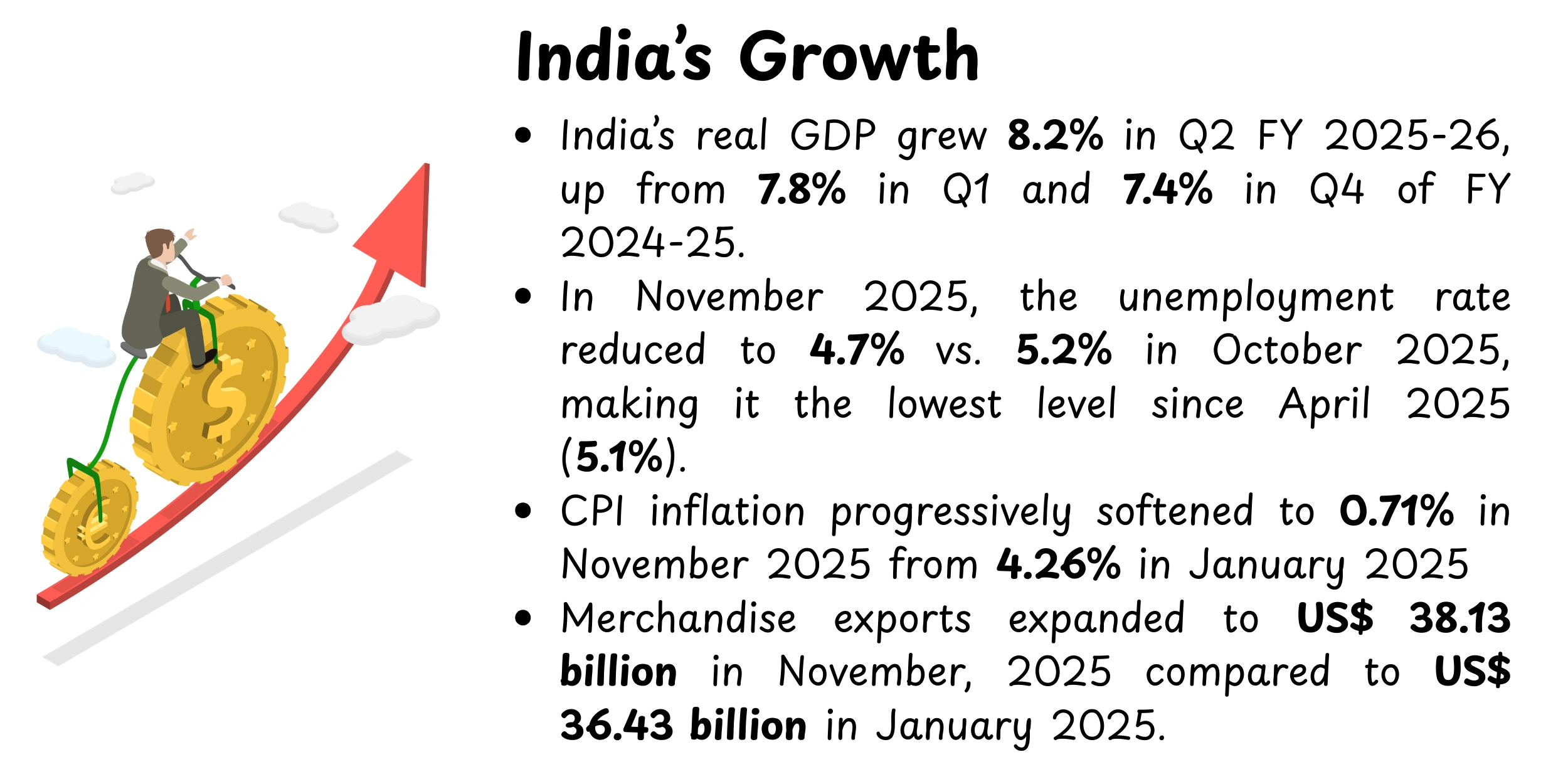
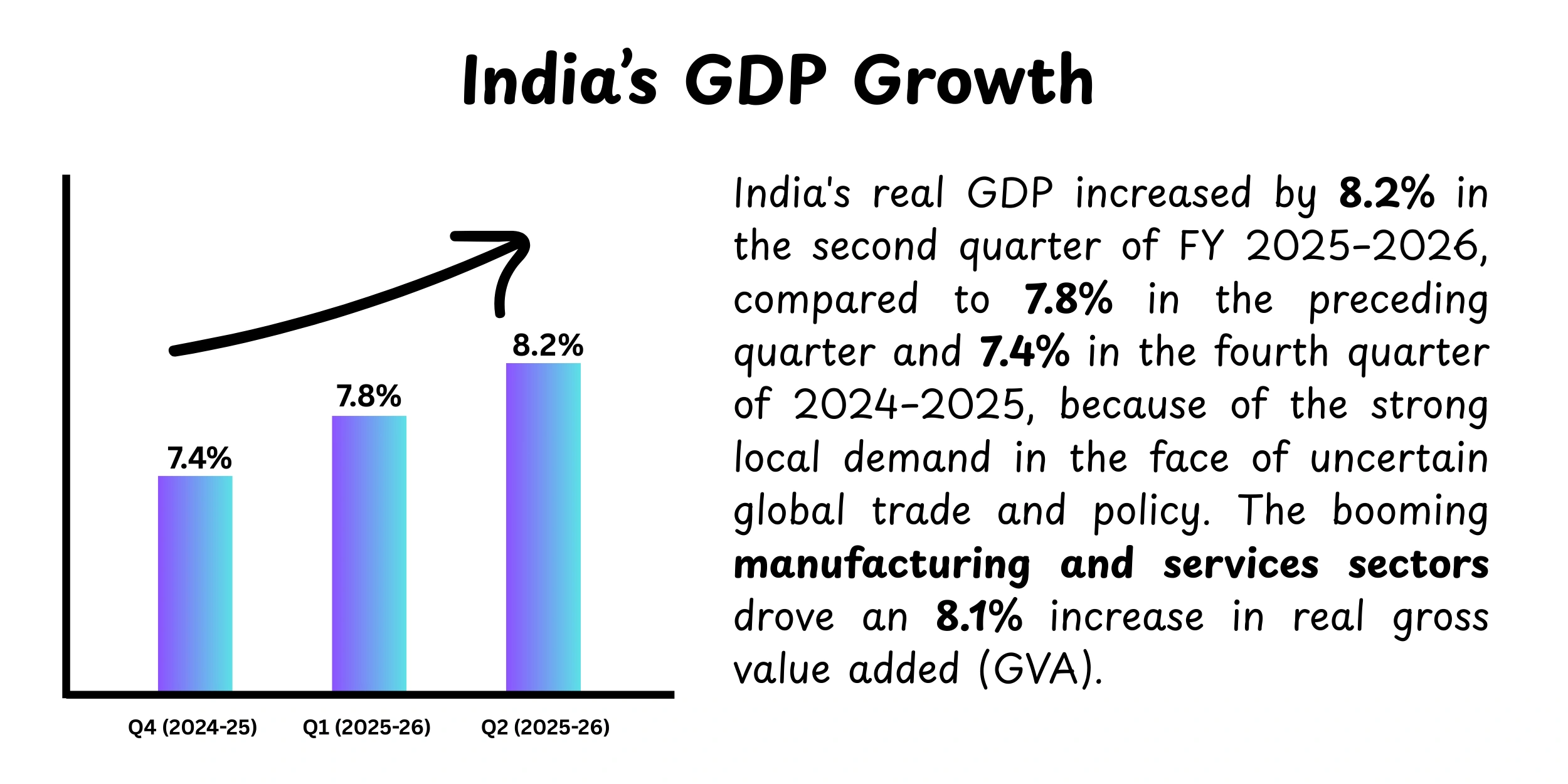
The real GDP growth of India has been found to be quite stable. Official figures show GDP growth of 7.8 percent in the Q1 FY2025-26 and rising to 8.2 percent in the Q2. The IMF and the World Bank have renewed their belief in India as the fastest-growing major economy in the world, with forecasts that it will grow in the 6-7% bracket by 2025-26. This long-term growth is indicative of the historical effect of budget restraint and structural adjustment.
Inflationary Containment
The other important thing is moderate inflation. The inflationary rate in the Consumer Price Index (CPI) decreased significantly, as it can be seen that in January 2025, the index was at 4.26%, and subsequently in November 2025, the percentage dropped to 0.71%. This can be explained by a prudent monetary policy of the Reserve Bank of India, the softening of the world commodity prices, and the improvement of agricultural supply chains. The ability to maintain growth and, at the same time, contain inflation sets the macroeconomic stability in India apart from other emerging economies, many of which are still struggling with stagflationary forces.
Employment and External Sector
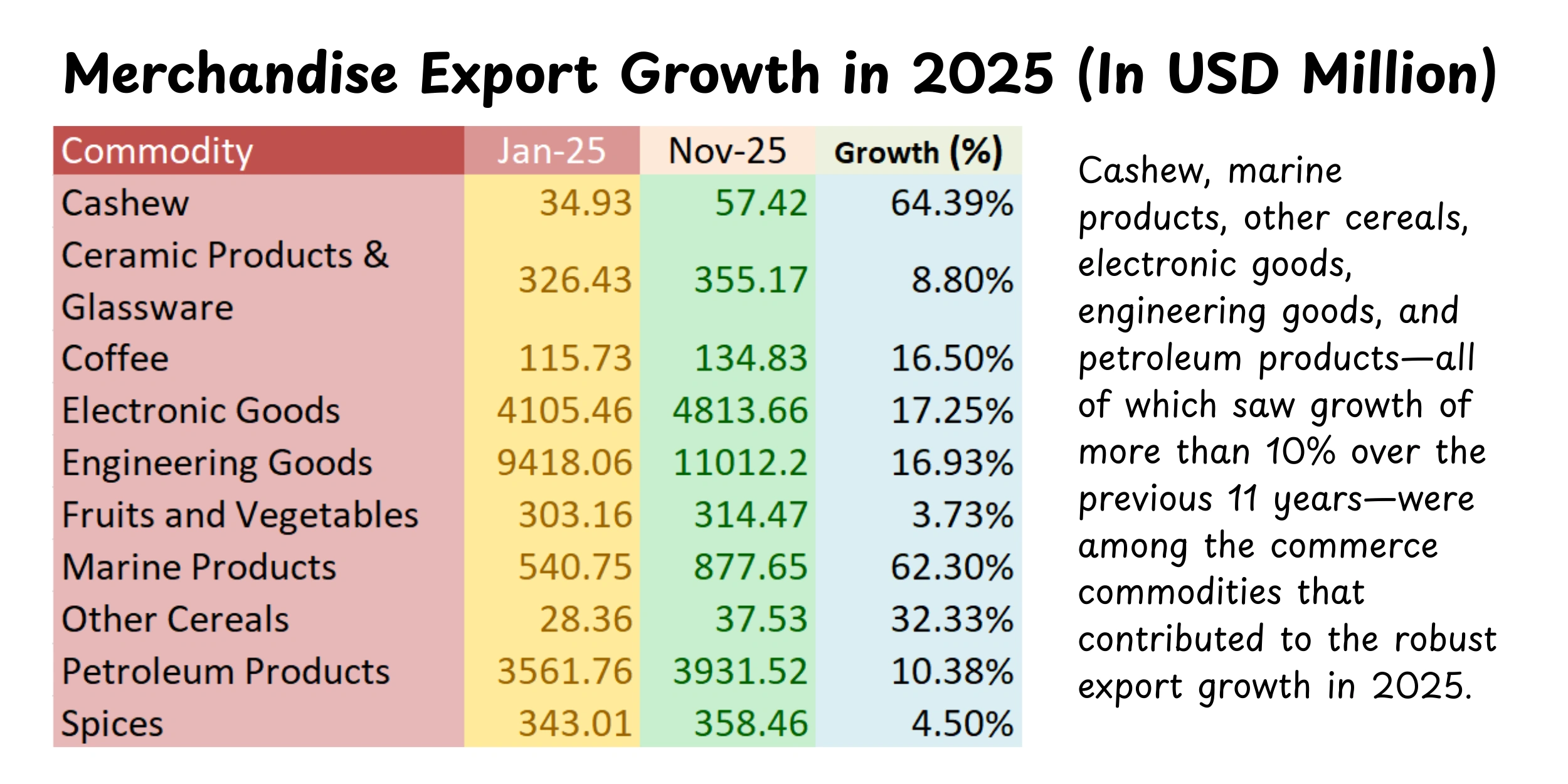
Some further reinforcements in the stability of the macro economy include gains in employment and trade. Last month the unemployment rate was at 4.7% lowest since April. The export of merchandise rallied to USD 38.13 billion in November 2025, compared to USD 36.43 billion earlier in the year. These signs point out that growth has been made and sustained not only by consumption but also by external competitiveness and resilience in the labor market.
Policy Bases and Future Prospects
Projecting the GDP growth at 6.3% in FY2025-26 in May 2025, the Survey of Professional Forecasters by the Reserve Bank of India predicted a 2-6% comfort band of inflation within the FY2025-26 period. Fiscal prudence, Digital administration, and expansion of infrastructure are anchors that provided stability. In the future, it is a challenge for India to maintain this balance in a world against trade protectionism and geopolitical risks. However, the combination of high growth, low inflation, and gain in employment puts India in a position to cement its economic leadership.
Policy Reforms and Strength of Institutions
Comprehensive policy overhauls and strengthening of institutional bases are the two main pillars that enabled India to have economic resilience in 2025. These efforts have increased the competitive forces, sharpened the governance frameworks, and made India a reliable ally in the global economic marketplace.
Taxation and Fiscal Reforms
Throughout 2025, India put in place a package of income-tax cuts and a reorganization of Goods and Services Tax (GST), the aim of which is to boost in-country demand, as well as make the compliance-process easier. These reforms reduced fiscal taxes on middle-income households and, at the same time, boosted tax buoyancy. According to an article by the Economic Times, both the rationalisation of GST and the recalibration of the direct taxes played a key role in making the Indian economy lean and attractive to investors. The spirit of fiscal discipline, at the same time, combined with prudent use of infrastructure, helped to build up investor confidence, which helped in creating macroeconomic stability.
Modernisation of Labor and Regulations
The modernisation of the 2025 labour code was a way to bring together the employment rules that can bring more flexibility to industries without violating workers' rights. This has made the compliance systems easier to comply with, so that bureaucratic constraints were less prevalent, and so the expansion of the small and medium enterprises was encouraged. The digital governance initiatives also featured in institutional reforms and enhanced transparency, and limited inefficiencies of welfare delivery systems. All of this increased the institutional strength of India in order to administer inclusive and sustainable growth.
Trade Agreements and Foreign Direct Investment
India opened Foreign Direct Investment (FDI) in the insurance sector and other strategically vital sectors, leading to accumulated inflows exceeding
USD 1.05 trillion by mid-2025. The first nine months of FY25 have recorded a record inflow of equity by
27%. Simultaneously, India extended its trading reach, with such pacts as the India-UK Comprehensive Economic and Trade Agreement (CETA), and the India-Oman Comprehensive Economic Partnership Agreement (CEPA). These reforms increased the incorporation of India in the global supply chains and strengthened the institutional credibility of the country in international negotiations.
Digital Transformation and Institutional Strength
Resilience to institutions was further strengthened by the adoption of digital platforms at a high rate. The level of Unified Payments Interface (UPI) transactions increased to 172 billion in 2024, which is nine times the volume of digital transactions compared to FY18. This digitisation increased the level of financial inclusion, reduced transaction costs, and enhanced the level of institutional efficiency. In addition, regulatory bodies in India were quite adaptable in how they reacted to international problems that reforms did not confine themselves to law, but instead delivered practical results.
Innovation and Demographic Dividend
The demographic dividend of India and fast innovation has defined the economic prospect of India in 2025. Young labor force, assimilation of technology, and high institutional support all create unprecedented prospects for long-term growth.
Demographic Strength and Young Workforce
One of the most important assets of India in terms of demographic organization is the demographic dividend. The country has a population of over 65 percent of people aged below 35 years, thus the country has a large working age group relative to the dependents. The future of this demographic dividend, set to last through 2055, provides a temporal saving and productivity boost. The dividend, however, is realized with an alternative of using competent skill-formation, educational attainment, and job creation, therefore, mediating the process of translating demographic potential into specific economic manifestation.
Employability Challenges and Skilling
The disparity in employability is widespread despite the demographic edge. The 2023 Wheebox report revealed that only 46 percent of the Indian graduates are job-ready. In turn, such programmes like Pradhan Mantri Kaushal Vikas Yojana (PMKVY 4.0) and other corporate skilling schemes have expanded and added vocational training, including AI-based modules and virtual reality simulators. These innovations are meant to bridge the gap between academic training and industry demands; the young people of India will be in a position to participate in the growth positively.
Technological Change and Innovation Ecosystem
The innovation environment in India has grown at a faster rate. The digitalisation initiative across the country and the growth of Global Capability Centres will also generate almost three million new jobs in technology. The emergence of AI, blockchain, and the Internet of Things appears to be helping start-ups in the fintech, health, and agri-tech sectors to solve systemic problems, which further improve the reputation of India as a technological hub.
Inclusive Growth and Support of Institutions
The institutional structures have made sure that innovation is helpful to a wide range of societal groupings. The collaboration between the state and business in skill training, schemes on digital inclusion in rural areas, and specific support of marginalized communities has extended access. India can improve social equity by integrating the concept of inclusivity into the innovation agenda, also enhancing its economic resilience. Such a combination of the demographic dividend and innovation is what ensures that the growth is no longer focused or localized but rather is widely spread out across regions and communities.
Global Positioning & Strategic Leverage
The Indian globalization in 2025 is a strategic balance between economic resilience, agility of diplomacy, and energy security. This power adds strength to the role of India as a stabilizing force in a further-discretized international system.
Navigating Trade Pressures
In early 2025, the United States slammed tariffs of up to 50 percent on the primary Indian exports, steel, chemicals, and electronics. To this, India diversified its trade ties in Europe, Southeast Asia, Africa, and the Middle East, thus reducing its dependence on the U.S market and improving its global status. According to Firstpost, these actions describe the ability of India to take external shocks and, at the same time, strengthen its reputation as a reliable trading partner.
Energy Independence and Strategic Independence
The 2025 energy policy of India was shaped by the increasing U.S. sanctions against oil in Russia and Iran. In spite of these limitations, India maintained the import flows and controlled the inflation and diplomatic relations. Economic Times Energy report records the fact that India's success in acquisitions of cheap energy and the exercises on strategic autonomy highlight the existential quality of the country in international geopolitics. This balance mechanism guaranteed that the momentum of domestic growth could not be affected by the external energy shocks.
The Increasing Economic Presence in the World
The fact that India continues to undergo economic reforms and has an institutional strength translated into international recognition. By the middle of 2025, India became the fourth largest economy, where exports of goods have risen to USD 825 billion, and services export has doubled to USD 387 billion as compared to a period of ten years ago. The level of cumulative foreign direct investment inflows reached USD 1.05 trillion, and weighted with the highest percentage of 27 percent of equity inflows recorded in the course of FY 25. Such figures, published by the Press Information Bureau (PIB), highlight the widening spectrum of leverage of India in the global value chains and its increased popularity as an investment destination.
Diplomatic Bonuses and Strategic Alliances
In 2025, the Indian diplomatic efforts covered the development of trade agreements, including the India-United Kingdom Comprehensive Economic and Trade Agreement (CETA) and the strengthening of the relationship with the Gulf countries by the India -Oman Comprehensive Economic Partnership Agreement (CEPA). These alliances expanded the influence of India both in developed and emerging markets. At the same time, the active meetings of India at the climate negotiations and multilateral fora strengthened the perception of India as a responsible actor in the international arena. Diversified diplomacy makes the economic power stronger, promising India to be not only a growth pillar but also a stabilizing force.
Conclusion
The economic trend of India in the year 2025 reflects a unique combination of rapid growth as well as low inflation, hence confirming the title given as a Goldilocks moment. The country is resilient in the face of global volatility due to the macroeconomic stability, structural changes, demographic dividend, and strategic position in the global arena. It is the combination of national power and global influence that points to the rise of India as one of the most influential players in the world's economic and governance structures. The year 2025 is, therefore, not just a statistical number mark but a break point, and summarises the decades-long development of India and makes it more authentic as either an engine of growth or a stabiliser of the international order.