How AI is shifting from cloud computing to local devices over the next five years. Learn why on-device AI will transform privacy, speed real-time performance. AI will transition from cloud-first systems to powerful on-device intelligence enabling instant performance privacy and greater efficiency.
|
Key Highlights
- The Future of Local AI
- The Technological Change to Local AI
- Local AI as Decentralised Personal Agents
- Social and Ethical Implications of Localised AI
- Global Impact and Future Prospects of Local AI
|
Over the next five years, AI is expected to transition from a cloud-first approach to a decentralized, on-device architecture. By 2026, an estimated 80% of AI inference workloads could be processed locally on devices instead of relying on centralized cloud data centers. The most significant change in artificial intelligence (AI) is currently happening, where the centralised structure in cloud-based infrastructure is being replaced by decentralised and device-focused use. Ramesh Raskar, the MIT Associate professor of computational imaging and a major expert in AI, underlines that in the short span of about five years, much of the daily AI processing can be done locally on common devices. The paradigm shift will bring forth greater privacy, inclusivity, and resilience of the system, and redefine the relationship between people and technology.
Over the next five years the future of AI is Local and Fast. AI will transition from cloud-first systems to powerful on-device intelligence, enabling instant performance, stronger privacy, and greater efficiency. Ramesh Raskar, Associate professor of MIT, at the India AI Impact Summit 2026, highlighted that a turning point had been reached, where every day artificial intelligence tasks could be performed on local devices. The importance of this transition lies in privacy, the digital inclusion process, and the democratization of technology that would eventually give people more power and reduce their dependence on the giant corporations as technology giants. With local intelligence, the decentralised personal agents may be able to democratize access, decrease reliance on monopolistic infrastructures, and encourage human-need-based innovation. This article will look at the technological, ethical, and societal consequences of this transition.
The Technological Change to Local AI: Future is Local
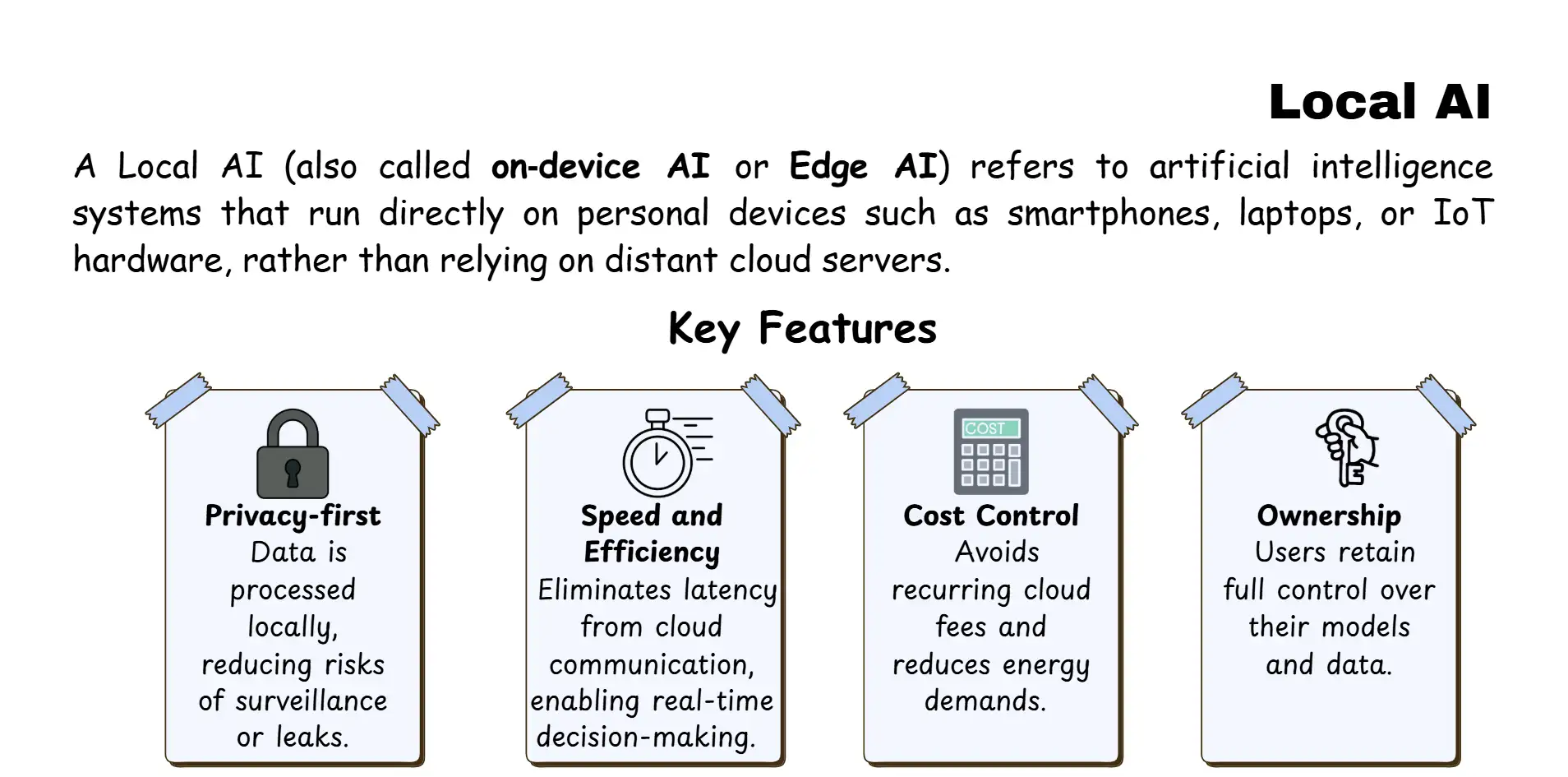
The Future is Local is a growing movement and strategic framework arguing that economic, social, and environmental sustainability requires a shift away from global dependence toward decentralized, community-driven systems. Local AI models are transforming modern computing by placing intelligence directly on your device rather than relying heavily on the cloud. Simply put, they bring the “brain” closer to the body processing data right where it’s generated for faster more seamless performance.
Cloud Dependence to Edge AI Autonomy
AI systems utilize massive cloud computers to compute information and provide outputs. The recent studies have, however, shown that edge computing, which involves processing data on the same devices like smartphones, sensors, and IoT systems, helps to decrease the latency and increase efficiency. According to a survey involving strategies in creating Edge AI, advancements in 5G and specialized hardware have made local inference prompt and crucial in real-time scenarios.
Innovations in Hardware and Local AI Productivity
Innovations in hardware particularly Neural Processing Units (NPUs), dedicated AI accelerators, and next-generation GPUs like NVIDIA Blackwell are accelerating the move toward on-device AI. By delivering lower latency, stronger data privacy, and less dependence on cloud infrastructure, these advancements significantly boost productivity. They power real-time capabilities such as advanced voice commands, instant image analysis, and locally running language models on PCs and edge devices.
General Applications of Local India Stack AI
The India Stack AI is a five-layer strategic framework aimed at democratizing artificial intelligence and scaling it for public good. Officially showcased at the India AI Impact Summit 2026, held from 16–20 February in New Delhi, the initiative brings together digital public infrastructure and sovereign AI capabilities to accelerate innovation across healthcare, agriculture, governance, and other critical sectors.
Local AI as Decentralised Personal Agents
The concept of decentralised personal agents is a paradigm shift in the sphere of Artificial Intelligence, which has moved the responsibility towards the governance system to separate users. This model preempts the autonomy, privacy, and inclusivity in everyday digital interactions.
Autonomy in Local AI
Decentralised agents can act autonomously without the intervention of big corporations on their personal devices, unlike standard AI-based systems. Empirical evidence provides insight into how self-sovereign agents, with the help of blockchain technology and trusted execution environments, help users of the protocol maintain ownership of their data and decision-making procedures.
Privacy and Data Protection under Local AI
These agents are also able to process information locally, as a result of which the exposure to external servers is reduced significantly. Ramesh Raskar argues that decentralisation reduces the threat of surveillance attacks and supports misuse, building trust in AI systems. This will be in line with the growing international concerns over the issue of data governance and online rights.
Customised Local AI for Inclusivity
Decentralised AI models are crucial for the language, cultural, and contextual needs. An example of how personalisation can be used to provide global scalability whilst maintaining context sensitivity can be seen in the vision of the MIT Media Lab, which sees worldwide scalability in the form of billions of specialised agents working together in a decentralised architecture.
Localised AI’s Emerging Applications
Its practical applications would involve a personal health advisor, educational tutor, and financial assistant that would work directly on the end-user devices. These agents not only democratise access to them; they also provide resilience against monopolistic control, hence equitable participation in the digital economy.
Social and Ethical Implications of Localised AI
Decentralised and implemented into personal agents, artificial intelligence raises significant questions in society and ethics. Such implications are beyond the technical issues, and they determine the governance framework, equity, and human rights frameworks.
Digital Inclusion and Equity in Local AI
Decentralised AI can provide communities where internet availability is slow an opportunity to accrue to intelligent systems in those areas. According to the analysis conducted by UNESCO, a fair application of AI can help to eliminate the digital divide, especially in education and healthcare.
Governance and Responsible Accountability in Local AI
Autonomous agents require new surveillance systems. The most recent arXiv paper introduces an independent accountability structure and ethical protection of blockchain-oriented governance in the form of the ETHOS framework, which classifies this as decentralised governance. The misuse should be prevented, and transparency should be secured by such models.
Bias and Ethical Risks with Local AI
Though decentralisation gives people power, it also creates a risk of increasing existing prejudice in case decentralised agents are not well designed. UNESCO warns that AI in courts and police departments should be highly regulated to prevent the use of discrimination. Such risks should be prevented through ethical guardrails such as fairness audit and inclusive datasets.
Trust and Local AI Resilience
The agents are decentralised, which increases the resistance to monopolistic power and cyber-attacks. The ability to dissipate intelligence to heterogeneous devices gives more resilient systems to societies. However, trust has to be nurtured based on a clear design and participatory governance, which should make citizens empowered and not surveilled.
Global Impact and Future Prospects of Local AI
Artificial intelligence is expected to undergo a radical shift with the establishment of decentralised personal agents in mainstream use, highlighting the technological maturity and the wide dimensions of society.
Five-Year Horizon of Local AI
Researchers in the industry believe that by 2030, about 60 percent of AI inference will be performed on edge devices, as opposed to centralized servers. This trend suggests that personal agents can be used as everyday companions in education, healthcare, and governance, and provide real-time assistance without having to be constantly connected.
Global Co-Operation in Local AI
The OECD report on artificial intelligence governance (2024) is banking on the significance of international cooperation in ensuring interoperability and protection of ethical norms in decentralized systems. Without a common denominator, the disjointed ecosystems may hinder creativity and destroy trust. As a result, the joint systems will be invaluable to balance innovation and accountability.
Resilient Local AI Ecosystems
Decentralised AI precludes the strength towards cyber-attacks and monopolistic power. As was recently shown through a study by the World Economic Forum, distributed intelligence is relevant in mitigating systemic risks. This resilience is considered essential in all areas of critical infrastructure, disaster response systems, and financial systems.
Inclusive Global Impact of Localised AI
Local AI systems provide a means of democratisation by serving communities with bandwidth internet availability. Findings of the research organised by UNESCO state that decentralised AI projects equalise digital inequalities and provide the poor with context-relevant and culturally specific tools.
Conclusion
The path identified by Ramesh Raskar highlights a more radical change, one that is a shift in artificial intelligence toward the decentralised, device-based personal agents, rather than the centralised infrastructures of the past. This development is not just a technological development; it is a change towards privacy, inclusivity, and resilience of the digital ecosystem. An empowered, but not a dependent, tool, AI can help to narrow the intelligence gap between communities and harness equitable access and human-centred progress by placing intelligence close to people. It is easy to state that such decentralisation could become an appropriate new stage of global technological governance.